What you'll learn
- How Christopher Boone is presented as protagonist, narrator and investigator.
- How Ed, Judy and Siobhan shape Christopher’s understanding of truth and trust.
- How minor characters such as Mrs Alexander, Mrs Shears and Wellington drive the plot.
- How to write character analysis for Edexcel IGCSE Modern Drama using evidence and methods.
The starting point: characters in a staged story
These notes refer to Simon Stephens’s stage adaptation of Mark Haddon’s novel. For Edexcel IGCSE, this is a Component 2 Modern Drama text, so the exam is open book: you may use a clean copy of the play. Even so, you need to know the key character moments before you go in.
Characterisation
Characterisation means the methods a writer uses to create a character. In drama, this includes dialogue spoken words, stage directions instructions for performance, relationships, repeated actions, and the order in which information is revealed.
The protagonist is the main character whose choices drive the action. Christopher Boone is the protagonist, but he is also a narrator: a narrator is the voice that tells the story. This matters because the play does not simply ask you to watch Christopher — it asks you to experience events through his way of seeing.
For Edexcel, character paragraphs mainly need AO1 and AO2. AO1 means you show close knowledge of the text and build a clear argument. AO2 means you analyse how language, form and structure create meaning.
The central pattern
Most characters are defined by what they do to Christopher’s access to truth: some conceal it, some reveal it, and Siobhan helps him shape it into a story.
This overview shows the main character functions:
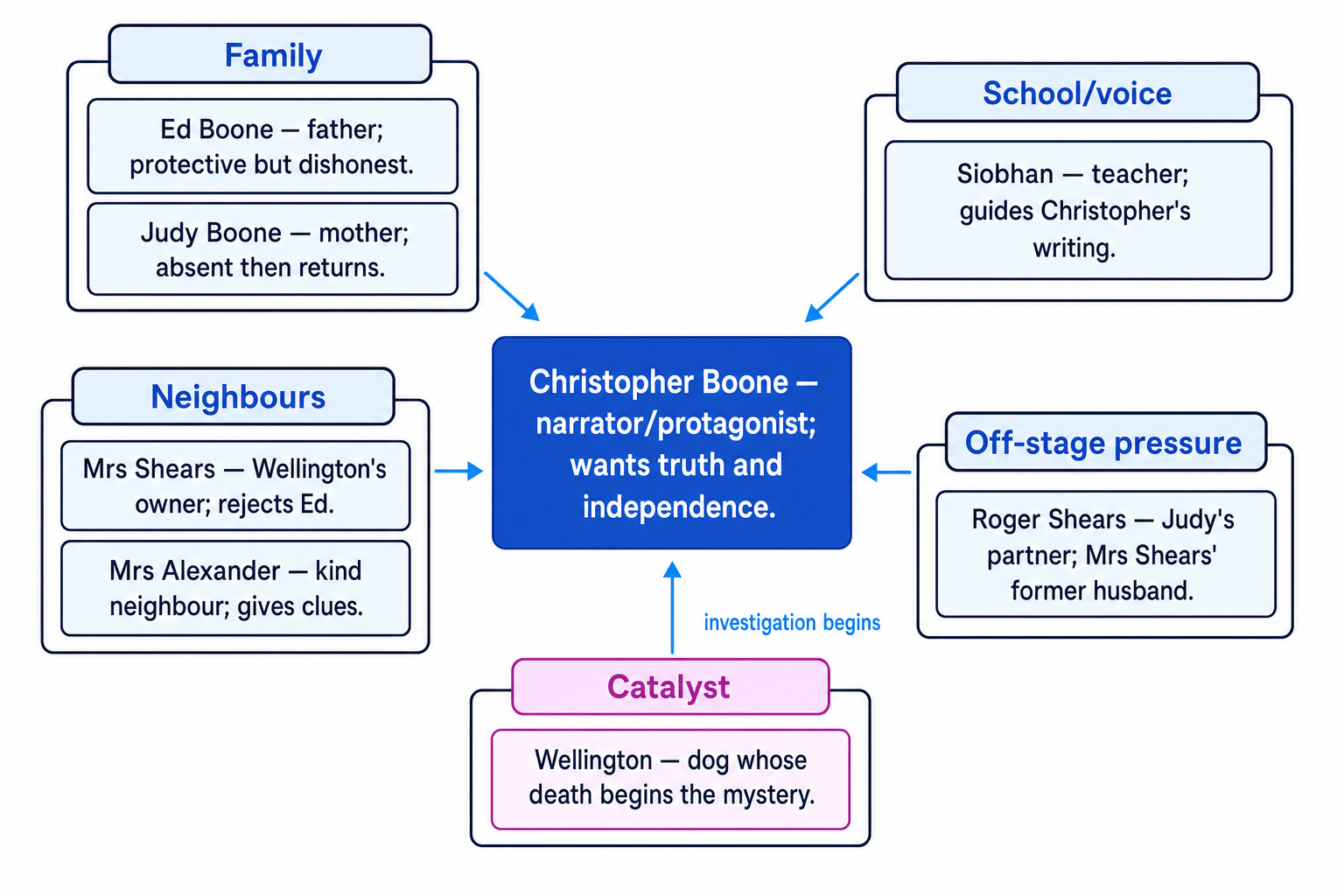
Christopher Boone: protagonist, narrator and investigator
Christopher introduces himself through facts: “My name is Christopher John Francis Boone” and “I know all the countries of the world and their capital cities and every prime number up to 7,057.” This opening characterises him through precision and order. Instead of beginning with feelings, he begins with knowledge.
His statement “I find people confusing” is simple but important. The adjective “confusing” suggests that social behaviour is not natural or easy for him to interpret. Stephens uses Christopher’s perspective to make the audience question “normal” adult behaviour too, especially when adults lie, hide information or speak indirectly.
Christopher’s love of truth is one of his defining traits. He says, “I do not tell lies,” and explains that he likes dogs because “dogs are faithful and they do not tell lies because they cannot talk.” The contrast between dogs and humans becomes central: Wellington’s death is not only a mystery but also a way of exposing human dishonesty.
Christopher is also brave. He investigates Wellington’s death, discovers the letters from his mother, travels to London alone, and sits his Maths exam despite fear and exhaustion. By the end, his confidence that he can do “anything” shows real development: not a sudden personality change, but a growth in independence.
Diagnosing instead of analysing
Do not spend a paragraph simply labelling Christopher. A stronger answer analyses how Stephens presents his perception through precise language, repeated patterns, sensory overload, direct narration and his need for truth.
Ed Boone: protective love and broken trust
Ed is Christopher’s father. He is caring, practical and protective, but also dishonest and frightening. That mixture makes him one of the most complex characters in the play.
At first, Ed appears to be Christopher’s safest adult. Their repeated hand-touch is important stage business: stage business means a repeated physical action that communicates meaning in performance. Because Christopher does not like ordinary hugs, the hand-touch becomes a personalised sign of affection. It shows that Ed has learned how to love Christopher in Christopher’s own terms.
However, Ed’s lies destroy this trust. He tells Christopher that Judy is dead, hides her letters, and eventually confesses: “I killed Wellington, Christopher.” The blunt verb “killed” makes the confession shocking. The direct address “Christopher” makes it intimate, because Ed is not confessing to a stranger; he is confessing to the child who trusted him.
Ed is not simply a villain. Stephens presents him as a damaged parent who has made terrible choices. This is useful in essays because it lets you write a more mature argument: Ed’s love is real, but love without honesty becomes dangerous.
Analysing Ed's mixed character
-
Ed is presented as emotionally complicated because his ordinary care for Christopher makes him seem protective before the audience learns the truth.
-
The confession “I killed Wellington, Christopher” uses the blunt verb “killed”, so the violence cannot be softened or excused.
-
Structurally, this revelation changes the play from a detective mystery into an escape story: Christopher’s safest adult suddenly becomes someone he fears.
-
Therefore, a strong argument is that Stephens makes Ed morally complex, showing that protection built on lies can become another form of harm.
Judy Boone: absence, letters and uncomfortable honesty
Judy, Christopher’s mother, is first presented through absence. Christopher believes she has died, because Ed has told him this. When Christopher finds her letters, the structure of the play changes: the past returns and Ed’s version of events collapses.
The letters are an epistolary device, meaning a method where letters are used to tell part of the story. This is powerful because Judy’s voice reaches Christopher before he physically meets her again. She is absent, but her words are present.
Judy admits, “I was not a very good mother.” This is a painful moment because she does not present herself as ideal or heroic. Her honesty contrasts with Ed’s concealment. However, she should not be dismissed as uncaring. Her letters show guilt, love and frustration, and her return into Christopher’s life is awkward rather than sentimental.
Judy’s character helps Stephens avoid simple family stereotypes. The play does not present parenting as easy. Both Ed and Judy love Christopher, but both fail him in different ways: Ed through lies and control, Judy through leaving and struggling to cope.
Siobhan: teacher, listener and theatrical bridge
Siobhan is Christopher’s teacher and one of the most important supportive figures in the play. She listens carefully, helps Christopher organise his writing, and often acts as a bridge between Christopher’s private thoughts and the audience.
A framing device is a method that shapes how a story is presented. Siobhan helps frame Christopher’s writing as theatre. In performance, she can read, prompt or guide sections of Christopher’s account, which makes her feel partly like a teacher and partly like a gentle director of the story.
Siobhan’s importance is that she supports without taking over. Ed often tries to protect Christopher by controlling information. Siobhan helps Christopher gain control by expressing information. This difference is crucial.
A useful contrast
Compare Ed and Siobhan through verbs: Ed hides, controls and eventually confesses; Siobhan listens, guides and enables. Character verbs make your analysis sharper.
Mrs Alexander, Mrs Shears, Roger Shears and Wellington
Minor characters in this play are not decorative. They push the plot forward and reveal hidden truths.
Mrs Alexander is a kind neighbour who gives Christopher crucial information. Her comment that “Mr Shears and your mother were very good friends” is deliberately indirect, but Christopher gradually understands its meaning. She represents a different kind of adult: not perfect, but patient and willing to help.
Mrs Shears is Wellington’s owner. Her anger at Wellington’s death begins the public conflict, and her rejection of Ed helps explain his emotional collapse. She is not developed as fully as Ed or Judy, but she matters because her relationships connect the dead dog to the broken adult world.
Roger Shears is Judy’s partner in London and Mrs Shears’s former husband. He is more of a pressure than a deeply explored character. His presence makes Judy’s new life unstable and uncomfortable, especially once Christopher arrives.
Wellington is a dog, but he has a major character function. A catalyst is something that starts a chain of events. Wellington’s death is the catalyst for the whole play. A symbol is a person, object or event that stands for a larger idea. Wellington symbolises the truth buried beneath ordinary suburban life: the dog’s death exposes the lies of the humans.
How to write about character relationships
Strong character analysis usually tracks change. A relationship that changes across the play gives you more to analyse than a fixed description.
| Relationship | How it begins | How it changes | What it reveals |
|---|---|---|---|
| Christopher and Ed | Trust, routine, hand-touch | Broken by the letters and Wellington confession | Love cannot survive without truth |
| Christopher and Judy | Believed dead, then rediscovered through letters | Awkward reunion and gradual rebuilding | Parenthood is flawed but not loveless |
| Christopher and Siobhan | Teacher and student | She helps shape his story | Listening can empower Christopher |
| Christopher and Mrs Alexander | Stranger/neighbour | Source of kindness and information | The outside world is risky but not only hostile |
When writing, avoid listing traits such as “Christopher is clever” or “Ed is angry.” Instead, link each trait to a method and an effect: Christopher’s precise factual language shows his need for order; Ed’s confession turns care into fear; Judy’s letters make absence emotionally present.
In the exam
-
Start with a clear character argument, not a plot summary: for example, “Stephens presents Ed as loving but morally unreliable.”
-
Use your clean copy quickly: know 3–4 key moments for each major character before the exam so you do not waste time searching.
-
Analyse methods every time: dialogue, stage directions, repeated actions, letters, narration and structural revelations are all useful for AO2.
Check yourself
- How does Christopher’s love of truth shape the plot and his relationships?
- Why is Ed more complex than a simple “bad father”?
- How does Siobhan help the audience understand Christopher’s voice?