Welcome to your study notes on the plot summary of Simon Stephens' stage adaptation of The Curious Incident of the Dog in the Night-time. For your Edexcel IGCSE English Literature exam (Component 2, Section A), you need to understand not just what happens to Christopher, but how Simon Stephens structures the drama to make us experience the world through Christopher's eyes.
A Play Within a Play
Remember, this is a stage adaptation! Simon Stephens structures the play metatheatrically—meaning it is a play about putting on a play. Siobhan, Christopher's teacher, reads from Christopher's notebook, transforming his written words into the live action you see on stage.
What you'll learn
- How the play’s unique "play-within-a-play" structure shapes our understanding of the plot.
- The dual narrative arcs: the detective mystery of Wellington’s death and Christopher’s heroic journey to London.
- How key plot milestones drive Christopher's emotional growth and independence.
- How to analyze structural choices to secure top marks in your Edexcel IGCSE essay.
1. The Play's Unique Structure (Metatheatre)
Before diving into the chronological events, it is essential to understand the structural framework Stephens uses. Unlike a traditional chronological play, The Curious Incident is presented as a metatheatrical performance.
Metatheatre
Metatheatre is a term used to describe drama that deliberately reminds the audience they are watching a play. In this text, Christopher’s notebook is read aloud by Siobhan, and the ensemble cast acts out his thoughts, memories, and written words in real-time.
This structure means the plot unfolds on two levels:
- The External Narrative: Christopher's real-life experiences in Swindon and London.
- The Internal/Staged Narrative: Siobhan reading Christopher's book, with Christopher occasionally interrupting to correct the actors, set up props, or comment on his own life.
This clever framing device gives the audience a direct window into Christopher's mind, helping us empathize with his unique sensory experience of the world.
2. Chronological Plot Arc: Act by Act
The plot can be split into two main movements, mirroring the two acts of the play. Let's explore the timeline of Christopher’s physical and emotional journey.
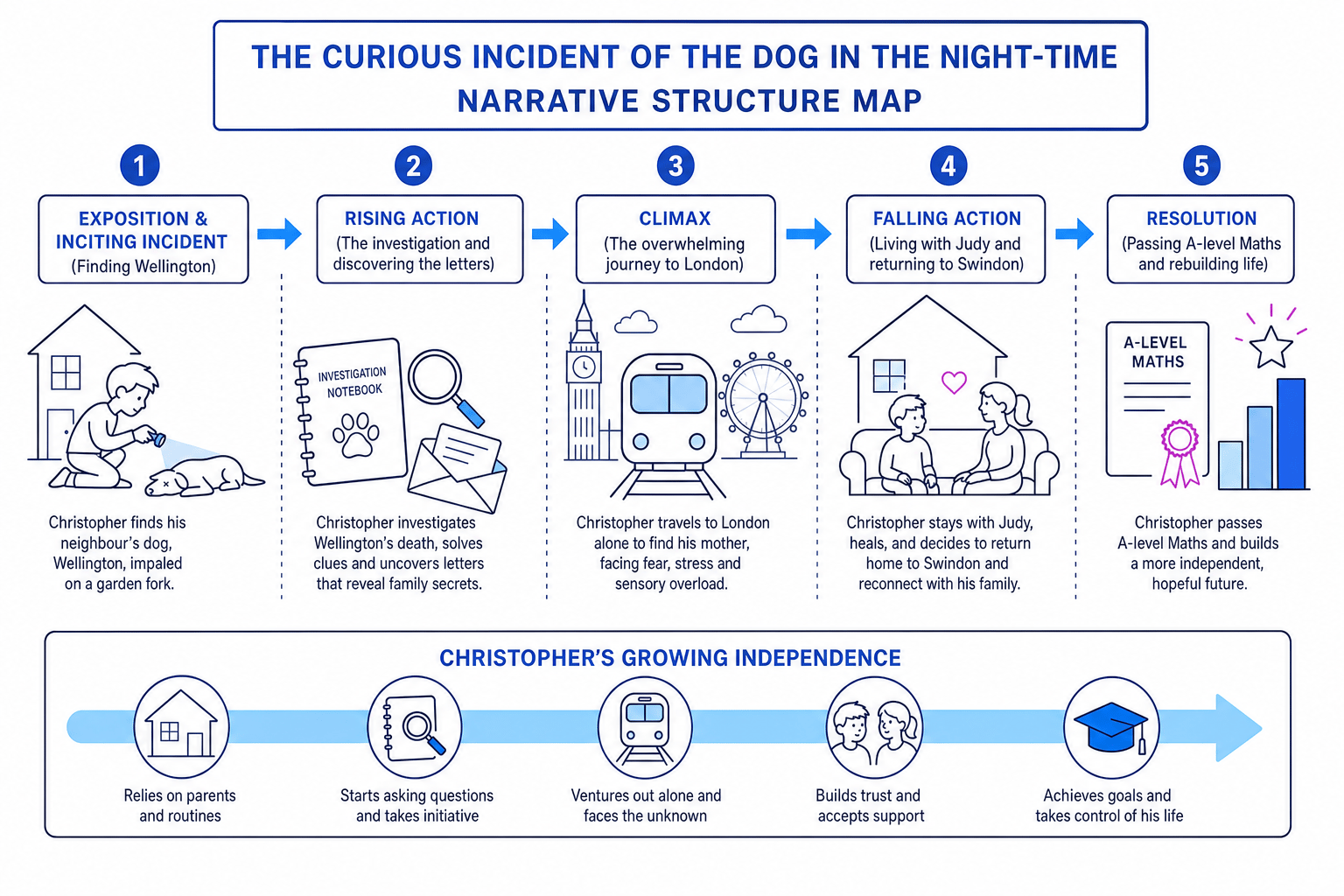
Act 1: The Detective Journey (Exposition and Rising Action)
- The Catalyst: The play opens under a shocking spotlight. Christopher stands next to Wellington, Mrs. Shears’ dead poodle, who has been impaled by a garden fork. Christopher is falsely accused of the crime by a policeman, leading to a physical altercation because Christopher dislikes being touched.
- The Decision: Inspired by his literary hero, Sherlock Holmes, Christopher decides to write a "murder mystery novel" and investigate who killed Wellington. Siobhan acts as our narrator here, reading Christopher’s book to the audience.
- The Obstacle: Christopher's father, Ed Boone, is fiercely opposed to the investigation. He commands Christopher to "stay out of other people's business."
- The Discovery of Letters: While searching for his confiscated notebook in his father's room, Christopher discovers a hidden stack of letters addressed to him from his mother, Judy. This is a massive plot shock: Ed had told Christopher his mother died of a heart attack two years prior. In reality, she ran away to London with their former neighbor, Roger Shears.
- The Confession: Ed finds Christopher with the letters. Realizing he can no longer hide the truth, Ed confesses to Christopher that he lied about Judy. He also admits that, in a fit of angry frustration after a fight with Mrs. Shears, he was the one who killed Wellington.
Confusing the Novel and the Play
In your exam, make sure you reference the play rather than the novel. Refer to the stage directions, the use of the ensemble, and Siobhan's narration. Write about "the audience" rather than "the reader," and "playwright Simon Stephens" rather than "novelist Mark Haddon."
Act 2: The Hero's Journey (Climax and Resolution)
- The Flight (Climax): Terrified that his father is a murderer ("If he could kill Wellington, he could kill me"), Christopher decides he is no longer safe at home. He resolves to travel to London alone to find his mother. This marks his transition from a local "detective" to an epic explorer.
- The Sensory Overload: Christopher's journey from Swindon to London is the emotional and visual climax of the play. Stephens utilizes the ensemble cast, loud soundscapes, and flashing lights to project Christopher's intense sensory overload inside Paddington Station and the London Underground.
- The Reunion: Christopher arrives safely at his mother's flat in London. Judy is shocked and deeply apologetic about her absence, and she instantly takes him in. However, Christopher's presence causes tension between Judy and Roger Shears.
- The Return: Realizing London is too overwhelming and that Christopher needs to take his A-level Maths exam, Judy leaves Roger and returns to Swindon with Christopher. They move into a small rented room.
- The Resolution: Ed desperately tries to rebuild trust with Christopher. He presents him with a golden retriever puppy named Sandy to show his commitment to patience. Christopher passes his A-level Maths with an "A grade," and the play ends with him expressing absolute confidence in his independent future: "Does that mean I can do anything?"
The Metatheatrical Post-Script
Don't forget the very final moment of the play! After the curtain call, Christopher returns to the stage to explain the mathematical solution to his favorite A-level question. This "post-script" reinforces his intellectual triumph and leaves the audience celebrating his unique mind.
3. Structural Analysis: Why This Order Matters
When analyzing the plot for Edexcel AO2 (Language, Form, and Structure), you must look at why Stephens arranges the scenes this way.
The play utilizes a dual narrative arc:
- The Outer Journey: Solving a dog's murder (which fails/ends early) transitions into a survival quest to London.
- The Inner Journey: Christopher's transition from total dependence on his father's structured rules to self-reliance and emotional independence.
Let's look at how to analyze a structural pivot point in your writing.
Analyzing Plot Transitions
Analyze how Simon Stephens uses the transition between Ed's confession (the truth about Mother and Wellington) and Christopher's decision to run away to create dramatic tension.
- Identify the structural device: Locate the precise shift in the plot. The discovery of the letters acts as a peripeteia (a sudden reversal of fortune or change in circumstances) that shatters Christopher’s safe, structured world.
- Select precise evidence: Use a short, impactful quotation. When Ed confesses, Christopher's logical mind processes this as physical danger, stating: "I had to get out of the house. Father had murdered Wellington. That meant he could murder me."
- Analyse Stephens' dramatic methods: Explain how the stagecraft highlights this plot beat. Stephens uses physical stage action—Christopher crouching silently, paralyzed by fear—while the ensemble creates an atmosphere of domestic claustrophobia to emphasize Christopher's feeling of betrayal.
- Evaluate the effect on the audience: Link this back to the core themes. The sudden collapse of the trust between father and son transforms the domestic mystery into a high-stakes survival thriller, forcing the audience to experience Christopher's acute vulnerability and panic.
Component 2 is Open Book!
Because your Component 2 exam is open book, you will have a clean copy of the play in front of you. Do not waste precious revision time memorizing long, massive blocks of text. Instead, focus on memorizing where key plot shifts happen, and practice finding short, three-to-four-word structural quotations quickly.
In the exam
- Focus on dramatic structure: Avoid simply retelling the story. Always explain how a specific scene or plot point (like Siobhan reading the letters) affects the audience's understanding of Christopher’s mind.
- Reference the stage craft: When discussing key plot events (like the London Underground journey), reference how the physical theatre, lighting, and sound designs reflect Christopher's internal state.
- Link plot to context (AO4): Remember that Christopher’s structured routine and need for truth are linked to his neurodivergent perspective. Show how the disruptions to his plot/routines are deeply distressing for him.
Check yourself
- Why is Christopher's choice to travel to London alone considered the major climax of both the physical and emotional plot arcs?
- How does the "play-within-a-play" framing device (Siobhan reading Christopher's book) help to soften the impact of painful plot developments for the audience?
- What is the symbolic significance of Christopher receiving Sandy the dog at the resolution of the plot?