What you'll learn
- What The Curious Incident of the Dog in the Night-Time is about, in its stage version.
- How the play’s detective plot becomes a family drama about truth, trust and independence.
- How Simon Stephens uses dramatic form, Christopher’s perspective and staging to shape the audience’s response.
- What Edexcel IGCSE examiners expect you to do when writing about this play.
First things first: which text are you studying?
You are studying Simon Stephens’ stage adaptation of Mark Haddon’s novel The Curious Incident of the Dog in the Night-Time. That matters because in the exam you are not just analysing a story — you are analysing a play.
A play is a text written for performance. It is built from dialogue — the words characters speak — and stage directions — instructions about action, movement, setting, sound, lighting or pauses.
Stage adaptation
A stage adaptation is a version of an existing text rewritten for theatre performance. For this text, you should write mainly about how Simon Stephens presents ideas through dialogue, structure and staging, while remembering that the story originated in Mark Haddon’s novel.
For Edexcel International GCSE English Literature, this text belongs to Component 2: Modern Drama and Literary Heritage. Component 2 is open book, so you are allowed a clean copy of the prescribed text in the exam.
Open book does not mean easy
Because you have the play in front of you, examiners expect precise references. You still need to know the plot, key moments and methods well enough to find evidence quickly and use it intelligently.
The basic premise
The protagonist — the central character — is Christopher Boone, a fifteen-year-old boy from Swindon. He is highly logical, loves maths and facts, and often finds other people difficult to understand. Early in the play, he discovers his neighbour’s dog, Wellington, dead on the lawn.
The opening is deliberately blunt and factual: “The dog was dead.” This immediately creates mystery, but it also introduces Christopher’s distinctive way of describing the world: precise, literal and observant.
Christopher decides to investigate who killed Wellington. At first, the play seems like a detective story. But the investigation leads him into painful truths about his own family, especially his father Ed and his mother Judy.
The title and the detective frame
The title alludes to a Sherlock Holmes story. An allusion is a deliberate reference to another text, person or idea. In the Sherlock Holmes story “Silver Blaze”, the “curious incident” is that a dog does not bark when expected. This connects Stephens’ play to the detective genre.
Genre
A genre is a type or category of text, such as detective fiction, tragedy, comedy or family drama. Genres create expectations: in a detective story, we expect clues, suspects, investigation and revelation.
However, Curious Incident does not stay as a simple “who killed the dog?” story. The real emotional mystery becomes: what has happened inside Christopher’s family, and can trust be rebuilt?
How the plot is structured
Structure means the way a writer organises events, revelations and turning points. In this play, the structure has two main strands:
- the detective plot, where Christopher investigates Wellington’s death;
- the family plot, where Christopher discovers hidden truths about his parents.
These strands meet when Father admits, “I killed Wellington.” That confession solves the detective mystery, but it creates a much bigger emotional crisis.
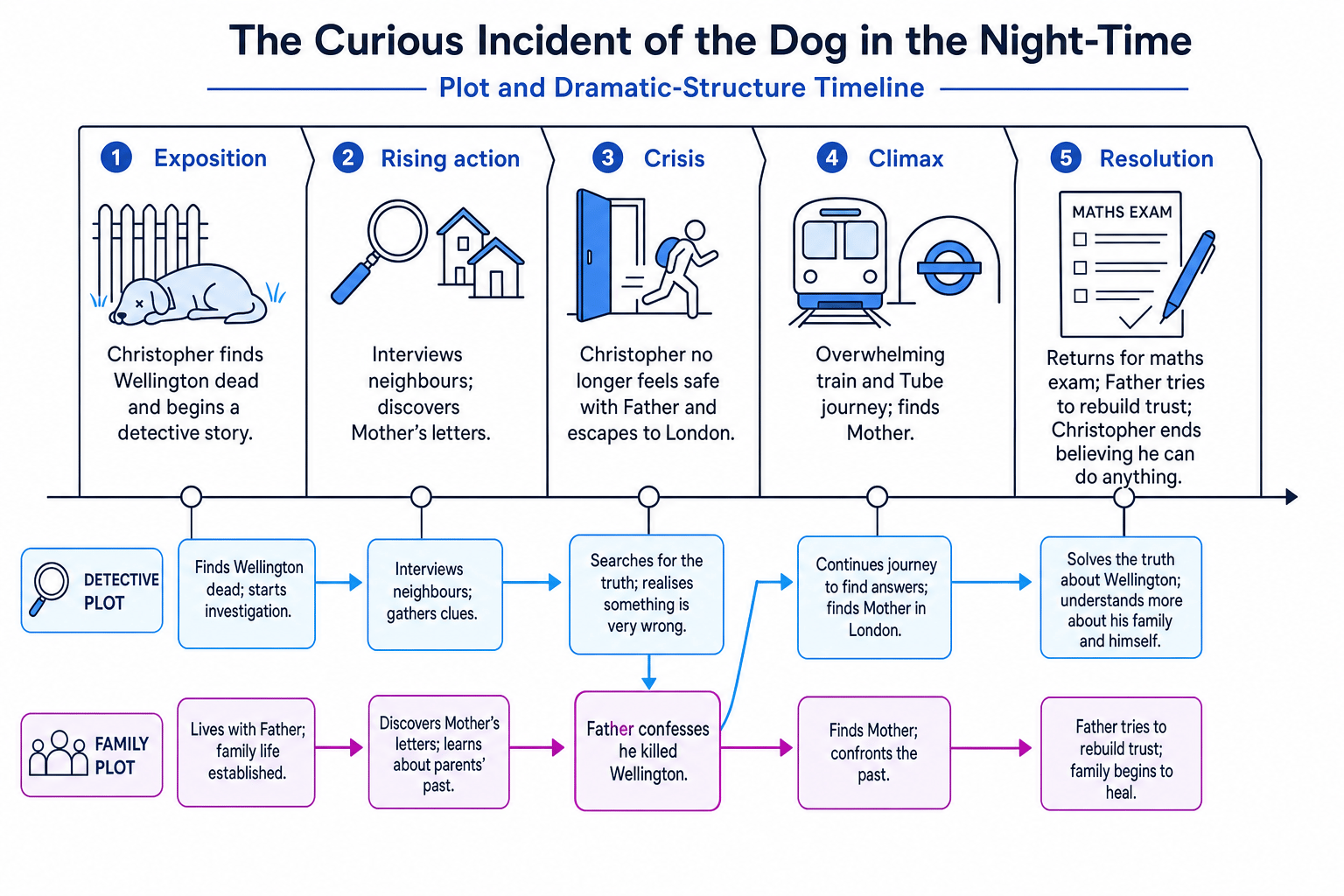
Tracking Father’s confession as a turning point
-
Start with the detective plot: Father’s confession, “I killed Wellington,” answers the question that began the play. Christopher has found the killer.
-
Now connect it to the family plot: the killer is not a stranger or a neighbour, but Christopher’s father. This changes the meaning of the investigation because the danger is suddenly inside Christopher’s home.
-
Notice the structural effect: what should be the ending of a detective story becomes the beginning of a crisis. Christopher’s loss of trust pushes him to leave Swindon and travel to London.
-
Link this to the audience: Stephens makes the audience feel that truth is necessary, but also frightening, because it can destroy the sense of safety Christopher depends on.
Christopher’s perspective
A perspective is a way of seeing and understanding events. Much of the play is filtered through Christopher’s perspective. That means the audience often experiences the world as he experiences it: intensely detailed, logical, sometimes overwhelming and often confusing when emotions or social rules are involved.
Christopher says, “I find people confusing.” The line is simple, but it is central to how the play works. Stephens encourages the audience to understand Christopher’s difficulties without reducing him to them.
Christopher is not just a case study
Avoid writing as if Christopher is only a diagnosis or a “problem”. In literature, you analyse how a character is constructed through voice, action, relationships and dramatic methods.
In the play, Christopher’s mind is not just described — it is theatricalised. Theatricalised means made visible or audible on stage. His lists, maps, mathematical patterns, fear of crowds and need for order can be shown through movement, sound, lighting and the arrangement of actors.
Analysing Christopher’s voice
-
Choose a precise quotation: Christopher says, “I do not tell lies.” This is a declarative sentence, meaning a sentence that states something directly.
-
Analyse the wording: the phrase “do not” sounds absolute and rule-based. Christopher presents truth-telling as a fixed principle, not a flexible social choice.
-
Connect method to meaning: Stephens uses Christopher’s direct voice to make him seem honest and reliable, while also showing why adult secrecy is so damaging to him.
-
Link to the wider play: the line prepares us for the contrast between Christopher’s honesty and the lies or half-truths told by adults around him.
Form: why it matters that this is drama
Form means the overall type and shape of a text. Here, the form is modern drama. That means Stephens can create meaning through things a novel cannot show in the same way: stage space, actor movement, sound effects, lighting and live performance.
For example, Christopher’s journey to London is not only a plot event. On stage, it can become a sensory experience for the audience. The crowding, noise and confusion of stations and trains help the audience feel why the journey is so demanding for Christopher.
Write like a drama student
When analysing this play, include dramatic methods: stage directions, movement, sound, lighting, props, dialogue, scene changes and how the audience responds. Do not write as if you are only analysing a novel.
Main concerns of the play
This is only an overview, so keep these ideas broad for now. The detailed theme work belongs in a separate section.
Truth and lies
Christopher values truth: “I do not tell lies.” Yet the adults around him hide painful truths, especially about his mother and Wellington. The play asks whether lies can ever protect someone, or whether they always damage trust.
Order and chaos
Christopher likes systems, numbers, maps and rules. These help him make sense of the world. But family life is messy and emotional, so the play often contrasts logical order with human chaos.
Independence and bravery
Christopher’s journey to London is frightening, but it also proves his courage. By the end, his belief that he “can do anything” shows growth, even though the play does not pretend all problems are solved.
Family and repair
The play is not simply about escaping family. It is also about whether damaged relationships can begin to heal. Father’s attempts to rebuild trust are slow and imperfect, which makes the ending feel more realistic.
A small quotation map
| Quotation | Method to notice | Why it matters |
|---|---|---|
| “The dog was dead.” | Blunt declarative sentence | Opens the mystery and establishes Christopher’s factual voice. |
| “I find people confusing.” | Simple direct statement | Helps the audience understand Christopher’s social difficulty and viewpoint. |
| “I do not tell lies.” | Absolute phrasing | Introduces truth as a moral rule for Christopher. |
| “I killed Wellington.” | Confession and structural reversal | Solves the detective plot but creates a family crisis. |
| “can do anything” | Optimistic final assertion | Suggests growth, courage and future possibility. |
Treating the play as only a plot summary
Do not spend a whole paragraph retelling what happens. For AO1, show secure knowledge of the play; for AO2, analyse how Stephens presents ideas through language, form and structure.
What exam success looks like
An assessment objective is a skill the examiner rewards. For this modern drama text, the most relevant skills are knowing the play well, giving an informed personal response, and analysing Stephens’ methods.
A strong paragraph usually moves like this:
point → evidence → method → effect → link back to the question
For example, if the question is about truth, you might argue that Stephens presents truth as both necessary and dangerous. You could use Christopher’s “I do not tell lies” to show his moral clarity, then contrast it with Father’s confession about Wellington. The best answers keep returning to the question rather than drifting into general comments.
In the exam
-
Use your clean copy actively: find short quotations and stage directions, but do not waste time hunting for perfect long quotes.
-
Write about Stephens’ dramatic methods, not just “what happens”: mention dialogue, structure, staging and the audience’s response.
-
Keep your argument focused on the question. Each paragraph should make a clear point, support it with evidence, analyse a method, and link back to the key idea.
Check yourself
- How does the play begin as a detective story but become a family drama?
- Why is Father’s confession a structural turning point?
- What makes analysing the stage version different from analysing the original novel?