What you'll learn
- How to turn an An Inspector Calls question into a clear argument.
- How to build analytical paragraphs that hit AO1 and AO2.
- How to adapt model essay plans for themes, characters and dramatic methods.
- How to avoid common “safe but shallow” essay habits.
What a model essay is actually for
A model essay is not something to memorise word-for-word. It is a guide to how a strong response thinks.
For Edexcel IGCSE English Literature, An Inspector Calls appears in Component 2: Modern Drama, which is open book: you may use a clean copy of the play. However, “open book” does not mean “easy quotation hunt”. You still need to know the play well enough to find moments quickly and use short, precise references.
Model essay
A model essay is a sample answer that demonstrates a strong line of argument, precise textual evidence, and analysis of the writer’s methods. Your aim is to copy the thinking process, not the wording.
The main target
A strong An Inspector Calls essay proves an argument about Priestley’s choices as a dramatist: what he presents, how he presents it, and why that matters to the audience.
The two assessment skills you need
The relevant assessment objectives for An Inspector Calls are AO1 and AO2.
AO1 and AO2
AO1 means showing close knowledge of the play, using references, and writing a clear personal argument. AO2 means analysing Priestley’s methods: language means word choice and imagery, form means the play as a staged drama, and structure means the order, pacing and patterning of events.
So, if you write “Mr Birling is selfish”, that is a basic AO1 point. If you explain how Priestley makes Birling’s selfishness seem foolish by placing the Inspector’s arrival immediately after Birling’s speech about looking after “himself and his own”, you are moving into AO2.
Start with the question, not the quotation
Many weaker essays begin with a quotation they happen to remember. Strong essays begin with the question focus.
Thesis
A thesis is your overall answer to the question: the main idea your whole essay will prove.
For example, if the question is about responsibility, your thesis should not simply be: “Priestley shows responsibility is important.” That is true, but too general. A sharper thesis explains how the idea develops across the play.
Turning a question into a thesis
Question: How does Priestley present ideas about responsibility in An Inspector Calls?
-
Decide what changes across the play. At the beginning, Mr Birling rejects social responsibility, claiming that “a man has to mind his own business and look after himself and his own”. By the end, the Inspector insists, “We are responsible for each other.”
-
Choose a whole-play argument. The essay could argue that Priestley presents responsibility as a moral lesson the older generation resist but the younger generation begin to accept.
-
Build in Priestley’s purpose as a dramatist. The play was first performed in 1945 but set in 1912, so Priestley can make the audience judge Edwardian capitalist confidence from a later viewpoint.
-
Turn this into a thesis: Priestley presents responsibility as the central moral test of the play: Mr and Mrs Birling try to deny it, but the Inspector’s questioning exposes how private selfishness creates public suffering.
The structure of a strong essay
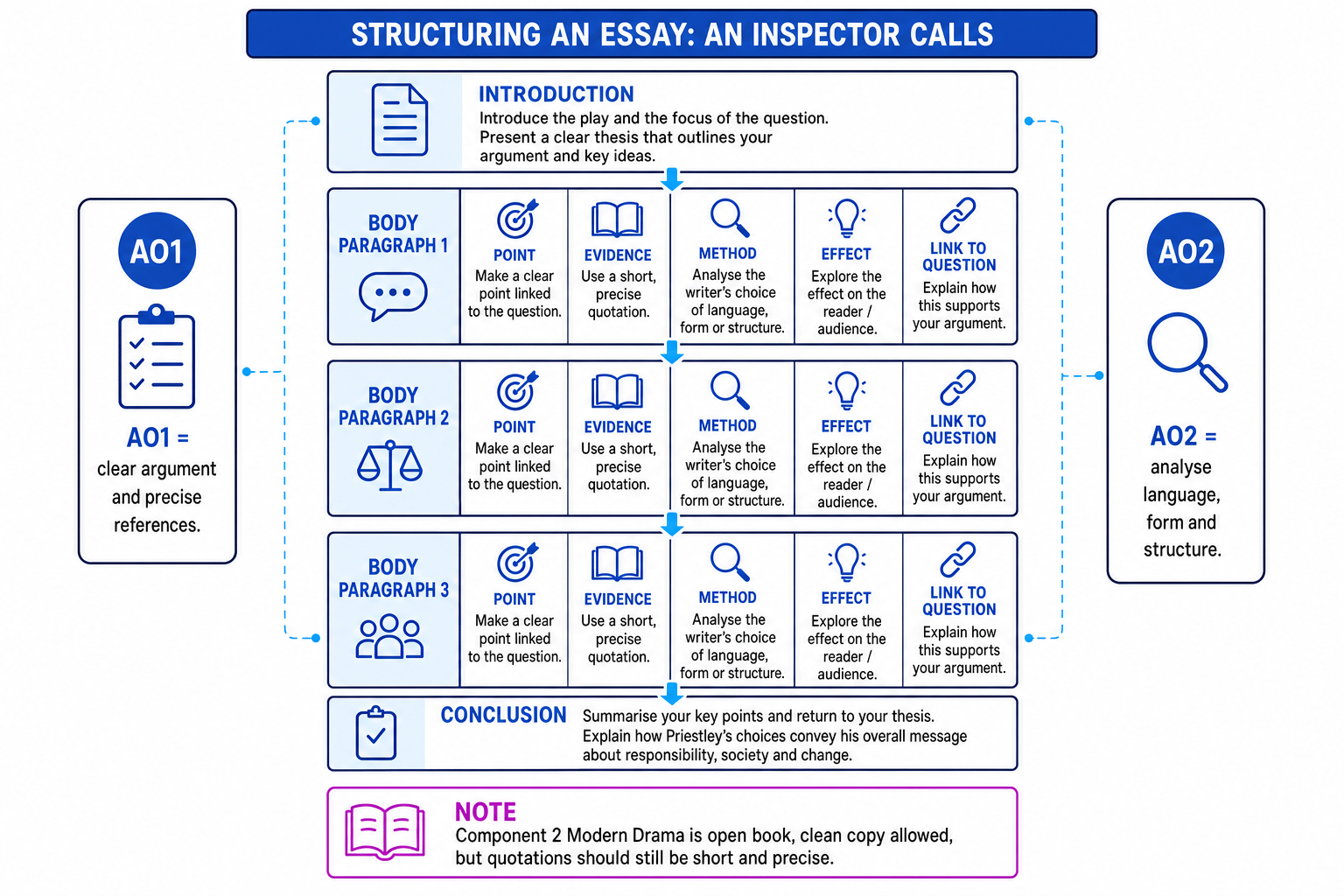
A strong essay usually has:
- a short introduction with a clear thesis;
- three developed analytical paragraphs;
- a conclusion that returns to Priestley’s overall message.
Each paragraph should work like a mini-argument: point → evidence → method → effect → link.
Evidence, method and effect
Evidence is a short quotation or precise reference. A method is a writer’s deliberate choice, such as stage directions, dramatic irony, symbolism, repetition or contrast. The effect is what that choice makes the audience think, feel or understand.
Device spotting
Do not write, “Priestley uses a metaphor” and stop there. Terminology only helps if you explain how the method shapes meaning and affects the audience.
Model paragraph technique: responsibility
A stage direction is an instruction in the play text telling actors how to move, speak or appear on stage. Priestley’s stage directions matter because An Inspector Calls is drama, not a novel.
Dramatic irony happens when the audience knows more than a character. Mr Birling’s confident predictions about the Titanic and war are dramatically ironic because the audience knows he is wrong.
Building a paragraph on responsibility
-
Make a point that answers the question directly. For a responsibility essay, you might argue that Priestley undermines Mr Birling’s selfish worldview from the start.
-
Select evidence that shows both belief and structure. Mr Birling says “a man has to mind his own business and look after himself and his own”; soon after, the “sharp ring of a front door bell” interrupts him.
-
Analyse the method. The doorbell is a structural interruption: Priestley times the Inspector’s arrival so that it cuts across Birling’s individualistic speech.
-
Explain the effect. The audience sees the Inspector as a challenge to Birling’s values. Because Birling has already been shown as foolish through dramatic irony, his rejection of social responsibility becomes less trustworthy.
-
Shape the analysis into a paragraph:
Priestley presents responsibility by first exposing the selfishness of those who deny it. Mr Birling claims that “a man has to mind his own business and look after himself and his own”, reducing morality to private interest and family reputation. Priestley immediately challenges this through structure: the “sharp ring of a front door bell” interrupts Birling’s speech, bringing the Inspector into the play as a dramatic answer to his complacency. This interruption makes responsibility feel unavoidable, as if the outside world is forcing its way into the Birlings’ comfortable dining room. Therefore, Priestley suggests that social responsibility cannot be escaped, however confidently the privileged try to shut it out.
Model essay plan: responsibility
If the question is How does Priestley present responsibility?, a strong essay could be shaped like this:
Introduction
Argue that Priestley presents responsibility as the central moral lesson of the play. The Inspector exposes how each character’s private choices contribute to Eva Smith’s suffering.
Paragraph 1: Mr Birling rejects responsibility
Use Mr Birling’s speech about looking after “himself and his own”. Link this to his confidence, dramatic irony, and the Inspector’s entrance. You could also use “I can’t accept any responsibility” to show his refusal to learn.
Paragraph 2: The Inspector teaches collective responsibility
Use the Inspector’s statement: “We don’t live alone. We are members of one body. We are responsible for each other.” Analyse the repetition of “we” as inclusive language. The Inspector makes responsibility communal, not optional.
Paragraph 3: The generations respond differently
Sheila recognises Eva’s humanity: “But these girls aren’t cheap labour — they’re people.” Eric admits, “We did her in all right.” By contrast, Mr and Mrs Birling focus on avoiding blame. Priestley uses this contrast to suggest hope lies with the younger generation.
Conclusion
Return to the final warning: “fire and blood and anguish”. Priestley presents responsibility as urgent because failure to learn it leads to social destruction.
Model essay plan: the Inspector
A question might ask: Explore the importance of the Inspector in An Inspector Calls.
Your thesis could be: Priestley makes the Inspector important not just as a detective, but as a moral force who controls the structure of the play and voices its central message.
A symbol is something that represents a bigger idea. The Inspector can be read symbolically because he represents conscience, judgement and social responsibility.
Paragraph 1: His entrance gives him authority
Priestley’s stage directions say the Inspector “need not be a big man” but creates an impression of “massiveness, solidity and purposefulness”. The contrast suggests his power is moral rather than physical.
Paragraph 2: He controls the play’s structure
The Inspector insists on “one person and one line of inquiry at a time”. This makes the revelations unfold in a controlled sequence, increasing tension and forcing each character to face guilt individually.
Paragraph 3: He delivers Priestley’s message
His final speech warns that if people do not learn responsibility, “they will be taught it in fire and blood and anguish”. The violent imagery makes the warning feel prophetic and urgent.
Writing about the Inspector
Do not spend the whole essay debating whether the Inspector is “real”. It is usually more useful to analyse what Priestley makes him do dramatically: expose, challenge, structure and warn.
Model essay plan: Sheila
A character question might ask: How does Priestley present Sheila Birling?
A strong argument would track her development. Development means how a character changes across the play.
Paragraph 1: Sheila begins sheltered and privileged
At the start, she is described as “very pleased with life”. This stage direction presents her as comfortable within the Birling family’s wealth and social confidence.
Paragraph 2: Sheila becomes morally aware
After hearing about Eva Smith, Sheila says, “I’ll never, never do it again to anybody.” The repetition of “never” shows genuine remorse, unlike her parents’ defensive responses.
Paragraph 3: Sheila challenges the older generation
Sheila tells her family, “You mustn’t try to build up a kind of wall between us and that girl.” The metaphor of a “wall” suggests emotional and class separation. Priestley makes Sheila increasingly perceptive, allowing her to understand the Inspector’s lesson before the others do.
Adapting a plan for Sheila
-
Start with the question focus. If the question asks about Sheila’s “change”, organise the essay chronologically: beginning, middle, end.
-
Choose quotations that show movement. “Very pleased with life” shows comfort; “I’ll never, never do it again” shows remorse; “It frightens me the way you talk” shows moral independence.
-
Link the change to Priestley’s dramatic purpose. Sheila becomes a sign that the younger generation may learn from the Inspector’s message, even when the older generation refuse.
How to use context without losing focus
For this section, context is not separately assessed as AO4, but it can still support a thoughtful argument if it is brief and relevant.
For example, you might mention that Priestley wrote the play after the Second World War but set it before the First World War. That helps explain why Mr Birling’s confidence looks foolish and why the Inspector’s warning about “fire and blood and anguish” sounds so powerful.
Do not bolt on context
Avoid ending paragraphs with disconnected sentences like “This links to socialism.” Instead, connect context to Priestley’s dramatic choices and the question you are answering.
What the best model essays have in common
The best essays do not try to mention everything. They choose the most useful moments and analyse them deeply.
They also keep returning to Priestley as the writer. Instead of saying “Sheila changes”, say “Priestley presents Sheila as capable of change”. Instead of saying “the Inspector is powerful”, say “Priestley gives the Inspector structural control over the interrogation”.
That small shift keeps your essay analytical rather than just descriptive.
In the exam
- Spend a few minutes planning a thesis and three paragraph points before you start writing.
- Use your clean copy to check short quotations, but do not waste time copying long passages.
- In every paragraph, analyse at least one method: language, stage directions, structure, contrast or dramatic irony.
- Keep linking back to the question and to Priestley’s purpose as a dramatist.
Check yourself
- Can you turn a question about responsibility, the Inspector, or Sheila into a clear thesis?
- Does each paragraph explain a method and its effect, rather than just naming a device?
- Are your quotations short, accurate and linked directly to the question?