What you'll learn
- How to turn a question on The Curious Incident of the Dog in the Night-Time into a clear argument.
- How to use short, precise quotations and stage directions in an open-book drama exam.
- How to build analytical paragraphs on language, form, structure and staging.
- How to avoid common “model essay” mistakes, especially plot summary and feature-spotting.
First: what is a model essay?
A model essay is not something to memorise word for word. It is a pattern you can adapt: a way of shaping an argument, choosing evidence, and explaining the effects of Simon Stephens’ dramatic methods.
For Edexcel IGCSE, The Curious Incident of the Dog in the Night-Time is studied as Modern Drama in Component 2, which is open book. You may use a clean copy of the play in the exam, but you still need to know the text well enough to find useful moments quickly.
Model essay
A model essay is a sample response that shows how to organise ideas, use evidence and analyse the writer’s methods. It should teach you a transferable structure, not give you a script to memorise.
The key assessment focus is AO1 and AO2. AO1 means showing close knowledge of the play and giving an informed personal response. AO2 means analysing how Stephens uses language, form and structure to create effects on the audience.
The basic shape of a strong answer
A strong essay usually has:
- A short introduction with a clear argument.
- Three or four analytical paragraphs.
- A brief conclusion that returns to the question.
Thesis
A thesis is your central argument: the main idea your whole essay will prove. In literature essays, a thesis should answer the question and suggest how the writer creates meaning.
For this play, your thesis should usually mention Stephens as the dramatist. You are not just writing about what Christopher does; you are writing about how Stephens presents Christopher, Ed, Judy, Siobhan, truth, family, independence, fear or another theme.
Turning a question into a thesis
Question: Explore how Stephens presents Christopher’s independence in the play.
- Compare Christopher at different points in the play: at the beginning he relies on rules, familiar spaces and adults such as Ed and Siobhan; later he travels to London and claims, “I can do anything.”
- Decide what is complicated about the idea: independence is not shown as easy or magical. It is frightening, physical, noisy and emotionally painful.
- Turn that into an argument: Stephens presents Christopher’s independence as hard-won rather than simple, showing that his confidence grows through fear, betrayal and problem-solving.
Planning before you write
Before writing, choose a small number of powerful moments. In drama, a “moment” can be a line of dialogue, a stage direction, a scene, a repeated motif, or a structural turning point.
The planning route below shows how to move from the question to a full paragraph, without drifting into retelling the story.
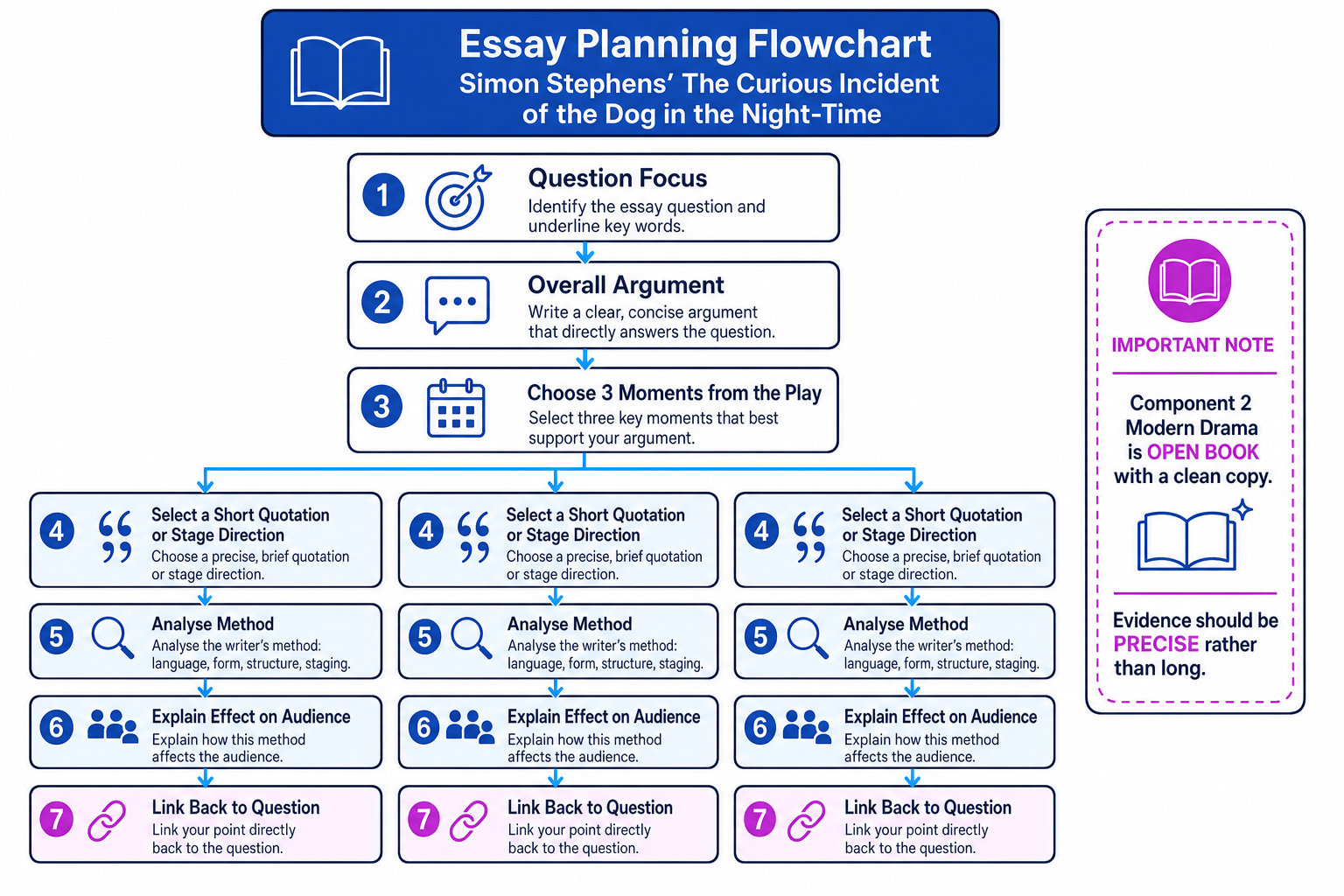
Writer’s method
A writer’s method is a deliberate choice made to create meaning. In this play, useful methods include dialogue, stage directions, dramatic structure, physical theatre, sound, lighting, mathematical patterns, Christopher’s narration and the detective-story form.
Use the open book wisely
Because the exam is open book, do not waste time copying long passages. Use your clean copy to find brief, exact fragments such as “I find people confusing,” “I killed Wellington,” or “I can do anything,” then spend most of your time analysing them.
What to analyse in this play
Language
Language means the words and phrases used by characters or in stage directions. Christopher’s language is often precise, logical and factual. For example, the opening detail “It was 7 minutes after midnight” immediately presents his exact way of observing the world.
You can also analyse how Christopher reacts to figurative language. His statement that “metaphors are lies” reveals both humour and seriousness: Stephens shows that Christopher values literal truth and struggles when language depends on implied meaning.
Form
Form means the type of text and the conventions it uses. This is a play, so you should write about it as drama, not as though it were only a novel. Stephens adapts Haddon’s narrative into a staged performance, often using Siobhan, ensemble movement and theatrical effects to make Christopher’s inner experience visible.
Structure
Structure means the order and arrangement of events or ideas. The play begins like a mystery, with Wellington dead and Christopher investigating. Later, the mystery widens into a family crisis when he discovers Ed’s lies and Judy’s letters. By the ending, the focus has shifted from solving a crime to Christopher proving his own capability.
Analyse the play as theatre
The strongest essays remember that Stephens is writing for an audience. Always ask: how would this line, movement, sound, silence or stage image affect someone watching the play?
Model essay plan: truth and lies
Here is a flexible plan for a question such as:
Explore how Stephens presents truth and lies in The Curious Incident of the Dog in the Night-Time.
Planning a response on truth and lies
- Establish the argument: Stephens presents truth as essential to Christopher’s sense of safety, while adult lies are shown as emotionally damaging even when they are meant to protect him.
- Choose a first moment about Christopher’s values: use “I do not tell lies” or “metaphors are lies” to show his literal, moral relationship with truth.
- Choose a turning point: Ed’s confession, “I killed Wellington,” destroys Christopher’s trust because the short declarative sentence makes the lie feel sudden and brutal.
- Choose a structural development: the hidden letters from Judy turn private family deception into something physical on stage, so the audience experiences discovery alongside Christopher.
- End with change: Christopher’s final confidence, “I can do anything,” suggests that truth is painful but also part of his movement towards independence.
Notice that this plan does not try to cover every event. It selects moments that prove one argument.
Building one analytical paragraph
A paragraph should not simply say: “This happens, then this happens.” It should move from point to evidence to method to effect.
Evidence
Evidence is a precise reference to the text. In drama, evidence can be a quotation from dialogue, a stage direction, a structural moment, or a repeated theatrical pattern.
Building a paragraph on Ed’s confession
- Decide what the moment proves: Ed’s confession is not only a plot twist; it breaks the trust Christopher needs in order to feel safe.
- Select short evidence: Ed admits, “I killed Wellington,” which is much more effective than copying a long exchange.
- Analyse method: the blunt declarative sentence gives the confession a shocking simplicity, contrasting with Christopher’s detailed, logical narration.
- Explain audience effect: the audience understands why Christopher feels threatened, because if Ed lied about “a big thing,” Christopher can no longer rely on his father’s words.
- Link back to the question: Stephens therefore presents lies as emotionally dangerous, not just morally wrong.
Resulting paragraph: Stephens makes Ed’s confession a turning point because it destroys Christopher’s trust in the person who should protect him. Ed’s statement, “I killed Wellington,” is a blunt declarative sentence, and its simplicity makes the revelation feel sudden and brutal. This contrasts with Christopher’s usual precision and careful logic, so the audience can see why the lie feels impossible for him to process calmly. When Christopher recognises that Ed has lied about “a big thing,” Stephens shows that dishonesty damages safety itself. Lies are therefore presented as frightening because they make familiar relationships unpredictable.
Model introductions and conclusions
Your introduction should be short. Do not begin with a biography of Mark Haddon or a general statement like “Everyone tells lies.” Go straight to the question.
A strong introduction might be:
Stephens presents truth as central to Christopher’s understanding of the world. Through Christopher’s literal language, the detective structure and Ed’s confession, the play shows that lies are not harmless: they damage trust and force Christopher to become more independent.
A conclusion should not repeat every paragraph. It should sharpen your overall answer:
By the end of the play, Stephens suggests that truth can be painful, but it is also necessary for Christopher’s growth. The final confidence of “I can do anything” does not erase the damage caused by lies, but it does show Christopher turning knowledge into independence.
Avoiding weak model-essay habits
Retelling the plot
A plot-summary paragraph says what happens. An analytical paragraph explains how Stephens presents it and why it matters. If your paragraph could begin with “Then…”, it probably needs more analysis.
Writing about diagnosis instead of drama
Avoid reducing Christopher to a label. The play never needs you to diagnose him in order to analyse him. Focus on Stephens’ presentation of his perspective, language, sensory experience, relationships and courage.
Terminology must earn its place
Only name a method if you explain its effect. “Declarative sentence,” “motif,” “structure” or “stage direction” will not gain much by themselves; the mark comes from linking the method to meaning.
A quick paragraph checklist
Before moving to the next paragraph, check that you have:
- Answered the question directly.
- Used a short quotation or precise stage reference.
- Named a relevant method.
- Explained the effect on the audience.
- Linked back to your thesis.
For this play, the best paragraphs often combine Christopher’s viewpoint with stagecraft. For example, a paragraph on the London journey could discuss not only his fear but also how sound, movement and crowded staging make the audience experience sensory overload.
In the exam
- Spend a few minutes forming a thesis and choosing three strong moments before you write.
- Use the clean copy for precise evidence, not for copying long chunks of text.
- Keep linking back to Stephens’ methods: language, form, structure, staging and their effects on the audience.
- Avoid bolted-on context; for this Modern Drama answer, your main marks come from close knowledge and dramatic analysis.
- Finish with a brief conclusion that answers the exact wording of the question.
Check yourself
- Can you turn a theme such as truth, family or independence into a clear thesis about Stephens’ presentation?
- Can you name one dramatic method besides quotation, such as staging, structure or physical theatre?
- Does each paragraph explain the audience effect, rather than just retelling what happens?