What you'll learn
- What Kindertransport is about and why its structure matters.
- How Diane Samuels blends past and present on stage.
- Why the play is about survival, identity, memory, and family secrets — not just historical events.
- How to approach the play for Edexcel IGCSE Component 2, Section A.
The play in one sentence
Diane Samuels’ Kindertransport explores how a Jewish child rescued from Nazi Germany survives physically, but grows into an adult whose buried trauma damages her sense of identity and her relationships with others.
The core idea
At its simplest, Kindertransport asks a painful question: can an act that saves a child’s life also leave lasting emotional wounds?
What does “Kindertransport” mean?
Kindertransport
The Kindertransport was the rescue movement that brought about 10,000 mostly Jewish children from Nazi-controlled Europe to Britain between 1938 and 1939. The word literally means “children’s transport” in German.
In the play, this historical event becomes personal. Samuels does not try to show the whole of the Holocaust. Instead, she focuses closely on one child, Eva Schlesinger, who is sent from Germany to England by her parents, Helga and Werner.
Eva is fostered by Lil Miller in Manchester. Over time, Eva becomes “Evelyn”, an English adult who hides her German-Jewish childhood from her daughter, Faith.
That name change — “Eva” to “Evelyn” — is one of the clearest ways Samuels shows the emotional cost of survival.
This is drama: read it as a play
Drama
Drama is literature written to be performed on stage. Meaning is created through dialogue, stage directions, props, entrances and exits, pauses, lighting, sound, and the physical presence of actors.
This matters because Kindertransport is not simply telling you what happened. It is showing you memory, fear, and conflict happening in front of an audience.
When you revise the play, do not only ask, “What happens?” Also ask:
- What can the audience see?
- Which time period is on stage?
- Which characters are physically close or separated?
- What objects are being handled, hidden, packed, or discovered?
- How does the past interrupt the present?
Writing about history instead of drama
A common mistake is to write a general essay about the Kindertransport as a historical event. For this text, you need to analyse Samuels’ dramatic choices: structure, dialogue, symbolism, props, and stagecraft.
The basic plot frame
The play moves between two main time periods.
The past: Eva’s story
In the past storyline, Eva is a young Jewish girl in Nazi Germany. Her mother Helga prepares her to leave on the Kindertransport. Eva travels to England, where Lil becomes her foster mother.
Eva’s childhood is shaped by separation, fear, and adaptation. She must learn a new language, live in a new country, and cope with the loss of her parents and home. German family words such as “Mutti” and “Vati” become reminders of the life she is forced to leave.
The present: Evelyn’s story
In the present storyline, Evelyn is an adult mother. Her daughter Faith discovers hidden evidence of Evelyn’s past. This discovery forces Evelyn to confront the identity she has tried to bury.
Faith’s questions matter because they show that trauma is not neatly contained in one generation. Evelyn’s silence has shaped Faith too.
The play’s structure: past and present are interwoven
Structure
Structure means how a text is organised: the order of events, shifts in time, contrasts, repetitions, beginnings, endings, and patterns.
Kindertransport has a non-linear structure.
Non-linear structure
A non-linear structure does not tell events in simple chronological order. It moves backwards and forwards in time, often to show memory, trauma, or hidden truths.
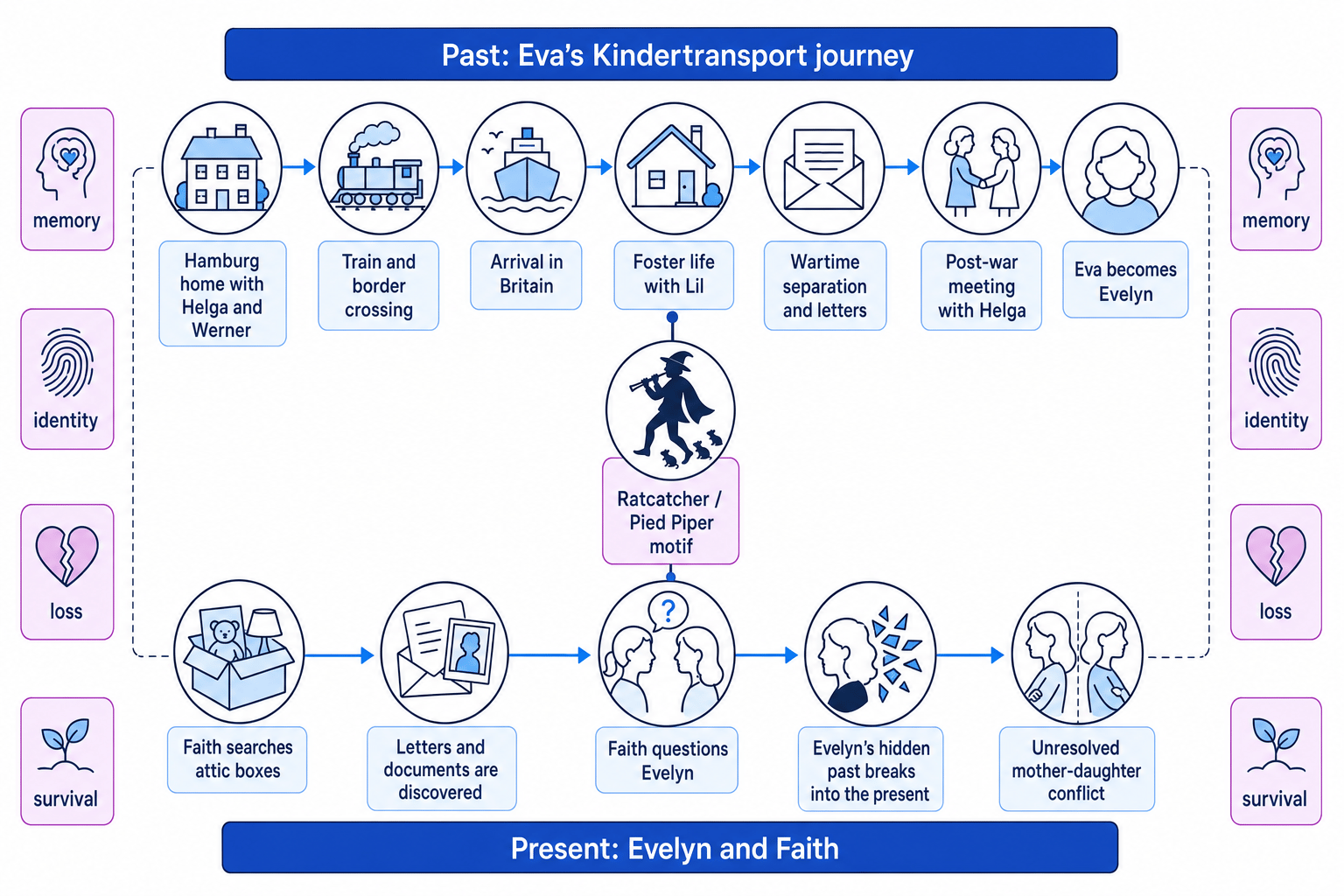
Samuels cuts between Eva’s childhood and Evelyn’s adulthood. This makes the audience experience the past as something still alive. Eva is not “finished” just because Evelyn has grown up.
The diagram below shows the play’s two timelines and how the Ratcatcher motif cuts across them.
Linking the two timelines
-
Start with the structural choice: Samuels places Eva’s past and Evelyn’s present side by side rather than telling Eva’s life in a straight line.
-
Identify the effect on the audience: this makes the past feel immediate, as if Evelyn’s childhood memories are breaking into the room with Faith.
-
Connect this to meaning: the structure suggests that trauma has not disappeared; it has been hidden, stored, and then uncovered.
-
Link back to the play’s central concern: Faith’s discovery shows that silence may seem protective, but it can damage trust between mother and daughter.
A “memory play”
You can describe Kindertransport as a memory play.
Memory play
A memory play is a drama in which the past is not just remembered in speech, but staged as part of the action. Memory shapes what the audience sees.
This is useful because Evelyn’s past is not presented as a calm, controlled explanation. It appears in fragments: journeys, documents, nightmares, songs, German words, and family objects.
The attic or storage space is important because it suggests that the past has been packed away but not destroyed. Letters, photographs, and documents become physical evidence of a hidden life.
Think in stage images
For Kindertransport, strong analysis often begins with a stage image: a suitcase, a label, a hidden box, a child on a journey, or the Ratcatcher appearing where he should not belong.
Identity: Eva becomes Evelyn
Identity
Identity means a person’s sense of who they are, including name, family, language, religion, culture, memory, and belonging.
Eva’s new life in England gives her safety, but it also pressures her to change. Her name becomes “Evelyn”, which sounds more English. This is not a small detail: names carry history.
The movement from “Eva” to “Evelyn” suggests assimilation.
Assimilation
Assimilation is the process of adapting to fit into a dominant culture, sometimes by losing or hiding parts of your original identity.
Samuels does not present assimilation as simply good or bad. It helps Eva survive, but it also creates division inside her. Evelyn can function as an English adult, yet she cannot fully escape Eva’s memories.
Analysing the name change
-
Use the evidence of the two names: “Eva” belongs to the German-Jewish child, while “Evelyn” belongs to the English adult identity she later adopts.
-
Identify the method: Samuels uses naming symbolically, so the change of name represents a change in culture, language, and self-presentation.
-
Explore the tension: “Evelyn” suggests safety and reinvention, but it also suggests that “Eva” has been suppressed rather than healed.
-
Link to the wider play: Faith’s discovery matters because it brings “Eva” back into Evelyn’s life, forcing the hidden identity into the present.
The Ratcatcher and the Pied Piper pattern
One of the play’s most striking features is the Ratcatcher.
Motif
A motif is a repeated image, idea, object, sound, or figure that gains meaning each time it appears.
The Ratcatcher comes from the Pied Piper story, where a mysterious figure leads children away. In Kindertransport, this fairy-tale figure becomes disturbing because Eva is also a child being led away from home.
He is not just a “monster”. He represents fear, authority, abandonment, and the way a child might process terrifying adult decisions. The repeated word “Ratcatcher” turns history into nightmare.
Samuels also uses doubling, where one actor may play more than one role. The Ratcatcher is linked with male authority figures, which makes ordinary officials feel threatening and dreamlike.
Symbol
A symbol is something concrete — such as a person, object, place, or image — that stands for a larger idea.
The Ratcatcher symbolises the terror of being taken away, even when that removal is meant to save Eva’s life. This is one reason the play feels morally complex.
Context: helpful, but not the whole answer
For Edexcel IGCSE, Kindertransport is studied in Component 2, Section A: Modern Drama. This section is open book, so you are allowed a clean copy of the text in the exam.
You are mainly rewarded for knowing the play well and analysing how Samuels creates meaning. Historical context helps you understand the stakes, but you should not bolt it on as a separate paragraph.
The key context is:
- Nazi persecution made Jewish families desperate to get children to safety.
- Most children travelled without parents.
- Many children never saw their parents again.
- Britain offered rescue, but children still faced loss, displacement, and pressure to adapt.
A complex rescue story
Samuels presents the Kindertransport as life-saving, but not emotionally simple. The play honours survival while also showing grief, guilt, silence, and fractured identity.
What to remember for an overview answer
If you need a quick overview thesis, use this:
Samuels presents the Kindertransport through a fragmented dramatic structure to show that survival does not end trauma. Eva’s rescue saves her life, but the adult Evelyn’s secrecy reveals the long-term damage of displacement, lost identity, and broken family bonds.
That is the kind of argument that works well because it connects:
- plot knowledge
- structure
- character development
- theme
- writer’s purpose
- audience effect
In the exam
-
Start from the question, then choose a precise moment from your clean copy: a discovery, confrontation, journey scene, or Ratcatcher appearance.
-
Analyse Samuels’ methods, not just events. Use terms such as structure, stagecraft, motif, symbolism, doubling, and dialogue only when you can link them to meaning.
-
Keep quotations short: single words like “Eva”, “Evelyn”, “Mutti”, or “Ratcatcher” can be powerful if you explain their effect carefully.
Check yourself
- Why does Samuels use two timelines instead of telling Eva’s story chronologically?
- What does the change from “Eva” to “Evelyn” suggest about identity and survival?
- How does the Ratcatcher make the play feel more like a nightmare or memory than a simple realistic story?