What you'll learn
- How to plan an Edexcel IGCSE essay on Simon Stephens’ stage adaptation of The Curious Incident of the Dog in the Night-Time.
- How to turn a question into a clear line of argument rather than a list of points.
- How to choose useful evidence from the play’s beginning, middle and end.
- How to build paragraph plans that cover AO1 and AO2 naturally.
Where this fits in the exam
For Edexcel International GCSE English Literature, The Curious Incident of the Dog in the Night-Time is studied as modern drama in Component 2. This section is open book, so you are allowed a clean copy of the play in the exam.
That does not mean you can search randomly during the essay. A strong plan helps you know roughly where key moments are and which short quotations or stage moments you want to use.
AO1 and AO2
AO1 is about your knowledge of the play, your understanding of characters and themes, and your personal, critical response. AO2 is about analysing Stephens’ methods: language, form and structure, including dialogue, stage directions, dramatic structure and theatrical effects.
The main job of a plan
A good essay plan is not just “three things I remember”. It is a route through an argument: what Stephens presents, how he presents it, and why that matters for the audience.
What an essay plan needs to do
1. Decode the question
Most questions on this play will ask you to explore how Stephens presents a character, relationship, theme or dramatic moment.
Line of argument
A line of argument is the main idea your whole essay proves. It should develop across the essay, rather than repeat the same point in every paragraph.
For example, if the question is about Christopher’s independence, a weak plan might say:
- Christopher is clever.
- Christopher goes to London.
- Christopher passes his maths exam.
Those are relevant, but they do not yet form an argument.
A stronger argument would be:
Stephens presents Christopher’s independence as hard-won: he is highly capable from the start, but he has to overcome fear, betrayal and sensory overload before he can say that he “can do anything”.
This gives you a direction: capability → crisis → independence.
Use this planning route before you start writing.
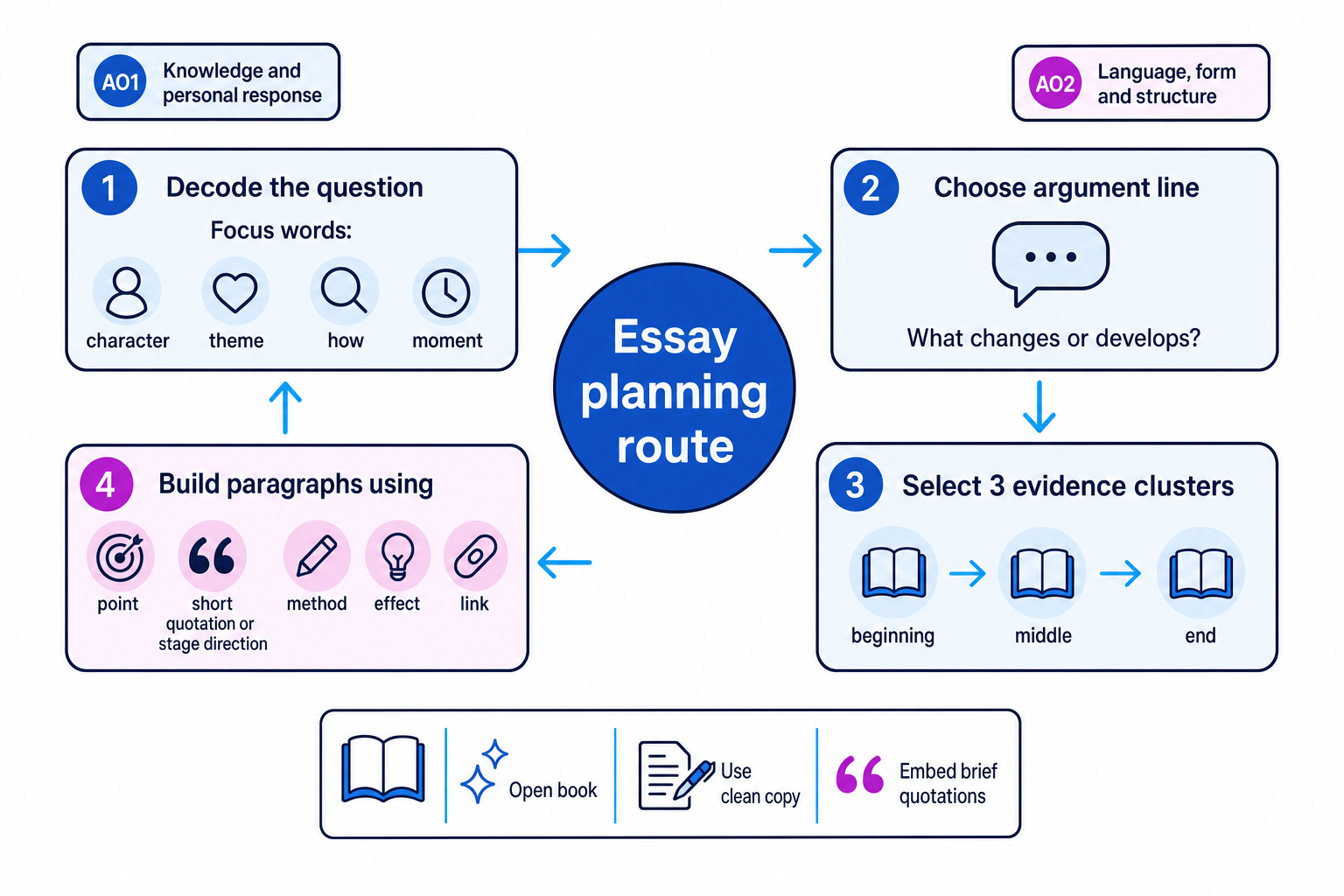
Turning a question into an argument
Question: Explore how Stephens presents Christopher’s journey towards independence.
- Identify the focus: the key word is “journey”, so the essay must show development across the play, not just describe Christopher at one moment.
- Decide the argument: Christopher is already intelligent and determined, but independence becomes meaningful because he faces emotional betrayal, confusing public spaces and the need to trust himself.
- Choose three evidence clusters: the opening investigation into Wellington’s death; the discovery of Mother’s letters and Father’s confession, “I killed Wellington”; the London journey and the final claim that this means he “can do anything”.
- Attach methods to each cluster: detective structure at the start, dramatic revelation in the middle, and intense theatrical staging of public space near the end.
Selecting evidence clusters
An evidence cluster is a small group of moments, quotations and methods that work together to support one point.
You do not need huge quotations. In fact, short quotations are usually better. You can embed them into your own sentence and spend more time analysing them.
Evidence cluster
An evidence cluster is a planned paragraph package: one main point, one or two short references, a method, and a link back to the question.
Useful clusters for this play
| Essay focus | Beginning | Middle | End |
|---|---|---|---|
| Christopher’s character | “I find people confusing”; his precise timing, “7 minutes after midnight” | his response to lies and betrayal; “I killed Wellington” | “I went to London on my own”; “I can do anything” |
| Truth and lies | Christopher says he tells the truth; he dislikes metaphor because “it should be called a lie” | Father hides Mother’s letters and confesses to killing Wellington | Christopher rebuilds certainty through maths, writing and action |
| Family relationships | Father appears protective and loving | Mother’s letters complicate the idea of blame; Father’s confession breaks trust | both parents remain flawed, but Christopher gains more control |
| Communication | Christopher struggles with faces and idioms | letters reveal what spoken communication has hidden | the play itself becomes a way for Christopher’s story to be heard |
| Theatrical form | Siobhan helps frame Christopher’s writing | ensemble voices and movement can represent confusion | the stage turns Christopher’s achievement into shared audience experience |
Use the open book wisely
Because the exam is open book, learn where key moments happen rather than trying to memorise long quotations. In the exam, find a short phrase quickly, then close-read it.
Paragraph planning: point, evidence, method, effect, link
A strong paragraph plan should include five parts.
Method
A method is a deliberate writer’s choice. In drama, this can include dialogue, stage directions, monologue, dramatic irony, contrast, repeated motifs, structure, sound, movement and the use of an ensemble.
For Curious Incident, do not only write about “words”. It is a play, so Stephens’ dramatic methods matter. You might analyse:
- Dialogue: Christopher’s literal, precise speech.
- Form: the play-within-a-play feeling created by Siobhan reading and shaping Christopher’s story.
- Structure: the detective plot turning into a family and independence story.
- Staging: movement, overlapping voices and visual patterns representing Christopher’s experience.
- Motifs: maths, maps, trains, stars, dogs and truth.
Building a paragraph plan
Essay focus: family relationships
- Make a precise point: Stephens presents Father’s love as real but damaged by control and dishonesty.
- Select evidence: Father’s confession, “I killed Wellington,” is a shocking simple sentence that changes how the audience judges him.
- Analyse method: the direct declarative sentence works like a dramatic reversal; the person who seemed protective becomes a source of fear.
- Explain effect: the audience understands why Christopher’s trust collapses, because the killing of Wellington symbolises a deeper betrayal.
- Link back: this shows that family love in the play is complicated — Stephens avoids presenting parents as simply good or bad.
Retelling the plot
Do not spend a paragraph simply explaining what happens. Every paragraph should answer the question by analysing how Stephens presents an idea and what effect this has on the audience.
Planning by question type
Character question: Christopher
Possible question: Explore how Stephens presents Christopher as a distinctive narrator.
Possible line of argument:
Stephens presents Christopher’s narration as distinctive because it is precise, logical and honest, but the play also shows that his way of seeing the world can be emotionally powerful for the audience.
Plan:
-
Precision and logic
Use Christopher’s opening precision: “7 minutes after midnight” and his knowledge of “every prime number up to 7,507”. Analyse how numerical detail establishes his ordered way of thinking. -
Difficulty with ordinary social language
Use “I find people confusing” and his view that metaphor “should be called a lie”. Analyse the contrast between Christopher’s literal language and the figurative language other people use. -
Audience sympathy and growth
Link his journey to London and the final confidence that he “can do anything”. Analyse how the structure moves from mystery to self-discovery.
Theme question: truth and lies
Possible question: Explore how Stephens presents truth and lies in the play.
Possible line of argument:
Stephens presents truth as essential to Christopher’s safety, while lies create emotional chaos even when adults think they are protecting him.
Plan:
-
Christopher’s need for truth
Start with Christopher’s belief in factual accuracy. His dislike of metaphor because it “should be called a lie” shows that truth is not just moral for him; it is how he understands the world. -
Adult lies as protection and betrayal
Father hides Mother’s letters and then confesses, “I killed Wellington.” The blunt confession exposes the damage caused by secrecy. -
Writing and theatre as truth-telling
The play’s structure lets Christopher’s own account be staged. Stephens makes storytelling a way of restoring Christopher’s control over events.
Forgetting dramatic form
This is the play adaptation, not just the novel. Avoid writing only “Haddon shows…” or treating the text as prose. Write about how Stephens stages Christopher’s experience.
Relationship question: Christopher and his parents
Possible question: Explore how Stephens presents Christopher’s relationships with his parents.
Possible line of argument:
Stephens presents Christopher’s parents as flawed but human: their love is genuine, yet their fear, guilt and dishonesty make Christopher’s home feel unstable.
Plan:
-
Father as protective but tense
At first, Father appears to provide routine and safety. But his anger and secrecy create dramatic tension. -
Mother as absent, then painfully present
The letters reveal Mother’s voice and regret. Her spelling mistakes, such as “pacient”, can make her seem ordinary and vulnerable rather than villainous. -
Christopher’s changing position
By the end, the key change is not that the family becomes perfect. It is that Christopher has more agency and can measure his achievement for himself.
Method question: staging Christopher’s experience
Possible question: Explore how Stephens uses dramatic methods to present Christopher’s view of the world.
Possible line of argument:
Stephens uses theatrical form to make the audience experience the intensity of Christopher’s mind, rather than simply hearing other characters describe him.
Plan:
-
Narration and framing
Siobhan helps shape Christopher’s writing for the stage, so the audience sees both Christopher’s story and the process of telling it. -
Precision and pattern
Maths, lists and exact times show Christopher’s need for order. The quote about prime numbers being “what is left when you have taken all the patterns away” links logic with uncertainty. -
Overload and movement
Busy public spaces, especially the journey to London, can be staged through noise, movement and multiple voices. This makes the audience feel pressure and confusion, supporting AO2.
Write about the audience
Because this is drama, keep using phrases like “the audience sees”, “the audience hears” and “Stephens stages”. This reminds the examiner you are analysing a play.
How much should you plan?
In the exam, you will not have time to write a beautiful full plan. Aim for a quick but useful plan:
- One clear thesis.
- Three main paragraphs.
- One or two short references per paragraph.
- A method for each paragraph.
- A final link to the question.
A quick plan might look like this:
| Paragraph | Point | Evidence | Method |
|---|---|---|---|
| 1 | Christopher begins as logical and precise | “7 minutes after midnight”; “prime number up to 7,507” | precise detail, character voice |
| 2 | Lies destroy his sense of safety | “I killed Wellington” | dramatic revelation, blunt dialogue |
| 3 | He gains independence through action | “London on my own”; “I can do anything” | structural development, ending |
Do not over-plan
If you spend too long planning, you may run out of time to analyse. A plan should guide the essay, not replace it.
Introductions and conclusions
Your introduction should be short. It should answer the question directly and give your line of argument.
A useful introduction formula is:
Stephens presents [focus] as [main idea]. Across the play, this develops from [start], through [middle conflict], to [ending].
For example:
Stephens presents Christopher’s independence as difficult but empowering. At the start, Christopher already has intelligence and determination, but after Father’s betrayal and the frightening journey to London, his final belief that he “can do anything” feels earned.
Your conclusion should not repeat every point. It should sharpen your argument:
Overall, Stephens suggests that independence does not mean Christopher no longer needs anyone. Instead, it means he has proved to himself and the audience that his voice, logic and courage matter.
In the exam
- Spend a few minutes turning the question into a line of argument before you write.
- Use your clean copy to check short quotations, but do not waste time hunting for perfect long ones.
- In every paragraph, analyse a dramatic method: dialogue, structure, staging, narration or audience effect.
Check yourself
- Can you create a three-paragraph plan for a question on truth and lies?
- Have you included at least one dramatic method in each planned paragraph?
- Does your plan show development across the play, rather than three disconnected points?