What you'll learn
- How to separate language, form and structure without treating them as a checklist.
- How Simon Stephens, adapting Mark Haddon’s novel, creates Christopher’s distinctive perspective on stage.
- How to analyse quotations, stage directions and plot shape for AO2.
- How to write about drama in the Edexcel IGCSE open-book Component 2 exam.
The three lenses
For Edexcel IGCSE, The Curious Incident of the Dog in the Night-Time is studied as modern drama: you are analysing Simon Stephens’s play script, adapted from Mark Haddon’s novel. That means you should look not only at what characters say, but also at what the play does on stage.
Language, form and structure
- Language means the writer’s choices of words, sentence patterns, images and dialogue.
- Form means the type of text and its conventions: here, a stage play adapted from a novel.
- Structure means how the text is arranged: the order of events, revelations, repetitions, contrasts and turning points.
Keep the three lenses separate at first, then show how they work together. This overview shows the main areas you can discuss in this play.
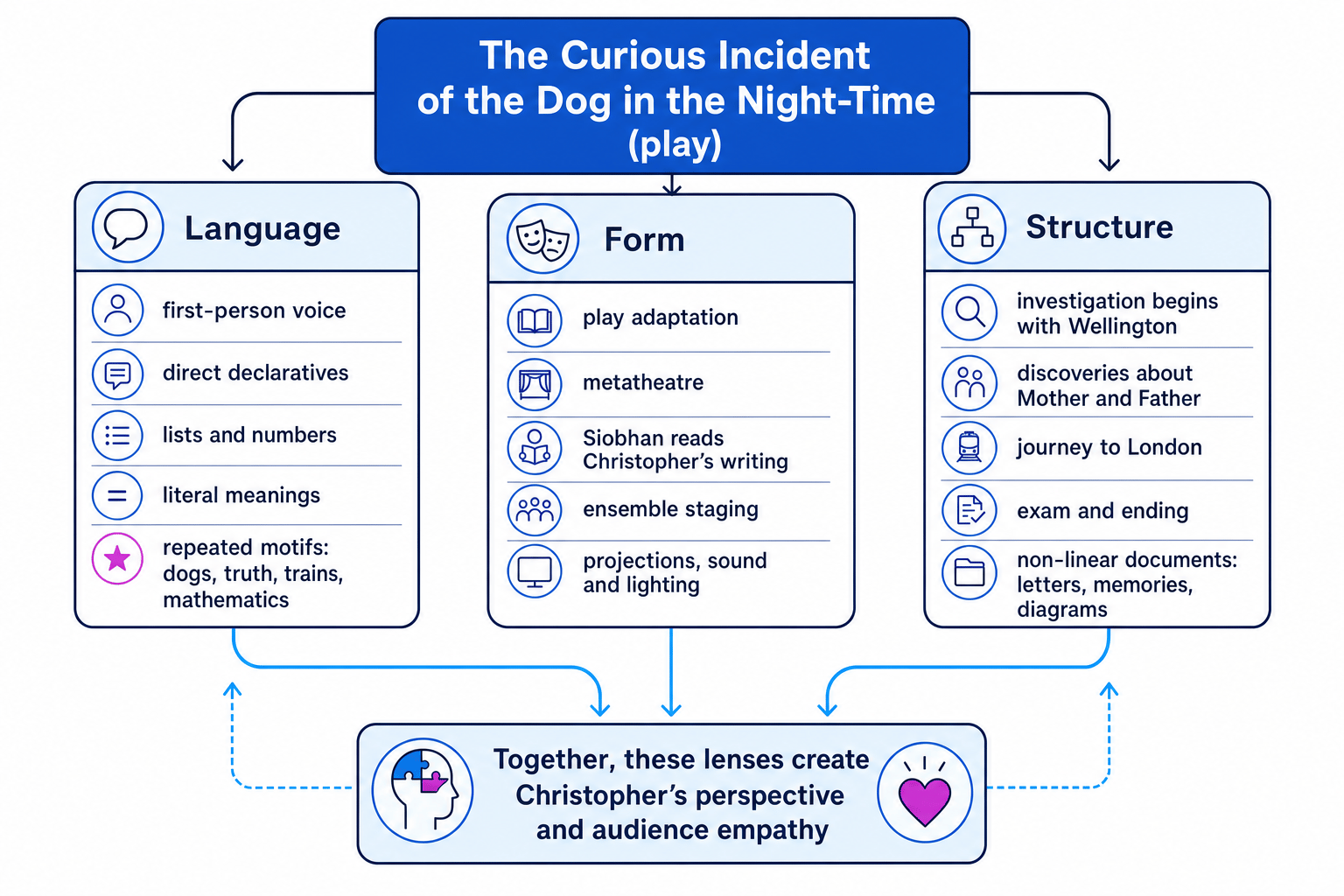
Method plus meaning
The strongest answers do not just name a device. They explain how Stephens uses language, form or structure to shape the audience’s understanding of Christopher, truth, trust and family relationships.
Language: Christopher’s distinctive voice
A voice is the recognisable way a speaker sounds on the page or stage: their vocabulary, rhythm, sentence length and way of organising thoughts. Christopher’s voice is often precise, factual and rule-based.
At the opening, the statement “It was 7 minutes after midnight” immediately shows his focus on exact detail. Instead of saying “late at night”, Christopher gives a measured time. This makes the audience enter his way of seeing the world: careful, observant and logical.
Stephens also uses declarative sentences. A declarative sentence is a sentence that states something as a fact. “The dog was dead” is short, plain and blunt. The emotional shock comes partly from the lack of emotional language: Christopher reports the scene as evidence.
Analysing Christopher's precise narration
- Notice the exact time in “It was 7 minutes after midnight”: the specific number suggests Christopher’s need for precision and order.
- Compare this with the shocking content of the scene: Wellington has been killed, but Christopher’s wording remains controlled and factual.
- Link the method to effect: the audience is positioned inside Christopher’s logical perspective, so the death becomes both emotionally disturbing and like the start of an investigation.
- Connect to the wider play: this precise voice supports the detective structure, because Christopher treats the world as something that can be solved through observation.
Literal language and the problem of metaphor
A metaphor is a comparison where one thing is described as if it is another, such as calling someone “a star”. Christopher often dislikes this kind of language because he values accuracy. He says metaphors “should be called lies”, which reveals his literal approach to words.
This matters because the play is full of people who hide, soften or distort the truth. Christopher’s language is direct: “I do not tell lies.” That simple sentence becomes more powerful when he discovers that adults around him have lied about major parts of his life.
Do not diagnose instead of analysing
Avoid making vague claims about Christopher as a medical case. In literature answers, focus on Stephens’s methods: literal language, precise detail, stage effects, repetition and structure.
Christopher’s literalness can create humour, but it is not only comic. It also creates pathos, meaning a feeling of sadness or sympathy. When he cannot easily read expressions, jokes or indirect speech, the audience sees how confusing and threatening ordinary social situations can become.
Repetition, motifs and semantic fields
A motif is a repeated image, idea or object that gains importance across a text. In this play, important motifs include dogs, truth, trains, maps, mathematics and rules.
A semantic field is a group of words linked by meaning. Christopher’s world often uses the semantic fields of logic, detection and mathematics: clues, facts, numbers, maps and problems. These word groups make his investigation feel ordered, even when the emotional world around him is chaotic.
Dogs are especially important. Christopher says, “I like dogs. You always know what a dog is thinking.” Dogs become linked with honesty and emotional safety. That makes Wellington’s death more than just a plot event: it introduces a world where safety has been violently broken.
| Quotation or detail | Method | Effect |
|---|---|---|
| “It was 7 minutes after midnight” | Precise detail | Establishes Christopher’s exact, observant perspective. |
| “The dog was dead” | Short declarative sentence | Makes the opening blunt and shocking. |
| “I do not tell lies” | Repetition of truth motif | Makes adult deception feel especially damaging. |
| Metaphors “should be called lies” | Comment on language | Shows Christopher’s literal thinking and suspicion of figurative speech. |
| “I killed Wellington” | Delayed revelation | Changes the mystery into a crisis of trust. |
Form: a play adapted from a novel
An adaptation is a new version of a text in a different form. Stephens adapts Haddon’s novel into drama, so Christopher’s private thoughts must become stage action, speech, sound, lighting and movement.
A stage direction is an instruction in a play script about action, setting, sound, lighting or movement. In The Curious Incident, stage directions are not just practical notes. They help create Christopher’s experience for the audience.
For example, crowded public spaces such as stations can be staged with overlapping voices, movement, signs, sound and lighting. This is important because Christopher may describe things factually, but the stage can show the pressure he feels.
Metatheatre
Metatheatre is theatre that draws attention to itself as theatre. In this play, Christopher’s writing is turned into performance, and Siobhan often helps voice or shape his account, reminding us that the story is being presented and staged.
Siobhan’s role is central to the form. She is not only a teacher; she also helps mediate Christopher’s narration for the audience. This lets Stephens keep the intimacy of the novel’s first-person voice while using the shared, visual form of theatre.
Linking staging to Christopher's experience
- Start with the dramatic method: in busy public scenes, the stage can combine voices, movement, sound and visual information all at once.
- Explain why this suits Christopher’s perspective: he notices many details, but the amount of information can become overwhelming.
- Analyse the audience effect: spectators do not just hear that Christopher is distressed; they experience a version of that pressure through the form of the play.
- Link to meaning: Stephens uses theatre to build empathy, making Christopher’s journey to London feel brave rather than simply plot-driven.
Structure: from mystery to emotional discovery
The play begins like a detective story. The audience wants to know who killed Wellington. This gives the opening a clear structural question and makes Christopher’s investigation easy to follow.
A turning point is a moment that changes the direction of the plot. Ed’s confession, “I killed Wellington”, is a major turning point because it solves the first mystery but creates a much deeper problem: Christopher’s trust in his father collapses.
The structure then shifts. The real mystery is no longer only “Who killed the dog?” but “Who can Christopher trust?” The discovery of his mother’s letters also changes the audience’s understanding of the past. Stephens structures the play so that personal truth is revealed in stages.
Tracking the detective structure
- Identify the opening question: Wellington’s death creates a murder-mystery structure, with Christopher acting as investigator.
- Follow the delayed revelation: Ed’s “I killed Wellington” answers the surface mystery later in the play.
- Explain the structural twist: instead of ending the story, the confession creates a bigger emotional conflict about lying, safety and family.
- Link to the ending: Christopher’s final confidence that he can do “anything” feels hopeful, but the family damage has not been magically erased.
Non-linear moments: letters, memories and interruptions
A linear structure tells events in time order. This play is mostly driven forward by Christopher’s investigation, but it also includes interruptions: memories, documents, explanations, diagrams and letters.
These non-linear moments matter because they show that truth is not discovered all at once. Christopher has to piece it together, like evidence in a case. The audience does the same.
Stephens also uses contrast. Christopher wants rules, clarity and truth, but the adult world is messy, emotional and indirect. The structure repeatedly places Christopher’s ordered thinking against chaotic situations: the police station, family arguments, the railway journey and London.
Writing about language, form and structure together
In a strong paragraph, you might begin with one clear point, embed a short quotation, name the method, then explain its effect on the audience.
For example:
Stephens presents Christopher as a narrator who tries to control frightening events through precise factual language. At the opening, Christopher states, “It was 7 minutes after midnight,” using exact numerical detail rather than emotional description. This precision establishes his logical voice and makes the stage world feel filtered through his perspective. However, because the detail appears beside the shocking image of Wellington’s death, the audience also senses the gap between Christopher’s calm reporting and the violence of the event. Stephens therefore uses language to make the mystery gripping while also encouraging empathy for Christopher’s unusual way of processing fear.
Use the open book well
In Component 2, you have a clean copy of the play. Use it to check short quotations and stage directions, but do not waste time copying long sections. A few precise words are enough if your analysis is detailed.
Final reminders
When you revise this topic, think in layers:
- Language: What exact words or sentence patterns create Christopher’s voice?
- Form: How does the play make thoughts, memories and overload visible or audible?
- Structure: How are discoveries delayed, repeated or contrasted?
In the exam
- Choose one precise method at a time: a quotation, a stage direction, a repeated motif or a structural turning point.
- Explain the effect on the audience, especially because this is drama: what do we see, hear, feel or realise?
- Link your analysis back to the question and to Christopher’s experience of truth, trust, fear or independence.
Check yourself
- How does Christopher’s literal language affect the way the audience responds to him?
- Why is Ed’s confession structurally important beyond solving Wellington’s death?
- How does the play form show Christopher’s inner experience in ways a novel cannot?