What you'll learn
- How to choose quotations that are genuinely useful in an essay.
- The most flexible short quotes for The Curious Incident of the Dog in the Night-Time.
- How to connect each quote to character, theme, structure and dramatic method.
- How to use quotations efficiently in the Edexcel IGCSE open-book drama exam.
Why key quotes matter
For Edexcel International GCSE English Literature Component 2, Section A: Modern Drama, this text is open book: you may use a clean copy of the play in the exam. A clean copy means no notes, highlighting or annotations.
Even so, you should still learn short quotation fragments. If you already know your “anchor quotes”, you can use the text to check details rather than waste time hunting for evidence.
Key quote
A key quote is a short, accurate piece of evidence that links to more than one important idea in the play. The best quotations are flexible: they can help you write about character, theme, structure, and the audience’s response.
For this section, the main assessment focus is AO1 and AO2. AO1 means showing close knowledge of the play and developing a clear personal response. AO2 means analysing how Simon Stephens uses language, form and structure to create meaning.
The quotation method: quote, method, effect
A quotation on its own does not earn much. You need to explain what the writer is doing with it.
Method and effect
A method is a deliberate choice made by the writer. In drama, methods include dialogue: the words characters speak; stage directions: instructions for performance; form: the type and shape of the text, here a stage play; and structure: the order in which events are revealed. An effect is what this choice makes the audience think, feel or notice.
Some useful terms for this play include:
- A declarative sentence: a sentence that makes a statement.
- A motif: a repeated idea, image or object that builds meaning.
- Symbolism: when something concrete, such as Wellington the dog, represents a bigger idea.
- Contrast: when two different ideas or moments are placed against each other.
Learn quotes as clusters
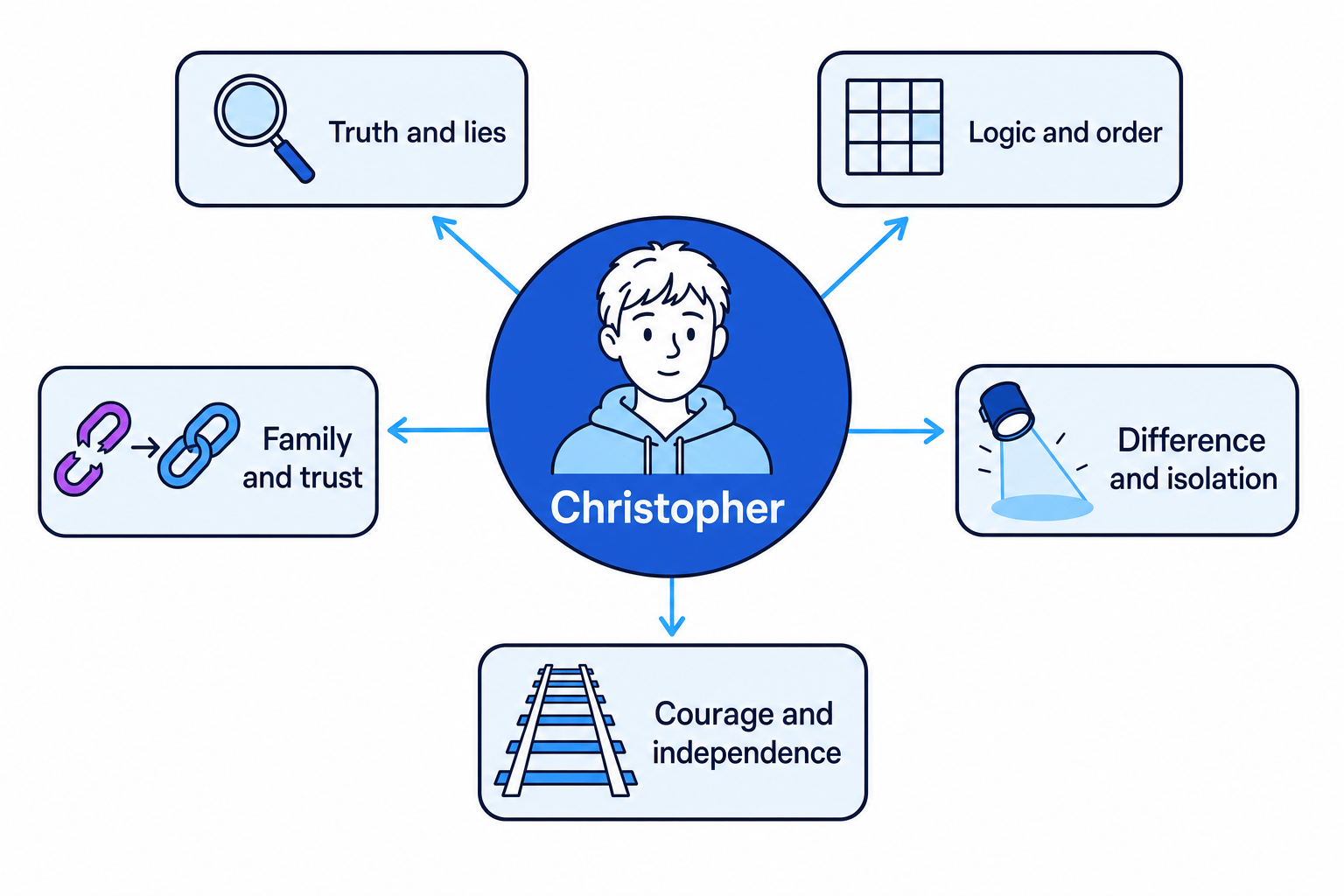
Do not revise quotations as isolated lines. Learn them in clusters: truth and lies, logic and order, family and trust, difference and isolation, and courage and independence.
This map shows the main routes your quotations can take. Notice that Christopher sits at the centre: most strong essays link the quote back to how the audience understands him.
Quote bank by theme
Different editions may have different page numbers, so revise by speaker and moment rather than page. The quotations below are deliberately short so you can embed them smoothly in your own sentences.
Truth, detection and order
| Quote | Speaker / moment | Method | How to use it |
|---|---|---|---|
| “It was seven minutes after midnight.” | Christopher, opening | Precise time detail | Establishes Christopher’s exact, observational voice and immediately gives the play a detective-story feel. |
| “The dog was dead.” | Christopher, opening discovery of Wellington | Short declarative sentence | The bluntness creates shock but also shows Christopher’s factual, unsentimental narration. |
| “I do not tell lies.” | Christopher, early self-explanation | Simple absolute statement | Presents truth as part of Christopher’s moral code, making Ed’s and Judy’s lies feel especially damaging. |
| “Metaphors are lies.” | Christopher, explaining language | Direct judgement on figurative language | Shows his literal way of thinking and makes the audience question normal social language. |
Christopher’s truthfulness is not just a character trait. Structurally, it drives the plot: his need to know who killed Wellington leads him towards much more painful truths about his parents.
Turning a quote about metaphors into analysis
- Start with a focused point: Christopher sees truth as something exact and measurable, not flexible or emotional.
- Use the evidence: when he says “Metaphors are lies,” he treats figurative language as morally suspicious.
- Analyse the method: the declarative sentence sounds certain and final, which reflects his need for clear rules.
- Explain the effect: the audience understands that Christopher’s difficulty is not lack of intelligence, but a different relationship with language and social convention.
- Link back to the play: this makes the family’s secrecy more painful because lies threaten the system of truth Christopher relies on.
Logic, patterns and control
| Quote | Speaker / moment | Method | How to use it |
|---|---|---|---|
| “every prime number up to 7,057” | Christopher’s self-introduction | Specific numerical detail | Challenges any assumption that Christopher is incapable; his intelligence is precise and extraordinary. |
| “Prime numbers are what is left” | Christopher, discussing patterns | Motif of mathematics | Suggests his mind seeks order even in a world that feels confusing and unpredictable. |
| “I like timetables” | Christopher, explaining routine | Plain declarative sentence | Shows that structure gives him security and helps the audience understand his distress when routines break. |
| “a Good Day” | Christopher’s system of coloured cars | Personal rule system | Reveals his attempt to create control, even when the rule may seem arbitrary to others. |
The play often contrasts Christopher’s logical systems with the emotional messiness of adult behaviour. Stephens does not present logic as cold or silly; instead, it becomes one of Christopher’s survival tools.
Use short fragments
You do not need to copy a whole sentence. A fragment like “I like timetables” is enough if you analyse it closely and connect it to a clear point.
Family, trust and betrayal
| Quote | Speaker / moment | Method | How to use it |
|---|---|---|---|
| “I was not a very good mother.” | Judy, in her letters | Confessional dialogue | Makes Judy more complex: she admits failure, but the audience also sees her guilt and love. |
| “I killed Wellington.” | Ed, confession | Blunt declarative sentence | The murder mystery becomes a family crisis; the simple wording makes the betrayal stark. |
| “Father had murdered Wellington.” | Christopher, after Ed’s confession | Formal naming and repetition of the crime | Shows Christopher reprocessing Ed as dangerous; trust collapses into fear. |
| “I love you very much, Christopher.” | Ed, trying to repair trust | Emotional declaration | Creates tension because Ed’s love is real, but it does not erase his violence or lying. |
Wellington is more than a dog in the plot. Through symbolism, Wellington becomes a sign of broken trust: the dead dog leads Christopher to discover the hidden damage in his family.
Making Ed or Judy too simple
Avoid writing that Ed is “just evil” or Judy is “just selfish”. The play is more complex: both parents fail Christopher, but Stephens also shows their guilt, love and desperation.
Difference, isolation and communication
| Quote | Speaker / moment | Method | How to use it |
|---|---|---|---|
| “I find people confusing.” | Christopher, early explanation | Direct statement | Gives the audience immediate insight into his social world and his isolation. |
| “I don’t like people grabbing me.” | Christopher, after physical contact | Boundary expressed through dialogue | Helps the audience understand his distress and the conflict between his needs and other people’s reactions. |
| “I see everything.” | Christopher, explaining perception | Emphatic statement | Presents his perception as intense and detailed, not deficient. |
| “I wanted to be on my own.” | Christopher, moments of overload | Repeated desire for distance | Shows isolation as both protective and painful. |
When you write about Christopher, be careful and respectful. The play encourages the audience to see the world through his perspective, not to reduce him to a label.
Courage, growth and independence
| Quote | Speaker / moment | Method | How to use it |
|---|---|---|---|
| “I was brave.” | Christopher, reflecting near the end | Simple self-evaluation | Marks a change in his confidence; he recognises his own achievement. |
| “I can do anything.” | Christopher, ending | Climactic declaration | Gives the ending a powerful sense of possibility, while still leaving family problems unresolved. |
| “I went to London” | Christopher, recalling his journey | Structural turning point | His journey becomes proof of independence and resilience. |
| “I solved the mystery” | Christopher, final reflection | Detective-plot language | Connects the opening mystery to his personal growth. |
The ending is hopeful, but it is not a fairy-tale ending. Christopher has achieved something huge, yet the relationships around him remain damaged. That balance makes the final confidence feel earned rather than unrealistic.
Adapting one quote for different questions
The best quotations work in more than one essay. For example, “I killed Wellington” can support several different arguments.
Adapting one quote to different themes
- For a question about truth, focus on the confession: Ed’s blunt statement finally gives Christopher the truth, but only after sustained deception.
- For a question about family, focus on betrayal: the person meant to protect Christopher becomes the source of fear and instability.
- For a question about structure, focus on the turning point: the murder mystery is solved, but the emotional conflict becomes much larger.
- For a question about audience response, focus on discomfort: the line is simple, but it forces the audience to hold together Ed’s love and his wrongdoing.
Building a paragraph from a key quote
A strong paragraph usually follows this pattern:
Point → Evidence → Method → Effect → Link
That means you make an argument, include a short quotation, analyse the writer’s method, explain the audience’s response, and link back to the question.
For example:
Christopher’s need for truth is presented as a core part of his identity. His statement, “I do not tell lies,” is a simple declarative sentence, making his moral rule sound absolute and non-negotiable. This means the audience understands why the adults’ lies are not minor mistakes to him; they destroy the reliability of the world he depends on. Stephens therefore makes truth both a personal value and a structural force that drives the play’s discoveries.
Embed quotations smoothly
Try to make quotations part of your own sentence: Christopher’s “I do not tell lies” presents truth as a rule he lives by. This is usually more controlled than dropping in a full sentence on its own.
Final revision shortlist
If you only have time to memorise ten, choose these:
- “It was seven minutes after midnight.”
- “The dog was dead.”
- “I do not tell lies.”
- “Metaphors are lies.”
- “I find people confusing.”
- “I like timetables.”
- “I was not a very good mother.”
- “I killed Wellington.”
- “I was brave.”
- “I can do anything.”
In the exam
- Use your clean copy to locate the moment, but rely on memorised anchor quotes so you do not waste time searching.
- Keep quotations short, then spend more time analysing methods such as declarative sentences, motifs, symbolism and structure.
- Always connect the quote back to the question: explain what it reveals about Christopher, family, truth, independence or the audience’s response.
Check yourself
- Which three quotations best show Christopher’s need for truth and order?
- How could “I killed Wellington” be used in an essay about both family and structure?
- What method could you analyse in “The dog was dead”, and what effect does it create?