When studying Simon Stephens’ stage adaptation of The Curious Incident of the Dog in the Night-time, understanding individual scenes is about more than just remembering the plot. Because the play is a piece of modern drama written for performance, you must analyse how Stephens uses stagecraft and dramatic structure to bring Christopher’s unique internal world to life for a live audience.
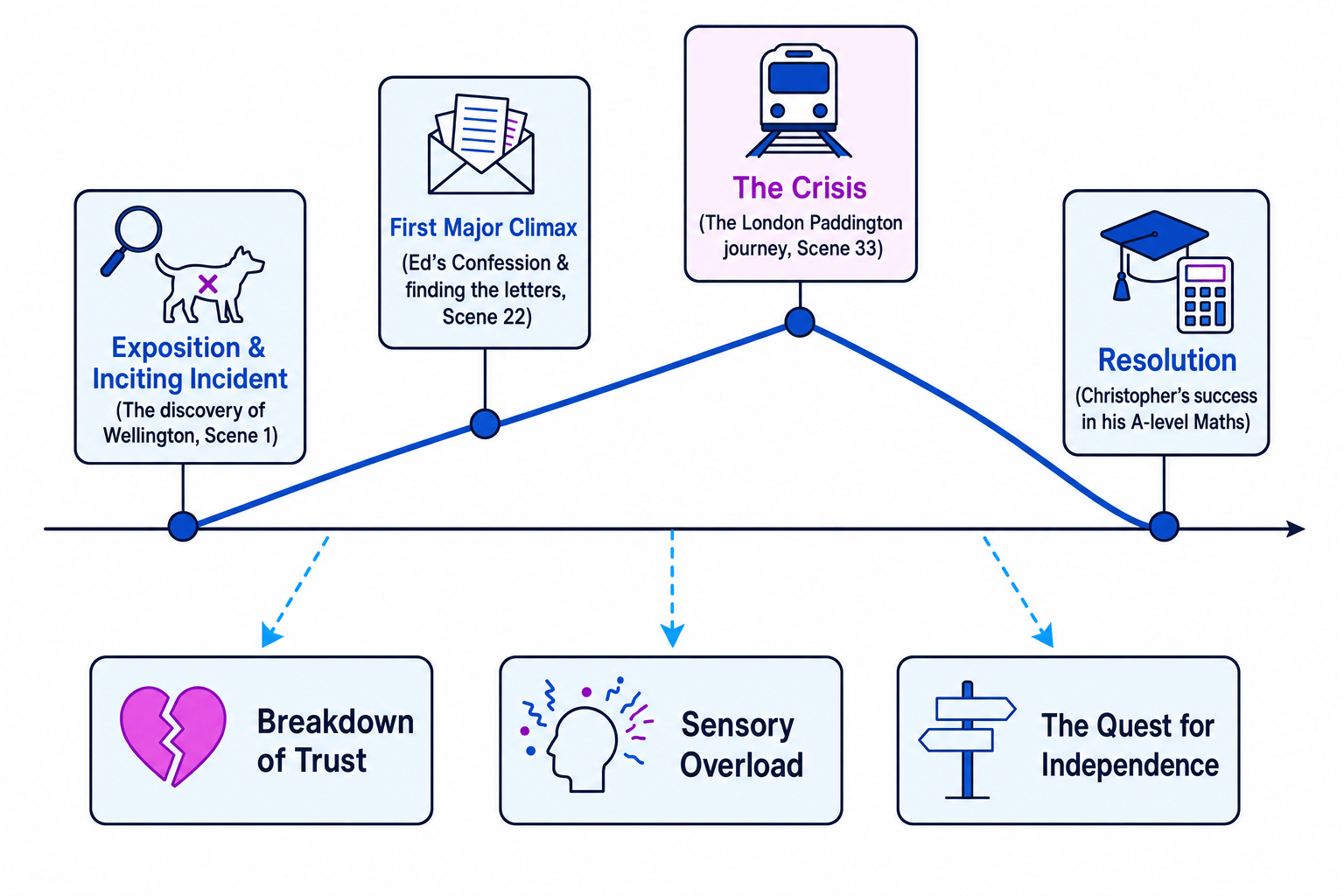
By focusing on a few pivotal scenes, you can unlock the main themes of the play: the breakdown of trust, the struggle for independence, and the overwhelming nature of the sensory world.
What you'll learn
- How to identify and analyse key turning points in the dramatic structure of the play.
- How to evaluate Simon Stephens’ use of theatrical techniques, including physical theatre and metatheatre.
- How to link specific scenic actions and stage directions to the wider themes of trust, logic, and isolation.
From Page to Stage: The Rules of Play Analysis
Before looking at specific scenes, we need to establish the basic dramatic concepts that distinguish a play from a novel. In a novel, a writer uses internal monologue to show a character’s thoughts. In a play, a playwright must externalise those thoughts using theatrical devices.
Stagecraft
Stagecraft refers to the practical and technical aspects of theatrical production. This includes lighting, sound, set design, prop usage, proxemics (the space between characters on stage), and physical movement (choreography).
Metatheatre
Metatheatre describes drama that self-consciously addresses the devices of theatre. In this play, the metatheatrical framing device of Siobhan reading aloud from Christopher’s book remind us that we are watching a performance shaped by Christopher’s own mind and narrative choices.
The structure of the play follows a distinct dramatic arc. Christopher’s initial quest to solve a mystery (the murder of Wellington) forces him out of his safe, structured environment and into a chaotic, unpredictable world.
Scene 1: The Inciting Incident and Setting the Frame
The play opens abruptly with a dead dog on stage. This striking image functions as the inciting incident—the event that disrupts the status quo and triggers the narrative journey.
Siobhan’s Role and Narrative Distance
Stephens immediately establishes Siobhan as our narrator. She reads directly from Christopher's notebook: "It was seven minutes after midnight. The dog was lying on the lawn..." By having Siobhan speak Christopher's words, Stephens creates a double perspective:
- We experience Christopher's literal, precise world-view.
- We benefit from Siobhan's calm, empathetic vocal delivery, which bridges the gap between Christopher and the audience.
The Conflict with Authority
When the policeman arrives, we see Christopher's logical but literal mind collide with societal expectations. When touched, Christopher hits the officer.
This reaction is not a sign of aggression, but a defensive response to sensory overload. The staging is crucial here: the sudden arrival of the officer, the rapid-fire questions, and the physical intrusion into Christopher's personal space create instant dramatic tension.
Direct Address and the Grid
The stage directions specify that the stage is designed like a grid. This represents Christopher’s desire for order, logic, and mathematical certainty in a world that he finds chaotic and unpredictable.
Scene 22: The Climax of Act One — Ed’s Confession
This scene represents the emotional peak of the play's first half. Ed Boone confesses to Christopher that he killed Wellington and that he lied about Christopher's mother being dead.
The Breakdown of Trust
Trust is Christopher's absolute foundation. Because he cannot tell lies, he assumes that others must tell the truth. Ed's confession utterly shatters this foundation.
ED: I killed Wellington, Christopher.
...
I'm sorry, Christopher. With a hand on my heart, I am so, so sorry.
The tragedy of the scene is heightened by proxemics. As Ed tries to get closer to comfort his son, Christopher physically retreats. Christopher's reaction is to pack his bag and plan his escape. The loss of trust translates instantly into a loss of physical safety.
Ignoring the Stage Directions
Students often quote only the spoken dialogue in their essays. In this scene, the stage directions are just as important as the words. Note how Christopher responds to Ed’s touch by "screaming" or curling into a ball. Stephens uses these physical actions to demonstrate how Christopher's emotional paralysis translates into a physical shutdown.
Scene 33: The Journey to London and Sensory Overload
In Act Two, Christopher travels to London to find his mother. Scene 33, set in Paddington Station, is the ultimate test of his independence and a tour de force of physical theatre.
Physical Theatre and the Ensemble
Stephens, working originally with the movement directors of Frantic Assembly, uses the ensemble (the group of supporting actors) to physically represent Christopher’s sensory overload. Instead of real trains and escalators, the ensemble members use their bodies to create a hostile, moving maze. They become doors, ticket barriers, and rushing commuters, blocking Christopher’s path and physically lifting or shifting him.
Sound and Visual Design
The play uses high-tech stagecraft to evoke Christopher's cognitive state:
- Sound: Screeching brakes, static white noise, and overlapping, distorted voices play at a loud volume to mimic the feeling of auditory overload.
- Lighting/Projection: Numbers, letters, and tube maps are projected rapidly onto the walls and floor, visualising the frantic data processing occurring inside Christopher’s head.
Form Matters!
When writing about the London journey, do not just describe the plot. Write about the form. Use terms like "non-naturalistic staging," "kinetic choreography," and "sonic landscape." This directly addresses Assessment Objective 2 (AO2) by showing you understand how theatrical devices create meaning.
Analysing a Key Scene
Let us look at how you can build a highly analytical paragraph evaluating a key moment from the play, using the structured Point-Evidence-Method-Effect-Link approach.
Analysing the dramatic impact of Ed's confession
- Point: Stephens uses physical actions and minimalist dialogue during Ed’s confession in Scene 22 to highlight the complete breakdown of communication and trust between father and son.
- Evidence: After Ed admits to killing Wellington, the stage directions note that Christopher "does not look at Ed" and begins to "double up, groaning," while Ed "reaches out his hand to touch Christopher's shoulder."
- Method: Stephens employs contrasting physical actions (proxemics) and non-verbal vocalisations ("groaning") to dramatise Christopher's psychological trauma.
- Effect: By showing Christopher physically shrinking away from his father's touch, Stephens visualises the emotional gulf that has suddenly opened between them. Ed's hand, meant as a comforting gesture, becomes a threat. The audience experiences a sense of tragic irony; Ed's desperate attempt to tell the truth and rebuild his relationship with Christopher instead causes its total destruction.
- Link: This moment is pivotal because it shifts Christopher from a passive investigator to an active fugitive, driving the transition into the physical and sensory trial of his journey to London in Act Two.
In the exam
- Identify the Scene's Function: Ask yourself where the scene sits in the wider play. Is it an inciting incident, a moment of rising tension, a climax, or a resolution?
- Integrate Stage Directions: Treat the stage directions with the same respect as the spoken lines. Quote them directly (e.g., "Stephens indicates that the ensemble...").
- Focus on the Audience: Always discuss how a live audience would react to the visual and auditory elements of the scene. Mention the sensory impact of sound and light.
- Link to Themes: Never analyse a device in isolation. Always connect your observation back to a core theme (such as the challenge of communication, parent-child relationships, or order versus chaos).
Check yourself
- How does the metatheatrical framing device of Siobhan reading Christopher's book change our perception of the events in Scene 1?
- What physical actions on stage illustrate Christopher’s loss of trust in Ed during Scene 22?
- In what ways does the production style shift from naturalistic to non-naturalistic during the London Paddington scene (Scene 33)?