Welcome to your study guide for William Shakespeare's Sonnet 116. This poem is one of the most famous declarations of romantic philosophy in the English language. In your Edexcel IGCSE English Literature exam (Component 1, Section B), you will need to compare this poem with another from the Part 3 anthology collection.
To score highly, you must analyze how Shakespeare uses the rigid structure of the sonnet, vivid natural imagery, and powerful language choices to present love as an absolute, unchanging force.
What you'll learn
- How Shakespeare uses the strict Shakespearean sonnet form to mirror his argument about love's stability.
- The meaning behind key metaphors, including celestial navigation and the personification of Time.
- Critical analytical strategies to compare Sonnet 116 with other poems in the Edexcel Anthology.
The Big Picture: What is Sonnet 116 About?
At its heart, Sonnet 116 is an attempt to define true love. Crucially, Shakespeare does not define love by what it is first; instead, he begins by explaining what love is not.
According to the speaker, true love is purely spiritual ("the marriage of true minds") rather than merely physical. It is constant, absolute, and completely unaffected by changes in circumstances, physical aging, or the passage of time.
The Headline Takeaway
True love is an unchanging, eternal anchor. If love can be altered by external events or the physical decay of the beloved, then it was never genuine love in the first place.
Form and Structure: The Architecture of Love
Shakespearean sonnets are not just pretty love poems; they are highly structured logical arguments. Shakespeare uses the perfection of the poetic form to represent the perfection of the love he is describing.
Shakespearean (English) Sonnet
A 14-line poem written in iambic pentameter with a strict rhyme scheme of ABAB CDCD EFEF GG. It consists of three quatrains (four-line stanzas) and a final rhyming couplet (two-line stanza).
Iambic Pentameter
A poetic meter consisting of ten syllables per line, following a pattern of unstressed then stressed syllables: da-DUM da-DUM da-DUM da-DUM da-DUM. This mimics the natural rhythm of a human heartbeat.
The structure of Sonnet 116 acts like a staircase, building a firm, logical argument across four distinct stages.
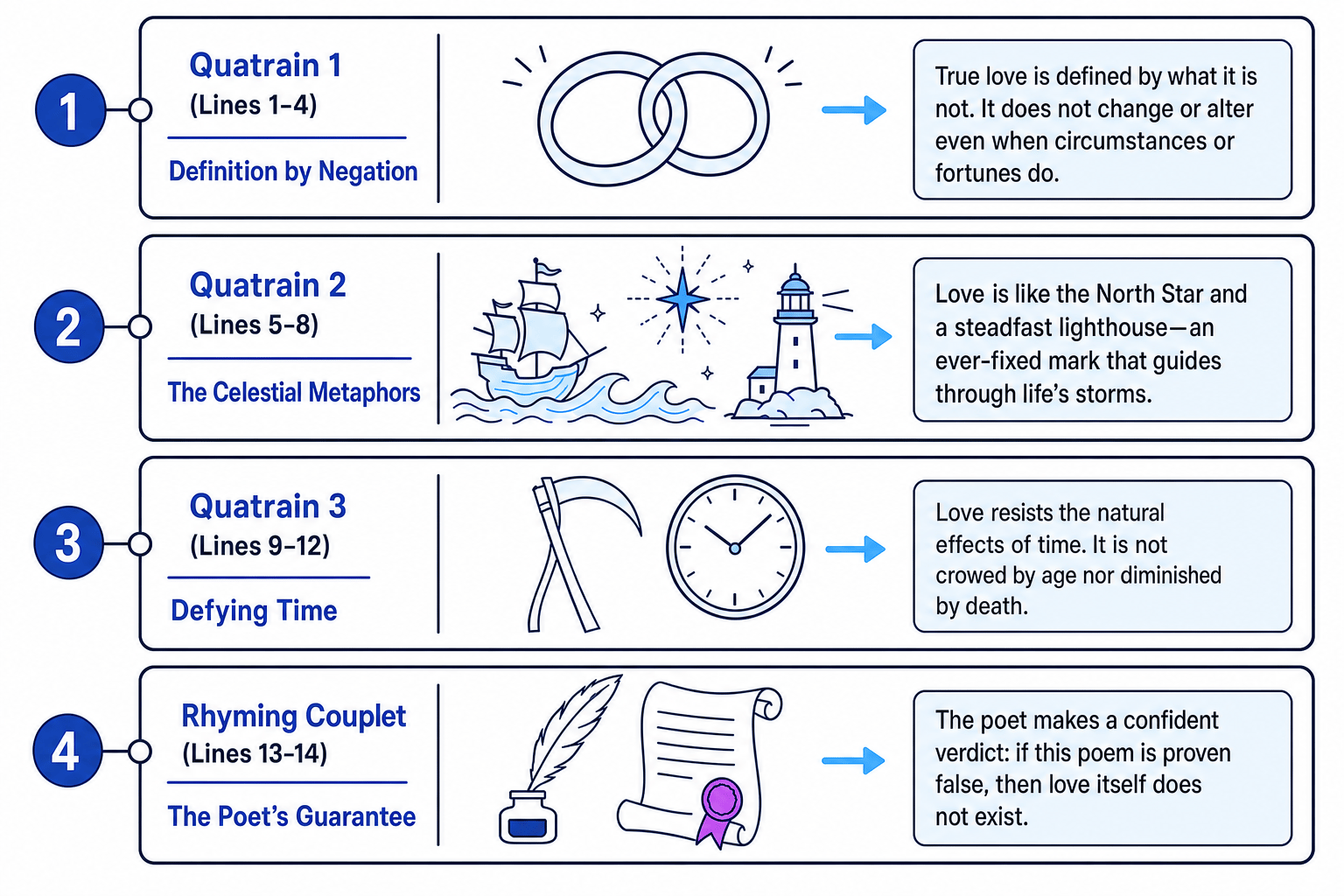
The Four-Stage Argument
- Quatrain 1 (Lines 1–4): Love is Unchanging. The poet establishes that true love is a union of minds that does not "alter when it alteration finds."
- Quatrain 2 (Lines 5–8): Love is a Guiding Light. The poet shifts to natural, cosmic imagery, comparing love to a lighthouse and the North Star.
- Quatrain 3 (Lines 9–12): Love Defies Time. The poet tackles the physical world. While physical beauty fades under "Time's bending sickle," spiritual love remains untouched.
- The Rhyming Couplet (Lines 13–14): The Absolute Guarantee. The poet stakes his entire reputation on his words. If his definition of love is proven wrong, then he "never writ, nor no man ever loved."
Structure is Meaning
Always connect form to meaning! When writing about iambic pentameter in this poem, suggest that its steady, heartbeat-like rhythm represents the absolute constancy and stability of true love. It does not falter or break, just as the ideal love it describes remains secure.
Close Language Analysis (AO2)
To secure top-band marks, you need to look closely at the poetic devices and language choices Shakespeare uses to persuade his reader.
1. Legalistic and Nuptial Language
Right from the opening line, Shakespeare uses language associated with marriage vows:
"Let me not to the marriage of true minds / Admit impediments"
The word "impediments" directly echoes the Anglican Marriage Service ("If any of you know cause or just impediment..."). By referring to the "marriage of true minds" rather than bodies, Shakespeare elevates love from a physical contract to a spiritual, intellectual union.
2. Definition by Negation (Litotes)
Shakespeare frequently uses negative words to define love: "not", "never", "no", "bends not". By showing us what love is not (it is not temporary, it does not bend, it is not Time's fool), he implies that true love is so vast and perfect that it cannot be described with positive human vocabulary; it can only be defined by its refusal to fail.
3. The Celestial and Nautical Metaphor
In Quatrain 2, Shakespeare writes:
"O no! it is an ever-fixed mark / That looks on tempests and is never shaken; / It is the star to every wand'ring bark"
Let's break down this imagery:
- "ever-fixed mark": This refers to a sea mark or a lighthouse. No matter how violent the "tempests" (storms) are, the lighthouse remains steady, guiding ships safely home.
- "the star to every wand'ring bark": A "bark" is a small boat, and the "star" is the North Star (Polaris), which sailors used to navigate. The star's height can be measured ("whose worth's unknown, although his height be taken"), but its intrinsic value to a lost sailor is infinite.
Misinterpreting the 'Star' Metaphor
Students often write that the star represents "looking pretty in the sky." Avoid this! The star is a functional, survival tool. Love is not just decorative; it is a vital, life-saving guide that prevents us from getting lost in life's metaphorical storms.
4. Personifying Time as the Grim Reaper
In Quatrain 3, Shakespeare presents Time as a destructive force:
"Love's not Time's fool, though rosy lips and cheeks / Within his bending sickle's compass come"
- "Time's fool": Historically, kings kept "fools" (court jesters) for entertainment. Shakespeare asserts that love is not a plaything or servant of Time.
- "bending sickle's compass": "Time" is personified here as the Grim Reaper, wielding a curved sickle to harvest human lives and physical youth ("rosy lips and cheeks"). While physical beauty is easily cut down by the passage of time, true love stands outside of time's reach, lasting "even to the edge of doom" (the end of the world).
Comparative Strategy (AO3)
In Component 1, Section B, you must write a comparative essay. You will be given a named poem from the anthology (which could be Sonnet 116) and asked to compare it to another poem of your choice from the collection.
When planning your comparison, look for conceptual links.
Ideal, Constant Love vs. Fragile, Decaying Love
- Sonnet 116 presents love as an eternal, positive, unshakable force.
- Compare this with Neutral Tones by Thomas Hardy, where love is shown to be dead, deceptive, and cold, using bleak natural imagery (a "starving sod" and a "gray" landscape) to show how love decays over time.
Eternal Memory vs. Painful Separation
- Sonnet 116 argues that love outlasts physical death ("even to the edge of doom").
- Compare this with Remember by Christina Rossetti. Both poems deal with love and the passage of time, but Rossetti's speaker grapples with the painful reality of physical separation and death, ultimately deciding that it is better to "forget and smile" than to "remember and be sad."
Worked Example: Structuring a Comparative Paragraph
Here is a step-by-step walkthrough of how to construct a high-scoring analytical paragraph comparing Shakespeare's presentation of love's constancy with Thomas Hardy's presentation of love's decay in Neutral Tones.
Developing a comparative analysis of love's endurance
-
Formulate a comparative thesis point.
Start by directly comparing the two poets' core themes.
Draft: "While Shakespeare presents love as an eternal, unshakable force that survives all challenges, Hardy depicts love as something fragile and temporary that decays into bitter resentment."
-
Embed a specific method and quote from the first text (Shakespeare) and analyze its effect.
Select a key linguistic device (e.g., the celestial navigation metaphor) and explain how Shakespeare uses it.
Draft: "Shakespeare emphasizes love's permanent nature in Sonnet 116 by utilizing maritime imagery, asserting that love is 'the star to every wand'ring bark'. By comparing love to the North Star, Shakespeare suggests that love is a constant, celestial guide for lost human beings ('barks'). The star's 'height' may be measured, but its value is infinite, illustrating that true love transcends physical measurement and remains resilient against life's metaphorical storms."
-
Transition to the comparative text using a clear comparative connector, then analyze a contrasting method and quote.
Link Hardy's contrasting use of imagery back to your thesis.
Draft: "In stark contrast, Hardy rejects this romanticized view of cosmic stability in 'Neutral Tones', employing bleak, decaying natural imagery to show how love can perish. Instead of a brilliant, guiding star, Hardy's setting is framed by a sun that is 'white, as though chidden of God', and leaves that have 'fallen from an ash, and were gray'. The monochromatic color palette of 'gray' and 'white' represents the emotional death of the relationship, contrasting sharply with the 'rosy lips and cheeks' that Shakespeare mentions as physical indicators of youth and vitality. While Shakespeare's love resists the harvest of Time's 'bending sickle', Hardy's love has already withered, reduced to a lifeless landscape."
In the exam
- Know your quotes: Because this is a closed-book exam, memorize at least three short, powerful quotes from Sonnet 116 that cover different techniques (e.g., "marriage of true minds" for legal/nuptial imagery; "ever-fixed mark" for maritime metaphor; "bending sickle's compass" for personification).
- Address Form and Structure: Do not just analyze words. You must mention the sonnet form. Explain why Shakespeare uses a form that is so neat and balanced (it mirrors the perfect harmony of true love).
- Use comparative transitions: When writing your essay, ensure your paragraphs transition smoothly between the two poems. Use phrases like: Similarly, ..., In contrast to this, ..., While Shakespeare presents... Hardy suggests..., or This idea is echoed in...
- Link to the Writer's Purpose: Always ask yourself: Why did the poet write this? Shakespeare wrote this to praise a selfless, spiritual, ideal form of human connection that transcends mortal limitations.
Check yourself
- Why does Shakespeare use negative constructions ("not", "never") to define love in the first quatrain?
- What is the literal meaning of the "ever-fixed mark" and the "star to every wand'ring bark" in the context of Elizabethan navigation?
- What is the dramatic purpose of the final rhyming couplet? How does it serve as a logical conclusion to the sonnet's argument?
