What you'll learn
- What happens in Vernon Scannell’s “Hide and Seek” and why the ending feels so unsettling.
- How Scannell uses second-person narration, commands, sensory imagery and structure to control the reader’s response.
- Key quotations you can learn for the closed-book Component 1 anthology poetry comparison.
- How to write about this poem for AO2 and connect it to another poem for AO3.
1. The poem at a glance
“Hide and Seek” describes a child hiding during a game. At first, the child feels excited and confident: they call, “I’m ready! Come and find me!” and hide under sacks in a toolshed. As the poem continues, the hiding place becomes cold, dark and uncomfortable. The child believes the others are still searching, then finally comes out to claim victory — but nobody answers.
The poem’s final question, “where are they who sought you?”, changes everything. What began as a simple game becomes a moment of shock, loneliness and possible abandonment.
Speaker and second-person narration
The speaker is the voice of the poem. Second-person narration means the speaker addresses someone as “you”. In this poem, “you” places the reader inside the child’s experience, making the fear and confusion feel immediate.
Surface story and deeper meaning
On the surface, this is a poem about a children’s game. More deeply, it explores the frightening moment when confidence collapses and a child realises they may have been forgotten or left behind.
The poem’s emotional movement is one of its most important features: it shifts from playful confidence to suspense, then to isolation.
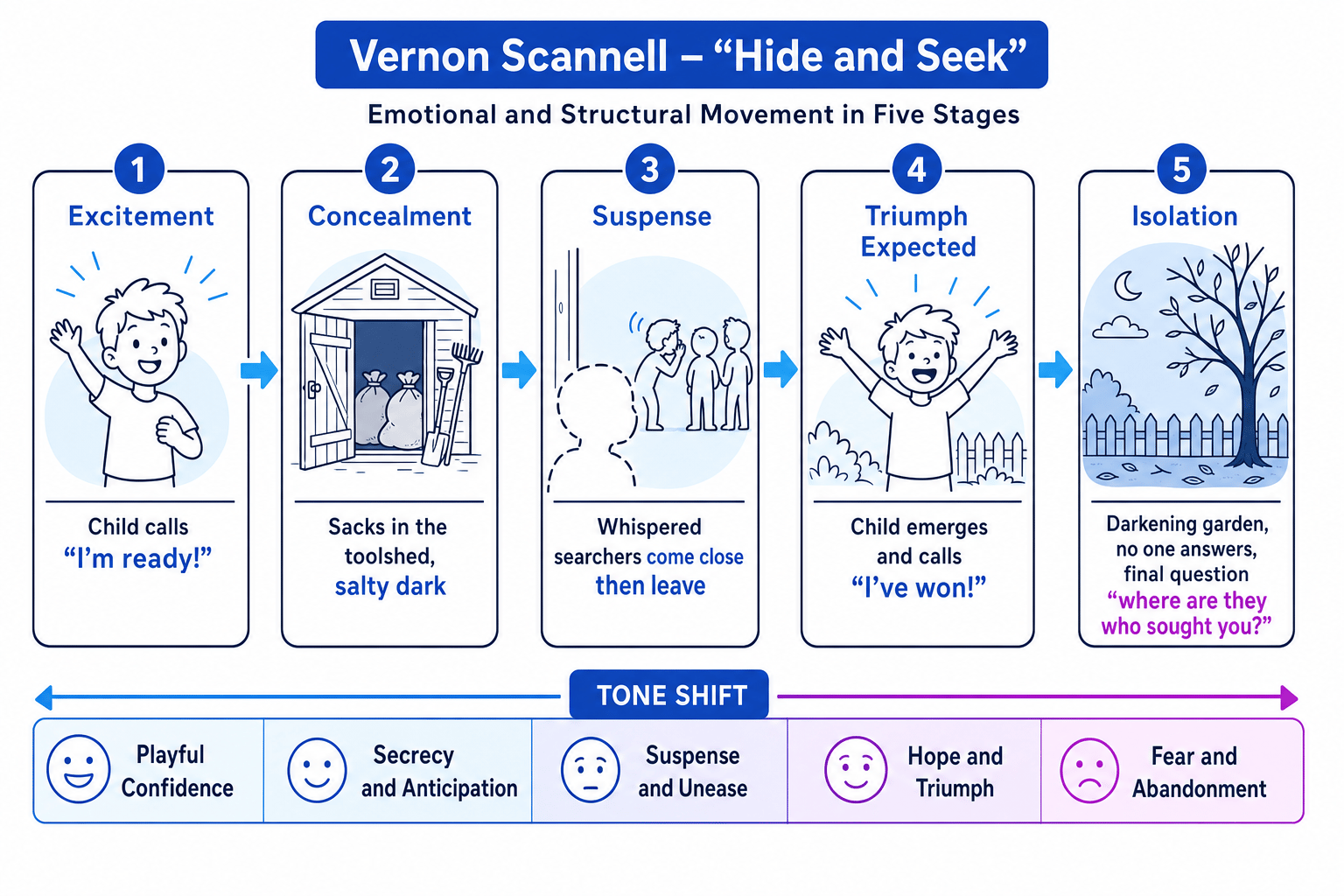
Tracing the emotional turn
- Start with the opening voice: “Call out. Call loud” uses repeated commands, creating energy and excitement.
- Notice how the hiding place changes: “salty dark” sounds secretive and adventurous at first, but darkness later becomes threatening.
- Compare the child’s imagined victory, “you’re the winner”, with the silent ending: “Nothing stirs.”
- Link the contrast to meaning: Scannell shows how quickly childhood confidence can turn into fear when the child is no longer sure anyone is looking for them.
2. Form and structure
Form means the poem’s overall shape and type. Structure means how the poem is organised: its order of events, line breaks, sentence lengths and shifts.
“Hide and Seek” is a narrative poem: it tells a story. It moves chronologically, meaning in time order, from the child hiding to the child emerging. This simple structure suits the game, but Scannell makes the ending disturbingly unresolved.
One continuous stanza
A stanza is a group of lines in a poem. “Hide and Seek” is presented as one continuous block, without reassuring stanza breaks. This can make the reader feel trapped in the child’s waiting. There is no clear pause or safe stopping point.
The poem also avoids a neat, nursery-rhyme pattern. There are moments of rhyme, such as “out” and “shout”, or “coat” and “throat”, but the pattern is irregular. This matters because the poem begins with a familiar childhood game, but its structure becomes less predictable.
Commands and pacing
Scannell uses many imperatives, which are command verbs: “Call”, “Don’t breathe”, “Push off”, “Uncurl”. These commands make the poem feel like a set of instructions, as if the child is coaching themselves through the game.
A caesura is a pause inside a line, often created by punctuation. In “Don’t breathe. Don’t move. Stay dumb.”, the full stops create sharp pauses. The rhythm becomes tense and controlled, like the child holding their breath.
Enjambment is when a sentence runs over from one line to the next. When Scannell describes the searchers going to “the lane / And then the greenhouse”, the movement continues across the line break, suggesting the search is still going on — or at least that the child imagines it is.
Explaining how structure creates suspense
- Identify the structural choice: the poem uses short commands and pauses during the hiding scene.
- Connect this to the child’s situation: “Don’t breathe. Don’t move” mimics the child’s physical stillness and fear of being discovered.
- Contrast this with the later release: “Push off the sacks. Uncurl and stretch” makes the child seem ready for victory.
- Show the effect of the ending: the final question withholds certainty, so the release turns into anxiety rather than triumph.
3. Language and imagery
Imagery is descriptive language that appeals to the senses or creates a picture in the reader’s mind. Scannell’s imagery makes the game feel physical: you can almost smell, feel and hear the hiding place.
Sensory imagery
The toolshed is described through smell and touch. The sacks “smell like the seaside”, a simile comparing the smell to the beach. At first, this feels childlike and imaginative: the unpleasant shed becomes part of an adventure.
But Scannell darkens that image with “salty dark” and “dark damp smell of sand”. The repeated darkness, dampness and saltiness make the hiding place feel uncomfortable and almost suffocating. The phrase “moves in your throat” is especially effective because it suggests the smell is entering the child’s body.
Personification
Personification gives human qualities to something non-human. Near the end, Scannell writes, “The darkening garden watches” and “The bushes hold their breath.” The natural world seems alive, but the other children are absent. That makes the ending feel eerie: the garden appears to be watching, but no human friend responds.
The personification also echoes the child’s earlier behaviour. The child was told “Don’t breathe”; now the bushes seem to “hold their breath” too. This creates a strange stillness across the whole setting.
Analysing the personified garden
- Choose the method: “The darkening garden watches” uses personification because a garden cannot literally watch.
- Look closely at the word choice: “darkening” suggests time passing and hope fading.
- Explain the reader’s response: the garden seems more present than the missing children, which makes the child’s isolation feel sharper.
- Link to the poem’s meaning: Scannell turns an ordinary garden into an unsettling space where the child is seen by nobody who matters.
A semantic field of silence
A semantic field is a group of words linked by meaning. Scannell creates a semantic field of silence and secrecy through phrases such as “hushed”, “Don’t breathe”, “Don’t move”, “Stay dumb”, “Nothing stirs” and “hold their breath.”
This repeated silence builds suspense. At first, silence is part of the rules of the game. By the end, silence becomes frightening because it suggests absence.
Device spotting
Do not just list methods like “simile, personification, imperatives.” Always explain how the method changes the mood or reveals the child’s vulnerability.
4. Tone
Tone means the attitude or mood created by the writer’s language. The tone of “Hide and Seek” changes sharply.
At the start, the tone is playful and excited. The direct speech “Come and find me!” sounds confident, as if the child expects the game to go well. In the middle, the tone becomes tense: verbs like “prowling” make the other children sound almost animal-like, as though they are hunters.
By the ending, the tone is bleak and eerie. The statement “Nothing stirs” is short and final. The last rhetorical question — a question asked for effect rather than to receive an answer — leaves the poem unresolved. The child has technically hidden successfully, but that “success” now feels like abandonment.
5. Themes
Childhood and vulnerability
Scannell presents childhood as imaginative but also exposed. The child believes they are clever and in control, but the reader gradually senses how vulnerable they are. The detail about their “feet” possibly sticking out is almost comic, yet it also reminds us that the child is small and physically fragile.
Isolation and abandonment
The ending focuses on being left alone. The child comes out expecting recognition, but instead finds silence. Scannell does not fully explain why the others have gone. That uncertainty is part of the poem’s power.
Winning and losing
The poem questions what it means to “win.” The child hides so well that nobody finds them — but that victory becomes painful. “you’re the winner” is therefore ironic: irony is when reality turns out differently from what is expected.
Loss of innocence
A symbol is something that represents a bigger idea as well as itself. The game can be read symbolically: hiding becomes a symbol of separation, and the empty garden becomes a symbol of loneliness. The poem captures a moment when childhood play turns into emotional fear.
AO3 comparison move
For comparison, do not stop at “both poems are about childhood” or “both poems are sad.” Compare methods: Scannell uses second-person narration, commands and an unresolved ending to make childhood feel frightening.
6. Key quotations to learn
Because Component 1 is closed book, learn short, accurate fragments that you can use flexibly.
| Quotation | Method | Effect |
|---|---|---|
| “Call out. Call loud” | Repetition and imperatives | Creates excitement and confidence at the start. |
| “smell like the seaside” | Simile and sensory imagery | Makes the hiding place seem imaginative and childlike. |
| “salty dark” | Compressed sensory imagery | Turns darkness into something physical and uncomfortable. |
| “prowling in” | Animalistic verb | Makes the searchers seem threatening. |
| “Don’t breathe. Don’t move” | Imperatives and caesura | Creates tension and mimics the child’s stillness. |
| “Hide in your blindness” | Metaphor | Suggests both literal darkness and the child’s ignorance of what is really happening. |
| “cold bites through your coat” | Personification | Makes the setting feel hostile. |
| “Nothing stirs” | Short sentence | Creates a frightening sense of emptiness. |
| “where are they who sought you?” | Rhetorical question and title echo | Leaves the poem unresolved and makes “seek” feel painful. |
7. Writing about the poem
A strong paragraph should move from a clear point, to evidence, to method, to effect, and then back to the theme or comparison.
Building a paragraph about isolation
- Make a focused point: Scannell turns the child’s expected victory into a moment of isolation.
- Choose precise evidence: use “The darkening garden watches” and “Nothing stirs.”
- Analyse method: personification makes the garden seem alive, while the short sentence emphasises silence and lack of human response.
- Explain effect: the reader feels the child’s shock because the setting appears to notice them, but the other children do not.
- Link to meaning: the game becomes a symbol of being abandoned or emotionally unseen.
In the exam
- Track the poem’s movement: excitement → concealment → suspense → expected victory → isolation.
- For AO2, name methods only when you can explain their effects on mood, meaning or the reader.
- For AO3, compare how Scannell’s methods shape ideas, not just whether another poem has a similar theme.
Check yourself
- How does the second-person “you” affect the way you experience the poem?
- Which two quotations best show the shift from playfulness to fear?
- How does the final question change the meaning of the title “Hide and Seek”?
