John Keats’s 1819 ballad "La Belle Dame sans Merci" (which translates from French as "The Beautiful Lady Without Mercy") is one of the most famous poems of the Romantic movement. It tells the haunting story of an unnamed knight-at-arms who is found physically devastated and emotionally paralyzed on a cold, barren hillside, having been seduced and abandoned by a mysterious, supernatural woman.
What you'll learn
- How Keats adapts the literary ballad form to mirror the cycle of illusion and abandonment.
- How to analyse floral and death imagery to trace the knight’s physical and mental deterioration.
- How to connect the poem to its Romantic context (AO4) and compare it effectively with other anthology poems (AO3).
1. Context and the Romantic Movement (AO4)
To appreciate the depth of Keats’s writing, you must first understand the era in which he wrote. Keats was a key figure in the second generation of Romantic poets (alongside Percy Bysshe Shelley and Lord Byron).
Romanticism
Romanticism was an artistic, literary, and intellectual movement of the late eighteenth and early nineteenth centuries. It prioritised raw emotion, individual experience, the sublime beauty of nature, and a fascination with medievalism, the supernatural, and folklore over rational, scientific thought.
Keats wrote this poem in April 1819, a period of profound personal suffering.
- Illness: His brother, Tom, had recently died of tuberculosis (consumption), and Keats himself was showing the early symptoms of the disease that would kill him just two years later at the age of twenty-five.
- Tragic Love: He was deeply in love with a woman named Fanny Brawne, but due to his poverty and failing health, they could not marry.
This blend of intense passion, doomed love, and the haunting, physical proximity of death heavily informs the bleak, feverish atmosphere of the poem.
2. Form and Structure (AO2)
Keats structures his poem as a ballad, a form traditionally used for narrative song-poems passed down orally.
Ballad
A ballad is a narrative poem, traditionally written in four-line stanzas (quatrains), which tells a dramatic story about love, betrayal, death, or the supernatural using simple, repetitive language.
The Frame Narrative
The poem uses a frame narrative (a story within a story) to structuralise the knight's tragedy.
- Stanzas 1–3: An anonymous, external speaker encounters the pale, dying knight-at-arms on a barren landscape and asks him what is wrong ("O what can ail thee, knight-at-arms...?").
- Stanzas 4–12: The knight takes over the narration, explaining how he met a beautiful lady in the meads, was seduced by her, fell asleep in her "elfin grot", and woke up ruined.
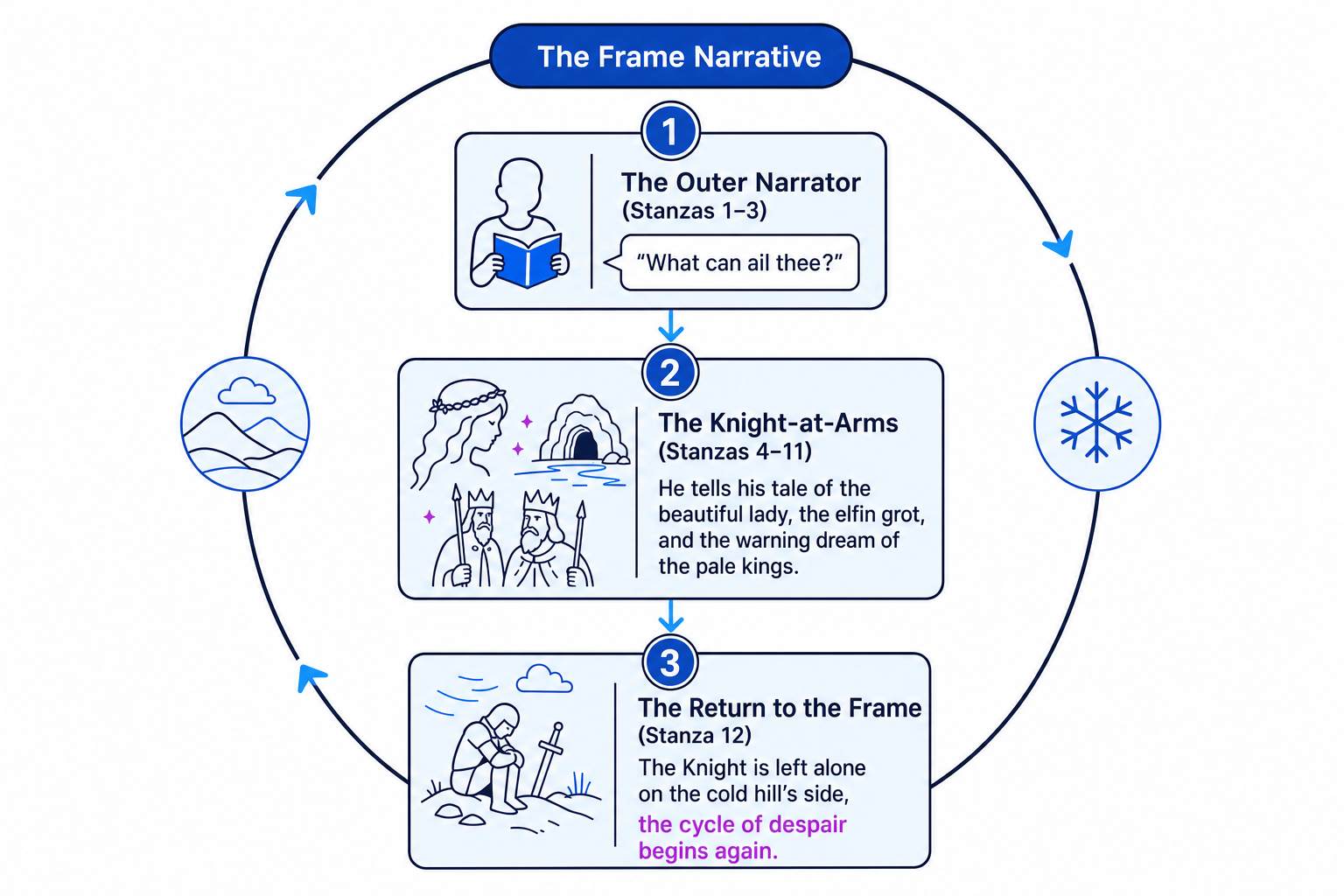
This structure is cyclical; the final stanza returns us to the bleak frame of the first three stanzas, emphasizing that the knight is permanently trapped in a loop of longing and despair.
Rhythmic Disruption
Traditional ballad stanzas use a regular rhythm alternating between iambic tetrameter (four beats) and iambic trimeter (three beats). However, Keats introduces a striking variation in the final line of each quatrain.
Iambic Tetrameter
A poetic meter consisting of four iambs (unstressed followed by stressed syllables) per line, creating a rising rhythm: da-DUM da-DUM da-DUM da-DUM.
While the first three lines of each stanza contain eight syllables (tetrameter), the fourth line is abruptly shortened—often to just four or five syllables (dimeter or trimeter). For example, look at Stanza 1:
"O what can ail thee, knight-at-arms, (8) Alone and palely loitering? (8) The sedge has withered from the lake, (8) And no birds sing." (4)
The Shortened Fourth Line
The abrupt, truncated fourth line disrupts the musical, rolling rhythm of the ballad. It acts as a structural cliff-edge, mirroring the sudden cessation of life, movement, and joy in the knight's world. It sonically reinforces the silence and stasis of the winter landscape.
3. Language and Imagery (AO2)
Keats contrasts two worlds: the sensory, fertile dreamscape of the elfin lady and the sterile, deathly reality of the cold hill's side.
The Imagery of Decay and Illness
In the opening stanzas, the external narrator notices physical signs of impending death on the knight, using natural imagery that subverts traditional symbols of love and beauty:
- "A lily on thy brow": The lily is a white flower traditionally associated with funerals and death. Instead of symbolizing purity, it denotes the pale, cold skin of a dying man.
- "A fading rose": The rose—the ultimate symbol of passion and romance—is "fast withereth too," representing the rapid decay of the knight's physical vitality and the death of his romantic ideal.
- "The sedge has withered": "Sedge" is marsh grass. Its death signals that the natural, fertile world has turned hostile and barren, a literary device known as pathetic fallacy.
The Supernatural Femme Fatale
The lady is described using highly ambiguous, ethereal imagery. She is a femme fatale—a mysterious and seductive woman whose charms snare her lovers in bonds of irreversible destruction.
Femme Fatale
A literary archetype of a female character who uses beauty, charm, and sexual allure to lure men into dangerous, compromising, or deadly situations.
Keats keeps her identity elusive:
- "A faery's child": She is linked to the supernatural, suggesting she does not belong to the mortal world.
- "Her hair was long, her foot was light, / And her eyes were wild": The word "wild" is repeated throughout the poem ("wild wild eyes"). It suggests an untamed, perilous nature that defies domesticity or human control.
- The Sensory Seduction: She feeds him "roots of relish sweet," "honey wild, and manna-dew." "Manna" is the miraculous food provided by God to the Israelites in the Bible; here, it has a sinister, addictive, and hallucinogenic quality, trapping the knight in an artificial paradise.
Misinterpreting the Lady's Villany
Do not assume the lady is simply an evil monster. Keats's depiction is highly ambiguous; she weeps ("she wept and sighed full sore"), which suggests she might also be trapped by her own nature or genuinely grieved by the inevitable tragedy of her mortal lovers. Avoid black-and-white character judgements in your essays.
4. Analysing Writer's Craft (AO2)
To score top marks in your Edexcel exam, you must construct analytical paragraphs that blend close language analysis with structural choices. Below is a worked example demonstrating how to unpack Keats's poetic methods.
Analysing structural deviation and its effect
Walk through this four-step process to construct a high-level analytical response examining how Keats uses structure and imagery to convey the knight's despair.
- Formulate a focused point: Identify how Keats uses structural variation alongside deathly imagery to show the knight's transition from romantic bliss to physical and emotional paralysis.
- Introduce precise textual evidence: Embed a quotation that demonstrates this shift, such as the transition into the dream sequence and the warning of the pale kings in Stanza 10:
"I saw pale kings and princes too, / Pale warriors, death-pale were they all; / They cried—‘La Belle Dame sans Merci / Thee hath in thrall!’"
- Analyse specific literary methods (AO2): Unpack the language and structural choices within your evidence.
- Repetition / Epizeuxis: The triple repetition of "pale" ("pale", "pale", "death-pale") creates an escalating sense of horror and morbidity, highlighting that the knight's fate is shared by other men of high status (kings, princes, warriors).
- Rhythmic Truncation: Look at the short fourth line: "Thee hath in thrall!". It contains only five syllables. The word "thrall" (meaning slavery or captivity) lands with abrupt, heavy emphasis due to this short line length, mimicking the closing shut of a trap.
- Connect to wider themes and context (AO4): Tie this to Keats's preoccupation with mortality. The physical paleness reflects Keats's own daily encounters with the ravages of tuberculosis, where victims literally lost their color and wasted away, while the spiritual "thrall" reflects the agony of unconsummated, obsessive desire.
5. Comparative Connections (AO3)
In Component 1, Section B of your Edexcel IGCSE exam, you will be required to write a comparative essay. You must compare "La Belle Dame sans Merci" with another poem from the Anthology.
Ideal Comparative Pairings
When choosing a poem to compare with Keats's ballad, look for shared themes of painful, unrequited, or destructive love, or the use of natural imagery to mirror emotional states.
- "Neutral Tones" (Thomas Hardy): Excellent for comparing the sterile, washed-out winter landscapes (pathetic fallacy) and the bitter disillusionment of love's end.
- "Remember" (Christina Rossetti): Useful for comparing how both poems treat the boundary between life, death, and memory, though Rossetti seeks selfless release whereas Keats's knight is trapped in eternal obsession.
- "A Complaint" (William Wordsworth): Great for comparing the pain of abandonment and the sudden, devastating transition from emotional abundance ("a fountain at my fond heart's door") to emotional poverty ("a comfortless and hidden well").
In the exam
- Structure your comparison balancedly: Do not write half your essay on Keats and the second half on your chosen comparative poem. Instead, use a theme-based structure where every paragraph compares the two poets' methods (AO3) side-by-side.
- Integrate AO4 naturally: Ensure that contextual points (like Keats's Romantic belief in the sublime yet terrifying power of nature, or his experience with tuberculosis) are used to explain why he wrote what he wrote, rather than dumped as biographical trivia.
- Address Form and Structure: Do not just analyze word choices. Comment explicitly on the ballad form, the ABCB rhyme scheme, and how the short fourth lines pace the reader's experience of the knight's tragedy.
Check yourself
- Why does Keats use the frame narrative structure instead of just having the knight tell his story from the very beginning?
- What is the symbolic difference between the floral imagery in Stanza 3 ("lily", "rose") and the floral imagery in Stanza 5 ("garland", "bracelets")?
- How does the repetitive use of the word "pale" in the dream sequence prepare the reader for the poem's conclusion?
