What you'll learn
- What Sujata Bhatt’s poem is about, and why language matters so deeply in it.
- How the poem’s structure moves from fear to recovery.
- How Bhatt uses metaphor, code-switching, repetition and imagery for effect.
- How to write about the poem in an Edexcel IGCSE anthology comparison.
First: what is happening in the poem?
Sujata Bhatt’s “Search For My Tongue” is about a speaker who fears she is losing her original language because she has to use another language in daily life. The poem explores what it feels like to live between languages, cultures and identities.
The speaker imagines having “two tongues in your mouth”: one is the mother tongue, and the other is the foreign tongue. At first, the mother tongue seems to “rot and die”, but during a dream it returns. By the end, it “blossoms” powerfully, suggesting that the speaker’s original language and identity cannot truly be destroyed.
Mother tongue and foreign tongue
A mother tongue is the first language someone learns, often connected with family, childhood and cultural identity. A foreign tongue is a language learned later or used in another country or culture.
Sujata Bhatt was born in Ahmedabad, India, and her first language is Gujarati. This context helps you understand the poem, but in the exam you still need to focus on the words and methods on the page.
Core meaning
The poem presents language as part of the self: losing a language feels like losing part of your body, but memory, dreams and identity help it grow back.
The title: “Search For My Tongue”
The title immediately creates a puzzle. A tongue is both a physical body part and a word for language. This double meaning is central to the poem.
The word “Search” suggests that the speaker has not simply forgotten something small. She is actively looking for a lost part of herself. The title therefore prepares us for a poem about identity, memory and recovery.
Voice and situation
The poem is written in the first person, meaning the speaker uses “I” and presents personal experience directly. It also uses direct address, where the speaker speaks to “you”. This makes the poem feel conversational, as though the speaker is explaining the experience to someone who does not understand.
The opening line, “You ask me what I mean”, suggests that the speaker has been challenged or misunderstood. Bhatt then turns the poem into an explanation of what language loss feels like from the inside.
Form and structure
Form and structure
Form means the overall type and shape of a poem, including features like rhyme, rhythm and layout. Structure means how the poem is organised: the order of ideas, shifts, contrasts and turning points.
“Search For My Tongue” is written in free verse, meaning it does not follow a regular rhyme scheme or fixed metre. Metre is a repeated pattern of stressed and unstressed syllables. The loose form suits the speaker’s uncertain, flowing thoughts.
The poem has three main movements: the fear of losing the mother tongue, the dream sequence in Gujarati, and the final image of the language growing back.
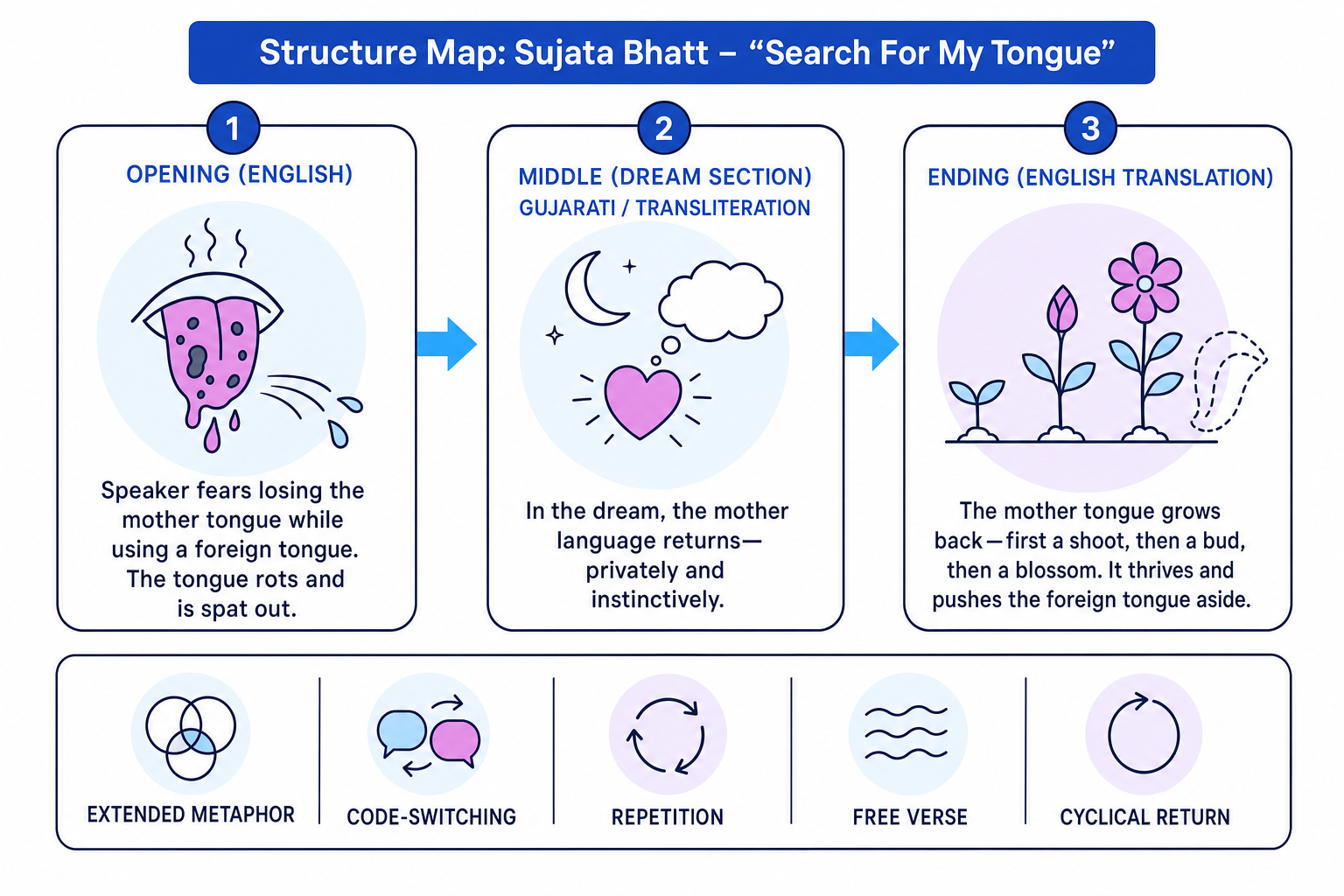
Tracking the structural shift
- The opening is in English and uses a tense hypothetical situation: “what would you do / if you had two tongues”. This presents bilingual identity as a problem or conflict.
- The middle shifts into Gujarati transliteration, so the poem’s form enacts the return of the mother tongue instead of merely describing it.
- The ending returns to English, but now English carries images of growth: “bud”, “shoot” and “blossoms”. This shows that the speaker has moved from fear of loss to confidence in renewal.
Code-switching and the Gujarati section
Code-switching
Code-switching means moving between two languages, dialects or ways of speaking within the same conversation or text.
Bhatt’s most distinctive method is the shift from English into Gujarati transliteration. Transliteration means representing the sounds of one language using the letters of another writing system.
This matters because the poem does not just tell us the speaker has two languages. It makes the reader experience that shift. If you do not understand Gujarati, you briefly feel excluded or uncertain. That can help English-speaking readers understand how disorientating language difference can be.
The Gujarati section appears during the dream. This suggests the mother tongue belongs to a deeper, more instinctive part of the speaker’s mind. It returns when conscious control is relaxed.
Treating Gujarati as a decorative extra
Do not say the Gujarati section is just there to “make the poem exotic”. It is structurally central: it proves that the mother tongue is alive and returning from within the speaker.
Extended metaphor: the tongue as body and plant
Extended metaphor
A metaphor describes one thing as if it is another. An extended metaphor continues that comparison across several lines or a whole text.
Bhatt extends the metaphor of language as a living tongue. In the opening, the mother tongue may “rot and die in your mouth”. This is disturbing because language loss becomes physical decay. The reader is made to feel that cultural loss is painful, intimate and almost violent.
Later, the metaphor changes. The lost tongue “grows back” like a plant. It becomes “a stump of a shoot”, then “the bud opens”, and finally “it blossoms out of my mouth”. This change from decay to flowering creates a movement from fear to renewal.
Analysing body imagery
- The phrase “rot and die in your mouth” turns language into flesh, so forgetting a language feels like bodily damage rather than ordinary forgetting.
- The verbs “rot” and “die” create a harsh, unpleasant image, making the reader sense the speaker’s anxiety and disgust.
- This makes the later plant imagery more powerful: when the language “blossoms”, it feels like a reversal of death and a recovery of identity.
Repetition and growth
Bhatt repeats forms of the verb “grows”: “grows back”, “grows longer”, “grows moist”, “grows strong veins”. This repetition makes the return of the mother tongue feel unstoppable and organic.
The phrase “the bud opens” is also repeated. This slows the moment down, as though the reader is watching the language unfold. The mother tongue does not return all at once; it develops naturally.
A useful AO2 sentence frame
Bhatt’s repetition of “grows” suggests that the mother tongue is not dead but living and regenerative, so language becomes a symbol of identity’s resilience.
Tone: from anxiety to triumph
Tone
Tone is the attitude or emotional mood created by the speaker’s voice and the writer’s language choices.
The tone begins as defensive and anxious. The speaker seems to be explaining herself to someone who may not understand: “You ask me what I mean”. The violent image of the tongue rotting creates fear and disgust.
During the dream, the tone becomes more private and intimate. By the end, it is more triumphant. The final image, “it blossoms out of my mouth”, suggests beauty, confidence and self-expression.
Themes
Language and identity
The poem shows language as inseparable from identity. The mother tongue is not just a communication tool; it is linked to memory, family and selfhood.
Cultural displacement
The “foreign tongue” suggests pressure to adapt to a different society. The poem recognises that bilingual people may feel divided between cultures.
Memory and survival
The dream shows that the mother tongue survives beneath the surface. Even when the speaker thinks it is lost, it returns.
Conflict and power
The poem does not present the two languages as peacefully balanced. The mother tongue “ties the other tongue in knots” and “pushes the other tongue aside”. This suggests a struggle for space inside the speaker’s mouth and identity.
Saying the poem rejects English completely
The poem is written mostly in English, so it cannot simply be anti-English. It is more precise to say Bhatt explores the pressure of using a foreign language and the resilience of the mother tongue.
Key quotations to learn
Because Component 1 Section B is closed book, memorise short, accurate quotation fragments rather than long chunks.
| Quotation | Method | What it suggests |
|---|---|---|
| “lost my tongue” | Metaphor | Language loss feels like losing part of the body. |
| “two tongues in your mouth” | Extended metaphor | Bilingual identity is presented as physically awkward and conflicted. |
| “mother tongue” / “foreign tongue” | Contrast | The poem separates emotional belonging from external pressure. |
| “rot and die in your mouth” | Violent body imagery | The fear of cultural loss feels painful and degrading. |
| “overnight while I dream” | Structural turning point | The mother tongue returns through the unconscious mind. |
| “grows back” | Plant imagery | The language is living and regenerative. |
| “ties the other tongue in knots” | Personification-like metaphor | The mother tongue becomes active and powerful. |
| “it blossoms out of my mouth” | Final image / symbolism | Identity and language return beautifully and confidently. |
Comparing the poem for AO3
In Edexcel anthology poetry, AO2 rewards your analysis of language, form and structure, while AO3 rewards connections between poems. For “Search For My Tongue”, the strongest comparison areas are usually:
- identity and belonging
- cultural conflict or displacement
- memory and the past
- the power of voice or self-expression
- internal conflict shown through imagery and structure
When comparing, avoid writing one paragraph on Bhatt and then a completely separate paragraph on another poem. Instead, make the link clear from the start: both poets may explore identity, but Bhatt does it through bilingual form and the physical metaphor of the tongue.
Building a comparison point
- Choose the shared theme first, such as identity under pressure.
- For Bhatt, connect the theme to method: the switch into Gujarati makes divided identity visible in the poem’s structure.
- Then compare the effect: Bhatt presents identity as something that can be threatened but naturally returns, especially through the final image of blossoming.
In the exam
- Use short quotation fragments accurately, such as “rot and die”, “grows back” and “blossoms”.
- Always connect method to meaning: do not just name “metaphor” or “code-switching”; explain what it makes the reader understand about language and identity.
- For comparison, start with a clear link between poems, then show how Bhatt’s methods are similar to or different from the other poet’s methods.
- Remember that Component 1 is closed book, so revise flexible quotations that can work for identity, conflict, memory and belonging questions.
Check yourself
- How does the word “tongue” work in two different ways throughout the poem?
- Why is the Gujarati section important to the poem’s structure, not just its content?
- Which three quotations would you use for a question about identity or belonging?
