Welcome to your study notes for "Blessing" by Imtiaz Dharker. This beautiful, sensory poem is a core part of your Pearson Edexcel International GCSE English Literature Anthology (Part 3).
In your exam (Component 1, Section B), you will be asked to compare one named poem from the anthology with another poem of your choice from the same collection. To do this successfully, you need a deep, secure understanding of how each poet uses language, form, and structure to convey their central ideas.
What you'll learn
- The literal and metaphorical meaning of the poem.
- How Dharker uses free verse and structural shifts to mirror the movement of water.
- The way religious, metallic, and sensory imagery transforms a scene of poverty into a celebration of abundance.
- How to construct a high-level comparative analysis for your exam.
1. Understanding the Poem: Meaning and Setting
Before we dive into the technical devices, let’s make sure you fully grasp the narrative arc of "Blessing".
The poem is set in an impoverished settlement (often associated with the slums of Mumbai, India, where Dharker has spent much of her life). In this hot, dry environment, water is not a utility on tap; it is a scarce, precious commodity.
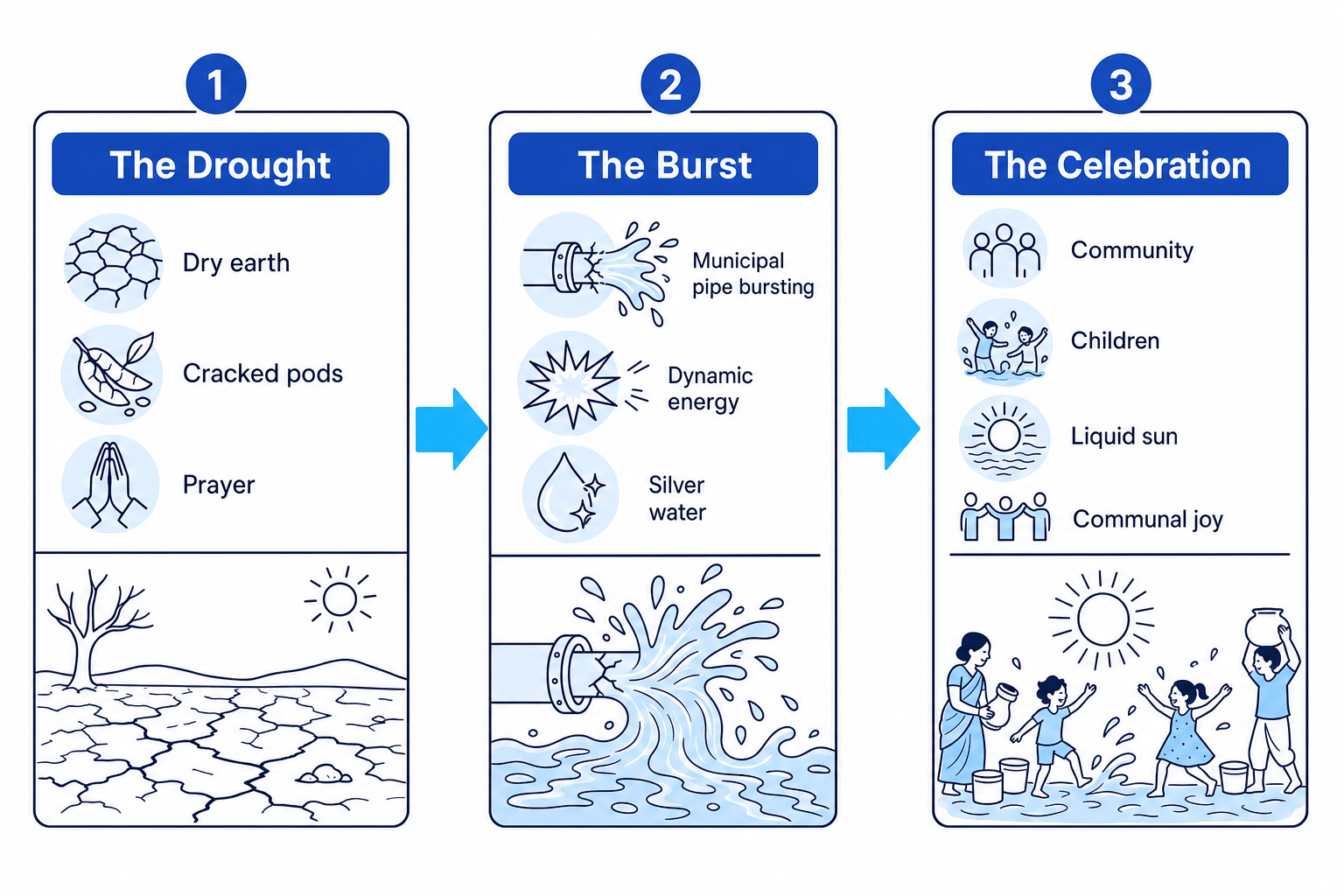
The poem moves from a state of painful drought to a moment of sudden, chaotic abundance when a municipal water pipe bursts. The local community rushes to collect the water in whatever vessels they can find. What begins as a depiction of struggle ends in a communal, almost spiritual celebration.
Municipal
Municipal refers to something relating to a town, city, or its local governing government. In this poem, the "municipal pipe" is the city's main water supply infrastructure that bypasses the poor settlement, making its burst deeply ironic and fortunate.
2. Form and Structure: The Flow of Water
One of Dharker’s greatest achievements in "Blessing" is how the shape of the poem on the page mirrors the action of the water. This is a crucial area for your AO2 (Analysis of Form and Structure) marks.
Free Verse and Variable Stanza Lengths
The poem is written in free verse (it has no regular rhyme scheme or meter). Why? Because regular, rigid stanzas would feel like a prison or a tight pipe. Free verse allows the lines to flow, splash, and spill across the page, just like the escaping water.
If you look closely at the stanzas, they mimic the event:
- Stanzas 1 and 2 are short and sparse (4 and 2 lines). This reflects the lack of water—the drought. The lines are dry and restricted.
- Stanza 3 is a single, dramatic line: "Suddenly the municipal pipe bursts." This abrupt line breaks the drought, mimicking the sudden physical crack of the pipe.
- Stanza 4 is a long, rushing 11-line stanza. It is packed with energy, movement, and people. The structure itself has flooded with life.
Enjambment
Dharker makes frequent use of enjambment (where a sentence runs over from one line or stanza to the next without terminal punctuation).
Enjambment
Enjambment is the continuation of a sentence without a pause beyond the end of a line, couplet, or stanza. In poetry, it is often used to create a sense of continuous movement, speed, or uncontrolled flow.
In "Blessing", enjambment is used to represent the unstoppable rush of the water as it gushes from the pipe and flows through the streets. It prevents the reader from pausing, pulling us into the frantic rush of the community.
Structure Mirrors Content
Always argue that the physical structure of "Blessing" is organic. It doesn't follow a pre-made template; instead, it expands and flows to match the physical state of the water, moving from dry restriction to wet, chaotic freedom.
3. Language and Imagery: The Alchemy of Water
To elevate your essays, you must analyze how Dharker’s language elevates water from a simple chemical compound (H2OH_2OH2O) into something holy and infinitely valuable. She does this through three main types of imagery: religious, metallic/wealth, and sensory.
The Religious Frame
The title "Blessing" immediately frames the event through a spiritual lens. Water is not just a resource; it is a divine gift.
- "the voice of a kindly god" (Stanza 2): The sound of a dripping tap is personified as a benevolent deity, emphasizing how desperately the people pray for rain or water.
- "congregation" (Stanza 4): The crowd gathering around the burst pipe is described not as a mob, but as a church congregation. This word transforms the chaotic street into a sacred space of worship.
The Imagery of Wealth (Metaphor and Alchemy)
Dharker uses the semantic field of money and precious metals to show how valuable water is to those who have nothing.
- "silver crashes to the ground" (Stanza 3): The water is directly compared to silver.
- "the sudden silver" (Stanza 4): The repetition of "silver" reinforces its precious, gleaming quality.
- "flow has found / a roar of tongues" (Stanza 4): Notice the wealth of internal rhyming and assonance here.
- "brass, copper, aluminium, plastic buckets, frantic hands" (Stanza 4): The list of containers moves from traditional, valuable metals (brass, copper) to cheap modern materials (plastic). In this moment, however, they are all equalized because what they hold is more valuable than any metal.
- "liquid sun" (Stanza 4): This stunning metaphor turns the water into light and gold, suggesting warmth, life, and celestial beauty.
Sensory Contrast
The poem relies on a stark contrast between dry, quiet pain and wet, noisy joy.
- The Dryness (Stanzas 1-2): "skin cracks like a pod". This simile compares human skin to a dried seed pod, suggesting intense dehydration and a loss of humanity—people are reduced to parched vegetation. There is "never enough to cry", showing that dehydration has even stolen their ability to express grief.
- The Wetness (Stanzas 3-4): Suddenly, the auditory imagery explodes. We hear the "splash", the "clatter", and the "crashes". The harsh, quiet drought is replaced by a symphony of metallic sounds as containers collide.
4. Analytical Application
Let's look at how to pull these language and structural points together into a high-scoring analytical paragraph. In your Edexcel exam, you need to show a clear chain of analysis: Point →\rightarrow→ Evidence →\rightarrow→ Method →\rightarrow→ Analysis of Effect.
Analyzing language and imagery in Blessing
Analyze how Imtiaz Dharker conveys the precious nature of water in "Blessing".
- Formulate your point: Dharker conveys the immense value of water by using metaphorical language that transforms the natural element into a form of divine, material wealth.
- Provide precise evidence: This is most vivid when the municipal pipe bursts and the water is described as "silver" crashing to the ground, which the children then chase as "liquid sun."
- Identify the methods: The writer employs metaphors ("silver", "liquid sun") alongside dynamic verbs ("crashes") and sensory imagery.
- Analyze the effect deeply (AO2): By characterizing the water as "silver" and "liquid sun", Dharker performs a poetic alchemy, transforming a basic necessity into precious metals and celestial light. The verb "crashes" provides a sharp auditory and kinetic contrast to the quiet, parched drought of the opening stanzas, signaling an explosion of energy. Describing the children as soaking in "liquid sun" suggests that the water does not just clean or sustain them, but physically illuminates and blesses them, temporarily washing away the bleakness of their poverty.
5. Key Themes and Comparative Connections
When preparing for the Section B comparative essay (AO3), you must know which themes "Blessing" explores so you can pair it effectively with other poems.
| Theme | How it appears in "Blessing" | Potential Comparative Poems (Anthology Part 3) |
|---|---|---|
| Scarcity vs. Abundance | The transition from the painful drought ("skin cracks") to the overwhelming rush of the burst pipe. | "What Were They Like?" (loss of culture/nature) or "Khalfan's Bronze" |
| Community and Joy | The way the disaster of a broken pipe unites the "congortion" in shared, chaotic play. | "Search for My Tongue" (personal identity/community roots) |
| Power of Nature / Divine | Water is treated as a "blessing" from a "kindly god," essential for survival. | "Wind" (nature's raw power) or "The Tyger" (divinity in nature) |
The Metaphor of the Children's Bodies
In the final stanza, Dharker writes about the children: "their thin bones cracks / show through his busy sparks of light / as the blessing sings over their small bones." Don't miss this! Even in their moment of absolute joy, the children are still "thin-boned"—their poverty and hunger have not disappeared. The "blessing" of water is beautiful, but temporary.
Ignoring the Undercurrent of Poverty
A common error is writing that this poem has a purely happy, celebratory ending. Do not ignore the stark reality: the community is still impoverished, the children are still "thin-boned", and they are still dependent on a broken, corrupt infrastructure ("municipal pipe") for their survival. The joy is real, but it is fleeting.
In the exam
To maximize your marks on "Blessing" in your Edexcel IGCSE paper:
- Structure your comparison logically: Do not write about "Blessing" for half your essay and then the second poem for the other half. Instead, use a theme-based structure. Compare how both poets use language to show scarcity in paragraph one, how they use form in paragraph two, and how they present community/humanity in paragraph three.
- Weave AO2 and AO3 together: Whenever you compare a point of meaning between the two poems, immediately contrast how that meaning is delivered. For example: "While Dharker uses free verse to mimic the chaotic flow of water in 'Blessing', [Poet X] uses a strict, repetitive stanza structure to convey the inescapable nature of..."
- Analyze the title: Always comment on how the title "Blessing" sets up a spiritual expectation that is fulfilled by the mundane, physical reality of municipal water.
- Use micro-quotations: Instead of quoting whole lines, integrate single words into your sentences (e.g., Dharker describes the water as "silver", "liquid sun", and a "singing" blessing). This keeps your writing sharp and analytical.
Check yourself
Before moving on to another poem, make sure you can answer these questions:
- Why does Dharker use a one-line stanza ("Suddenly the municipal pipe bursts.") right in the middle of the poem?
- What does the simile "skin cracks like a pod" suggest about the physical impact of the drought on human beings?
- How does the word "congregation" alter our view of the crowd gathering around the water?
- Why does the poet mention that the children's "thin bones" are still visible under the "sparks of light"?
