What you'll learn
- How U A Fanthorpe presents childhood experience and adult authority.
- How the poem contrasts clock time with a child’s more emotional, imaginative sense of time.
- How form, structure, capitalisation, and invented words create meaning.
- How to write about this poem for Edexcel IGCSE anthology comparison, using AO2 and AO3.
Big picture: what happens in the poem?
“Half-past Two” is a narrative poem about a young child who is punished at school and told to stay in the classroom until “half-past two”. The problem is that he has not yet been taught how to read clock time, so the instruction means very little to him.
At first, this seems comic and simple. But the poem becomes more mysterious: because the child cannot understand adult time, he temporarily “escapes” into a timeless, sensory world. When the teacher remembers him, she puts him back into ordinary “schooltime”, but he never forgets that strange experience.
Narrative poem
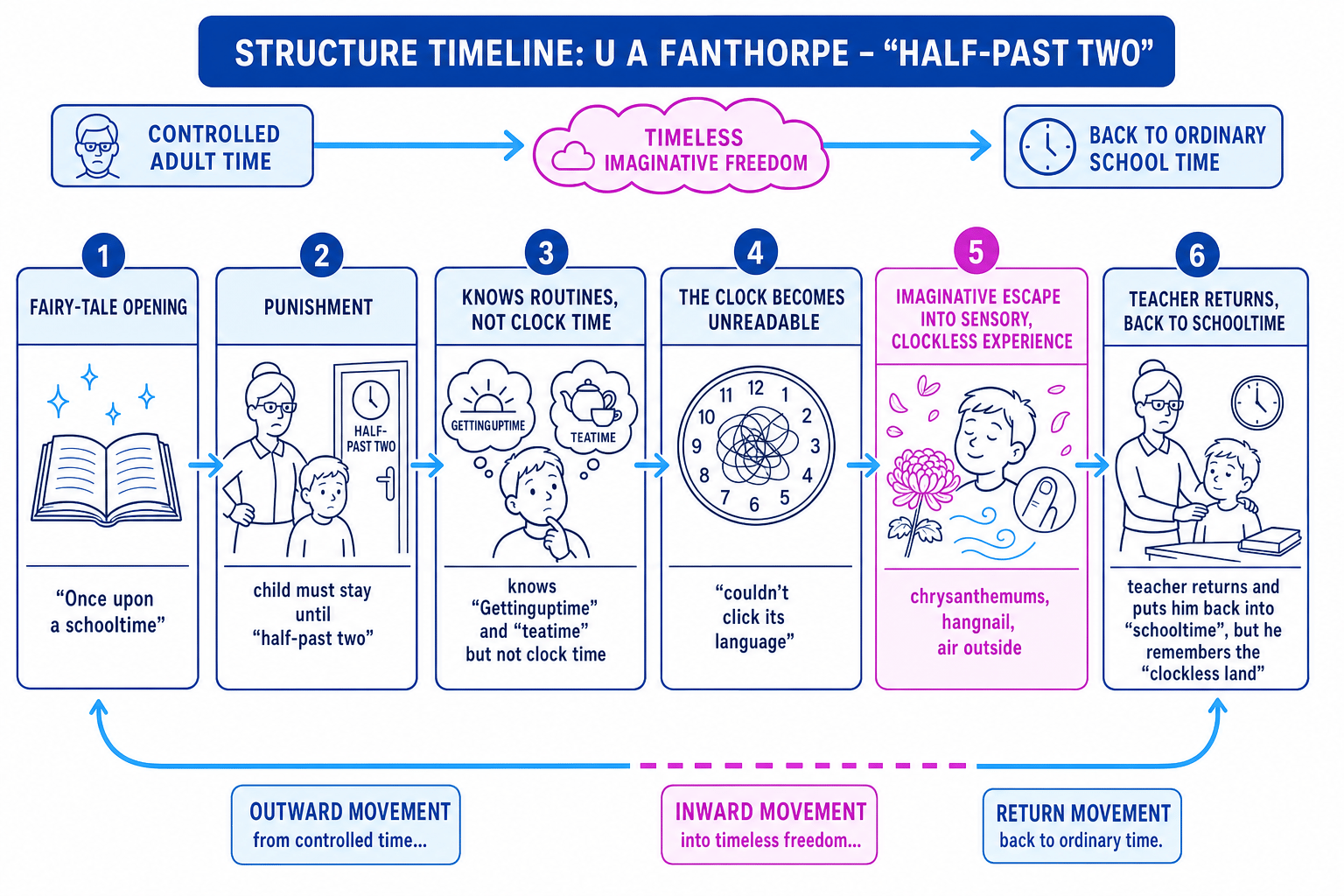
A narrative poem tells a story. “Half-past Two” has a clear sequence: wrongdoing, punishment, confusion, escape into timelessness, return to ordinary life, and lasting memory.
The timeline below shows the poem’s movement from ordinary school rules into imaginative freedom, then back again.
Core meaning
Fanthorpe suggests that children may experience time in a richer, stranger way than adults. The child’s ignorance of “half-past two” becomes not just a problem, but a doorway into imagination and wonder.
The title: “Half-past Two”
The title sounds ordinary and precise. It belongs to the adult world of clocks, school timetables, punishments, and rules. However, for the child, “half-past two” is meaningless because he has not learned to connect the clock face with the idea of time.
This creates a central contrast: adults assume time is obvious, but the child experiences time through routines, feelings, and relationships.
Form and structure
Free verse
Free verse is poetry without a regular rhyme scheme or fixed metre. Fanthorpe uses free verse so the poem can sound like remembered speech and childlike thought rather than a strict, controlled song.
The poem is written in short stanzas, mostly three lines long. This gives it a neat, classroom-like appearance, but the language inside often behaves playfully and unpredictably. That contrast matters: the school tries to organise the child, but his inner experience slips beyond the rules.
The poem begins with “Once upon a schooltime”, a twist on the fairy-tale phrase “Once upon a time”. This immediately mixes childhood storytelling with institutional school life.
Structure
Structure means how a text is organised: its order of events, stanza pattern, shifts in focus, openings, endings, and repetitions.
The structure is almost circular. The child starts in “schooltime”, escapes into a “clockless land”, then is “slotted” back into ordinary time. But it is not a simple return, because the final lines show that the experience has changed him: “he never forgot”.
Linking structure to meaning
- Notice the starting point: “Once upon a schooltime” places the child inside school rules, but also inside a fairy-tale mode where strange things can happen.
- Track the shift: when he cannot read “half-past two”, he moves “Out of reach of all the timefors”, suggesting that adult time loses power over him.
- Compare the ending with the beginning: he is returned to “schooltime”, but the memory of the “clockless land” remains, so the structure shows both control and escape.
Calling it only a funny poem
The poem is playful, but it is not only comic. The humour leads into serious ideas about childhood, fear, adult authority, imagination, and the way time controls human life.
Language: a child’s view of time
Fanthorpe uses invented compound words such as “Gettinguptime”, “Timetogohomenowtime”, and “Timeformykisstime”. These words show that the child understands time through experiences, not numbers.
Neologism
A neologism is a newly invented word. Fanthorpe’s joined-up time words imitate how a child might label the day according to routines and feelings.
The invented words are funny, but they are also moving. “Timeformykisstime” links time with affection and family, especially because it is followed by “that was Grantime”. To the child, “Grantime” is more meaningful than “half-past two” because it belongs to love and habit.
Child time versus adult time
Adult time is abstract, measured, and rule-based. Child time is concrete, emotional, and personal: meals, television, going home, and being kissed.
Capitalisation and authority
The poem capitalises phrases such as “Something Very Wrong”, “She”, “Her”, and “Time”. This is not accidental.
Capitalisation as a method
Capitalisation means using capital letters. In literature, unusual capitalisation can make words seem more important, powerful, official, or strange.
“Something Very Wrong” turns the child’s offence into a huge moral event, even though the narrator says, “I forget what it was”. This gap is important: the adult narrator cannot remember the wrongdoing, but the child remembers the emotional force of being told he was “wicked”.
The teacher becomes “She”, with a capital letter. This makes her seem enormous and powerful in the child’s eyes, almost like a figure from myth or religion rather than an ordinary adult.
Analysing capitalisation
- Choose a precise quotation: “Something Very Wrong” is stronger than simply saying the child misbehaved.
- Identify the method: the capital letters exaggerate the seriousness of the offence.
- Explain the effect: Fanthorpe shows how adult judgement can feel frighteningly large to a child, even when the actual mistake is forgotten.
Imagery: the clock as a strange creature
The child knows “the clockface”, but not how to interpret it. Fanthorpe describes the clock’s hands as “little eyes / And two long legs for walking”. This makes the clock seem like a living creature.
Personification
Personification gives human or living qualities to something non-human. Here, the clock seems to have a body, but its meaning remains unreadable to the child.
The phrase “he couldn’t click its language” is especially important. The verb “click” suggests both understanding and the ticking/clicking of a clock. The clock has a “language”, but it is one the child has not been taught.
This makes adult time seem like a code. If you have not learned the code, you are excluded from the system.
The “clockless land”
When the child waits, he moves “beyond onceupona” and “Out of reach of all the timefors”. Fanthorpe turns not knowing the time into a kind of escape. The classroom becomes strange and heightened.
The sensory imagery is vivid: “the smell of old chrysanthemums”, “the silent noise his hangnail made”, and “the air outside the window”. These details show the child becoming intensely aware of small sensations.
Oxymoron
An oxymoron places contradictory words together. “Silent noise” is an oxymoron because silence and noise usually oppose each other.
“Silent noise” captures the child’s heightened awareness: in the quiet classroom, even tiny sensations seem loud. The phrase also suggests that this experience is hard to explain using ordinary adult language.
The final image, “Where time hides tick-less waiting to be born”, personifies time as something not yet active. “Tick-less” suggests a world before clocks, measurement, and adult rules.
Tone
Tone
Tone is the attitude or feeling created by the writer’s language. It can shift during a poem.
The tone begins playfully, especially with “Once upon a schooltime” and the comic invented words. It also has a gentle, nostalgic quality, as if an adult is remembering childhood.
However, there is unease too. The child is “too scared at being wicked” to remind the teacher that he cannot tell the time. Fanthorpe shows how small adult actions can feel frightening and absolute to children.
By the end, the tone becomes magical and reflective. The child’s punishment accidentally gives him a glimpse of freedom from clock time.
Key quotations to learn
| Quotation | Method | Effect |
|---|---|---|
| “Once upon a schooltime” | Fairy-tale echo / wordplay | Blends childhood imagination with school routine. |
| “Something Very Wrong” | Capitalisation | Shows how huge and frightening the offence feels to the child. |
| “She hadn’t taught him Time” | Capitalisation / irony | The teacher punishes him using knowledge he does not yet have. |
| “Gettinguptime” | Neologism | Shows the child understands time through routines. |
| “he couldn’t click its language” | Metaphor / pun | Presents clock time as a code the child cannot decode. |
| “Out of reach of all the timefors” | Invented language | Suggests escape from adult demands and schedules. |
| “silent noise” | Oxymoron | Captures heightened sensory awareness in the quiet classroom. |
| “slotted him back into schooltime” | Metaphor | Makes school time seem mechanical and controlling. |
| “clockless land” | Metaphor | Presents timelessness as imaginative freedom. |
Closed-book quotation strategy
For Component 1 Section B, you will not have the anthology in front of you. Learn short, flexible quotations like “Something Very Wrong”, “clockless land”, and “tick-less waiting to be born” because they can support several points.
Themes
Childhood and innocence
The child is not stupid; he simply has a different understanding of the world. Fanthorpe respects the child’s perspective by showing that his “mistake” leads to a profound imaginative experience.
Adult authority
The teacher is not presented as cruel, but she is careless. She forgets that “She hadn’t taught him Time” and later says, “I forgot all about you.” The repetition of forgetting suggests adult systems can overlook children’s needs.
Time and control
The poem questions whether measured clock time is the only valid kind of time. School depends on timetables, but the child’s experience shows a freer, more mysterious version of time.
Imagination and memory
The child’s escape is temporary, but it stays with him. The line “he never forgot” makes memory central: a brief moment of confusion becomes a lifelong imaginative insight.
Writing about the poem in comparison
For AO3, you need to compare “Half-past Two” with another anthology poem. Do not just say both poems are “about childhood” or “about time”. Compare how the poets present their ideas.
For example, you might compare whether another poem presents childhood as safe, painful, powerful, confusing, or lost. With Fanthorpe, your strongest angle is that childhood confusion becomes imaginative freedom.
In the exam
- Start with a clear argument about the poem’s main contrast: adult clock time versus the child’s personal, imaginative time.
- Use short quotations accurately, then analyse methods such as neologism, capitalisation, metaphor, oxymoron, and structure.
- For comparison, link ideas and methods: explain how Fanthorpe’s playful language creates a different effect from the other poet’s choices.
Check yourself
- Why is “half-past two” meaningless to the child, and why does that matter?
- How do Fanthorpe’s invented words show the child’s understanding of time?
- What is the effect of the final image, “time hides tick-less waiting to be born”?
