What you'll learn
- What a theme is, and how to turn it into a strong argument.
- The main themes in Romeo and Juliet: love, hate, fate, family, youth, gender and death.
- How Shakespeare develops themes through language, form and structure.
- How to write about themes in an Edexcel IGCSE Component 2 essay.
First: what is a theme?
Theme
A theme is a big idea explored across a text. In an essay, you should go beyond naming the theme and explain what Shakespeare seems to suggest about it.
So, “love” is not yet a full point. A stronger thematic argument would be:
Shakespeare presents love as powerful and sincere, but dangerously vulnerable in a society ruled by hatred, family honour and violence.
That gives you something to prove using quotations, methods and context.
Themes are connected
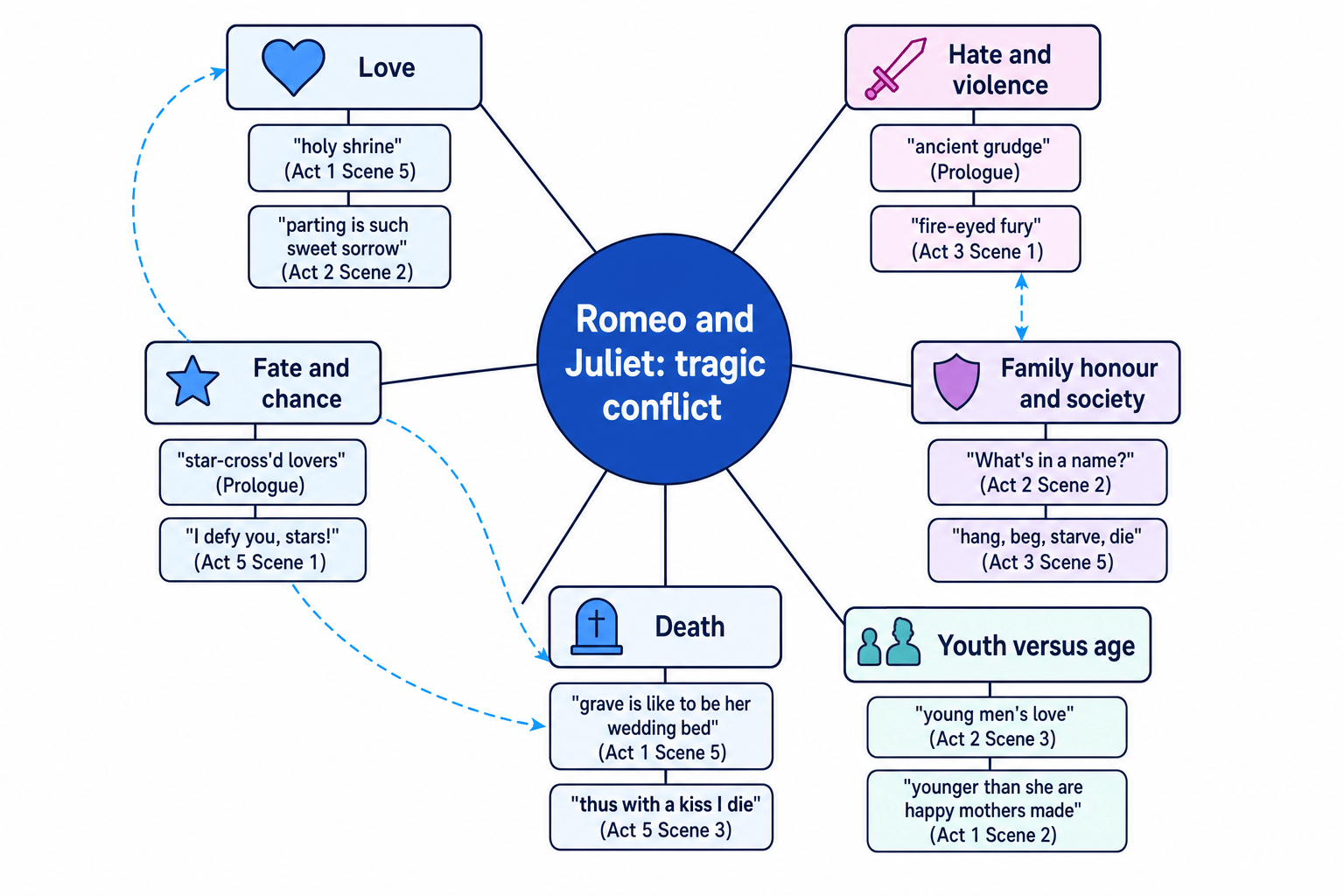
The best answers do not treat themes as separate boxes. In Romeo and Juliet, love is tied to death, family is tied to violence, and fate is tied to human choices.
Use this theme web as a starting map: it shows how the biggest ideas overlap rather than sitting separately.
How Shakespeare builds themes
Shakespeare develops themes through language, form and structure. Language means the words and images he chooses. Form means the type or shape of writing, such as a sonnet or soliloquy. Structure means the order of events and how the play is arranged.
A motif is a repeated image, idea or pattern. For example, stars, light, darkness, poison and death all become motifs in the play.
Foreshadowing is when the writer hints at what will happen later. Dramatic irony is when the audience knows more than the characters. Both are crucial in Romeo and Juliet, because the Prologue tells us from the start that the lovers will die.
Tracing love and death through structure
-
The Prologue calls Romeo and Juliet “star-cross’d lovers” and says they “take their life”, so the audience watches their love story already knowing it will end in death.
-
In Act 1 Scene 5, Juliet says, “My grave is like to be my wedding bed” before she even knows Romeo is a Montague. Shakespeare fuses marriage and death, making love feel doomed from its beginning.
-
In Act 5 Scene 3, Romeo says, “Thus with a kiss I die.” The structure completes the pattern: the kiss, which first symbolised love, becomes the action linked to death.
Love: sacred, sudden and dangerous
At first, Romeo’s love for Rosaline seems exaggerated and self-pitying. He uses oxymorons, which are phrases joining contradictory ideas: “O brawling love! O loving hate!” This shows his idea of love is confused and artificial.
His love for Juliet is different. When Romeo and Juliet meet in Act 1 Scene 5, they share a sonnet, a fourteen-line poem traditionally associated with love. Their lines fit together, suggesting harmony and mutual attraction. Romeo calls Juliet a “holy shrine”, using religious imagery, which means language connected with religion. This makes their physical attraction seem pure and spiritual.
A semantic field is a group of words linked by meaning. In this scene, the religious semantic field includes “shrine”, “pilgrim”, “saints” and “prayer”. Shakespeare makes their love feel sacred, but also risky: they are treating romantic desire with the intensity of worship.
Analysing the shared sonnet
-
Romeo’s phrase “holy shrine” turns Juliet into something sacred, so his desire is presented as worship rather than simple physical attraction.
-
Because Romeo and Juliet complete a sonnet together, Shakespeare uses form to show that they are intellectually and emotionally matched.
-
However, the speed of the sonnet also matters: they move from first meeting to kissing within moments. This supports Juliet’s later fear that their love is “too rash, too unadvised, too sudden”.
Friar Laurence warns them: “These violent delights have violent ends.” Shakespeare therefore presents love as beautiful but extreme. The tragedy is not simply that Romeo and Juliet love each other; it is that their love exists inside a violent world that gives them no safe time or space.
Writing that love is only positive
Do not write that Shakespeare presents love as simply “good”. Romeo and Juliet’s love is genuine, but Shakespeare repeatedly links it to haste, secrecy, danger and death.
Hate, violence and masculine honour
The play begins with public violence. The Prologue mentions an “ancient grudge”, suggesting the feud is old, inherited and perhaps irrational. Nobody seems able to explain exactly why the Montagues and Capulets hate each other.
The phrase “civil blood makes civil hands unclean” is important. “Civil” can mean connected to citizens or society, but it also suggests politeness and order. Shakespeare shows a city that should be civilised becoming stained by violence.
Tybalt represents aggressive masculine honour. When he sees Romeo at the Capulet feast, he says, “This, by his voice, should be a Montague.” He treats Romeo’s presence as an insult, not a chance for peace. Later, he calls Romeo a “villain”, forcing Romeo into a public conflict even though Romeo secretly loves him as Juliet’s cousin.
Connecting violence to society
-
The “ancient grudge” shows that hatred is inherited from the older generation, so the young men are born into conflict.
-
Tybalt’s insult “villain” shows how quickly language becomes a challenge to honour. In this world, being publicly shamed can lead to violence.
-
Mercutio’s curse, “A plague o’ both your houses!”, widens the blame. Shakespeare suggests the whole social system of family rivalry is diseased, not just one character.
AO4 context matters here. In Shakespeare’s early modern society, male honour and family reputation were taken very seriously, especially among powerful households. But do not bolt context onto the end of a paragraph. Link it directly to Shakespeare’s meaning: the feud shows how social codes can destroy private happiness.
Fate and chance
Fate
Fate means the idea that events are controlled by a power beyond human choice. In the play, Shakespeare balances fate with accident, timing and personal decisions.
The Prologue describes the lovers as “star-cross’d”, referring to the belief that stars could influence human lives. This creates a sense that Romeo and Juliet are doomed before they begin.
But Shakespeare does not remove responsibility from the characters. Romeo chooses to attend the Capulet party. Tybalt chooses violence. Friar Laurence chooses a risky plan. The tragedy comes from fate and human error working together.
Romeo’s cry “I defy you, stars!” in Act 5 Scene 1 is especially tragic. He thinks he is rebelling against fate, but his decision to return to Verona helps fulfil the ending the Prologue predicted.
Analysing fate without ignoring choice
-
“Star-cross’d lovers” frames the play as doomed, so the audience expects disaster and notices every warning sign.
-
Romeo’s “I defy you, stars!” personifies fate as something he can fight. Personification means giving human qualities to something non-human or abstract.
-
The irony is that Romeo’s attempt to resist fate leads him towards Juliet’s tomb. Shakespeare makes fate feel powerful, but he also shows how impulsive choices speed it up.
Family, obedience and gender
Patriarchy
A patriarchy is a society or family system in which men hold most of the authority. In Romeo and Juliet, fathers, husbands and male relatives expect obedience.
Juliet’s conflict is not only romantic; it is social. She is expected to obey her father and marry Paris. At first, Capulet seems protective, saying Juliet is “yet a stranger in the world”. Later, when she refuses Paris, he becomes threatening: “hang, beg, starve, die in the streets.”
This sharp change shows how conditional his care is. Juliet is valued as a daughter while she obeys; when she resists, she is treated as property that has rebelled.
Juliet’s question “What’s in a name?” challenges the importance of inherited identity. She understands that “Montague” and “Capulet” are labels, not the true essence of Romeo or herself. Shakespeare presents her as thoughtful and brave, but trapped in a society where names control lives.
Using context for Juliet’s position
-
Juliet’s refusal to marry Paris creates conflict because early modern daughters were generally expected to obey their fathers, especially in wealthy families.
-
Capulet’s threat “hang, beg, starve, die” shows that patriarchal power is not abstract; it can become economic and physical punishment.
-
Juliet’s “What’s in a name?” therefore becomes more than a romantic line. It questions a society where family identity matters more than individual feeling.
Youth and age
The younger characters act quickly, intensely and emotionally. Romeo and Juliet marry after knowing each other for a very short time. Juliet herself recognises the danger when she calls their love “too rash, too unadvised, too sudden”.
However, the older generation is not presented as wise enough to prevent disaster. The Prince fails to stop the feud until it is too late. Capulet becomes controlling. The Nurse gives practical but morally weak advice when she tells Juliet to marry Paris. Friar Laurence tries to help, but his secret plan is dangerously complex.
Friar Laurence’s comment that “young men’s love then lies / Not truly in their hearts, but in their eyes” criticises youthful superficiality. Yet Shakespeare also shows that adult authority is deeply flawed. The tragedy comes partly from a gap between generations: the young are impulsive, but the adults fail to guide or protect them.
Death and tragedy
A tragedy is a play in which serious conflict leads to suffering and death, often making the audience feel pity and fear. From the Prologue onwards, death hangs over the lovers.
Shakespeare repeatedly mixes the language of love and death. Juliet says, “My only love sprung from my only hate!” The word “sprung” suggests something natural growing, but it grows out of hatred. Later, in the tomb, Juliet’s “O happy dagger!” is disturbing because the weapon becomes linked to reunion with Romeo.
By the end, the Prince says, “For never was a story of more woe / Than this of Juliet and her Romeo.” The final line makes the lovers famous, but only after they have been sacrificed. Shakespeare suggests that the feud is healed too late.
Turning themes into exam paragraphs
For Edexcel IGCSE, Romeo and Juliet is assessed in Component 2, which is open book. You may use a clean copy of the text, meaning no annotations. Open book does not mean you have time to search randomly: you still need strong quotation knowledge.
In your essay, AO1 means showing close knowledge and a clear personal argument. AO2 means analysing Shakespeare’s language, form and structure. AO4 means linking the play to relevant context, such as patriarchy, family honour, religion, astrology or early modern marriage expectations.
A strong paragraph usually moves like this:
point → evidence → method → effect → link to theme and context
Theme sentence starter
Try beginning theme paragraphs with “Shakespeare presents…” rather than “The theme of…” This pushes you into argument, not description.
Building a theme paragraph
-
Make a precise point: Shakespeare presents love as sacred and sincere, but also dangerously intense.
-
Use evidence: Romeo calls Juliet a “holy shrine”, placing her in a religious semantic field.
-
Analyse method and effect: the religious imagery elevates their attraction, while the shared sonnet form shows harmony between them.
-
Link wider meaning: because this sacred love appears inside a society ruled by the “ancient grudge”, Shakespeare makes the audience feel that something beautiful is being destroyed by inherited hatred.
In the exam
-
Use the open-book text to check short, precise quotations, not to hunt for ideas from scratch.
-
Make each paragraph argue what Shakespeare suggests about a theme, then prove it through language, form or structure.
-
Add context only when it sharpens your analysis: connect patriarchy, honour, fate or religion directly to the quotation and the theme.
Check yourself
- How does Shakespeare link love and death before the final scene?
- Why is “What’s in a name?” important for both family and identity?
- How can you write about fate while still showing that characters make choices?