When you study William Shakespeare's Romeo and Juliet for the Edexcel IGCSE, it can be tempting to treat the characters as if they were real historical figures with private lives. To score highly in your exam, you must shift your perspective. Shakespeare's characters are deliberate literary constructs designed to convey specific themes, drive the dramatic structure, and provoke distinct emotional and intellectual responses from an Elizabethan audience.
This guide will help you understand the core relationships, trace character transformations, and analyze how Shakespeare uses characters to explore deep thematic conflicts.
What you'll learn
- How to analyze characters as constructs representing larger societal and thematic ideas (AO1/AO4).
- The dramatic function of character foils and how their contrasts drive the play's tension (AO2).
- How to trace the transformation of Romeo and Juliet from archetypes to complex tragic figures.
- How to write top-tier character analyses that integrate language, structure, and Elizabethan context.
Characters as Dramatic Constructs
To master your analysis, you must constantly ask: Why did Shakespeare construct this character in this specific way?
In the patriarchal, highly structured world of Elizabethan England, social roles were tightly defined. Characters in Romeo and Juliet are built to challenge, reinforce, or suffer under these societal norms. For instance, Lord Capulet is not just an angry father; he is the dramatic embodiment of absolute patriarchal authority. His changing attitude toward Juliet reflects how Elizabethan women were often treated as political and economic currency.
The Construct Mindset
Never write "Juliet felt sad because...". Instead, write "Shakespeare constructs Juliet's despair in this scene to expose the claustrophobic limitations placed on young women within patriarchal family structures."
Structural Architecture: Foils and Contrast
Shakespeare structures the play around binary oppositions: love versus hate, light versus dark, youth versus age. To highlight these themes, he uses dramatic foils.
Dramatic Foil
A dramatic foil is a character who contrasts sharply with another character, thereby highlighting and emphasizing the specific traits, values, or flaws of both.
The character relationship map below illustrates how Shakespeare sets up these opposing forces and structural dynamics:
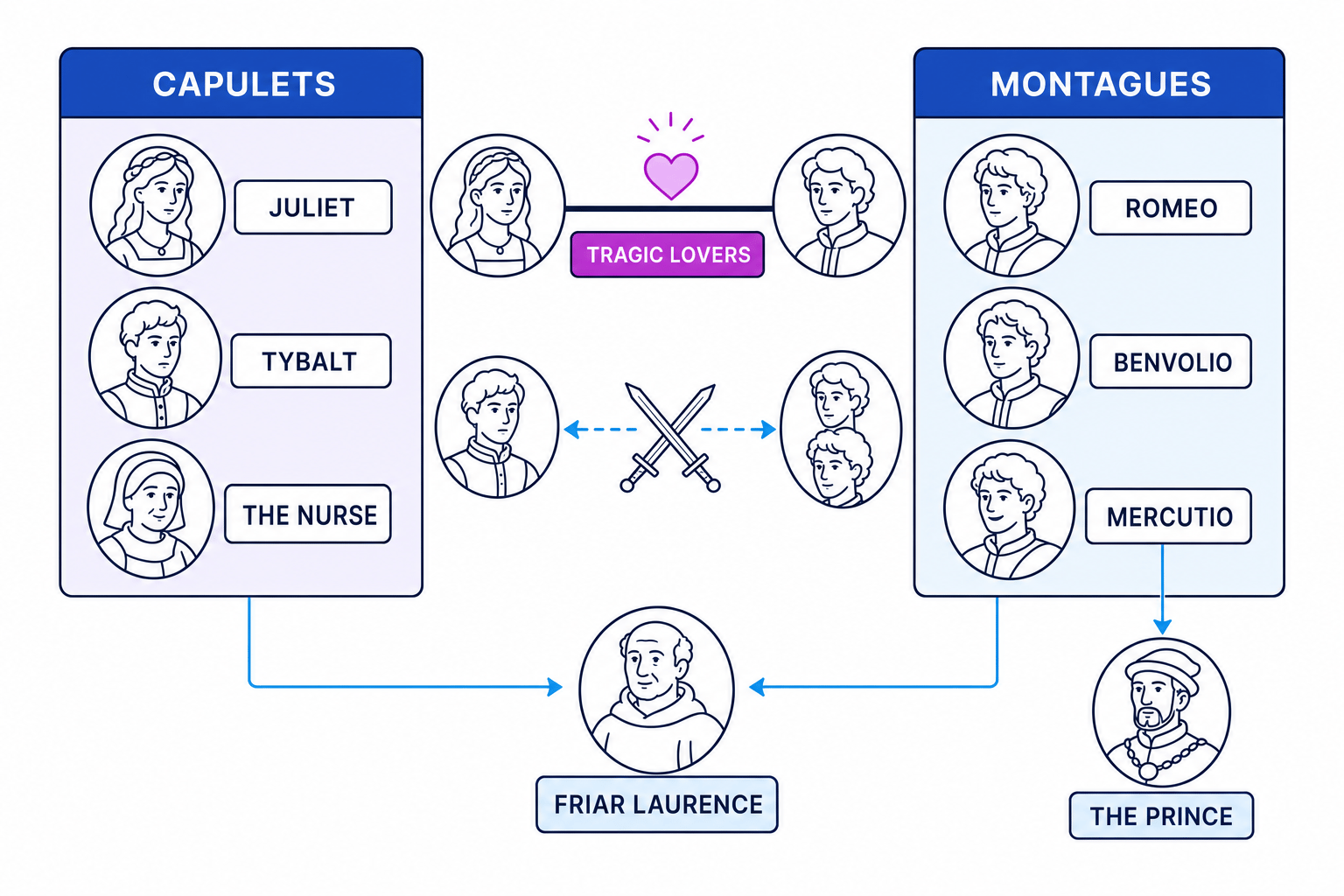
Benvolio versus Tybalt
From the very first scene of the play, Shakespeare establishes a structural contrast between Benvolio (whose name stems from the Latin root for "goodwill") and Tybalt (associated with aggression and territorial pride).
- Benvolio is a peacemaker: "I do but keep the peace. Put up thy sword." (Act 1, Scene 1)
- Tybalt is a catalyst for violence: "What, drawn, and talk of peace? I hate the word, / As I hate hell, all Montagues, and thee." (Act 1, Scene 1)
By placing these two characters in direct opposition immediately, Shakespeare shows how easily fragile social order can be disrupted by masculine pride and territorial anger.
Romeo versus Mercutio
Mercutio acts as a direct foil to Romeo’s romantic idealism.
- Romeo views love through the lens of high art, beauty, and spiritual devotion.
- Mercutio views love through a cynical, highly physical, and bawdy lens. In Act 1, Scene 4, when Romeo sighs that love is "too rude, too boisterous," Mercutio retorts: "If love be rough with you, be rough with love."
Through Mercutio's mocking wit—most famous in his mercurial Queen Mab speech—Shakespeare undercuts the elevated language of courtly love, grounding the tragedy in a gritty, physical reality.
The Protagonists: Journeys of Transformation
In a Shakespearean tragedy, the protagonists must undergo profound personal change before reaching their inevitable doom.
Romeo Montague: From Petrarchan Lover to Tragic Hero
At the start of the play, Romeo is presented as a cliché. He is suffering from unrequited love for Rosaline and speaks in artificial, highly patterned language.
Petrarchan Lover
A Petrarchan lover is an poetic archetype of a man who is in love with an idealized, unobtainable woman. He expresses his suffering through highly stylized, exaggerated metaphors and oxymorons.
When describing his feelings for Rosaline in Act 1, Scene 1, Romeo speaks in contradictory phrases: "O brawling love, O loving hate... heavy lightness, serious vanity!" This language is performative; Romeo is in love with the idea of being in love.
However, when he meets Juliet, his language transitions to natural, spiritually charged poetry. Their first conversation forms a perfect Shakespearean sonnet (Act 1, Scene 5), filled with religious imagery ("holy shrine," "pilgrim," "saints"). This structural change signals that his love for Juliet is genuine, mutual, and transcendent.
Despite this maturity, Romeo's hamartia (tragic flaw) remains his impulsiveness. He reacts instantly to his emotions, culminating in his fatal decision to avenge Mercutio by killing Tybalt: "O sweet Juliet, / Thy beauty hath made me effeminate / And in my temper soften'd valour's steel!" (Act 3, Scene 1). Here, his sudden shift back to the code of male violence drives the play toward its tragic catastrophe.
Juliet Capulet: From Obedient Daughter to Courageous Agent
Juliet undergoes the most dramatic evolution in the play. When we first meet her in Act 1, Scene 3, she is passive and obedient. When her mother asks if she can love Paris, she replies: "I'll look to like, if looking liking move; / But no more deep will I endart mine eye..." This represents a young girl perfectly submissive to her family’s wishes.
By Act 3 and 4, Juliet completely casts off her submissive role:
- She challenges the concept of family identity: "What’s in a name? That which we call a rose / By any other word would smell as sweet." (Act 2, Scene 2)
- She takes control of her own destiny, initiating marriage and making arrangements with Friar Laurence.
- When abandoned by her parents and her Nurse in Act 3, Scene 5, she makes a calculated, isolated decision to seek death rather than betray her marriage: "If all else fail, myself have power to die."
Juliet’s maturity vastly outpaces Romeo’s. While Romeo reacts with hysterical despair and attempts suicide upon his banishment, Juliet calmly and courageously plans to fake her own death, facing the terrifying prospect of waking up alone in a tomb.
Ignoring Juliet's Agency
Many students describe Juliet as a weak, passive victim of fate. In reality, Shakespeare constructs her as remarkably strong and decisive. She actively challenges her father’s authority and takes huge physical and emotional risks to maintain her independence. Always emphasize her agency when discussing her character.
The Catalysts: The Nurse and Friar Laurence
Both Romeo and Juliet are isolated from their biological parents. Instead, they turn to parental surrogates: the Nurse and Friar Laurence.
| Character | Role / Archetype | Key Motivation | Tragic Failure |
|---|---|---|---|
| The Nurse | Comic relief / Confidante | Juliet's immediate happiness and physical comfort. | Lacks moral courage. In Act 3, Scene 5, she advises Juliet to commit bigamy by marrying Paris: "I think it best you married with the County." |
| Friar Laurence | Wise mentor / Holy man | Political reconciliation. He hopes the marriage will "turn your households' rancour to pure love" (Act 2, Scene 3). | Relies on deceptive, risky schemes (such as the sleeping potion) and flees the tomb out of fear in Act 5, Scene 3. |
Both characters fail the lovers because they represent worldly pragmatism (the Nurse) and political calculation (the Friar), neither of which can comprehend or protect the absolute, spiritual love of Romeo and Juliet.
Analysing Character Construction
In your open-book Component 2 exam, you will have access to a clean copy of the play. This means you do not need to memorize huge chunks of text, but you must know exactly how to select and analyze structural shifts and linguistic choices to explain how Shakespeare constructs his characters.
Here is a step-by-step walk-through of how to construct a high-scoring analytical paragraph on character change.
Analysing Juliet's transformation in Act 3, Scene 5
Scenario: Analyze how Shakespeare presents the changing relationship between Juliet and her parents in Act 3, Scene 5.
-
Formulate a context-linked, thesis-driven topic sentence (AO1/AO4).
Start by identifying the structural shift in Juliet's character and link it to the patriarchal context.
Draft: "In Act 3, Scene 5, Shakespeare constructs Juliet's direct defiance of her father to highlight her rapid transition from a submissive daughter to an independent agent, exposing the brutal nature of Elizabethan patriarchal control."
-
Select precise textual evidence and analyze the writer's methods (AO1/AO2).
Find a key quotation from this scene and examine the language or dramatic structure. Focus on Lord Capulet’s reaction to her refusal.
Analysis: When Juliet refuses to marry Paris, Lord Capulet erupts in anger, calling her "hang thee, young baggage! disobedient wretch!"
The noun "baggage" is a commercial metaphor that reduces Juliet to cargo or physical property, illustrating that her value to her father lies solely in her utility as a political marriage alliance. The imperative "hang thee" reveals the violent fury triggered when a patriarch’s absolute authority is challenged.
-
Evaluate the effect on the audience and link back to the overarching themes (AO1/AO2).
Explain how this character interaction serves the wider tragedy.
Synthesis: Juliet's quiet, formal language ("Good father, I beseech you on my knees") contrasts sharply with Capulet's fragmented, furious prose. This structural contrast visually and aurally isolates Juliet on stage. By showing her abandoned by her father, her mother ("Talk not to me, for I'll not speak a word"), and eventually her Nurse, Shakespeare structurally prepares the audience for Juliet's ultimate tragic isolation in Act 4 and 5, demonstrating that her agency comes at the cost of her total social exclusion.
Utilizing the Open-Book Format
Since you have the text in front of you, don't waste time quoting long passages. Pick short, punchy phrases (two to four words) so that you can spend more time analyzing the deeper thematic implications and linguistic devices.
In the exam
- Focus on character function: Never treat characters as real people. Always write about them as tools used by Shakespeare to explore ideas like generational conflict, the destructiveness of feud, or the restrictive nature of gender roles.
- Track the dramatic arc: If you get a question on a character (e.g., Romeo, Juliet, Mercutio, or Tybalt), structure your essay chronologically to show how they change or how their actions accelerate the play's momentum from comedy to tragedy.
- Integrate context naturally: Do not bolt historical facts onto the end of your paragraphs. Ensure your points about Elizabethan patriarchy, male codes of honour, or religious attitudes toward suicide are woven directly into your analysis of why a character speaks or acts in a certain way.
Check yourself
- Why does Shakespeare introduce Romeo as a grieving Petrarchan lover before he meets Juliet?
- How does the character of Tybalt act as a dramatic foil to Benvolio, and what thematic conflict does this highlight?
- In what ways does Juliet’s linguistic style change from Act 1, Scene 3 to her final moments in Act 5, Scene 3?