What you'll learn
- What context means for Romeo and Juliet and Edexcel IGCSE.
- The key Elizabethan ideas behind family, marriage, honour, fate, religion and love.
- How to use context without turning your essay into a history paragraph.
- How AO4 can strengthen close analysis of Shakespeare’s language, form and structure.
Why context matters
Romeo and Juliet is assessed in Component 2, Section B: Literary Heritage, which is open book: you may use a clean copy of the play in the exam. Context is especially important here because Edexcel rewards your understanding of how the play relates to the world that produced it.
Context
Context means the social, historical, cultural and literary background that helps shape a text and how audiences might understand it.
AO4
AO4 is the assessment objective that rewards your understanding of the relationship between a text and its context. In Romeo and Juliet, this means linking Shakespeare’s choices to Elizabethan beliefs, values and literary conventions.
The best context work does not say, “In Shakespeare’s time…” and then drift away from the play. It uses context as a lens to explain Shakespeare’s characters, methods and effects.
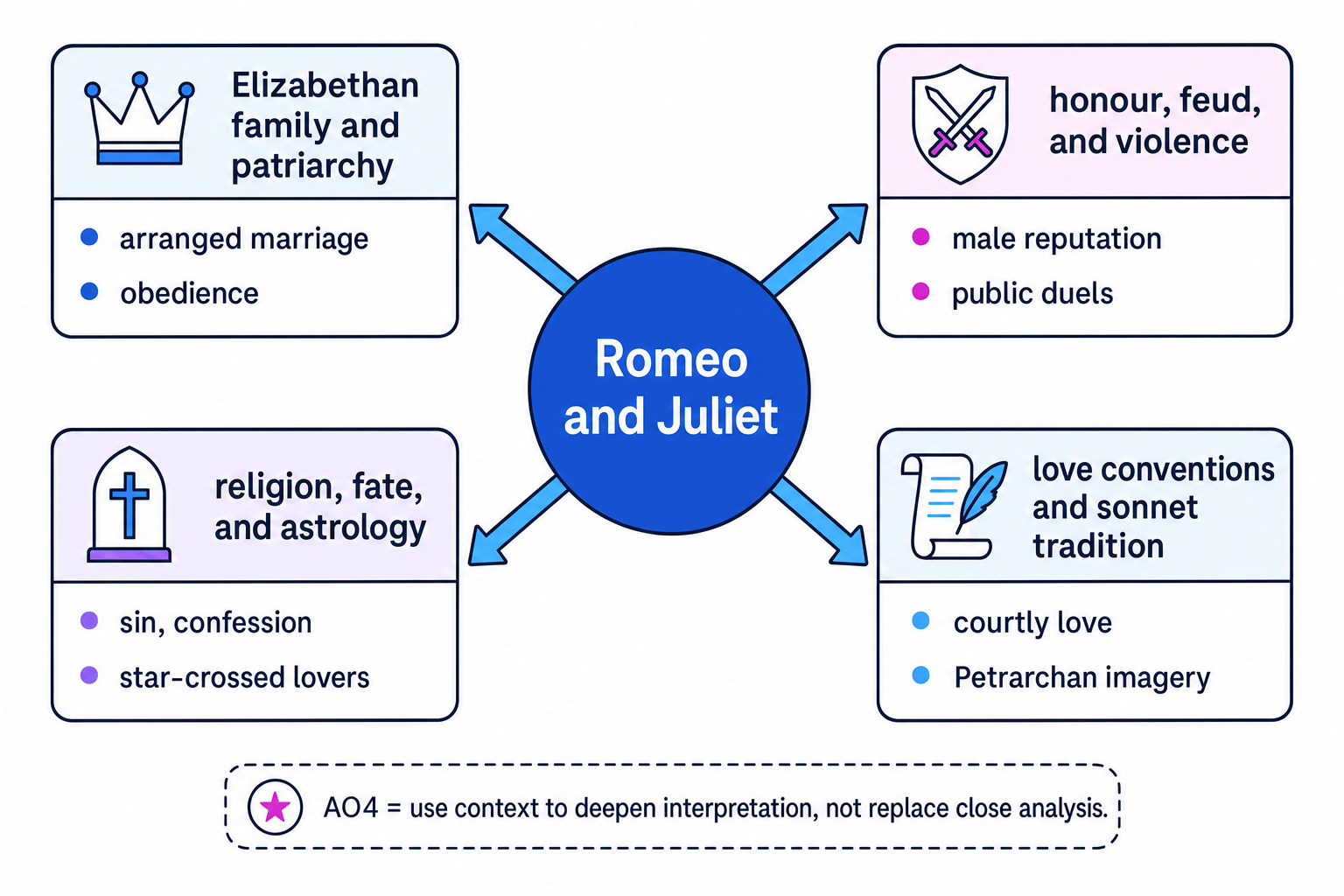
Context is a lens
Use context to deepen your interpretation of a quotation. The order should usually be: point → evidence → method → effect → context link, not a separate history lesson.
The basic historical setting
Shakespeare probably wrote Romeo and Juliet in the mid-1590s, during the reign of Queen Elizabeth I.
Elizabethan
Elizabethan refers to the period of Queen Elizabeth I’s reign in England, from 1558 to 1603.
The play is set in Verona, Italy, not England. This matters because Shakespeare can explore extreme family rivalry, Catholic religious practices, arranged marriage and public violence at a slight distance from his own society. However, his first audiences would still have recognised many of the pressures: obedience to parents, concern for reputation, fear of disorder, and religious ideas about sin and fate.
Treating Verona as a history textbook
Do not write as if every detail shows exactly how all Italians or all Elizabethans lived. Shakespeare creates a dramatic world, not a documentary. Context should support interpretation, not replace it.
Family, patriarchy and marriage
One of the most important contexts is patriarchy.
Patriarchy
Patriarchy is a social system in which men hold most authority, especially fathers and husbands within the family.
In wealthy families, marriage was often connected to status, inheritance and family alliance. Young women were expected to obey their fathers, although Shakespeare complicates this: Capulet initially tells Paris, “My will to her consent is but a part” in Act 1 Scene 2, suggesting Juliet’s agreement matters. Later, however, he violently demands obedience.
Juliet begins the play as a dutiful daughter. When Lady Capulet asks about marriage, Juliet says, “I’ll look to like, if looking liking move” in Act 1 Scene 3. Her careful phrasing suggests obedience, caution and self-control. By Act 2 Scene 2, she imagines rejecting family identity altogether: “Deny thy father and refuse thy name.”
Oversimplifying Juliet’s age
Avoid saying, “All girls married at thirteen.” Juliet’s youth is shocking and important, but early marriage was more likely among elite families and was not universal. The safer point is that Shakespeare presents Juliet under intense family pressure.
Explaining Juliet’s defiance
- Start with Capulet’s language in Act 3 Scene 5: he calls Juliet “young baggage! disobedient wretch!” The insults reduce his daughter to something worthless and emphasise his anger at disobedience.
- Link the moment to patriarchy: in this context, a father expected control over his daughter’s marriage, especially when the match affected family status.
- Develop the interpretation: Shakespeare makes Juliet’s refusal brave but dangerous. Her private love challenges the public power of the family, which helps drive the tragedy.
Honour, masculinity and the feud
The play opens with “two households” caught in an “ancient grudge” from the Prologue. A feud is a long-running conflict between families or groups, often passed down through generations.
Honour and masculinity
Honour means public reputation, especially the respect a person believes they deserve. Masculinity refers to social expectations about what it means to be a man.
In Verona, young men are quick to defend reputation with violence. Tybalt’s hatred of peace — “What, drawn, and talk of peace?” in Act 1 Scene 1 — shows a world where compromise can look like weakness. This context helps explain why Romeo’s attempt to avoid fighting Tybalt fails so badly.
After Romeo secretly marries Juliet, he tries to treat Tybalt as family: “I do protest, I never injured thee” in Act 3 Scene 1. But Mercutio sees this as shameful, calling it “calm, dishonourable, vile submission.” The feud turns peace into dishonour.
Connecting honour to the turning point
- Notice the conflict between what Romeo knows and what other men see: Romeo knows Tybalt is now his relative, but Mercutio sees only a public refusal to fight.
- Apply the honour context: in a culture where male reputation depends on courage and retaliation, Romeo’s peaceful language appears humiliating.
- Link to structure: Mercutio’s death pushes Romeo from love into revenge — “fire-eyed fury be my conduct now!” — turning the play more sharply towards tragedy.
Fate, religion and the stars
The Prologue calls Romeo and Juliet “star-cross’d lovers,” which immediately raises the idea of fate.
Fate and astrology
Fate is the idea that events are controlled by a power beyond human choice. Astrology is the belief that the stars and planets influence human lives.
Many Elizabethans were familiar with astrological ideas, even though Christian teaching also stressed moral responsibility. Shakespeare uses this tension throughout the play. Romeo says “O, I am fortune’s fool!” after killing Tybalt in Act 3 Scene 1, as if he is controlled by luck or destiny. Later, when he believes Juliet is dead, he cries, “I defy you, stars!” in Act 5 Scene 1.
Religion also shapes the play. Marriage is treated as sacred, Friar Lawrence acts as a religious adviser, and suicide would have been understood by a Christian audience as a serious sin. Yet Shakespeare still encourages deep pity for the lovers, making the audience feel the pressure between religious morality and emotional tragedy.
Balancing fate and choice
- Use the Prologue’s “star-cross’d lovers” to show that the audience is invited to see the ending as partly destined from the beginning.
- Compare this with Romeo’s actions: “I defy you, stars!” sounds rebellious, but he still chooses to buy poison and rush back to Verona.
- Form a balanced interpretation: Shakespeare uses belief in fate to create tragic inevitability, but he also shows how impulsive choices and social conflict help cause the deaths.
A strong AO4 balance
Try phrases like “Shakespeare draws on…”, “This would have reminded an Elizabethan audience…”, or “In a society where…”. These keep context connected to interpretation rather than sounding memorised.
Love poetry and sonnet conventions
Shakespeare also draws on literary context: the traditions of love poetry.
Sonnet and Petrarchan love
A sonnet is a fourteen-line poem often associated with love. Petrarchan love is a poetic convention where a male lover idealises an unattainable woman and describes his suffering in exaggerated language.
At the start, Romeo’s love for Rosaline sounds artificial and conventional. He uses oxymorons — phrases that combine opposites — such as “O brawling love, O loving hate” in Act 1 Scene 1. This suggests confusion, performance and self-dramatisation.
His first meeting with Juliet feels different. Their dialogue forms a shared sonnet, beginning with Romeo’s religious metaphor: “If I profane with my unworthiest hand / This holy shrine” in Act 1 Scene 5. Juliet responds intelligently: “Good pilgrim, you do wrong your hand too much.” The shared form suggests mutual attraction, equality and verbal harmony.
Reading the first meeting through literary context
- Compare Romeo’s earlier Rosaline language with his dialogue with Juliet: the Rosaline speech is full of exaggerated contradictions, while the Juliet exchange is controlled and shared.
- Apply sonnet context: because the sonnet was a recognised love form, Shakespeare makes their first conversation feel like poetry created together.
- Interpret the effect: their love seems more reciprocal than Romeo’s courtly love for Rosaline, but the religious imagery also makes their passion feel intense, almost sacred.
Using context in a paragraph
The most important skill is integration.
Integrated context
Integrated context means weaving background information into your analysis of the play, instead of placing it in a separate sentence that could belong to any essay.
The bolted-on context paragraph
A weak answer says: “In Elizabethan times, fathers controlled daughters. This is shown in the play.” A stronger answer analyses Capulet’s words first, then uses patriarchy to explain why those words have power.
Turning context into analysis
- Begin with a focused point about Shakespeare’s presentation: Capulet’s authority becomes threatening when Juliet resists him.
- Choose precise evidence and method: “Hang thee, young baggage! disobedient wretch!” uses insults and exclamatives to show anger and control.
- Add context to sharpen the meaning: in a patriarchal society, Juliet’s refusal is not just a family disagreement but a challenge to the father’s public authority.
- Link back to tragedy: Shakespeare shows how social expectations around obedience help isolate Juliet and push her towards desperate decisions.
A developed sentence might look like this:
Shakespeare presents Capulet’s fatherly authority as frighteningly unstable when he calls Juliet “young baggage! disobedient wretch!” in Act 3 Scene 5. The harsh insults and exclamatives turn family love into verbal violence. In a patriarchal society where daughters were expected to obey fathers over marriage, Juliet’s resistance becomes socially dangerous, helping Shakespeare show how family control contributes to the tragedy.
In the exam
- Use your clean copy to find short, precise quotations rather than copying long speeches.
- Link context to Shakespeare’s methods: language, form, structure, dramatic irony, symbolism or stage action.
- Avoid context dumps. One sharp contextual phrase tied to a quotation is usually better than a whole paragraph of background.
Check yourself
- How does patriarchy make Juliet’s refusal to marry Paris more dangerous?
- Why does honour culture help explain Mercutio and Romeo’s behaviour in Act 3 Scene 1?
- How can “star-cross’d lovers” suggest fate without removing all responsibility from the characters?