What you'll learn
- How the plot of Romeo and Juliet moves from feud to secret love to tragedy.
- How each Act contributes to Shakespeare’s tragic structure.
- Why Act 3 is the key turning point in the play.
- How to use plot knowledge in an Edexcel IGCSE Literature answer without simply retelling the story.
Starting point: what “plot” means
Plot
The plot is the sequence of events in a text, especially how one event causes another. In Romeo and Juliet, the plot is not just “two lovers die”: it is a chain of family conflict, secrecy, haste, violence, failed messages and tragic timing.
Shakespeare sets the play in Verona, an Italian city divided by a long-running feud between two noble families: the Montagues and the Capulets. Romeo is a Montague; Juliet is a Capulet. Their love is dangerous because it crosses this social boundary.
The whole plot in one sentence
Two young lovers from enemy families secretly marry, but a street fight leads to Romeo’s banishment, a failed plan, and both lovers’ deaths, which finally ends the feud.
The tragic shape of the play
Tragedy
A tragedy is a form of drama in which conflict, human weakness, social pressure and chance lead to suffering, death, and a serious moral lesson for the audience.
Romeo and Juliet is a tragedy, but Shakespeare tells us the ending before the action begins. The Prologue, spoken by the Chorus — a figure who introduces or comments on the action — calls Romeo and Juliet “a pair of star-cross’d lovers” who “take their life”. This creates foreshadowing, which means hints about what will happen later.
The audience knows from the start that the lovers will die. That creates dramatic irony, where the audience knows more than the characters. When Romeo and Juliet hope for happiness, we are painfully aware that the ending has already been announced.
The play is easiest to remember as a chain of causes: public feud → private love → secret marriage → violent revenge → banishment → failed message → double suicide → reconciliation.
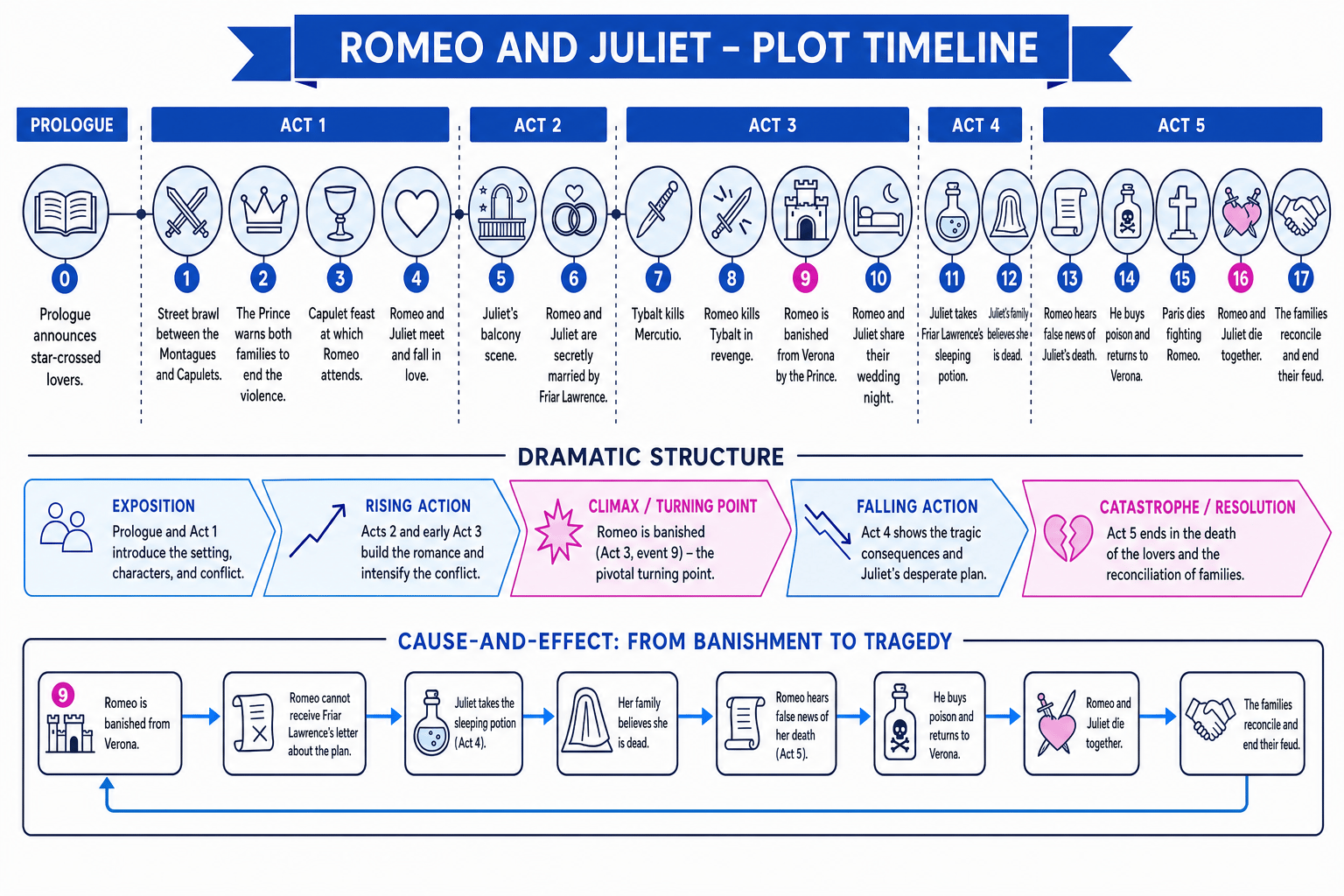
Dramatic structure: the big movements
Dramatic structure
Dramatic structure means the way a play is organised to build tension. Useful stages include exposition — the introduction of setting and conflict; rising action — complications that increase tension; turning point — the moment the direction of the plot changes; and catastrophe — the final disaster in a tragedy.
In Romeo and Juliet, the structure is tightly compressed. The main action takes only a few days, which makes the love feel intense and the tragedy feel rushed. Shakespeare repeatedly shows speed: Romeo and Juliet fall in love quickly, marry secretly the next day, and are separated almost immediately.
Act 3 is your hinge
If you are stuck in an essay, remember this: before Act 3, the plot still has comic and romantic possibilities; after Act 3 Scene 1, the deaths of Mercutio and Tybalt push the play firmly towards tragedy.
Act 1: feud, warning, and first love
Scene 1: public violence
The play opens with servants from the Montague and Capulet households quarrelling in the street. The fight begins over petty insults — “Do you bite your thumb at us, sir?” — which shows how easily Verona’s violence can explode.
Prince Escalus stops the brawl and warns both families: “If ever you disturb our streets again, / Your lives shall pay the forfeit of the peace.” This matters later because Romeo’s punishment after killing Tybalt is shaped by the Prince’s earlier warning.
Romeo first appears as a lovesick young man, not over Juliet, but over Rosaline. His oxymoron “O brawling love! O loving hate!” shows emotional confusion and prepares us for a play where love and violence are closely linked.
Scene 5: the Capulet feast
Romeo attends the Capulet feast in disguise and sees Juliet for the first time. His language changes instantly: “O, she doth teach the torches to burn bright!” The metaphor presents Juliet as light in darkness, a recurring image in their love story.
They speak together in a shared sonnet-like exchange, making their first meeting feel balanced, intimate and sacred. However, the discovery of each other’s identity changes everything. Juliet’s line “My only love sprung from my only hate!” sums up the central conflict: love is born inside hatred.
Act 2: secret love and secret marriage
Act 2 develops the private world of the lovers. In the famous balcony scene, Juliet asks, “O Romeo, Romeo! wherefore art thou Romeo?” Here, “wherefore” means why, not where. She is asking why he has to be Romeo Montague.
Juliet imagines love as something deeper than a family name: “That which we call a rose / By any other name would smell as sweet.” Shakespeare explores the gap between private identity and public social labels.
Romeo and Juliet arrange to marry, helped by Friar Lawrence. The Friar hopes the marriage will turn the families’ “rancour” into “pure love”, meaning he believes the relationship could end the feud. Yet he also warns them: “These violent delights have violent ends.” This is another moment of foreshadowing.
Forgetting the secrecy
Do not summarise the marriage as if it solves the conflict. The marriage is secret, so it actually makes the plot more dangerous: Romeo is now connected to Tybalt by marriage, but nobody else knows.
Act 3: the turning point
Act 3 Scene 1 is the decisive turning point. Tybalt challenges Romeo, but Romeo refuses to fight because he has secretly married Juliet and now sees Tybalt as family. Mercutio misunderstands Romeo’s refusal as cowardice and fights Tybalt himself.
Tybalt kills Mercutio. Mercutio’s dying curse — “A plague o’ both your houses!” — blames both families, not just one side. Romeo then kills Tybalt in revenge and immediately recognises the power of fate: “O, I am fortune’s fool!”
The Prince banishes Romeo from Verona. Banishment means being forced to leave a place as punishment. For Romeo and Juliet, this is devastating: Romeo is alive, but separated from Juliet. Juliet is then pushed by her parents towards marriage with Paris, making her situation desperate.
Tracing cause and effect from Act 3
-
Romeo secretly marries Juliet, so when Tybalt challenges him, Romeo refuses to fight because Tybalt is now his relative by marriage.
-
Mercutio does not know about the marriage, so he sees Romeo’s refusal as dishonourable and fights Tybalt himself.
-
Tybalt kills Mercutio, which changes Romeo’s behaviour from peace-making to revenge: Romeo kills Tybalt.
-
Because Romeo kills Tybalt after the Prince’s earlier warning against street violence, Romeo is banished rather than allowed to remain in Verona.
-
Romeo’s banishment causes the later communication failure: he is outside Verona and does not receive Friar Lawrence’s message explaining Juliet’s sleeping-potion plan.
Act 4: Juliet’s desperate plan
In Act 4, Juliet is isolated. Her father insists she must marry Paris, and when she refuses, he insults her as a “disobedient wretch”. Juliet turns to Friar Lawrence because the adults around her cannot openly protect her.
The Friar gives Juliet a sleeping potion that will make her appear dead. The plan is risky but not intended as suicide: Juliet will be placed in the Capulet tomb, Romeo will be told the truth, and they will escape together.
Juliet’s soliloquy before taking the potion shows her fear. A soliloquy is a speech in which a character speaks their thoughts aloud, often while alone. Juliet says, “My dismal scene I needs must act alone,” showing that she must face the terrifying plan without support.
When the Capulets find Juliet apparently dead, Capulet uses a simile: “Death lies on her like an untimely frost / Upon the sweetest flower of all the field.” The image presents Juliet as young, beautiful and destroyed too early.
Act 5: failed message, double death, reconciliation
In Act 5, Romeo hears from Balthasar that Juliet is dead. Crucially, he does not receive Friar Lawrence’s letter explaining that Juliet is only sleeping. Romeo cries, “Then I defy you, stars!” This links back to the Prologue’s “star-cross’d lovers” and shows Romeo trying to resist fate even as he moves towards it.
Romeo buys poison from a poor apothecary and returns to Verona. At the tomb, he kills Paris, who has come to mourn Juliet. Romeo then drinks the poison beside Juliet and dies: “Thus with a kiss I die.”
Juliet wakes too late. Seeing Romeo dead, she uses his dagger to kill herself: “O happy dagger!” The adjective “happy” is disturbing because it shows that death has become, in Juliet’s mind, the only way to reunite with Romeo.
At the end, the families finally recognise the cost of their feud. The Prince’s final judgement, “For never was a story of more woe / Than this of Juliet and her Romeo,” turns the lovers’ deaths into a public moral lesson.
Why the ending matters
The ending is not simply unlucky. Shakespeare combines fate, chance, and human responsibility. The lovers are “star-cross’d”, but the adults also make damaging choices: the families maintain the feud, Capulet pressures Juliet, Friar Lawrence creates a risky plan, and the Prince’s law cannot fully control Verona’s violence.
For Edexcel IGCSE, this matters because strong answers do not just retell what happens. They explain how Shakespeare structures events to shape the audience’s response. Plot knowledge supports AO1 because you can refer accurately to key moments; it also supports AO2 when you discuss methods such as foreshadowing, dramatic irony, soliloquy and tragic structure.
Retelling without analysing
In an essay, avoid writing a long summary of the plot. Select the moment that proves your point, add a short quotation, name Shakespeare’s method, and explain the effect on the audience.
Using plot in Component 2
Romeo and Juliet appears in Component 2, Section B: Literary Heritage. This is open book, meaning you may use a clean copy of the play in the exam. However, open book does not mean easy: you still need to know where key events happen so you can find evidence quickly and write a focused argument.
A good plot-based point might look like this: Shakespeare places Mercutio’s death at the centre of the play so that the mood shifts from youthful romance to irreversible tragedy. Mercutio’s curse, “A plague o’ both your houses!”, widens the blame from individual characters to the whole feud.
In the exam
-
Start with the exact plot moment you need: Act 1 meeting, Act 2 marriage, Act 3 deaths and banishment, Act 4 potion, or Act 5 tomb.
-
Link the event to Shakespeare’s structure: explain whether it introduces conflict, increases tension, creates a turning point, or completes the tragedy.
-
Use one short quotation accurately, then analyse how the method shapes meaning rather than retelling the whole scene.
Check yourself
- Why is Act 3 Scene 1 usually seen as the turning point of the play?
- How does the Prologue change the audience’s experience of the love story?
- Which events in Act 5 depend on failed communication and timing?