What you'll learn
- How Romeo and Juliet works as a Shakespearean tragedy.
- The basic plot shape: from feud, to love, to catastrophe, to reconciliation.
- The key methods Shakespeare uses: language, form and structure.
- How to approach the play for Edexcel IGCSE Literature, where this text is assessed in Component 2.
The play at a glance
Romeo and Juliet is a play by William Shakespeare, first performed in the 1590s. It is set in Verona, Italy, where two noble families — the Montagues and the Capulets — are locked in an old feud. Against this violent public conflict, Romeo Montague and Juliet Capulet fall in love, marry secretly, and die because the world around them cannot make room for their love.
A feud is a long-running conflict between families or groups. Shakespeare calls it an “ancient grudge” in the Prologue, suggesting the hatred is old, inherited, and almost automatic.
Tragedy
A tragedy is a serious drama in which conflict, flawed choices, chance, and social pressure lead to suffering and usually death. In Romeo and Juliet, the tragedy is not only that the lovers die, but that their deaths are needed before the adults recognise the damage caused by the feud.
The ending is announced at the start: “A pair of star-cross’d lovers take their life” in the Prologue. This means the audience watches the play with a sense of inevitability: we know where the story is heading, so moments of happiness feel fragile.
The plot shape
The play moves quickly. The action takes place over only a few days, which makes love, violence and decision-making feel intense and rushed.
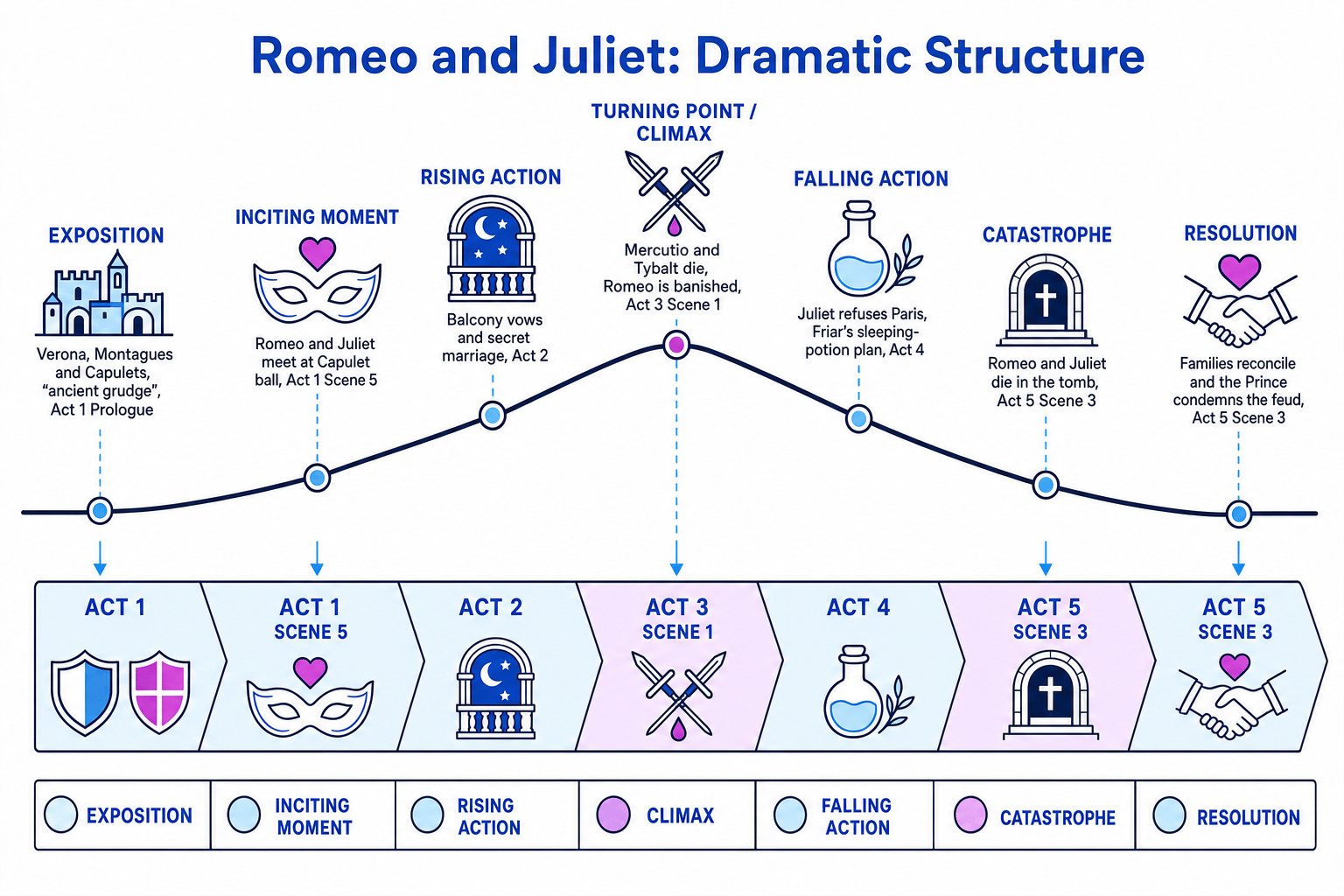
A useful way to understand the plot is through dramatic structure, which means the way a play is organised to create tension and meaning. The exposition is the opening situation; the inciting moment is the event that starts the central action; the rising action builds pressure; the climax is the decisive turning point; the falling action shows the consequences; the catastrophe is the disastrous ending; and the resolution is the final settling of events.
The play’s tragic arc begins with public disorder, rises through secret love and family conflict, turns sharply with Mercutio’s and Tybalt’s deaths, and ends in the tomb.
The tragic pattern
Shakespeare does not present the deaths as a random accident. The catastrophe grows from a combination of fate, family hatred, impulsive decisions, secrecy, and a society obsessed with honour and obedience.
The Prologue: Shakespeare tells us the ending
The play opens with a Prologue, which is an introductory speech. It is spoken by the Chorus, a speaker who frames the story for the audience. The Prologue creates foreshadowing, where a writer hints at or reveals what will happen later.
It also creates dramatic irony. Dramatic irony happens when the audience knows something that some or all characters do not. Because we know the lovers are “death-mark’d”, Romeo and Juliet’s happiest scenes are shadowed by danger.
Analysing the Prologue
-
Start with the phrase “star-cross’d lovers” from the Prologue. The word “star” suggests fate, astrology and forces beyond human control, while “cross’d” suggests opposition and misfortune.
-
Connect this to the play’s structure. Because the audience is told the lovers will “take their life”, Shakespeare makes us watch for the causes of the tragedy rather than simply wondering what will happen.
-
Add the effect of dramatic irony. When Romeo and Juliet speak lovingly, the audience feels tension because their language of love exists alongside our knowledge of their deaths.
-
Link to the whole play. The Prologue frames the relationship as both beautiful and doomed, so a strong overview argument can discuss fate and human responsibility together.
The central conflict: private love against public hatred
At the centre of the play is a contrast between the private world of Romeo and Juliet’s love and the public world of family identity, masculine honour and civic violence.
Romeo and Juliet try to create a space where names do not matter. In the balcony scene, Juliet asks, “O Romeo, Romeo! wherefore art thou Romeo?” in Act 2 Scene 2. “Wherefore” means “why”, not “where”: she is asking why he must be Romeo Montague. Her question shows that love challenges the inherited labels that Verona treats as fixed.
But the feud keeps invading private life. Mercutio’s curse, “A plague o’ both your houses!” in Act 3 Scene 1, blames both families. The word “plague” suggests corruption spreading through society, not just one personal quarrel.
Misreading Juliet’s question
“Wherefore art thou Romeo?” does not mean “Where are you, Romeo?” Juliet knows Romeo is nearby. She means “Why are you Romeo?” — why must he belong to the enemy family?
Key themes in overview
A theme is a recurring big idea in a text. For an overview, you do not need to memorise every theme in detail yet. Instead, learn the main tensions that drive the whole play.
Love and hate
The play repeatedly places love next to violence. Romeo and Juliet’s first meeting is tender and formal, but it happens at a Capulet feast where Romeo risks being discovered as an enemy. Later, their marriage is followed almost immediately by the deaths of Mercutio and Tybalt.
Fate and choice
The Prologue’s “star-cross’d” language suggests fate, but characters still make choices. Tybalt chooses aggression, Romeo chooses revenge after Mercutio dies, Capulet pressures Juliet to marry Paris, and Friar Lawrence chooses a risky secret plan.
Youth and age
The young characters often feel emotionally intense and urgent. The older generation, especially the Capulets and Montagues, fails to guide them wisely. Shakespeare shows a society where adults try to control young people but cannot protect them.
Order and disorder
Prince Escalus represents civic order. His warning in Act 1 Scene 1 — “If ever you disturb our streets again, / Your lives shall pay the forfeit of the peace” — shows that the feud is not just a family issue; it threatens the whole city.
Shakespeare’s methods: language, form and structure
For Edexcel, you need to analyse how Shakespeare creates meaning, not just what happens.
Language means the writer’s choice of words and imagery. Imagery is descriptive language that appeals to the senses or creates pictures in the mind. A metaphor describes one thing as if it is another. Romeo’s line “It is the east, and Juliet is the sun” in Act 2 Scene 2 is a metaphor because Juliet is presented as the sun.
Form means the type of text and its conventions. Romeo and Juliet is a play, so speeches, dialogue, stage action and entrances/exits matter. Shakespeare also uses poetic forms within the play. Romeo and Juliet’s first conversation in Act 1 Scene 5 forms a shared sonnet, linking their love with harmony and sacred devotion.
Structure means the order and pattern of events. The shift from comedy-like excitement in Act 2 to bloodshed in Act 3 is crucial: Shakespeare turns romantic hope into tragic consequence.
A motif is a repeated image, idea or pattern. Light and darkness form an important motif in the play.
Linking light imagery to meaning
-
Use Romeo’s metaphor in Act 2 Scene 2: “It is the east, and Juliet is the sun.” The image makes Juliet seem life-giving, radiant and transformative.
-
Connect the method to emotion. Romeo’s language suggests that love changes his whole world, as if Juliet replaces darkness with light.
-
Compare a later moment. In Act 3 Scene 5, Romeo says, “More light and light; more dark and dark our woes!” Here, daylight means separation, danger and grief.
-
Draw a whole-play conclusion. Shakespeare’s light motif is unstable: love is beautiful, but in Verona even light can become painful because the lovers are not free.
Context: use it to deepen analysis
Context means the social, historical and literary background that helps explain a text. For Romeo and Juliet, useful context includes patriarchal family structures, arranged marriage, religion, honour culture, and Elizabethan beliefs about fate and astrology.
But context should never replace analysis. For example, it is useful to know that daughters were expected to obey fathers, but the exam value comes from linking this to Capulet’s language when he threatens Juliet in Act 3 Scene 5: “Hang thee, young baggage!” His insult shows how quickly his earlier affection turns into patriarchal control when Juliet resists him.
Bolting on context
Do not write a separate history paragraph that could fit any Shakespeare play. Attach context to a precise moment, quotation or method, then explain how it shapes the audience’s understanding.
Edexcel exam overview
For Pearson Edexcel International GCSE English Literature, Romeo and Juliet is assessed in Component 2, which is open book. You may use a clean copy of the prescribed text in the exam.
Open book does not mean easy. You still need secure knowledge of the play so you can find moments quickly, select short quotations, and build an argument. Strong responses combine close knowledge and personal interpretation, analysis of Shakespeare’s methods, and relevant context.
Open book still needs memory
Learn where key moments happen: the Prologue, the Capulet ball, the balcony scene, Act 3 Scene 1, Juliet’s refusal of Paris, the potion plan, and the tomb. The clean copy helps most when you already know what you are looking for.
A strong overview argument
A helpful whole-play argument might be:
Shakespeare presents Romeo and Juliet’s love as sincere and powerful, but tragically vulnerable in a society shaped by inherited hatred, patriarchal authority and violent ideas of honour.
That kind of argument is stronger than saying “the play is about love” because it already includes tension. Literature essays usually become more convincing when you write about conflict, change and complexity.
In the exam
-
Begin with a clear argument about the whole play, not a plot summary.
-
Use short, precise quotations and analyse Shakespeare’s methods: word choice, imagery, form, structure and stagecraft.
-
Link context to the text directly, especially when discussing family authority, honour, religion, marriage or fate.
Check yourself
-
What does “star-cross’d lovers” suggest about the role of fate in the play?
-
Why is Act 3 Scene 1 such an important turning point?
-
How can you use context without letting it replace close analysis?