Welcome to your guide on crafting high-scoring essays for William Shakespeare's Romeo and Juliet. For the Pearson Edexcel International GCSE English Literature specification (4ET1), Romeo and Juliet is assessed in Component 2, Section B (Literary Heritage).
Because this is an open-book exam, you are allowed to bring a clean copy of the play into the examination room. This means you do not need to stress about memorising massive blocks of text. Instead, your focus must be on finding precise, high-impact quotations quickly, analysing Shakespeare’s craft deeply, and linking his creative choices back to the Elizabethan context.
What you'll learn
- How to balance the three critical Assessment Objectives (AOs) required for a top-band mark.
- How to structure an analytical paragraph that weaves together evidence, literary methods, and historical context.
- How to construct a clear, persuasive thesis statement that answers the exact question asked.
Understanding the Edexcel Assessment Objectives (AOs)
To score in the highest level (Level 5), you must understand exactly what the examiners are looking for. Your essay is not just a summary of what happens in the play; it is a critical argument about how and why Shakespeare wrote it.
There are three key Assessment Objectives you must target in your Romeo and Juliet essay:
Assessment Objectives (AOs)
- AO1: Close knowledge and understanding of the text, presenting a focused, personal, and evaluative response.
- AO2: Analysis of how language, form, and structure are used to create meaning and effects, using correct literary terminology.
- AO4: Understanding of the relationship between the text and its historical, social, and cultural context.
To achieve high marks, you cannot treat these objectives as separate items to tick off. They must be woven together in every single paragraph.
Anatomy of an Elite Analytical Paragraph
A standard "PEE" (Point, Evidence, Explanation) paragraph is not detailed enough to secure a Grade 9. To meet the high standards of AO1, AO2, and AO4, you need a more sophisticated structural model.
The diagram below outlines the five-part paragraph architecture that will help you seamlessly blend close-reading analysis with historical context.
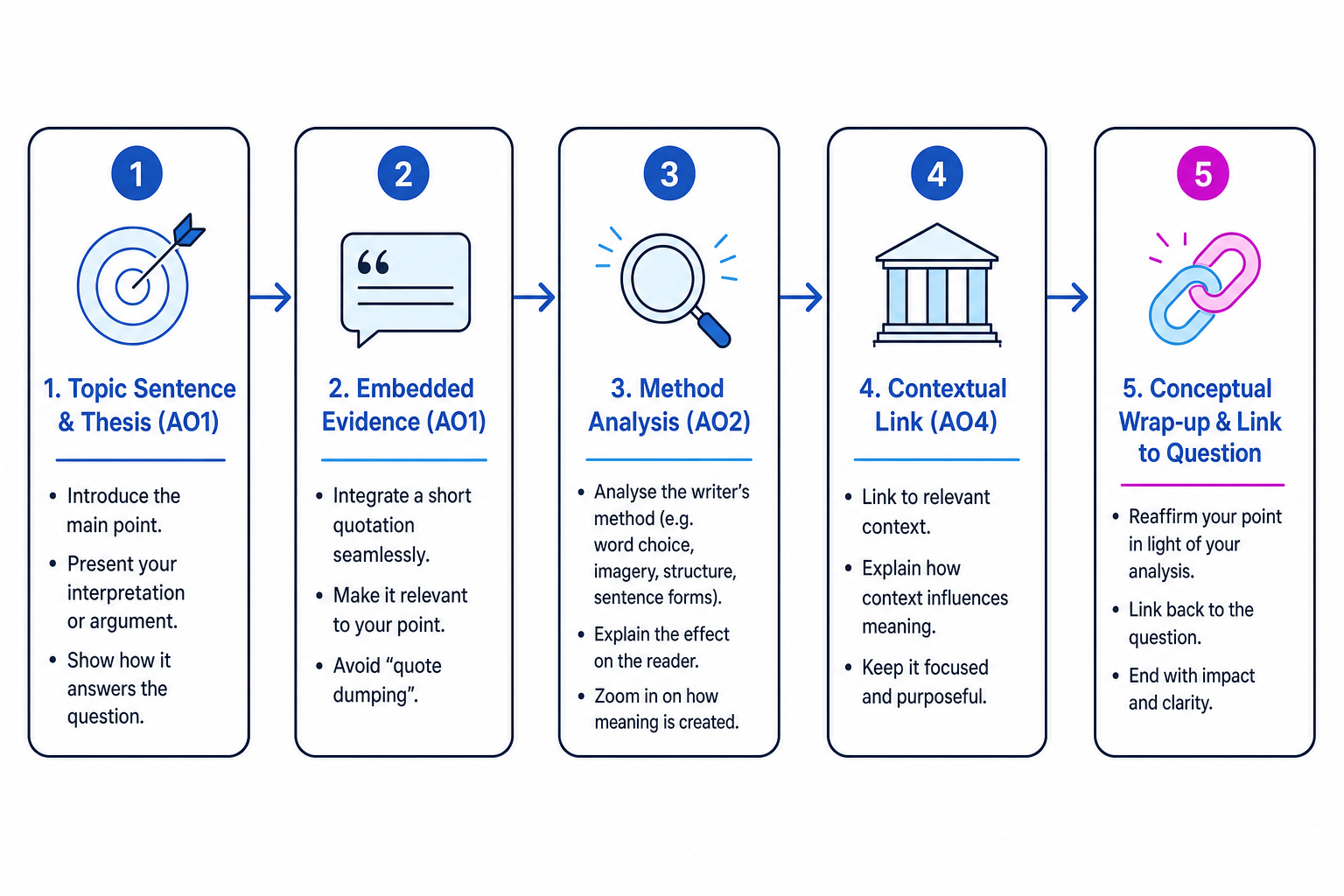
Let's break down each component:
1. Topic Sentence & Thesis (AO1)
Your paragraph must start with a bold argument that directly answers the essay question. Avoid starting with a plot point (e.g., "Tybalt fights Mercutio in Act 3"). Instead, focus on Shakespeare's conceptual intent (e.g., "Shakespeare presents Tybalt as a physical manifestation of the ancient grudge, using his aggressive nature to expose the toxic demands of familial honor").
2. Embedded Evidence (AO1)
Integrate your quotations directly into your own sentences. Rather than dropping a quote in as a standalone sentence, "sandwich" it so your writing flows naturally.
Quote Integration
Instead of writing: Tybalt is angry. He says: "Now, by the stock and honour of my kin, / To strike him dead I hold it not a sin." Try embedding it: Tybalt's violent worldview is immediately clear when he claims that "to strike [Romeo] dead" is "not a sin," justifying his homicidal intent through the lens of family honour.
3. Method Analysis (AO2)
This is where you zoom in on specific language, form, or structural devices. Avoid "device spotting" (identifying a metaphor or a rhyming couplet without explaining what it does). Instead, focus on how the device creates meaning for the audience.
<keyidea title="The "AO2 Zoom-In" Principle">
Do not just label a literary device. Always explain how the specific word choices or structural patterns shape the audience’s emotional and psychological reaction to the scene.
4. Contextual Link (AO4)
Connect your analysis to the social, political, or philosophical realities of the Elizabethan era. Context should never be dropped in as an isolated history fact; it must explain why Shakespeare made a specific artistic choice.
5. Conceptual Wrap-up
End your paragraph by linking your point back to the overall essay question. How does this specific scene or character help Shakespeare deliver his overarching message to his audience?
Step-by-Step Paragraph Construction
Let's look at how to build an analytical paragraph from the ground up, using a common exam focus: the presentation of conflict. We will focus on Tybalt's confrontation with Lord Capulet in Act 1, Scene 5 (the feast scene).
Drafting an analytical paragraph on Tybalt's role in conflict
- Formulate a conceptual topic sentence (AO1): Draft an opening sentence that links Tybalt's character directly to the theme of destructive conflict.
- Draft: Shakespeare presents Tybalt as a catalyst for conflict who prioritises patriarchal tribalism over social order and parental authority.
- Select and embed precise evidence (AO1): Locate a brief, powerful quote from Act 1, Scene 5 where Tybalt reacts to Romeo's presence and embed it into your prose.
- Draft: Upon discovering Romeo at the feast, Tybalt appeals to his ancestral lineage, declaring, "Now, by the stock and honour of my kin, / To strike him dead I hold it not a sin."
- Analyse Shakespeare's literary methods (AO2): Identify the structural and language techniques used in the quote and explain their dramatic impact on the audience.
- Draft: The use of the rhyming couplet ("kin" / "sin") highlights Tybalt's rigid, unwavering mindset, lending his declaration a dark, ritualistic rhythm. By rhyming his family's reputation with "sin," Shakespeare uses juxtaposition to illustrate how the feud has warped Tybalt's moral compass. To Tybalt, murder is not a moral transgression but an act of sacred duty.
- Integrate purposeful context (AO4): Explain how Tybalt's obsession with "honour" reflects Elizabethan social codes and beliefs.
- Draft: This absolute devotion to "honour" mirrors the Elizabethan concept of vendetta and the code of duelling, which plagued Renaissance England. King James I later wrote pamphlets condemning this private violence, viewing it as a threat to state stability. Through Tybalt, Shakespeare reflects this contemporary anxiety, illustrating how the younger generation’s obsession with reputation threatens to destroy civil order.
- Construct a conceptual link to the wider play: Summarise how this moment foreshadows the tragedy of the play's climax.
- Draft: Therefore, Tybalt’s inability to subordinate his personal pride to Lord Capulet's command highlights the destabilising power of the feud, foreshadowing the inevitable bloodshed in Act 3 that sweeps away both Mercutio and Tybalt himself.
Avoiding Common Essay Mistakes
When writing under timed conditions, it is easy to slip into bad habits. Here are the most common pitfalls to avoid.
<commonmistake title="The "Context Dump"">
Do not write paragraphs containing historical facts that have no connection to the play’s language or themes. Writing a paragraph explaining that "Elizabethans believed in astrology" without directly linking it to the cosmic imagery in Romeo's speeches (like his cry of "I am fortune's fool!") will not earn you AO4 marks. Every piece of context must act as a lens to better understand Shakespeare's words.
The Danger of the Open-Book Exam
Because you have the text in front of you, you might be tempted to copy out long, multi-line block quotations. This wastes valuable writing time and hurts your AO2 mark. Examiners prefer short, highly targeted fragments (1 to 5 words) that you can dissect in close detail. Keep your quotes brief and your analysis long!
Structuring the Whole Essay
Your complete essay should follow a clear, logical trajectory. A standard structure consists of an introduction, three main body paragraphs, and a conclusion.
The Thesis Statement
Your introduction must culminate in a strong, clear thesis statement. This is a single sentence that outlines your central argument and acts as a road map for the rest of your essay.
The Thesis as a Compass
Think of your thesis statement as a compass. If your compass is pointing in a vague direction, your essay will wander aimlessly through plot summary. A sharp, precise thesis ensures that every analytical paragraph you write travels in the exact same direction toward a clear, unified conclusion.
Let's look at how to turn a weak, passive thesis statement into a powerful, high-scoring argument:
- Weak Thesis: In this essay, I will show how Shakespeare presents Juliet as a character who changes a lot during the play and eventually dies.
- Strong Thesis: Shakespeare presents Juliet not as a passive victim of fate, but as an increasingly assertive protagonist who systematically defies patriarchal authority to claim personal agency over her own identity and destiny.
In the exam
- Spend 5 minutes planning: Do not start writing immediately. Read both prompt choices carefully, select the one that allows you to write about the most complex themes, and quickly jot down three main arguments (your paragraph topics) and their corresponding scenes.
- Draft a sharp thesis statement: Ensure your introduction explicitly answers the prompt and outlines your conceptual argument rather than just listing characters you will discuss.
- Track your AOs: As you write, check that each paragraph contains a clear topic sentence (AO1), close-up word-level analysis of a key technique (AO2), and a direct link to Elizabethan values or audience reception (AO4).
- Utilise the text strategically: Use your clean copy of the play to check the spelling of character names and locate precise, short quotations that feature rich literary devices (e.g., oxymorons, dramatic irony, or iambic pentameter).
Check yourself
- Can you explain the difference between a simple plot statement and an analytical topic sentence?
- Why is it better to use three 4-word embedded quotes rather than one long 3-line block quote?
- How would you link the Capulets' treatment of Juliet in Act 3, Scene 5 to the historical context of Elizabethan family structures and marriage customs?