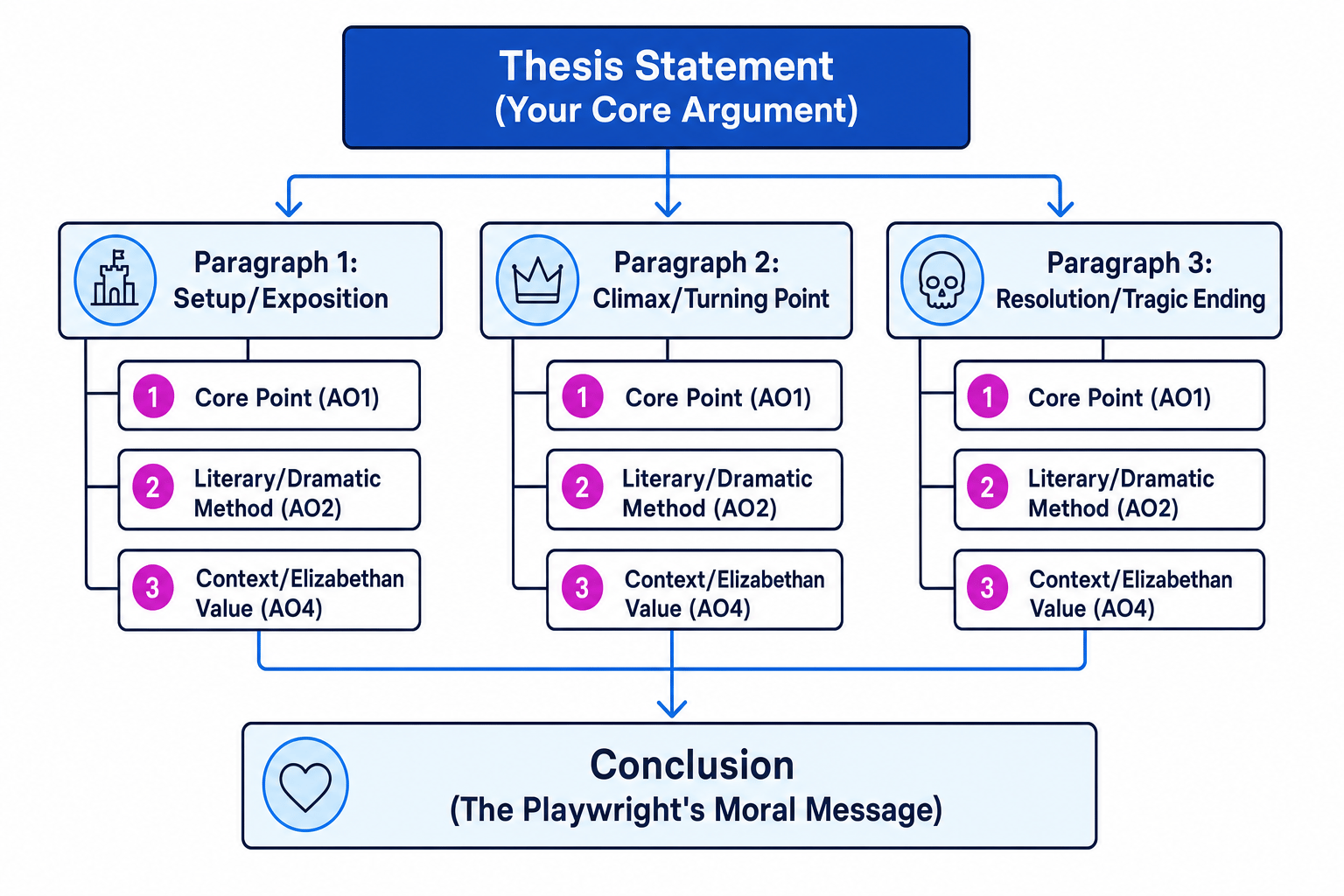
Step-by-Step Essay Planning
Let's walk through the actual intellectual steps required to construct a top-tier essay plan under exam conditions.
Structuring a theme-based essay plan
Prompt: Explore how Shakespeare presents the destructive nature of family honor in Romeo and Juliet.
- Deconstruct the prompt and draft a thesis statement: Identify the key terms: "destructive nature" and "family honor." Ask yourself: Why does family honor destroy these young people? In Shakespeare's Italy (and Elizabeth's England), honor was tied to social standing, public reputation, and masculinity.
- Drafted Thesis: Shakespeare presents family honor not as a noble virtue, but as a rigid, toxic social code that prioritizes patriarchal pride over human empathy, ultimately forcing the young lovers into a structural trap where death is their only escape.
- Establish Pillar 1 (The Exposition / Setup of the feud): Look at how family honor is established early in the play. In Act 1, Scene 1, even the servants (Sampson and Gregory) fight to uphold their masters' "honor."
- Point: The feud is sustained by a toxic culture of male honor that corrupts even the lower classes and the youth.
- Evidence: "The quarrel is between our masters and us their men" / "draw thy tool" (Act 1, Scene 1).
- Method (AO2): Shakespeare uses crude, aggressive puns and phallic imagery to link male violence directly with sexual and social domination.
- Context (AO4): Elizabethan society was highly patriarchal and hierarchical. Young men were expected to defend family reputation through violent duelling, which Queen Elizabeth I actively tried to outlaw due to its destabilizing effects on society.
- Establish Pillar 2 (The Climax / The turning point of the tragedy): Where does family honor cause the ultimate crisis? In Act 3, Scene 1, Mercutio and Tybalt die because Romeo attempts to transcend family honor, only to be dragged back into it.
- Point: The demands of family honor destroy genuine human connection and force characters into cycles of inevitable vengeance.
- Evidence: Tybalt calls Romeo a "villain" (Act 3, Scene 1). Mercutio curses both houses: "A plague o' both your houses!" Romeo laments that Juliet's beauty has made him "effeminate."
- Method (AO2): The transition from the comedic, prose-heavy early acts to the dark, rapid blank verse of the tragedy highlights how the mechanical inevitability of the feud crushes individual freedom. Dramatic irony is used as the audience knows Romeo and Tybalt are now kinsmen.
- Context (AO4): The concept of sprezzatura (courtly behavior) and the absolute social necessity of responding to insults (like "villain") under the Italianate code of honor.
- Establish Pillar 3 (The Resolution / The cost of honor): How does the play end, and what is the final verdict on family honor? Look at the tomb in Act 5, Scene 3.
- Point: The older generation only recognizes the futility of their "honor" when it has completely wiped out their lineage, leaving them with cold, golden statues instead of living children.
- Evidence: Capulet calls the bodies "sacrifices of our enmity." Montague offers to raise a statue of Juliet in "pure gold" (Act 5, Scene 3).
- Method (AO2): The morbid symbolism of the "golden statues" shows that even in grief, the fathers are still obsessed with material wealth, competition, and public display—proving how deeply ingrained their social vanity is.
- Context (AO4): The Protestant audience in London would view the tragic end as a moral lesson against the sins of pride, wrath, and civil disobedience, aligning with the "Homily against Disobedience and Wilful Rebellion" read in Elizabethan churches.
Pitfalls to Avoid
Even with a clean copy of the play in front of you, it is easy to slip into common exam traps. Keep these pitfalls in mind as you outline your plan.
The 'History Essay' Trap (AO4)
Many students treat AO4 (Context) as a separate history lesson, writing paragraphs about the Black Plague or Queen Elizabeth without linking them to Shakespeare's literary choices. Every context point must directly explain the language or action in your quote. For example, don't just say "Elizabethans believed in stars." Say: "By describing Romeo and Juliet as 'star-crossed' in the Prologue, Shakespeare uses the common Elizabethan belief in astrology to emphasize that their tragic fate is predetermined, stripping them of agency and heightening the play's dramatic irony."
Feature Spotting (AO2)
Do not just list literary terms like "oxymoron" or "alliteration" in your plan without explaining their dynamic effect on the audience. If you note down that Juliet uses oxymorons in Act 3, Scene 2 (e.g., "beautiful tyrant, fiend angelical"), your plan must note why: it structurally mirrors her psychological conflict as she tears between her loyalty to her cousin Tybalt and her love for her husband Romeo.
The Clean Copy Advantage
Because you have a clean copy of the text in the exam, use your 5-minute planning time to locate the exact scenes you want to reference. Write the Act and Scene numbers in your plan so you can flip directly to them without wasting valuable writing time.
In the exam
When the exam begins, follow this strict time-management strategy:
- Spend the first 5 to 7 minutes planning. Do not start writing your introduction immediately. A student who plans for 7 minutes and writes for 38 minutes will almost always score higher than a student who writes continuously for 45 minutes without direction.
- Draft your thesis statement in full on your planning sheet. This ensures your essay stays anchored to a central argument and doesn't drift into aimless plot summary.
- Check your plan against the Assessment Objectives. Ask yourself: Do I have at least two specific quotes to analyze (AO1/AO2)? Have I noted down the specific dramatic or poetic devices Shakespeare uses? Have I integrated context (AO4) into my points?
- Use your plan as a checklist. As you write each paragraph, cross off the quotes, methods, and context points from your plan to ensure you don't leave any marks on the table.
Check yourself
Before sitting your mock or final exams, practice building essay plans for the following prompts and ask yourself:
- Can I write a thesis statement for the character of Friar Laurence that argues he is either a well-meaning mentor or a reckless, irresponsible catalyst of the tragedy?
- How would I structure an essay plan on the theme of time and haste using the three-pillar dramatic arc (exposition, climax, resolution)? Which scenes show time being sped up or compressed?
- If asked to write an essay on the presentation of parents, what precise context about Elizabethan parenting, marriage arrangements, and patriarchy (AO4) would I pair with Capulet's outburst in Act 3, Scene 5 ("hang, beg, starve, die in the streets")?