What you'll learn
- How Macbeth works as a Shakespearean tragedy, not just “a play about murder”.
- The basic plot shape from prophecy to downfall.
- The key methods Shakespeare uses: structure, soliloquy, imagery, motifs and dramatic irony.
- How to use overview knowledge in an Edexcel IGCSE essay without making vague general points.
Starting point: what an overview is
Before you study characters, themes, quotations or essay plans in detail, you need a clear “map” of the whole play. That map helps every paragraph you write feel purposeful.
Overview
An overview is your big-picture understanding of a text: what happens, how it is structured, what the writer seems to be exploring, and why the text matters.
For Macbeth, the overview is simple at first: a respected soldier hears a prophecy, chooses murder to gain power, becomes a tyrant, and is destroyed. But Shakespeare makes that simple plot morally complex by asking whether Macbeth is controlled by fate, tempted by evil, pressured by others, or responsible for his own choices.
The core idea
Macbeth is a tragedy about how ambition, when separated from morality, can corrupt the self, damage the natural order, and destroy a country.
The form: Macbeth as a tragedy
Tragedy
A tragedy is a serious drama in which a central character’s downfall causes suffering and usually ends in death. The audience is encouraged to feel fear, pity and moral reflection.
Macbeth begins the play admired as “brave Macbeth” in Act 1 Scene 2. By the end, Malcolm calls him “this dead butcher” in the final scene. That huge change is the tragic movement of the play: Shakespeare shows a heroic figure becoming morally ruined.
A tragic hero is the important central character in a tragedy. Macbeth is not purely evil at the start. He is courageous, imaginative and capable of moral thought. His tragedy is that he chooses to follow his “black and deep desires” even though he knows Duncan is a good king.
A tragic flaw is a weakness or error in judgement that contributes to the hero’s downfall. In Macbeth’s case, this is often described as ambition: a powerful desire for status, success or power. However, it is too simple to say “ambition kills him”. Shakespeare shows ambition mixing with fear, insecurity, temptation and violence.
Tracing Macbeth’s tragic fall
- Compare Macbeth’s public identity at the start and end: he is praised as “brave Macbeth” near the beginning, but condemned as a “dead butcher” at the end.
- Notice what changes between those two descriptions: Macbeth moves from defending Scotland to murdering Duncan, Banquo and Macduff’s family to protect his crown.
- Link that change to tragedy: the audience sees a man with heroic potential become the cause of national suffering.
- Turn this into analysis: Shakespeare makes Macbeth’s downfall disturbing because it feels chosen, gradual and preventable.
The plot shape: from order to chaos to restoration
At the start, Scotland appears threatened by rebellion and invasion, but Duncan’s rule is presented as legitimate. A legitimate ruler is someone with the accepted right to rule. Macbeth helps restore order in battle, but the witches’ prophecies awaken his desire to become king.
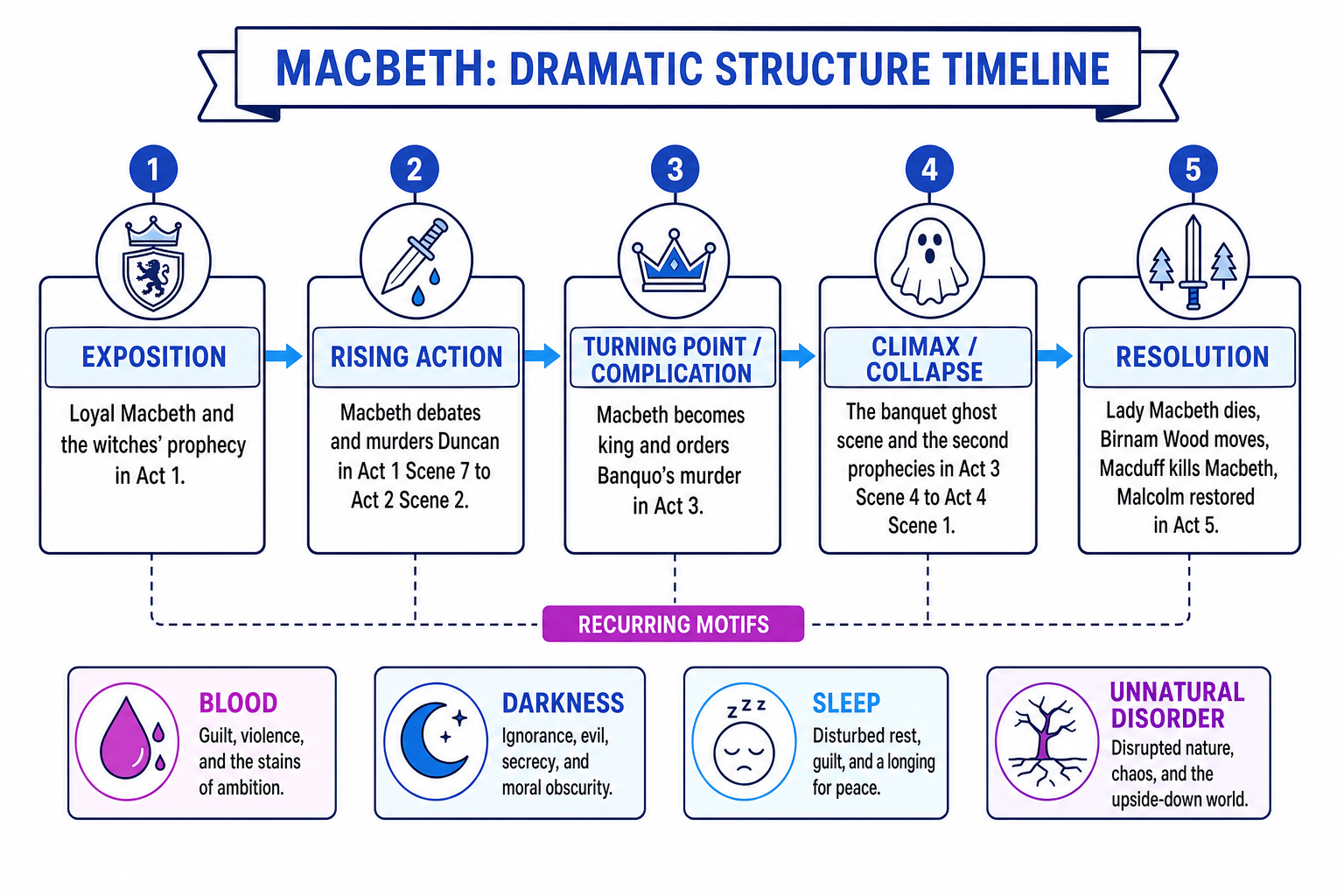
This timeline shows the overall dramatic structure: the arrangement of events across the play.
Structure
Structure means how a text is organised: the order of events, turning points, contrasts, repetitions and endings.
The play’s structure is a fall. Macbeth rises in status — Thane of Glamis, Thane of Cawdor, then king — but falls morally and psychologically. Shakespeare makes that rise feel increasingly unstable. Once Macbeth has the crown, he cannot enjoy it: “To be thus is nothing, but to be safely thus” in Act 3 Scene 1.
That line is crucial because it shows that power does not satisfy Macbeth. It creates fear. He has gained the throne, but not peace.
The main conflict: choice, prophecy and responsibility
The witches tell Macbeth he “shalt be king hereafter” in Act 1 Scene 3. A prophecy is a prediction about the future. But the witches do not directly tell Macbeth to murder Duncan. That gap matters.
Shakespeare keeps the moral responsibility on Macbeth. He imagines murder before anyone else forces him into it: “My thought, whose murder yet is but fantastical” in Act 1 Scene 3. Later, he admits he has “no spur” except “vaulting ambition” in Act 1 Scene 7.
Blaming everything on the witches
Do not write that the witches “make Macbeth kill Duncan”. A stronger answer says they tempt him and use misleading language, but Macbeth still chooses violence.
This gives the play its tension. Macbeth seems caught between fate and free will. Fate means the idea that events are predetermined. Free will means the ability to choose your actions. Shakespeare never makes this completely neat, which is why the play remains interesting.
Shakespeare’s methods at overview level
In Edexcel essays, you need more than plot knowledge. You need to analyse how Shakespeare creates meaning. That means discussing methods: the deliberate choices a writer makes, such as language, form and structure.
Language, form and structure
Language means the words and images Shakespeare chooses. Form means the type of text and its dramatic features, such as soliloquies. Structure means the organisation of events, scenes and contrasts.
Soliloquies: hearing Macbeth think
A soliloquy is a speech where a character speaks their thoughts aloud, usually while alone on stage. Macbeth’s soliloquies are essential because they let the audience see his mind dividing against itself.
In Act 1 Scene 7, Macbeth knows Duncan is virtuous and that murder may bring judgement: “We still have judgement here.” Yet he goes ahead. This makes him morally aware, not ignorant.
Motifs and imagery: repeated patterns of meaning
A motif is a repeated image, idea or symbol across a text. A symbol is something concrete that represents a bigger idea. In Macbeth, blood becomes a motif of guilt and violence. After Duncan’s murder, Macbeth asks: “Will all great Neptune’s ocean wash this blood / Clean from my hand?” in Act 2 Scene 2.
Darkness is another repeated pattern. Macbeth asks, “Stars, hide your fires; / Let not light see my black and deep desires” in Act 1 Scene 4. Light and darkness become linked with moral visibility and concealment.
Dramatic irony and foreshadowing
Dramatic irony happens when the audience knows more than a character on stage. When Duncan calls Macbeth’s castle a “pleasant seat” in Act 1 Scene 6, the audience knows the Macbeths are planning his murder. This makes Duncan’s trust seem innocent and vulnerable.
Foreshadowing is when an earlier detail hints at what will happen later. The witches’ chant “Fair is foul, and foul is fair” in Act 1 Scene 1 foreshadows a world where appearances deceive and moral boundaries become confused.
Analysing darkness imagery
- Start with the quotation: Macbeth says, “Stars, hide your fires; / Let not light see my black and deep desires.”
- Identify the method: Shakespeare uses imagery of light and darkness. “Stars” and “light” suggest moral truth or visibility, while “black” suggests evil and concealment.
- Connect the method to Macbeth’s state of mind: Macbeth knows his desires are morally wrong, so he wants them hidden even from heaven or nature.
- Link to the whole play: this moment prepares the audience for a tragedy where secret ambition becomes public violence.
Context: the world Shakespeare was writing for
Context
Context means the social, historical, political or religious ideas surrounding a text’s creation and reception.
Macbeth was written in the early 1600s, during the reign of King James I. Shakespeare’s audience would likely have taken kingship, treason and witchcraft very seriously.
Regicide means the murder of a king. Duncan’s murder is not treated as just a political crime; it is presented as an offence against God, nature and the nation. Macduff calls it “most sacrilegious murder” in Act 2 Scene 3. Sacrilegious means disrespectful or offensive towards something holy.
The play also reflects fears about disorder. After Duncan’s murder, nature seems disturbed: “The night has been unruly” in Act 2 Scene 3. This links to pathetic fallacy, where weather or nature reflects human emotion or moral chaos.
Witchcraft is also important. King James I was interested in witchcraft and had written Daemonologie. The witches would have seemed more threatening to many Jacobean audience members than they may seem to a modern audience. However, in an essay, context should support your analysis, not replace it.
Using context well
A strong context sentence explains how a Jacobean audience might respond, then links back to Shakespeare’s methods and message. Avoid dropping in historical facts that do not help your point.
Applying context to Duncan’s murder
- Choose a focused quotation: Macduff describes Duncan’s death as “most sacrilegious murder”.
- Identify the contextual idea: in Shakespeare’s society, killing a king could be seen as an attack on divine and political order.
- Analyse the word “sacrilegious”: it makes the murder sound not only criminal but spiritually horrifying.
- Link to meaning: Shakespeare presents Macbeth’s ambition as destructive because it breaks moral, religious and national order at once.
The overview anchors you should know
You do not need to memorise huge chunks at this stage. Aim for short, accurate quotation anchors that connect to the play’s big ideas.
| Big idea | Anchor quotation | Why it matters |
|---|---|---|
| Heroism to corruption | “brave Macbeth” | Establishes Macbeth’s honour before his fall. |
| Prophecy and temptation | “shalt be king hereafter” | Begins Macbeth’s dangerous imagining of power. |
| Hidden ambition | “black and deep desires” | Shows Macbeth knows his thoughts are morally dark. |
| Guilt | “Macbeth does murder sleep” | Suggests murder destroys innocence and peace of mind. |
| Tyranny | “To be thus is nothing” | Shows kingship brings Macbeth fear, not security. |
| Despair | “Life’s but a walking shadow” | Reveals Macbeth’s emptiness near the end. |
What Edexcel wants you to do with this overview
For Edexcel International GCSE English Literature, Macbeth is studied for Component 2, Section B: Literary Heritage. This component is open book, meaning you are allowed a clean copy of the text in the exam. But open book does not mean easy: you still need secure knowledge so that you can find relevant moments quickly and write with confidence.
Your best answers will combine close knowledge of the play with analysis of Shakespeare’s language, form and structure. You should also use context where it genuinely deepens interpretation, especially when writing about kingship, regicide, witchcraft, gender expectations or order and disorder.
Open book does not mean quotation hunting
If you spend the exam searching for quotations, you lose thinking time. Learn a small bank of precise quotations, then use the clean copy to check wording and locate nearby details.
The big takeaway
At overview level, think of Macbeth as a play of movement: from loyalty to treason, from order to chaos, from heroic identity to moral emptiness. Shakespeare does not simply show that ambition is bad. He shows how unchecked ambition changes how a person thinks, speaks, sees others and understands life itself.
In the exam
- Start from the question, then choose one precise moment in the play that helps answer it.
- Link plot to method: explain how Shakespeare’s language, form or structure shapes the audience’s response.
- Use context only when it sharpens your interpretation, especially for kingship, regicide, witchcraft or Jacobean beliefs.
- Keep quotations short and accurate; analyse individual words such as “black”, “sleep”, “sacrilegious” or “butcher”.
Check yourself
- How does Macbeth change from the beginning of the play to the final scene?
- Why is it too simple to say the witches “make” Macbeth murder Duncan?
- Which repeated motif would you use to discuss Macbeth’s guilt, and why?