What you'll learn
- How to separate language, form and structure when analysing Romeo and Juliet.
- How Shakespeare uses imagery, verse, prose, sonnets, foreshadowing and dramatic irony.
- How to turn methods into AO2 analysis: method → effect → meaning.
- How to use your open-book text efficiently in Edexcel IGCSE Component 2.
The three lenses: language, form and structure
When you analyse Shakespeare, you are not just spotting “techniques”. You are explaining how choices shape the audience’s understanding of love, violence, fate, family and death.
Language, form and structure
Language means the words and images Shakespeare gives characters. Form means the type of writing and its conventions, such as tragedy, drama, sonnets, verse and prose. Structure means how the play is arranged: the order of events, contrasts between scenes, turning points, beginnings and endings.
A strong paragraph usually blends all three. For example, Romeo and Juliet’s first meeting is not only romantic language; it is also shaped as a shared sonnet, placed structurally just after the Capulet party begins, so their private harmony appears inside a public world of feud.
The big idea
Shakespeare’s methods often create contrast: love against hate, youth against age, private feeling against public violence, and speed against caution.
Language: words, images and patterns
Figurative language
Figurative language
Figurative language describes one thing through another to create meaning. Common types include metaphor — saying something is something else — and simile — comparing using “like” or “as”.
Romeo’s language is full of idealised love imagery. In the balcony scene, he says, “It is the east, and Juliet is the sun” (Act 2 Scene 2). This is a metaphor: Juliet is not literally the sun, but Romeo presents her as life-giving, beautiful and powerful. The image also suggests that Juliet replaces darkness with light.
Analysing Romeo's light imagery
- Start with the image: Romeo calls Juliet “the sun”, so Shakespeare makes Juliet seem bright, central and almost worshipped.
- Connect the image to character: Romeo’s language shows how intensely and quickly he idealises Juliet, turning love into something cosmic and absolute.
- Link to the wider play: the light image is fragile because the lovers meet at night and are surrounded by danger, so Shakespeare makes their love seem both beautiful and doomed.
Oxymoron and emotional conflict
Oxymoron
An oxymoron places contradictory words together, such as “loving hate”, to show tension, confusion or conflict.
Early in the play, Romeo describes love as “O brawling love, O loving hate” (Act 1 Scene 1). The contradictions sound dramatic, but they also prepare us for the whole play: love and violence are never far apart.
Method plus meaning
Do not write: “Shakespeare uses an oxymoron.” Instead, write: “Shakespeare uses the oxymoron ‘loving hate’ to show that love in Verona is already tangled with conflict.”
Religious imagery
When Romeo and Juliet first speak, their language is full of religion: “holy shrine”, “pilgrims”, “saints” and “sin” (Act 1 Scene 5). This makes their attraction feel sacred rather than merely physical. However, it also creates tension because they are from enemy families and later marry secretly.
Their shared language turns a forbidden meeting into something that feels spiritually meaningful. Shakespeare makes the audience want their love to succeed, even though the Prologue has already told us they are “star-cross’d lovers”.
Form: drama, tragedy, verse and prose
The play as a tragedy
Tragedy
A tragedy is a dramatic form in which serious conflict leads to suffering, death and a final recognition of what has gone wrong.
Romeo and Juliet is tragic because the ending is announced from the beginning: “A pair of star-cross’d lovers take their life” (Prologue). The audience watches the lovers move towards a catastrophe they cannot avoid.
This creates dramatic irony.
Dramatic irony
Dramatic irony happens when the audience knows more than one or more characters on stage.
For example, in Act 5 Romeo believes Juliet is dead, but the audience knows she has taken the Friar’s potion. This makes his actions horrifyingly tense because we understand that his suicide is based on incomplete knowledge.
Blank verse and iambic pentameter
Blank verse and iambic pentameter
Blank verse is unrhymed poetry, often written in iambic pentameter: lines with five pairs of syllables, usually moving from an unstressed beat to a stressed beat.
Many noble characters speak in blank verse. This gives their speech dignity and emotional intensity. When the rhythm becomes broken or irregular, it can suggest emotional pressure.
Juliet’s speech often shows intelligence and intensity. In Act 3 Scene 2, she longs for night: “Gallop apace, you fiery-footed steeds”. The urgent imperative “Gallop” and the energetic image of “fiery-footed” horses show desire, impatience and dramatic speed.
Prose and social world
Prose
Prose is ordinary speech that is not arranged into regular poetic lines.
Characters such as the Nurse and servants often speak in prose. This can create comedy, realism and social contrast. The Nurse’s rambling memories and earthy humour bring everyday life into the play, which makes the later tragedy feel even harsher.
Verse does not always mean noble feelings
Do not assume verse always means “good” and prose always means “low status”. Shakespeare can use either form flexibly. The key is to ask what the change in form does in that moment.
The shared sonnet
Sonnet
A sonnet is a fourteen-line poem traditionally associated with love. Shakespeare uses the sonnet form when Romeo and Juliet first meet.
At the Capulet party, Romeo and Juliet build a sonnet together. Their lines fit into one poetic structure, suggesting instant harmony. The form makes their connection seem unusually balanced: they complete each other’s rhythm and imagery.
Explaining the shared sonnet
- Identify the formal choice: Romeo and Juliet’s first conversation forms a sonnet, a poetic form associated with love.
- Explain the effect: because they share the structure, Shakespeare presents their attraction as mutual rather than one-sided.
- Add contrast: this private harmony happens at a public Capulet feast, so their unity is surrounded by social division and family hatred.
Structure: how the tragedy is built
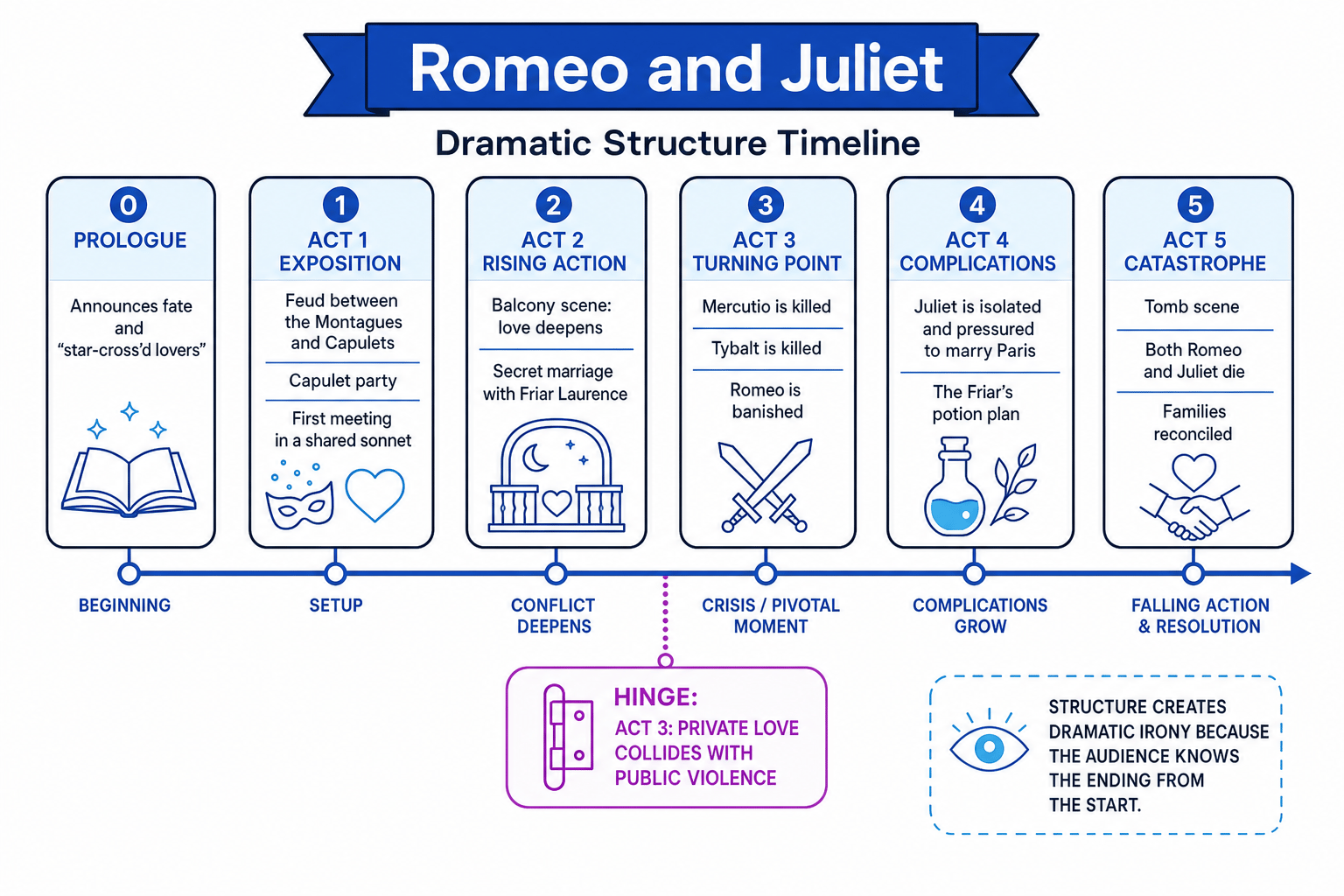
Shakespeare structures the play so that it feels fast, pressured and unavoidable. The Prologue tells us the ending first, then the action moves rapidly from meeting to marriage, banishment, the potion plan and death.
It helps to see the whole tragic shape of the play as a timeline.
The Prologue: fate and foreshadowing
Foreshadowing
Foreshadowing is when a writer hints at events that will happen later.
The Prologue calls the lovers “star-cross’d”, linking their deaths to fate and astrology. It also describes their relationship as “death-mark’d love”. Shakespeare therefore frames love and death together before the characters even appear.
The effect is not to remove tension, but to change it. The audience is not asking, “Will they die?” Instead, we ask, “How will this happen, and could it have been prevented?”
Act 3 as the turning point
Turning point
A turning point is the moment when the direction of the plot changes decisively.
Act 3 Scene 1 is the structural hinge of the play. Before it, the plot is driven mainly by secrecy, excitement and romantic possibility. After Mercutio and Tybalt die, Romeo is banished, and the lovers’ private marriage becomes trapped inside public violence.
Analysing Act 3 as a turning point
- Compare before and after: before Act 3, Romeo and Juliet’s love still has possible futures; after Act 3, banishment makes ordinary married life impossible.
- Link events to theme: Mercutio’s curse, “A plague o’ both your houses!”, shows that the feud destroys people beyond the two families’ main heirs.
- Explain structure: Shakespeare places this violence immediately after the secret marriage, so hope turns quickly into disaster and the pace of tragedy accelerates.
Speed and compression
The play takes place over only a few days. This compressed structure makes the lovers’ relationship feel urgent and intense. It also makes adult decisions seem dangerously rushed: Capulet suddenly pushes Juliet towards Paris, the Friar attempts a risky plan, and Romeo acts before receiving the full truth.
Friar Lawrence warns, “These violent delights have violent ends” (Act 2 Scene 6). Structurally, this warning is important because the play proves him right: intense passion in a violent society burns out quickly.
Do not blame fate alone
The Prologue stresses fate, but Shakespeare also shows human choices: the feud, Tybalt’s aggression, Capulet’s pressure, Friar Lawrence’s secrecy and Romeo’s impulsiveness. A top answer can hold both ideas together.
Motifs and repeated contrasts
Motif
A motif is a repeated image, idea or pattern that develops meaning across a text.
Important motifs in Romeo and Juliet include light and darkness, stars, poison, speed, names, and death-as-marriage imagery.
Juliet’s line “My only love sprung from my only hate” (Act 1 Scene 5) captures the play’s central pattern. The repetition of “only” makes the discovery feel absolute and shocking. Structurally, it comes just after the lovers’ first meeting, so Shakespeare turns romance into danger almost immediately.
Misreading 'wherefore'
When Juliet says, “O Romeo, Romeo, wherefore art thou Romeo?” (Act 2 Scene 2), “wherefore” means “why”, not “where”. She is asking why he must be Romeo — a Montague — not where he is.
Writing about methods in Edexcel IGCSE
For Edexcel IGCSE Component 2, Romeo and Juliet is in the open-book paper, so you may use a clean copy of the text. However, open book does not mean you should spend ages searching. You need secure knowledge of key scenes and short quotations.
A useful analytical pattern is:
Point → evidence → method → effect → link
For example:
Shakespeare presents Romeo and Juliet’s love as beautiful but dangerously idealised. When Romeo sees Juliet, he says, “It is the east, and Juliet is the sun.” The metaphor makes Juliet seem life-giving and almost heavenly, showing the intensity of Romeo’s attraction. However, because this light appears in a play already framed by “death-mark’d love”, Shakespeare also suggests that beauty and danger are closely connected. This supports the tragic idea that private love cannot survive safely in Verona’s violent public world.
In the exam
- Choose short, precise quotations and analyse one or two words closely rather than copying long speeches.
- Name methods only when you can explain their effect: metaphor, oxymoron, dramatic irony, sonnet form, blank verse, prose, foreshadowing or motif.
- Use the open-book text to check accuracy, but rely on your memory of key scenes so you do not lose time searching.
Check yourself
- How does the Prologue shape the audience’s response to the rest of the play?
- Why is Romeo and Juliet’s first conversation being a shared sonnet important?
- What changes structurally after Act 3 Scene 1?