For Pearson Edexcel International GCSE English Literature (Specification 4ET1), Romeo and Juliet is assessed in Component 2, Section B (Literary Heritage). Because this is an open-book examination, you are allowed to take a clean copy of the play into the exam room.
This means your primary challenge is not memorizing long chunks of text. Instead, your success depends on your ability to quickly locate, select, and "explode" high-yield quotations—interpreting how Shakespeare's language, structure, and dramatic methods create meaning, while linking your analysis directly to Elizabethan context.
What you'll learn
- How to select "high-yield" quotations that allow for deep, multi-layered analysis.
- The critical thematic and contextual connections for key quotations across the play.
- A step-by-step method to dismantle and analyze Shakespearean language and structure in your exam essays.
1. The Strategy of "High-Yield" Quotations
In a literary heritage essay, you are assessed on three primary Assessment Objectives:
- AO1: Demonstrated understanding of plot, character, and theme through close textual reference.
- AO2: Analysis of how the writer uses language, form, and structure to achieve effects.
- AO3 is not assessed in this section (as it is reserved for poetry comparison), but AO4 is crucial: exploring the relationship between the text and its historical, social, and cultural context.
To score in the highest level, you must avoid "quote-dumping" (inserting a quotation simply to prove a plot point) and instead focus on close-word analysis.
High-Yield Quotation
A high-yield quotation is a short, dense passage of text that contains multiple literary methods, relates directly to central themes, and reflects the socio-historical context of the era.
Rather than highlighting long blocks of text in your study copy, focus on short phrases of 3 to 7 words. These are easier to embed seamlessly into your sentences, keeping your writing fluid and analytical.
Less is More in Open-Book Exams
Do not waste precious exam time flipping through your text looking for obscure lines. Prepare a mental "bank" of 15–20 short, highly versatile quotations that can adapt to almost any prompt (e.g., fate, conflict, gender roles, or death).
2. Master Quotations: Categorized by Theme
Let's explore several of the most powerful quotations in Romeo and Juliet. We will look at what they mean, how they are constructed, and how they connect to the world of Elizabethan England.
Theme A: Fate, Destiny, and Cosmic Determinism
Shakespeare's audience believed heavily in astrology, providence, and the idea that human lives were ruled by a divine plan or written in the stars.
Quote 1: "A pair of star-cross'd lovers take their life" (Prologue)
- Method: Metaphor, alliteration, foreshadowing.
- Analysis: The astrological metaphor "star-cross'd" implies that the heavens themselves are actively working against Romeo and Juliet. The stars represent fate; if they are "crossed," the planetary alignment is unfavorable, guaranteeing failure.
- Structure: Written in the prologue (a Shakespearean sonnet), this line tells the audience the ending before the play even starts. This creates dramatic irony that hangs over every romantic moment in the play, reminding the audience that their love is doomed.
- Context (AO4): Reflects the Elizabethan belief in the Wheel of Fortune (Rota Fortunae) and astrology—the belief that human destiny was governed by celestial bodies.
Dramatic Irony
A dramatic device where the audience knows vital information about the plot or characters that the characters themselves do not know. This heightens tension and shapes how the audience interprets actions.
Quote 2: "O, I am fortune's fool!" (Act 3, Scene 1)
- Method: Personification, alliteration.
- Analysis: Spoken by Romeo immediately after slaying Tybalt. By personifying "Fortune," Romeo positions himself as a helpless plaything or "fool" (an entertainer or pawn) kept for destiny's amusement. The harsh alliteration of the "f" sound conveys his sudden, breathless realization of his ruin.
- Dramatic Effect: This is the absolute turning point (the peripeteia or climax) of the tragedy. From this moment onward, the momentum shifts irrevocably toward catastrophe.
Theme B: The Tension of Love and Death
In Romeo and Juliet, love and violence are not opposites; they are constantly intertwined.
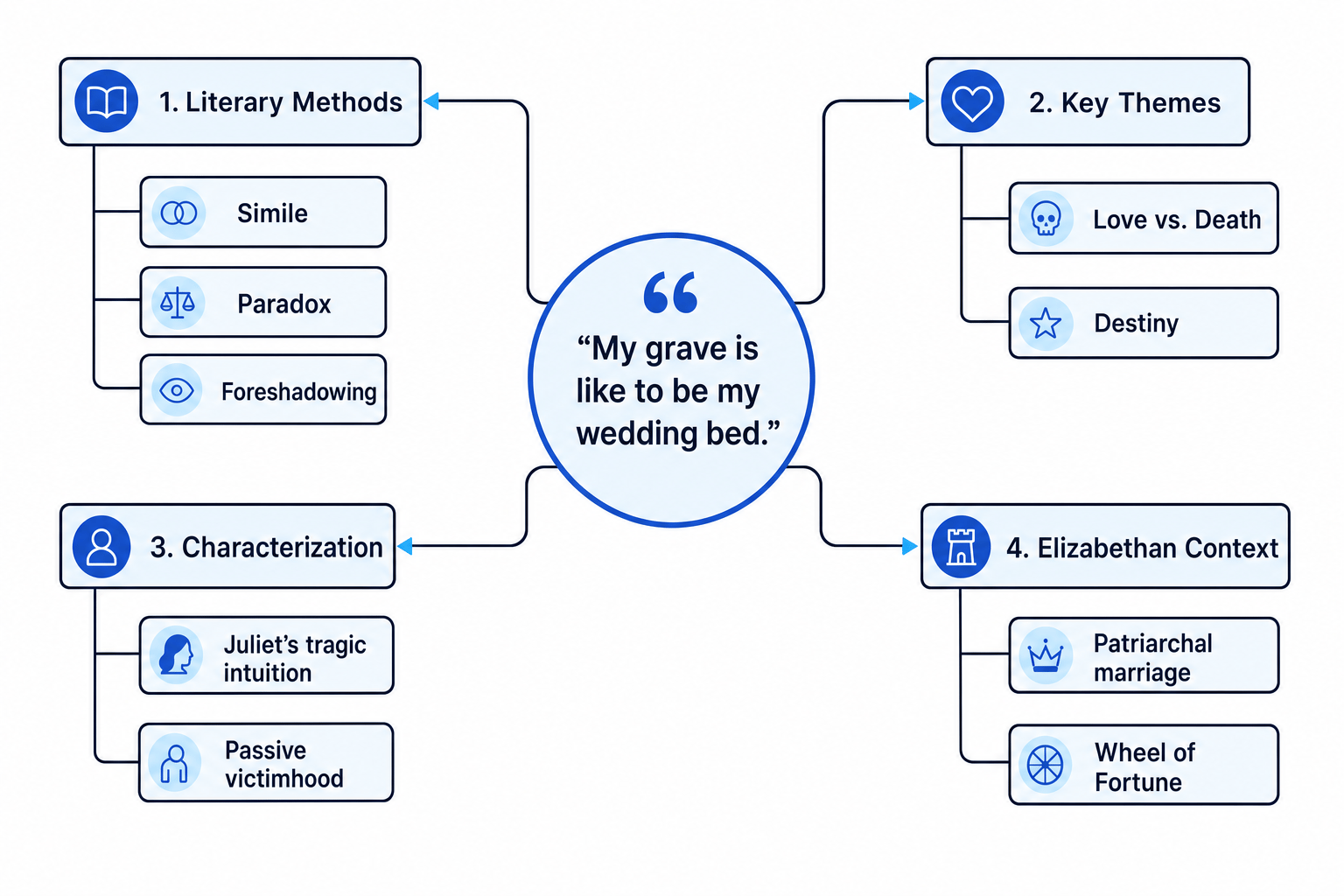
Quote 3: "My grave is like to be my wedding bed." (Act 1, Scene 5)
- Method: Paradox, simile, foreshadowing.
- Analysis: Spoken by Juliet before she even knows Romeo's identity. She states that if he is married, she will die unwed. This creates a powerful paradox—the joining of two completely opposite concepts: the "grave" (associated with decay and isolation) and the "wedding bed" (associated with life, consummation, and new beginnings).
- Context (AO4): In a patriarchal Elizabethan society, marriage was the primary destiny for a young noblewoman. By aligning her marriage with her death, Juliet unconsciously outlines the tragic trajectory of the play, where her defiance of her family’s patriarchal authority ultimately leads to the tomb.
Theme C: Light and Dark Imagery
Romeo and Juliet's love is consistently associated with brilliant light (torches, stars, lightning, the sun) that flashes briefly against an overwhelming background of darkness (the night, the feud, death).
Quote 4: "Juliet is the sun." (Act 2, Scene 2)
- Method: Metaphor, celestial imagery.
- Analysis: Romeo uses a direct metaphor to compare Juliet to the center of the solar system. The sun represents light, warmth, life, and spiritual purity. By extension, Romeo implies that without her, his world is in total darkness and decay.
- Structure: This is spoken in a soliloquy (when a character speaks their inner thoughts aloud alone on stage). The private nature of this statement underscores its sincerity, contrasting with the superficial "courtly love" Romeo previously felt for Rosaline.
Soliloquy
A dramatic speech delivered by a character alone on stage, revealing their innermost thoughts, feelings, and motives directly to the audience, bypassing other characters.
Calling Juliet the Sun a Simile
Do not write that "Juliet is the sun" is a simile. A simile uses "like" or "as" (e.g., "like the sun"). A direct assertion ("is the sun") is a metaphor. Confusing these basic terms instantly lowers your AO2 mark.
3. Exploding a Quotation: Step-by-Step Analysis
Let's look at how to construct a high-scoring analytical paragraph in your Edexcel exam. We will use Juliet's premonition as she watches Romeo climb down from her balcony in Act 3, Scene 5:
"Methinks I see thee, now thou art so low, / As one dead in the bottom of a tomb"
Analyzing Juliet's Premonition
Analyse how Shakespeare uses language and dramatic devices in this quotation to convey Juliet's state of mind and foreshadow the tragedy.
- Situate the quote within the dramatic structure of the play. This moment occurs immediately after the couple’s sole night together, just as Romeo is forced to descend into exile. Structurally, it marks the transition from the private, safe world of the night to the dangerous, public world of day.
- Identify the literary and structural methods employed. The passage utilizes a simile ("As one dead...") alongside visual imagery of descent and depth ("so low", "bottom of a tomb"). It is also a stark instance of foreshadowing and prophetic irony.
- Analyse the specific word choices and their psychological effects (AO2). The adjective "low" functions on two levels: physically, Romeo is descending the rope ladder to the ground, but metaphorically, it signals their descent into tragedy. The phrase "bottom of a tomb" creates a chilling, claustrophobic image. Juliet’s internal perspective ("Methinks I see thee") shifts from reality to a terrifying psychic vision, emphasizing her psychological isolation and vulnerability.
- Connect the analysis to Elizabethan tragic conventions and context (AO4). In the Elizabethan era, sudden premonitions of death were viewed as warnings from God or fate. By visualizing Romeo dead in a tomb, Juliet's language aligns with the overarching theme of cosmic determinism—she cannot escape the doom predetermined by her "star-cross'd" destiny, and the next time she sees him in person, he will indeed be dead in her tomb.
Embed Your Quotes
Instead of writing: Juliet says, "Methinks I see thee, now thou art so low." This shows she is worried. Try embedding: As Romeo descends, Juliet’s terrifying premonition that he looks like "one dead in the bottom of a tomb" transforms their physical separation into a stark foreshadowing of their ultimate doom. This demonstrates advanced control over your prose (AO1) and directly targets AO2.
In the exam
If you are aiming for Level 5 (top marks) in your Romeo and Juliet essay, apply this system:
- Keep it brief: Never copy out more than a line or two of text. The more compact your quotation, the more space you leave yourself to analyze individual words.
- Unpack double meanings: Focus on words with multiple connotations. For example, in "I am fortune's fool!", analyze how "fool" means both a victim of trickery and a royal entertainer.
- Anchor every quote to a method: Do not just say "This quote means..." Name the technique (e.g., sibilance, antithesis, iambic pentameter, dramatic irony) and explain why Shakespeare used it.
- Weave context into the language analysis: Never write a separate "context paragraph." Instead, explain how a word choice (like "star-cross'd") directly reflects the beliefs of Shakespeare's audience.
Check yourself
Use these questions to test your knowledge of key quotes and their implications:
- Identify the speaker, scene, and tragic significance of the line: "A plague o' both your houses!"
- What specific literary device is used when Juliet describes Romeo as a "beautiful tyrant, fiend angelical" in Act 3, Scene 2, and what does this reveal about her state of mind?
- How does the light/dark imagery of Romeo’s balcony speech ("Juliet is the sun") contrast with the literal darkness of the Capulet tomb in Act 5?