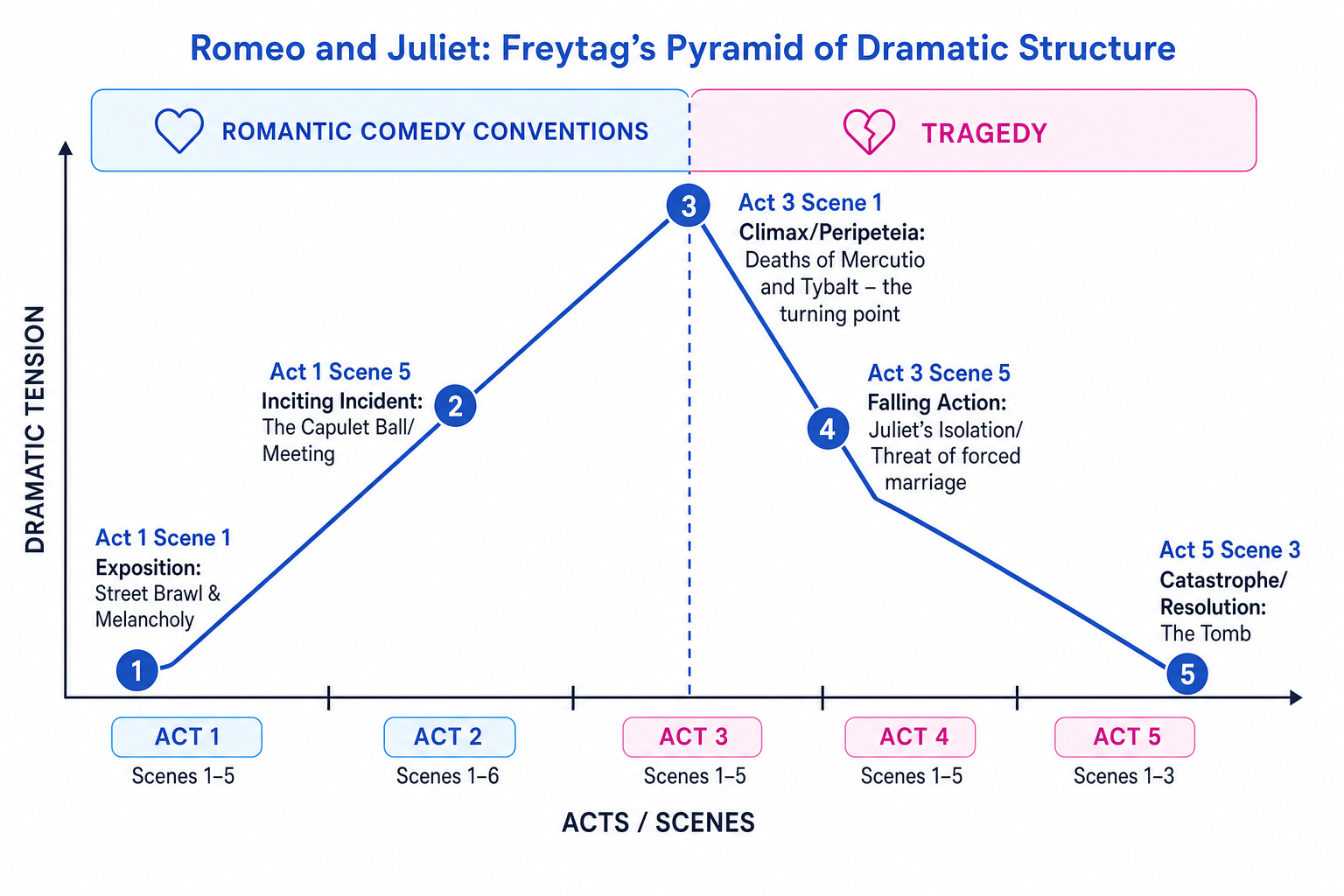
Now, let us examine these key scenes in detail, focusing on how you can dissect them in your exam.
1. Act 1, Scene 1: The Outbreak of Violence and Melancholy
Why this scene matters structurally
This is the play's exposition. Shakespeare uses it to establish the main forces driving the tragedy: the ancient, irrational feud, the threat of civic disorder, and the courtly love conventions that isolate Romeo.
Key thematic and linguistic techniques
- The Servants' Crude Humor: The play opens not with noblemen, but with the servants Sampson and Gregory. Their bawdy puns ("thrust Capulet's maids to the wall") reveal how deeply the feud has poisoned Veronese society. Violence is linked with sexual aggression and toxic masculinity.
- The Contrast of Romeo: When we first meet Romeo, he is absent from the brawl, wallowing in unrequited love for Rosaline. Shakespeare uses oxymorons to show Romeo's internal confusion:
"O brawling love, O loving hate [...] O heavy lightness, serious vanity"
— Romeo, Act 1, Scene 1
Oxymoron
An oxymoron is a figure of speech in which apparently contradictory terms appear in conjunction. Shakespeare uses them here to signal Romeo’s artificial, cliché-ridden infatuation (the "Petrarchan lover" trope), which contrasts sharply with the real, visceral love he later experiences with Juliet.
2. Act 1, Scene 5: The Capulet Ball (The Meeting)
Why this scene matters structurally
This is the inciting incident. The romantic and tragic plotlines collide in a highly charged public setting.
Key thematic and linguistic techniques
- Juxtaposition of Love and Hate: Shakespeare masterfully structures this scene by placing Tybalt's aggressive vows of vengeance directly alongside Romeo and Juliet's quiet, intimate first meeting.
- The Sacred Sonnet: When Romeo and Juliet speak, their dialogue interlocks to form a perfect 14-line Shakespearean sonnet:
ROMEO: If I profane with my unworthiest hand... (4 lines, abab)
JULIET: Good pilgrim, you do wrong your hand too much... (4 lines, cdcd)
ROMEO: Have not saints lips, and holy palmers too? (4 lines, efef)
JULIET/ROMEO: (2 lines concluding the rhyme scheme, gg)
By using religious imagery ("holy shrine", "pilgrim", "saints", "sin"), Shakespeare elevates their love above the crude, physical desires of the servants or the transactional, political marriage proposed between Juliet and Paris.
Missing the Sonnet Structure
Many students write that Romeo and Juliet "speak poetically." To get top marks for AO2, you must name the specific form: it is a shared sonnet. This structure visually and aurally demonstrates their perfect, instant compatibility. They literally complete each other’s rhymes.
3. Act 3, Scene 1: The Turning Point
Why this scene matters structurally
This is the climax or peripeteia (the sudden reversal of fortune). The hot summer heat of Verona reaches a boiling point, resulting in the deaths of Mercutio and Tybalt, and Romeo’s banishment.
Peripeteia
Peripeteia is a sudden reversal of fortune or change in circumstances, especially in a tragedy. In this scene, Romeo's fortunes collapse from newlywed joy to tragic exile in a matter of minutes.
Key thematic and linguistic techniques
- The Pathetic Fallacy: Benvolio warns that "these hot days is the mad blood stirring." Shakespeare uses the sweltering heat to mirror the rising physical tension and irritability of the characters.
- Mercutio's Curse: As he dies, Mercutio repeats three times: "A plague o' both your houses!" This curse acts as a pivotal moment of foreshadowing, stripping away the romantic illusion of the play and condemning the feud.
- Romeo’s Hamartia: Driven by grief and peer pressure, Romeo abandons his attempt to love Tybalt and succumbs to "fire-eyed fury." After slaying Tybalt, he cries:
"O, I am fortune's fool!"
— Romeo, Act 3, Scene 1
This line highlights a core theme: the struggle between free will and fate (AO4). To an Elizabethan audience, "Fortune" was a capricious goddess spinning a wheel; Romeo realizes he is merely a puppet in a cosmic game.
Analysing Dramatic Structure and Language in Act 3, Scene 1
Let's look at how to construct a high-level analytical response to a question about how tension is built in this scene.
Question: Explore how Shakespeare creates dramatic tension in Act 3, Scene 1.
Step-by-step analysis:
- Identify the macro-structural context: Start by situating the scene as the tragic turning point. State how the mood changes from the comedic, domestic bliss of the secret wedding in the previous scene (Act 2, Scene 6) to the public, sun-drenched street.
- Analyse structural contrast and dramatic irony (AO2): Point out that the audience has just witnessed Romeo and Juliet's wedding. Therefore, when Tybalt calls Romeo a "villain," the audience holds superior knowledge (dramatic irony). We know Romeo cannot fight Tybalt because they are now family, but Mercutio and Tybalt are entirely unaware. This gap in knowledge creates unbearable tension.
- Conduct close language analysis of Romeo's submission (AO2): Examine Romeo's refusal to fight: "I do protest I never injured thee, / But love thee better than thou canst devise." The verb "love" would shock Tybalt and outrage Mercutio, who views this as "calm, dishonourable, vile submission." Note how the adjectives "dishourable" and "vile" reflect the Elizabethan obsession with masculine honor.
- Connect to context (AO4): Explain that in Elizabethan England, dueling was illegal but common. Men of noble status were expected to defend their honor at all costs. Romeo's refusal to fight violates these strict societal expectations, forcing Mercutio to step in, which directly triggers the tragic chain of events.
4. Act 3, Scene 5: Patriarchal Tyranny
Why this scene matters structurally
Following the consummation of their marriage, this scene functions as Juliet’s personal tragedy. One by one, her support systems collapse: her father threatens her, her mother abandons her, and her Nurse betrays her trust.
Key thematic and linguistic techniques
- The Dawn Motif: The scene begins with the debate between the nightingale (symbolising secrecy and love) and the lark (symbolising harsh reality and the coming day). Day, which normally represents hope, here brings tragedy: "More light and light, more dark and dark our woes."
- Lord Capulet’s Verbal Violence: When Juliet refuses to marry Paris, Lord Capulet explodes into furious, abusive language, calling her "baggage," "wretch," and a "green-sickness carrion."
"An you be mine, I'll give you to my friend;
An you be not, hang, beg, starve, die in the streets"
— Lord Capulet, Act 3, Scene 5
Elizabethan Marriage Context (AO4)
Remember that in Elizabethan England, upper-class daughters were considered the legal property of their fathers. Lord Capulet's rage is not just bad parenting; it is an assertion of legal, economic, and patriarchal authority. His threat to let her starve was a highly realistic and terrifying prospect for a young woman of Juliet's class.
5. Act 5, Scene 3: The Capulet Tomb
Why this scene matters structurally
This is the catastrophe and resolution of the play. In this dark, Gothic setting, all of Shakespeare’s motifs—love, death, light, and dark—converge.
                  ┌─────────────────────────────┐
                  │      THE CAPULET TOMB       │
                  └──────────────┬──────────────┘
                                 │
         ┌───────────────────────┴───────────────────────┐
         ▼                                               ▼
   LOVE & DEATH CONVERGE                           THE RESOLUTION
   • Tomb is a "maw" (stomach)                     • Prince's final verdict
   • Romeo drinks poison                           • Feud ends in grief
   • Juliet's "happy dagger"                       • Golden statues promised
Key thematic and linguistic techniques
- The Metaphor of the Tomb as a Monster: Romeo describes the tomb as a "detestable maw" (stomach) and a "womb of death" that has gorged on "the dearest morsel of the earth" (Juliet). This personification emphasizes the unnatural devourment of youth by the ancestral feud.
- The Paradox of Light in Dark: Even in the pitch-black tomb, Romeo claims Juliet’s beauty "makes / This vault a feasting presence full of light." Shakespeare uses this final burst of light imagery to show that their love remains untarnished by the sordid world of Verona.
- The Tragic Resolution: When Juliet wakes to find Romeo dead, she does not hesitate. She calls the dagger "happy" because it will reunite her with her husband. The quick monosyllabic pacing of her final lines ("O happy dagger! / This is thy sheath; there rust, and let me die") contrasts with Romeo's long, poetic farewell, showing her decisive tragic heroism.
In the exam
To achieve the highest marks on the Romeo and Juliet exam question:
- Map the Scene's Location: Always state where the scene you are discussing fits within the play's overall five-act trajectory. Is it building comedy (Acts 1–2) or descending into tragic inevitability (Acts 3–5)?
- Integrate Context Naturally: Don't just "dump" historical facts. Tie your context directly to Shakespeare's dramatic choices. For example: “Capulet’s threat to let Juliet ‘starve’ in Act 3 Scene 5 reflects the rigid patriarchal structures of Elizabethan society, wherein a daughter's defiance of arranged marriage was viewed as a direct assault on family honor and economic stability.”
- Look for Structural Echoes: Show the examiner you see the play as a whole. Mention how Juliet's early foreshadowing in Act 1, Scene 5 ("My grave is like to be my wedding bed") is literally realized in Act 5, Scene 3 when she dies upon Romeo's body.
Check yourself
- Why is the transition from prose to poetry (and specifically the sonnet form) in Act 1, Scene 5 structurally significant?
- How does Shakespeare use the natural elements (weather, day/night) to parallel the changing fortunes of the characters from Act 3, Scene 1 to Act 3, Scene 5?
- What is the difference in how Romeo and Juliet face their deaths in Act 5, Scene 3, and what does this reveal about their respective characters?