Welcome to your study guide for Christina Rossetti’s beautiful and poignant poem, "Remember". Written in 1849 and published in 1862, this poem is a staple of Victorian literature. It explores the complex emotions surrounding death, grief, and the selfless nature of true love.
For your Edexcel IGCSE English Literature exam (Specification 4ET1), "Remember" is part of the Anthology's Section B (Part 3). In the exam, you will be asked to compare this poem with another from the anthology, focusing on how the poets present shared themes.
What You'll Learn
- The core conflict: How the speaker’s desire to be remembered transitions into a selfless wish for her beloved's happiness.
- Structural architecture: How Rossetti utilizes and adapts the traditional Petrarchan sonnet form to mirror her internal psychological shift.
- Language and imagery: The subtle linguistic devices—such as euphemism, repetition, and shifts in mood—that convey complex feelings about mortality.
- Comparative strategy: How to link "Remember" to other anthology poems for maximum marks in your comparative essay.
Understanding the Poem: Meaning and Trajectory
At its heart, "Remember" is a lyric poem addressed to a beloved. The speaker is contemplating her own imminent death and instructing her partner on how to cope after she is gone.
However, the poem does not maintain a single emotional state. Instead, it traces a psychological journey. It begins with a slightly possessive, anxious demand to be kept alive in the beloved’s memory, but pivots to a mature, selfless acceptance that forgetting may be necessary for the living to find peace.
Euphemism
A euphemism is a mild, indirect, or vague expression used in place of one considered harsh, blunt, or unpleasant. Rossetti uses euphemisms for death to soften the terrifying reality of mortality.
In the opening lines, the speaker avoids the harsh words "death" or "dying." Instead, she writes:
"Remember me when I am gone away, / Gone far away into the silent land;"
Here, "the silent land" acts as a powerful euphemism for the afterlife or the grave. The adjective "silent" suggests a place of absolute isolation, where communication between the lovers is permanently severed. This emphasizes the absolute boundary of death, explaining why the speaker is so desperate to cling to memory.
The Selfless Pivot
The ultimate takeaway of "Remember" is that true, mature love is selfless. The speaker's initial, human desire to be remembered (grief-driven and self-focused) is conquered by her deeper desire to protect her beloved from pain (love-driven and other-focused).
Structural Mastery: The Anatomy of the Sonnet
To understand how Rossetti delivers this emotional transition, we must look at the poem's structure. Rossetti chooses the traditional Petrarchan sonnet form.
Petrarchan Sonnet
A Petrarchan sonnet is a 14-line poem written in iambic pentameter, traditionally divided into two main parts: an octave (the first eight lines) and a sestet (the final six lines). The transition between the two is marked by a thematic or emotional shift known as the volta.
Let’s look at how Rossetti uses this structure to map her changing thoughts:
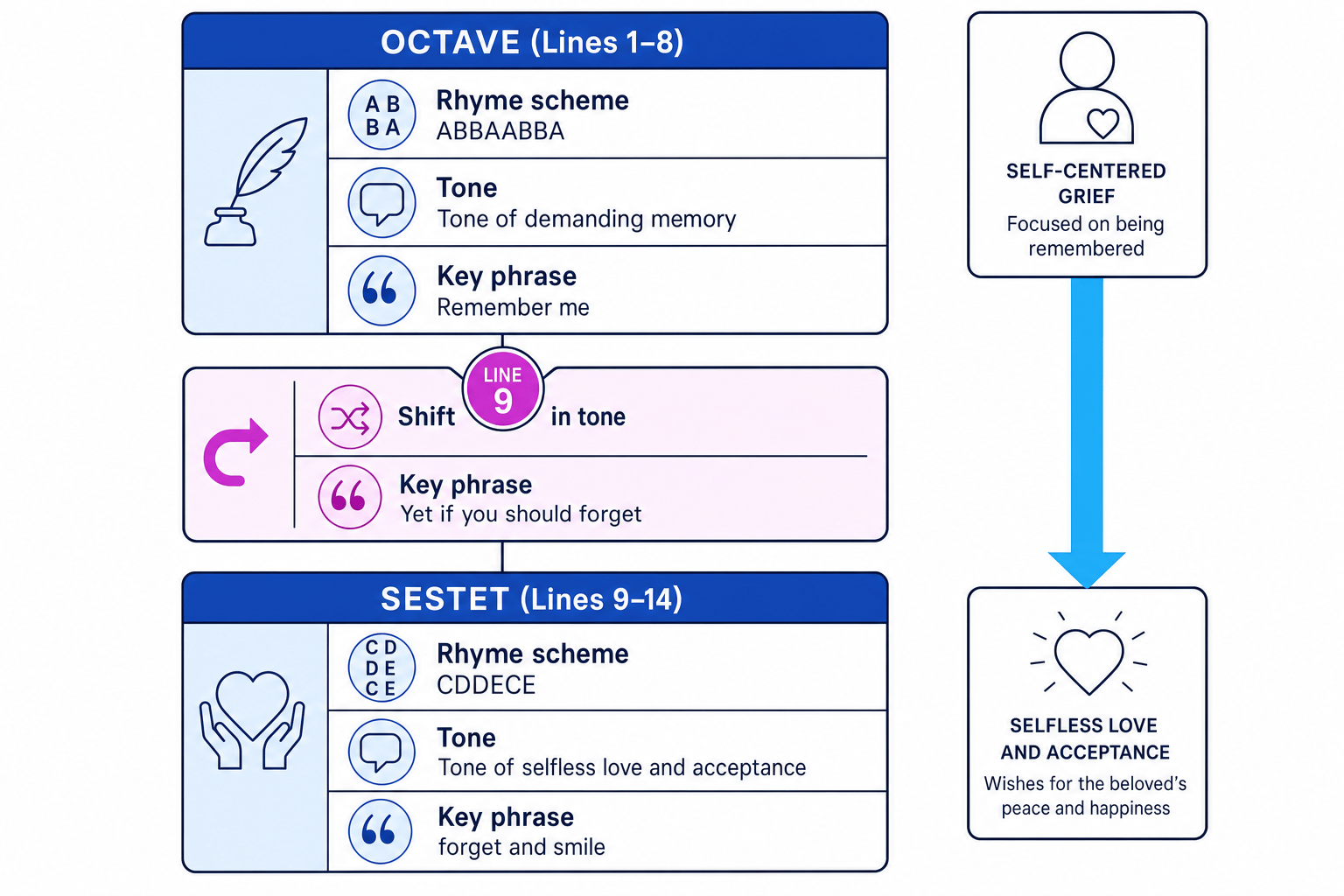
1. The Octave (Lines 1–8)
The octave follows a strict ABBAABBA rhyme scheme. This tight, repetitive structure mirrors the speaker's obsessive, circular thoughts about being forgotten.
- The Imperative Tone: The octave is dominated by the command "Remember me", which is repeated three times.
- The Physicality of Loss: Rossetti highlights physical intimacy: "When you can no more hold me by the hand". The loss of physical touch is what makes memory so vital to her.
- Control: The speaker notes how they used to plan their future together: "You tell me of our future that you planned". The passive role of the speaker here hints at a relationship where she felt led, making her current attempt to control the future through her commands even more striking.
2. The Volta (Line 9)
The volta (or "turn") arrives exactly at line 9:
"Yet if you should forget me for a while..."
The conjunction "Yet" signals an immediate shift in tone, rhyme, and outlook. The speaker moves away from the rigid demands of the octave and introduces a conditional element ("if you should"), showing a softening of her resolve.
3. The Sestet (Lines 9–14)
The sestet introduces a new rhyme scheme (CDDECE). This structural break from the octave reflects a release of tension.
- Acceptance: The speaker realizes that her insistence on being remembered could cause pain.
- Absolution: She gives her beloved permission to forget her, prioritizing their emotional well-being over her own legacy:
"Better by far you should forget and smile / Than that you should remember and be sad."
Wasting Time on Context in Section B
In the Edexcel IGCSE exam, Section B (Anthology Poetry) does NOT assess AO4 (Context). While knowing that Rossetti was a Victorian writer helps you understand her preoccupation with death and mourning, do not waste precious exam time writing paragraphs about the Pre-Raphaelite Brotherhood, Victorian mourning dress, or her religious devotion. You will receive zero marks for context here! Focus 100% on close language, form, and structural analysis (AO2) and comparisons between the poems (AO3).
Deep-Dive Language and Imagery Analysis
To score highly on AO2, you must analyze how Rossetti uses specific linguistic devices to construct meaning. Let's look at three key methods she employs:
Iambic Pentameter and Rhythmic Disruption
The poem is written in iambic pentameter (ten-syllable lines following a da-DUM da-DUM heartbeat pattern). This regular rhythm mimics a steady heartbeat, contrasting with the theme of death.
However, Rossetti subtly disrupts this meter at key moments. For instance, in the opening line:
"Re-mem-ber me..."
By starting with a trochee (a stressed syllable followed by an unstressed syllable: DUM-da) instead of an iamb (da-DUM), Rossetti places massive emphasis on the very first syllable of the poem. The word "Remember" demands immediate attention, mimicking the speaker’s urgency.
The Semantic Field of Transition and Distance
Rossetti utilizes a semantic field of departure to emphasize the growing distance between the living and the dead:
- "gone away"
- "gone far away"
- "silent land"
- "no more"
This language is quiet and gentle. There are no gothic images of decay or graves; instead, death is presented as a quiet, albeit permanent, relocation. This gentle presentation makes the speaker’s eventual selflessness feel more natural and peaceful.
Monosyllabic Simplicity
In the final lines of the poem, Rossetti shifts from complex, multi-syllable words to simple, monosyllabic language:
"Better by far you should forget and smile"
Almost every word in this line is a single syllable. This stripped-back language reflects absolute clarity and emotional honesty. The speaker has discarded all ornate, defensive language; she is left with a simple, pure wish for her beloved’s happiness.
Analyzing the transition at the volta
Here is how you can write a high-level analytical paragraph tracing the transition at the volta, demonstrating both AO2 (analysis of structure and language) and preparing you for a comparative essay (AO3).
-
State your analytical point clearly, focusing on structure and theme: Rossetti uses the structural transition of the Petrarchan sonnet's volta to shift the poem’s tone from a self-centric fear of erasure to a selfless act of love.
-
Introduce and embed precise textual evidence from both sides of the transition: While the octave is defined by the repetitive, imperative command to "Remember me", line 9 introduces a dramatic shift with the coordinator, "Yet if you should forget me for a while".
-
Analyze the literary and grammatical methods used by the poet: The conjunction "Yet" acts as the formal volta, immediately disrupting the rigid, possessive tone established by the repetitive 'ABBA' rhyme scheme of the octave. This shift is accompanied by a grammatical transition from the imperative mood ("Remember") to the subjunctive mood ("if you should"), which signals a sudden softening of control.
-
Explain the effect on the reader and connect it back to the overall theme: This structural pivot allows the reader to witness the speaker's internal psychological growth in real time. By abandoning her demanding pleas, the speaker releases her beloved from the burden of perpetual grief, showing that true love values the beloved’s peace ("forget and smile") over the speaker's own posthumous legacy ("remember and be sad").
In the exam
- Keep the focus comparative (AO3): In Section B, you must compare "Remember" with another poem. Great pairings include "Do not go gentle into that good night" (comparing different attitudes toward death—Rossetti's acceptance vs. Dylan Thomas's fierce resistance) or "Poem at Thirty-Nine" (comparing female perspectives on grief and legacy).
- Weave form into your answer: Do not just analyze words. Explain how the shape of the poem helps tell the story. Discussing the octave, sestet, and volta is an easy way to pick up top-tier marks for structure (AO2).
- Trace the emotional journey: Avoid treating the poem as static. Always discuss the progression of the speaker's mindset—she does not end the poem with the same attitude she had at the beginning.
Check yourself
- Why does Rossetti use the euphemism "the silent land" instead of saying "death" or "the grave"?
- What is the rhyme scheme of the octave, and how does it compare to the rhyme scheme of the sestet?
- How does the grammatical mood change from the first half of the poem to the second half?
