"Do not go gentle into that good night" is one of the most famous poems of the twentieth century. Written by the Welsh poet Dylan Thomas in 1951, it is a passionate, deeply moving plea from a son to his dying father. Thomas urges his father to fight against the inevitability of death rather than slipping away quietly.
On your Edexcel IGCSE syllabus, this poem sits in Section B: Anthology Poetry (Part 3). In your exam, you will need to compare this poem with another from the anthology, analyzing how both poets use language, form, and structure to convey their ideas (AO2/AO3).
What you'll learn
- The Power of the Villanelle: How Thomas uses a highly restrictive, traditional poetic form to contain and amplify chaotic, raw emotion.
- The Dual Metaphors of Light and Dark: How the poem sets up a fierce binary opposition between life (light, fire, meteors) and death (night, darkness, shadows).
- The Four Archetypes of Men: How Thomas categorizes different types of men to construct a universal argument against passive dying.
- How to Structure a Comparative Essay: How to link this poem’s formal rigidity and emotional intensity to other anthology texts in a structured exam response.
1. Structural Mastery: The Villanelle
To truly appreciate this poem, we must start with its shape. Thomas does not write in free verse (poetry without a set pattern). Instead, he chooses one of the most challenging, highly structured poetic forms in Western literature: the villanelle.
Villanelle
A villanelle is a nineteen-line poetic form consisting of five tercets (three-line stanzas) followed by a final quatrain (four-line stanza). It uses only two rhyming sounds throughout the entire poem and relies on two repeating refrains.
Refrain
A refrain is a line or group of lines that is repeated at specific intervals throughout a poem, similar to a chorus in a song.
The Mathematical Rigor of the Poem
To see how tightly constructed this poem is, let us map its rhyme and refrain scheme. Let the first repeating refrain be A1A_1A1 ("Do not go gentle into that good night") and the second repeating refrain be A2A_2A2 ("Rage, rage against the dying of the light"). Let any other line rhyming with these refrains (the "-ight" sound) be denoted as aaa, and let lines ending in the second rhyming sound (the "-ay" sound: day, play, bay, way, gay, pray) be denoted as bbb.
The structural blueprint of Thomas's villanelle is:
- Stanza 1 (Tercet): A1bA2A_1 b A_2A1bA2
- Stanza 2 (Tercet): abA1a b A_1abA1
- Stanza 3 (Tercet): abA2a b A_2abA2
- Stanza 4 (Tercet): abA1a b A_1abA1
- Stanza 5 (Tercet): abA2a b A_2abA2
- Stanza 6 (Quatrain): abA1A2a b A_1 A_2abA1A2
Notice how the two refrains alternate at the end of each middle stanza and then collide in the final two lines of the poem (A1A2A_1 A_2A1A2), acting as a final, concentrated double-blow of emotional intensity.
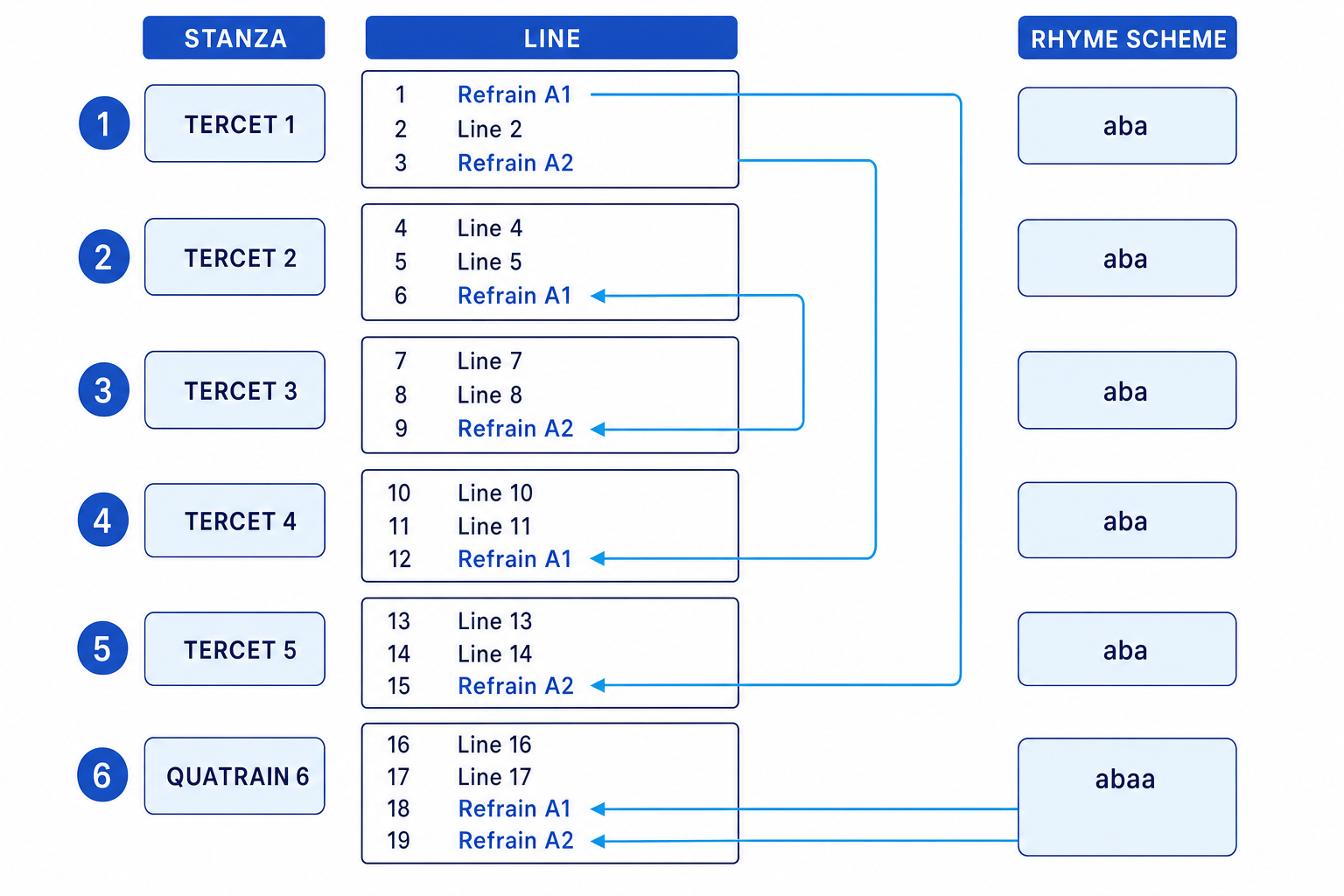
The Paradox of the Villanelle
The power of Thomas's poem lies in a central paradox: he uses an incredibly restrictive, repetitive, and artificial structural container (the villanelle) to express a wild, untamed, and deeply personal emotional outcry. The strict structure acts like a pressure cooker, intensifying the emotional force of his plea.
2. Imagery: The Binary Opposition of Light and Dark
Dylan Thomas constructs the poem around a vast, simple system of symbols based on the transition from day to night.
Binary Opposition
A binary opposition is a pair of related terms or concepts that are opposite in meaning (e.g., hot/cold, good/evil, light/dark) used in literature to create structural tension.
In "Do not go gentle...", Thomas maps life and death onto a binary opposition of light and darkness:
- "That good night" / "Close of day" / "The dying of the light": These phrases are euphemisms for death. Notice the irony in Thomas calling the night "good" while simultaneously begging his father to fight it.
- "Burn and rave" / "Lightning" / "Bright" / "Meteors": These terms represent the vitality, passion, and defiance of life. To live is not just to exist; it is to burn like a star.
The Power of the Imperative
Notice the grammatical mood Thomas uses. The title and the refrains are written in the imperative mood (verbs used to give commands: "Do not go", "Rage"). This tells us that the speaker is not just reflecting on death; he is actively commanding his father, pleading with desperate authority.
3. Categorizing Humanity: The Four Types of Men
Before addressing his father directly in the final stanza, Thomas spends the middle four stanzas detailing four different types of men. Each group, despite their differences, realizes at the end of their lives that they should have fought harder. This serves as a universal argument to persuade his father.
Let's break down these four types of men:
1. "Wise men" (Stanza 2)
- Their realization: They know "dark is right" (death is natural and inevitable).
- Their regret: "Because their words had forked no lightning." Their intellectual wisdom did not leave a lasting, revolutionary impact on the world.
- Their action: They refuse to go quietly because they want more time to make a real mark.
2. "Good men" (Stanza 3)
- Their realization: They look back at their "last wave" (their final actions, or a metaphorical wave of water).
- Their regret: They realize how their "frail deeds" might have "danced in a green bay" if they had been given more time. Their good acts feel small and unfulfilled.
- Their action: They rage so they can survive to do more good.
3. "Wild men" (Stanza 4)
- Their realization: They spent their lives living in the moment, "caught and sang the sun in flight."
- Their regret: They "learned, too late, they grieved it on its way." They did not realize that by celebrating the passing time, they were actually speeding up their own approach to death.
- Their action: They fight death to preserve the joy they lived by.
4. "Grave men" (Stanza 5)
- Their realization: These are serious, somber men near death ("grave" is a pun here—meaning both solemn and close to the literal burial grave).
- Their regret: They see with "blinding sight" that even those who have lost their physical vision can still have inner passion.
- Their action: "Blind eyes could blaze like meteors and be gay" (happy/full of life). They fight to experience that final, passionate flash of existence.
Feature Spotting without Effect
Many students write: "The poet uses a pun on the word 'grave' in stanza five." This is feature-spotting and will not score highly. To get top marks, you must explain the effect: "Thomas uses a pun on 'grave' to draw a grim connection between the solemn nature of these dying men and their proximity to the tomb, highlighting how even those who spent their lives in somber contemplation find a sudden, passionate desire to resist the silence of death."
4. Worked Example: Analyzing a Key Quote
In your Edexcel IGCSE exam, you will need to demonstrate deep analysis of language, form, and structure (AO2). Let’s walk through how to construct a high-scoring analytical paragraph on a key line from the poem.
Analyzing poetic techniques to explain thematic tension
Walk through the process of analyzing the line: "Blind eyes could blaze like meteors and be gay."
- Formulate a clear point: Begin by linking the quotation to the speaker's main message. State how the image of the "grave men" serves to inspire the speaker's father to show passion in his final moments.
- Embed the quotation and identify the structural/linguistic techniques: Introduce the quote naturally into your sentence and identify the key literary devices: the oxymoron ("blind eyes... blaze"), the simile ("like meteors"), and the alliteration of the plosive "b" sound ("blind," "blaze," "be").
- Analyze the specific effects of these techniques: Explain how these words work. The oxymoron suggests that even as physical sight fails, spiritual or emotional clarity can become incredibly bright. The simile "like meteors" evokes cosmic, fiery, and temporary brilliance—a meteor is a dying rock that burns at its most beautiful just before disappearing. The plosive "b" sounds create a rhythmic, energetic bounce, physically mimicking the lively defiance of the words "blaze" and "gay."
- Link back to the poet's wider purpose and the reader's response: Explain why Thomas chose these specific images. He is telling his father that physical frailty or blindness (which his father suffered from in real life) is no barrier to inner rebellion. The reader feels the desperate urgency of the son's plea, urging them to find passion in the face of inevitable loss.
5. The Climax: Stanza 6
In the final quatrain, the perspective shifts dramatically. The poem moves from a universal, philosophical catalog of "men" to an intensely personal, intimate space:
"And you, my father, there on the sad height, Curse, bless, me now with your fierce tears, I pray."
The "sad height" represents the physical peak of old age and the brink of death—a lonely, isolated precipice.
The oxymoron "Curse, bless" highlights the speaker's psychological conflict. The son does not mind if his father curses him with angry tears, as long as there is some sign of life, passion, and fight left in him. To curse the son with rage is to bless him with proof that the father's spirit is not yet defeated.
Watch out for Biographical Overreach
While it is helpful to know that Dylan Thomas wrote this for his father, D.J. Thomas, who was losing his sight and dying, remember that Edexcel Section B Anthology Poetry does not formally assess context (AO4). Keep your focus firmly on AO2 (Language, Form, and Structure) and AO3 (Comparison). Do not write paragraphs of historical biography; instead, refer to "the speaker" and "the speaker's father."
In the exam
When comparing "Do not go gentle into that good night" with another poem in Section B, follow these strategies:
- Compare the construction of voice: Compare the speaker's desperate, demanding tone in this poem with the voice in your chosen comparative poem (e.g., the quiet grief in Remember or the acceptance of mortality in Poem at Thirty-Nine).
- Juxtapose structural restraint with theme: Always write about the villanelle form. Contrast Thomas's tight, repetitive structure with poems that use looser forms or free verse to show how structure itself can represent control or a lack thereof.
- Track the imagery of transition: Compare how Thomas uses the journey of the sun ("the sun in flight") and the onset of night to represent dying, contrasted with how other poets use physical decay, seasons, or domestic settings to explore the same transition.
Check yourself
- Why is the villanelle's highly repetitive structure particularly effective for a poem about grief and desperate pleading?
- What are the four types of men described in stanzas 2–5, and what is the specific regret associated with each?
- Explain the significance and emotional effect of the oxymoron "Curse, bless" in the final stanza of the poem.
