In Jane Austen’s Pride and Prejudice, the lives of the Bennett family serve as a lens through which Austen explores the strict social dynamics of Regency England. As you study this text for your Edexcel IGCSE English Literature exam, you must look beyond the plot of who marries whom, and instead analyse the deeper social critiques Austen makes.
By understanding the novel's main themes, you will be able to construct a highly analytical essay that meets the demands of AO1 (textual knowledge and critical response), AO2 (analysis of language, form, and structure), and AO4 (exploration of historical and social context).
What you'll learn
- How Austen contrasts pragmatic, financial marriages with the companionate ideal.
- How the titular flaws of pride and prejudice function as mutual barriers to self-awareness.
- How rigid social class structures and gender inequality dictate the choices available to Regency women.
Themes Overview
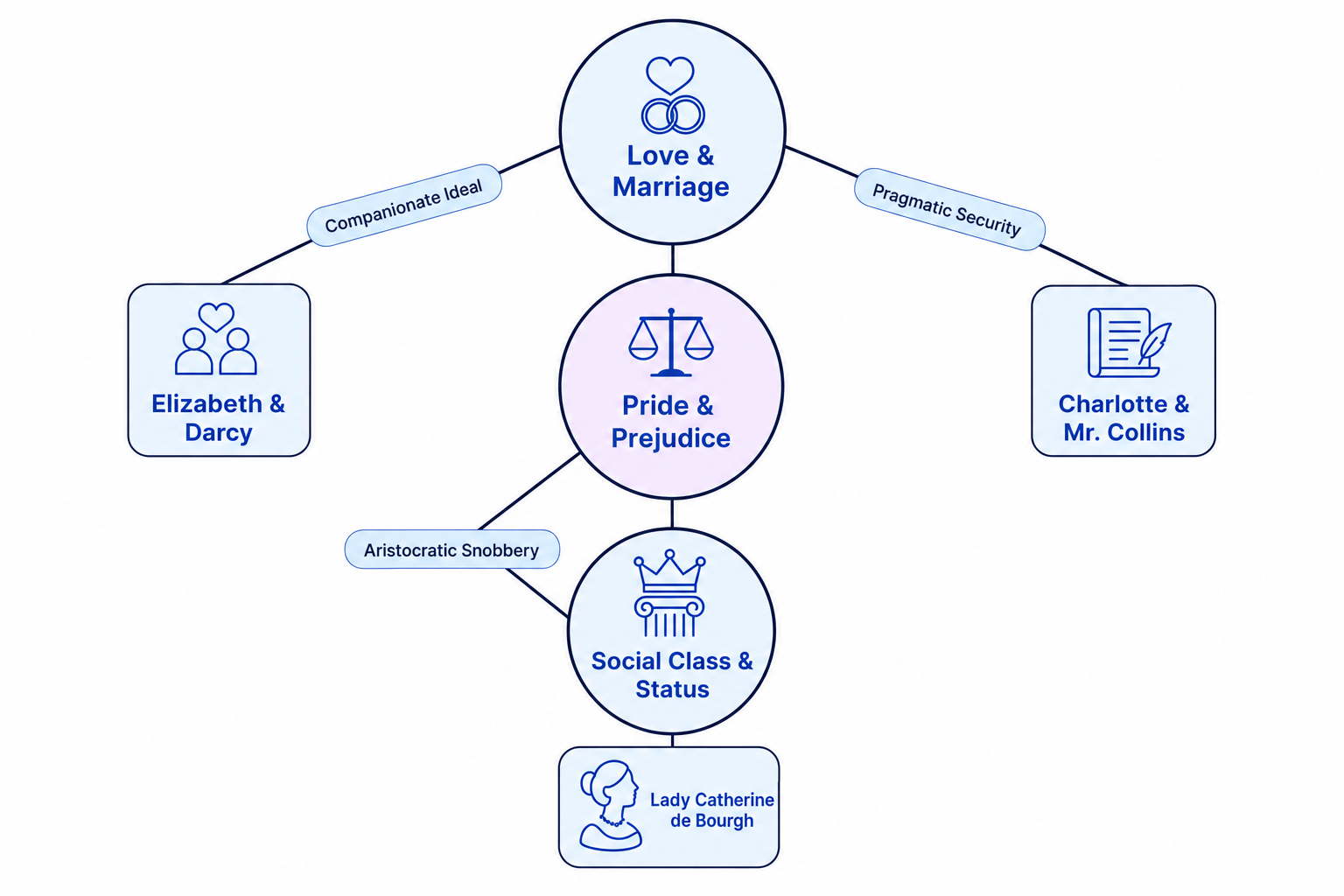
To write a top-tier essay, you need to see how Austen's themes do not exist in isolation. Instead, they interact with one another. For example, a character's choice of marriage partner is almost always dictated by their social class or financial vulnerability.
Theme 1: Love and Marriage
At the heart of Pride and Prejudice is a profound exploration of what makes a successful marriage. Writing in the early 19th century, Austen was acutely aware that for women of the gentry who did not inherit wealth, marriage was the only respectable career path.
Austen presents a spectrum of marriages, categorising them into two main types: pragmatic marriages and companionate marriages.
Companionate Marriage
A companionate marriage is a union based on mutual affection, intellectual equality, and respect, rather than purely on financial gain, social advancement, or physical infatuation.
The Pragmatic Union: Charlotte Lucas and Mr. Collins
When Charlotte Lucas accepts Mr. Collins, Elizabeth is shocked. However, Austen uses Charlotte to voice the harsh reality faced by many Regency women. Charlotte famously states:
"I am not romantic, you know. I never was. I ask only a comfortable home..." (Chapter 22)
Austen’s narrator reinforces this pragmatism, noting that marriage was the only "pleasantest preservative from want" for well-educated women of small fortune. While this marriage lacks passion, Austen does not entirely condemn it; she presents it as a logical, survivalist transaction.
The Shallow Infatuation: Lydia Bennet and Mr. Wickham
At the opposite end of the spectrum is the marriage of Lydia and Wickham. It is built entirely on physical attraction, youth, and impulse. Lydia's elopement is highly dangerous, risking the ruin of her entire family's social standing. Because their union lacks any moral or intellectual foundation, it quickly decays into mutual indifference and financial distress.
The Companionate Ideal: Elizabeth Bennet and Mr. Darcy
Elizabeth and Darcy represent Austen’s ideal of a companionate marriage. Unlike Jane and Bingley, whose relationship is sweet but passive, Elizabeth and Darcy must actively grow to deserve one another.
Their relationship is built on intellectual parrying. They challenge each other's flaws, leading to mutual improvement. Darcy learns humility, and Elizabeth learns to curb her hasty judgements.
Austen's Marriage Message
For Austen, a successful marriage must balance financial security with mutual respect and intellectual compatibility. Passion without moral foundation (Lydia) leads to ruin; security without affection (Charlotte) is respectable but unfulfilling; but the union of minds and hearts (Elizabeth and Darcy) represents true happiness.
Theme 2: Pride and Prejudice
The title of the novel suggests a neat division: Darcy represents pride, and Elizabeth represents prejudice. However, Austen's exploration of these flaws is far more complex. Both characters suffer from both traits, and their psychological journeys involve overcoming them.
Darcy’s Pride and Elizabeth’s Prejudice
Darcy's pride stems from his high social standing, his £10,000-a-year income, and his ancient family line. This pride makes him behave arrogantly at the Meryton assembly, where he refuses to dance with Elizabeth, declaring her:
"tolerable; but not handsome enough to tempt me." (Chapter 3)
This public slight immediately wounds Elizabeth's own pride, which in turn breeds her prejudice against him. Her prejudice makes her highly susceptible to Wickham’s lies. She prides herself on her quick "discernment" of character, but this very intellectual vanity blinds her to the truth.
Look for the Turning Point
In your essays, always point to Chapter 35 (Darcy's letter) as the structural turning point of the novel. This is where both characters undergo anagnorisis (a moment of sudden discovery or realisation).
Overcoming the Flaws
Upon reading Darcy's letter, Elizabeth experiences a profound moment of self-correction:
"How despicably have I acted!" she cries, realizing, "Till this moment, I never knew myself." (Chapter 36)
Darcy undergoes a parallel transformation. Elizabeth’s stinging rejection of his first proposal—where she tells him his manner was not "gentlemanlike"—forces him to confront his aristocratic arrogance.
Theme 3: Social Class and Status
As an open-book exam text (Component 2), Pride and Prejudice requires you to look closely at how Austen uses minor characters and settings to critique the rigid class hierarchy of Regency England (AO4).
The Regency Social Hierarchy
At the top of the social hierarchy in the novel are the aristocrats and wealthy landowners, represented by Lady Catherine de Bourgh and Darcy. Below them are the landed gentry, like the Bennets, who have social status but limited income. Further down are those in "trade" or professional careers, like Mr. Gardiner.
| Character / Group | Class / Status | Key Setting | Narrative Function |
|---|---|---|---|
| Lady Catherine | Aristocracy | Rosings Park | Represents rigid, snobbish class prejudice. |
| Elizabeth Bennet | Landed Gentry | Longbourn | Represents intellect and moral worth over inherited status. |
| The Gardiners | Trade / Middle Class | Gracechurch Street | Represents genuine nobility of character, despite lower social origins. |
Nobility of Birth vs. Nobility of Character
Austen uses satire to expose the hypocrisy of the upper classes. Lady Catherine de Bourgh is incredibly wealthy, yet she is rude, dictatorial, and completely lacks real manners. Conversely, Elizabeth's aunt and uncle, Mr. and Mrs. Gardiner, are in "trade" (which the snobbish Caroline Bingley sneers at), yet they display a natural elegance, kindness, and intelligence that surpasses the aristocracy.
When Lady Catherine demands that Elizabeth promise never to marry Darcy, Elizabeth delivers a stunning defense of her social equality:
"He is a gentleman; I am a gentleman's daughter; so far we are equal." (Chapter 56)
Through Elizabeth, Austen asserts that personal merit and moral integrity are far more valuable than titles or estates.
Worked Example: Analyzing Theme in a Passage
Analyzing Charlotte Lucas's Pragmatism in Chapter 22
Imagine you are writing an essay on the theme of marriage. Here is how to construct a high-scoring analytical paragraph focusing on Charlotte Lucas's pragmatism in Chapter 22.
Question: How does Austen present different attitudes toward marriage through the character of Charlotte Lucas?
-
State your point clearly (AO1/AO4): Austen presents Charlotte’s attitude toward marriage as a deeply pragmatic transaction, highlighting the economic vulnerability of middle-class Regency women who lacked financial independence.
-
Introduce and embed your evidence (AO1): After accepting Mr. Collins, Charlotte explains her reasoning, reflecting that "without thinking highly either of men or of matrimony, marriage had always been her object." Austen's narrator reinforces this by describing marriage as the "only honourable provision for well-educated women of small fortune."
-
Analyse the writer's methods (AO2): Austen uses the noun "object" to dehumanise the institution of marriage, framing it as a clinical target or financial objective rather than an emotional union. Furthermore, the alliterative phrase "pleasantest preservative" acts as a form of social irony; the word "preservative" suggests a desperate measure to ward off decay (the social ruin of poverty or spinsterhood) rather than a source of joy.
-
Link to context and the wider novel (AO4): This realistic portrayal contrasts sharply with Elizabeth’s romantic idealism. Through Charlotte, Austen provides a sharp social critique of the laws of entailment and the lack of career opportunities for women, showing that for many, marriage was not a choice of love, but a necessity for survival.
The 'Darcy is Pride, Elizabeth is Prejudice' Trap
Do not simplify the novel by arguing that Darcy is purely proud and Elizabeth is purely prejudiced. Austen writes with too much nuance for this. Darcy shows prejudice when he judges Elizabeth's family as socially beneath him, and Elizabeth shows pride when she assumes she can read Darcy's character perfectly at first glance. Show the examiner you understand that both characters possess both flaws.
In the exam
- Leverage the Open-Book Format: Because Component 2 is an open-book exam, do not waste time memorizing huge chunks of text. Instead, keep a mental map of where key thematic turning points occur (e.g., Chapter 19 for Mr. Collins's proposal, Chapter 34 for Darcy's first proposal, Chapter 35 for the letter, Chapter 56 for Lady Catherine's confrontation).
- Weave Context (AO4) into your Language Analysis (AO2): Never write a paragraph purely on history. Instead, connect historical details (like the laws of inheritance, class boundaries, or female accomplishments) directly to the specific words, metaphors, or ironies Austen uses in her characters' dialogue.
- Structure your Character Comparisons: If the question is about a theme like marriage, structure your essay by comparing different pairs (e.g., Paragraph 1: Elizabeth and Darcy as the companionate ideal; Paragraph 2: Charlotte and Collins as pragmatic realism; Paragraph 3: Lydia and Wickham as reckless infatuation). This shows a cohesive, complete understanding of the text.
Check yourself
- Can you explain why the letter Darcy writes to Elizabeth in Chapter 35 is crucial to the themes of both Pride and Prejudice?
- How does the character of Mr. Gardiner challenge the class snobbery of characters like Caroline Bingley and Lady Catherine de Bourgh?
- Why does Austen contrast the Bennet marriage (built on physical attraction and lack of respect) with Elizabeth and Darcy's future marriage?