Jane Austen’s characterisation in Pride and Prejudice is far more than a collection of vivid personalities. Characters are the vehicles through which Austen critiques Regency-era attitudes towards class, gender, marriage, and morality. To score highly in your Edexcel IGCSE English Literature exam, you must look past the plot and evaluate how Austen constructs these characters and why she uses them to challenge the social status quo.
What you'll learn
- How to analyse Austen’s signature narrative method—free indirect discourse—to track character bias and growth.
- The structural and psychological design of the main protagonists, Elizabeth Bennet and Mr Darcy.
- How Austen uses foil characters (such as Charlotte Lucas and George Wickham) to highlight her protagonists' virtues and flaws.
- How to link character choices to the constraints of Regency social context (AO4).
1. Austen's Characterisation Methods
Before looking at individual characters, you must understand the literary tools Austen uses to build them. Rather than relying on a simple first-person narrator or an detached, objective third-person narrator, Austen pioneered a sophisticated narrative technique that blurs the line between the narrator's voice and the characters' inner thoughts.
Free Indirect Discourse
A style of third-person narration that slips into a character's mind, presenting their thoughts, feelings, and internal vocabulary as if they were part of the narrator's own description. It allows the reader to experience a character's subjective bias firsthand without the writer explicitly labeling it as such.
Austen uses free indirect discourse (FID) primarily with Elizabeth Bennet. Because the narrator’s voice seamlessly blends with Elizabeth’s, we often inherit her prejudices. For example, when Elizabeth first encounters Darcy, the narrative adopts her sharp, judgmental lexicon. When we later discover her assessments were incorrect, we experience the same shock of self-correction that she does.
Flat vs. Round Characters
Austen structures her novel using a deliberate mix of "flat" and "round" characters:
- Round Characters (Dynamic): Characters like Elizabeth and Darcy who are complex, self-contradictory, and capable of profound change. Their language is flexible, moving from witty banter to deeply felt, honest confessions.
- Flat Characters (Caricatures/Static): Characters like Mrs Bennet, Mr Collins, and Lady Catherine de Bourgh. They do not change. They are defined by single-minded obsessions (e.g., Mrs Bennet’s fixation on marrying off her daughters, Mr Collins’s absurd sycophancy). Austen uses these caricatures to satirise the rigid, absurd expectations of Regency society.
The Function of Caricature
Flat characters are not a sign of weak writing. Austen uses them as fixed social obstacles against which Elizabeth and Darcy must struggle. Their rigidity highlights the flexibility and moral maturity of the protagonists.
2. The Protagonists: Mirror Arcs of Growth
The central narrative arc of Pride and Prejudice is a dual bildungsroman—a novel of education and moral growth—where both protagonists must undergo painful self-reckoning to become worthy of one another.
                  [INITIAL ENCOUNTER]
          Darcy's Pride  <--->  Elizabeth's Prejudice
                  (Meryton Assembly)
                          │
                          ▼
                  [CRITICAL CLIMAX]
          Darcy's Proposal & Letter to Elizabeth
                          │
                          ▼
                 [INTERNAL RECKONING]
          "Till this moment,   "We suffered from
          I never knew myself"  misapprehension"
                          │
                          ▼
                 [MUTUAL RESOLUTION]
            Union of Equality and Respect
Elizabeth Bennet: The Flawed Heroine
Elizabeth is characterized by her "lively, playful disposition" and her sharp wit. In a society that demands women be quiet, decorative, and compliant, Elizabeth is vocal and independent. She rejects the mercenary view of marriage, turning down both Mr Collins and Darcy’s initial proposal because she refuses to marry without "affection."
However, Austen does not present Elizabeth as flawless. Her quick intellect makes her overconfident in her own first impressions.
- Her Flaw (Prejudice): Elizabeth's pride is wounded by Darcy’s early snub at the Meryton Assembly ("she is tolerable; but not handsome enough to tempt me"). This injury to her ego blinds her to Darcy’s genuine virtue and makes her highly vulnerable to the deceptive charm of George Wickham.
- Her Turning Point: Reading Darcy’s explanatory letter in Chapter 36. Austen uses free indirect discourse to show Elizabeth's painful self-examination: "Till this moment, I never knew myself." She realizes she has been "blind, partial, prejudiced, and absurd."
Fitzwilliam Darcy: The Nobleman's Journey
Darcy represents the height of the landed gentry (AO4). He commands ten thousand pounds a year and the ancient estate of Pemberley. Because of his social standing, he is introduced as "haughty, reserved, and fastidious."
- His Flaw (Pride): Darcy conflates his high social standing with moral and intellectual superiority. His first proposal to Elizabeth is structured around his struggle against his better judgment: he details his objections to her low social connections and "degraded" family, expecting her to accept him out of economic desperation.
- His Turning Point: Elizabeth's fierce rejection of his proposal. Her accusation that he did not behave in a "gentleman-like manner" shatters his aristocratic complacency. Darcy’s transformation is evidenced by his anonymous, heroic rescue of the Bennet family from social ruin after Lydia's elopement with Wickham—an act performed purely for Elizabeth's benefit without any expectation of reward.
3. Character Foils as Structural Design
Austen uses foil characters—characters who contrast sharply with the protagonists—to highlight specific themes and virtues.
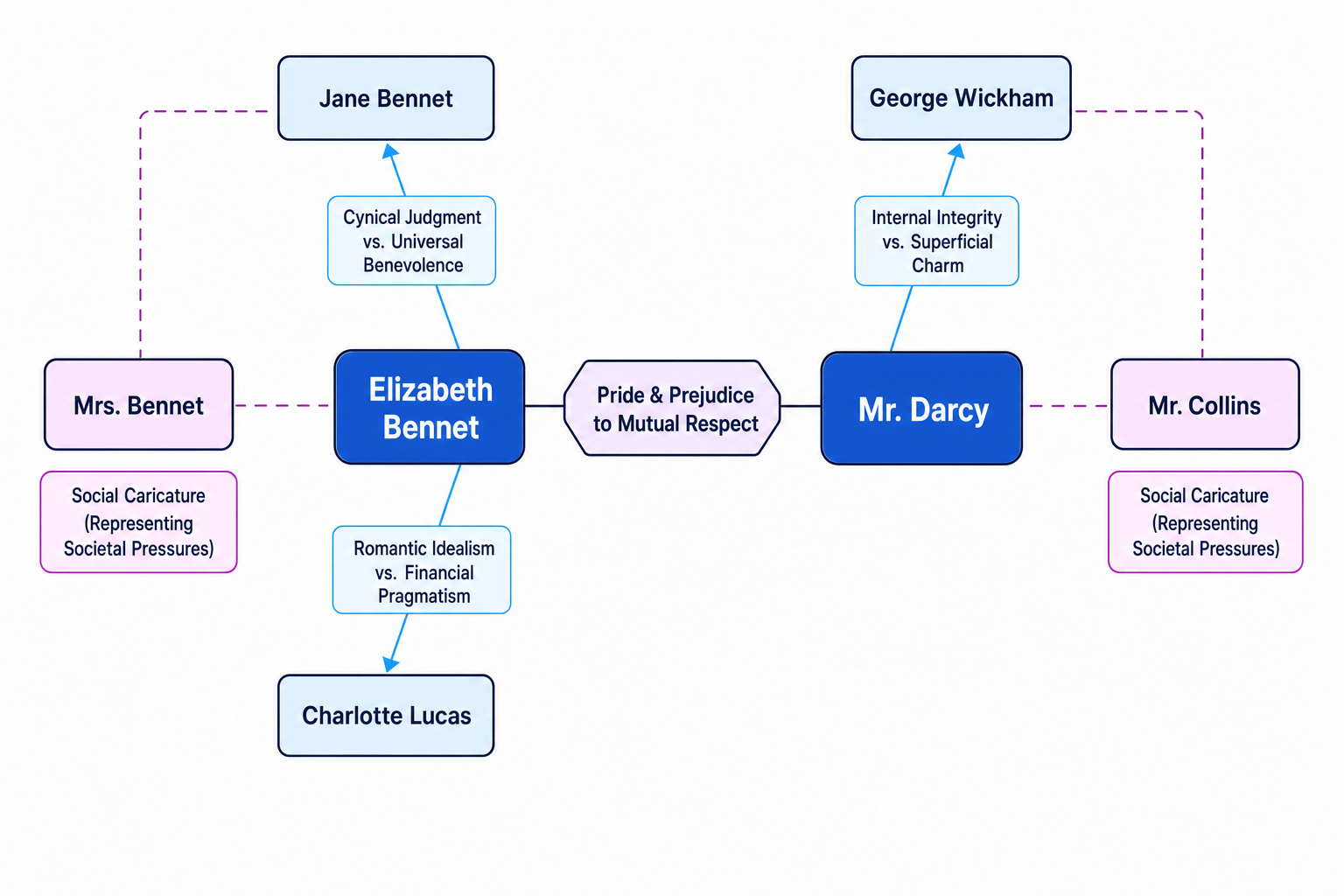
Foil Pair 1: Elizabeth Bennet vs. Charlotte Lucas (Theme: Marriage)
This foil relationship presents two opposing survival strategies for women in Regency England. Because of the law of entailment, women could not inherit their family estates and were economically dependent on marriage for security.
- Charlotte Lucas represents survivalist pragmatism. At twenty-seven, she is a financial burden on her family. She marries the absurd Mr Collins purely for "preservation from want." She famously argues that "happiness in marriage is entirely a matter of chance."
- Elizabeth Bennet represents idealistic individualism. She values her personal autonomy and emotional integrity over financial security, rejecting Mr Collins despite the immense social pressure to secure her family's future.
Foil Pair 2: Mr Darcy vs. George Wickham (Theme: Honour vs. Appearance)
This pairing explores the theme of reputation versus reality.
- George Wickham possesses "external grace"—a charming, polite, and open demeanor. He uses his easy manners to manipulate public opinion and paint himself as Darcy's victim. He represents the superficial polished "civility" that society values but which masks moral vacuum.
- Mr Darcy lacks easy social manners. He is blunt, aloof, and initially disliked. However, beneath this cold exterior lies deep moral integrity, loyalty, and a sense of duty.
Confusing Manners with Morals
Do not confuse polite social manners with moral goodness. Austen warns her readers through Wickham and Darcy that those with the most polished surface often have the most corrupt interiors, while true gentlemanly conduct is defined by deeds, not words.
4. Worked Example: Analysing a Character Foil Relationship
In the exam, you may be asked to discuss how Austen uses contrasting characters to explore a theme. Let's look at how to construct an analytical paragraph comparing Elizabeth and Charlotte Lucas on the theme of marriage.
Contrasting Elizabeth and Charlotte
Construct an analytical paragraph exploring how Austen uses the foil relationship between Elizabeth Bennet and Charlotte Lucas to critique Regency marriage.
-
State the analytical focus (Thesis/Point): Begin with a clear claim that links the comparison directly to Austen's structural purpose and historical context.
Draft: "Austen constructs Charlotte Lucas as a pragmatic foil to Elizabeth Bennet to highlight the harsh economic realities governing women in the Regency era, contrasting Charlotte’s transactional view of marriage with Elizabeth’s pursuit of emotional compatibility."
-
Integrate precise textual evidence (Evidence/Method): Introduce quotations from both characters, identifying the literary techniques used to reveal their mindsets.
Draft: "While Elizabeth insists that marriage must be rooted in mutual respect, Charlotte expresses a highly cynical, mercantilist perspective, asserting that 'happiness in marriage is entirely a matter of chance.' The use of the noun 'chance' reframes marriage as a lottery or a financial calculation rather than a spiritual union. This contrasts sharply with Elizabeth’s visceral reaction to Charlotte’s betrothal to Mr Collins, which she views as a 'humiliating picture' and a sacrifice of 'every better feeling to worldly advantage.'"
-
Analyse the effects and link to context (Effect/AO4/Link): Explain the impact on the reader, the authorial intent, and the relevant historical context (such as the lack of professional opportunities for women).
Draft: "Through this contrast, Austen does not simply condemn Charlotte; rather, she uses her to evoke a sense of pity. For a woman of twenty-seven with no fortune, marriage was a necessity to avoid social degradation. By juxtaposing Charlotte’s quiet resignation with Elizabeth’s passionate rebellion, Austen critiques a patriarchal system that forces women to choose between economic survival and personal integrity, demonstrating that for many Regency women, Charlotte’s compromise was the only logical path."
In the exam
- Never treat characters as real people: Always refer to them as constructs created by Jane Austen. Ask yourself: Why did Austen write this character this way? What social standard is she attacking through them?
- Track character voice: Look closely at how characters speak. Mr Collins speaks in winding, legalistic, pompous sentences full of empty compliments. Darcy’s speech is formal, precise, and logical. Elizabeth’s speech is rhythmic, playful, and rich with irony. Highlighting these stylistic features scores high marks for AO2 (Analysis of Language).
- Use the context wisely (AO4): Do not dump historical facts into your essay. Always link the context directly to a character's choices. For example, explain how Charlotte’s acceptance of Mr Collins or Mrs Bennet’s frantic matchmaking are direct responses to the real laws of entailment and the lack of career options for middle-class women.
Check yourself
- Why does Mr Darcy's letter to Elizabeth in Chapter 36 mark the structural turning point of the entire novel for both characters?
- How does the character of George Wickham serve as a moral mirror for both Elizabeth's prejudice and Darcy's pride?
- In what ways does Lady Catherine de Bourgh act as a caricature of aristocratic pride, and how does her confrontation with Elizabeth in Chapter 56 highlight Elizabeth’s growth?