To truly understand Jane Austen's Pride and Prejudice, we must step back into her world. The novel is not merely a sparkling romantic comedy; it is a sharp social satire of the Regency period in England.
Every interaction, insult, and proposal in the novel is governed by a strict network of social rules, financial pressures, and gender inequalities. For the Edexcel IGCSE English Literature exam, you need to understand these contextual factors and, crucially, integrate them directly with your analysis of Austen's language and characterisation.
What you'll learn
- How the class system of the landed gentry dictates social hierarchies and interactions in the novel.
- The legal and financial realities of the entail and how it shapes the lives of Regency women.
- The difference between mercenary, pragmatic, and companionate marriages in Jane Austen's era.
- How to weave this context seamlessly into your essays to score high marks in Assessment Objective 4 (AO4).
The Regency Era and the Social Class Structure
Jane Austen wrote the first draft of Pride and Prejudice (originally titled First Impressions) between 1796 and 1797, and published the revised novel in 1813. This time falls within the Regency period (1811–1820), an era marked by elegance, strict social etiquette, and deep class divisions.
Regency period
The historical era in the United Kingdom from 1811 to 1820, when King George III was deemed unfit to rule and his son, the Prince Regent (later George IV), ruled in his place. It is characterised by its distinctive culture, fashion, and rigid social codes.
Austen's characters belong almost entirely to the gentry or the aristocracy. However, within this world, there is a very fine, highly policed hierarchy.
Landed Wealth vs. Trade Wealth
In Regency England, the most prestigious form of wealth was landed wealth—owning vast estates that generated rental income. Working for a living, even in highly lucrative professions, was considered socially inferior.
- The Old Money Aristocracy: Represented by Lady Catherine de Bourgh. They held titles, owned ancient estates (like Rosings Park), and fiercely guarded their bloodlines against "connections" with lower social classes.
- The Landed Gentry: Represented by Mr Darcy (Pemberley) and Mr Bennet (Longbourn). They did not hold noble titles but owned land and occupied a high social standing. However, Mr Darcy's £10,000 a year dwarfs Mr Bennet's modest £2,000 a year.
- The "Nouveau Riche" (New Money / Trade): Represented by Bingley’s sisters and Mr Gardiner. The Bingleys’ wealth comes from northern trade, which makes Caroline Bingley desperate to hide her roots and buy a landed estate to secure gentry status. Mr Gardiner is a respectable, wealthy lawyer, but because he lives and works in "Cheapside" (a commercial district of London), he is looked down upon by Caroline Bingley and Lady Catherine.
The Class Conflict
The tension in the novel does not come from the desperately poor meeting the rich, but from the subtle frictions within the upper classes: the landed gentry (Bennets) interacting with the super-wealthy gentry (Darcy) and those whose wealth comes from "trade" (Bingleys/Gardiners).
Gender, Property, and the Law of the Entail
To modern readers, Mrs Bennet’s frantic obsession with marrying off her daughters can seem exhausting or comical. However, when viewed through the lens of Regency legal history, her anxiety is entirely justified.
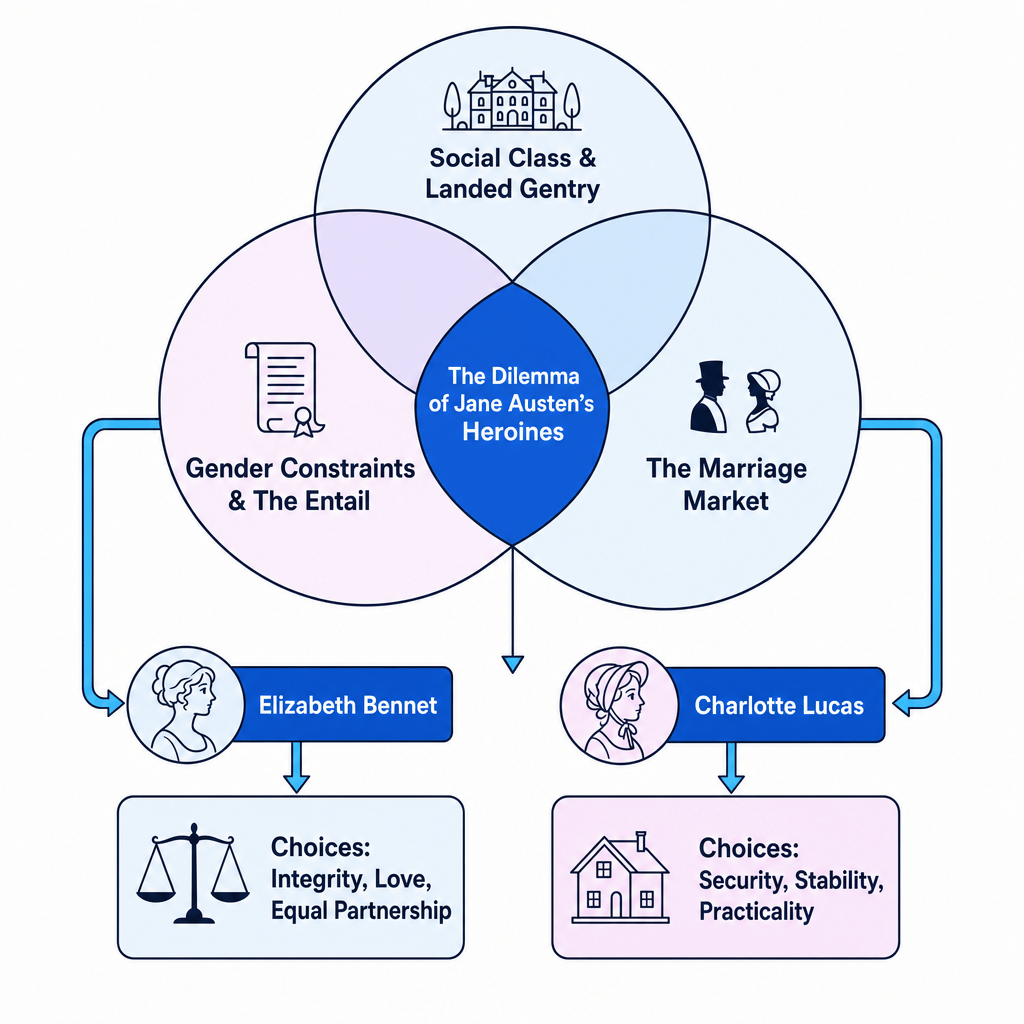
The Legal Vulnerability of Women
In the early nineteenth century, middle- and upper-class women had virtually no path to financial independence. They could not enter professions, attend university, or vote. If a woman did not marry, she was entirely dependent on the charity of her male relatives.
The Entail
The Bennet family's financial precarity is caused by a legal mechanism called the entail (or strict settlement).
Entail
A legal device used in wills and property deeds to limit the inheritance of an estate to specific heirs, usually male descendants ("fee tail male"), to prevent the family land from being split up or sold off.
Because Mr and Mrs Bennet have five daughters and no sons, the Longbourn estate is entailed to Mr Collins, a distant male cousin. Upon Mr Bennet’s death:
- The Bennet daughters will lose their home.
- They will be left with only their mother’s small dowry of £4,000 to share between them, yielding a tiny annual interest that would reduce them to poverty.
Slighting Mrs Bennet
Many students dismiss Mrs Bennet as merely a foolish, hysterical character. While Austen certainly satirises her bad manners, her underlying panic about her daughters’ futures is a realistic response to the brutal legal and economic realities facing Regency women.
The Regency Marriage Market
Because women had no financial autonomy, marriage was treated as a business transaction—often referred to as the marriage market.
A successful marriage required a balance of fortune (money), family (connections), and beauty/accomplishments.
The Ideal of the "Accomplished Woman"
Young women were expected to acquire "accomplishments" to attract a wealthy husband. These included playing the pianoforte, singing, drawing, speaking French, and maintaining a graceful posture. In Chapter 8, Darcy famously adds that a woman must also improve her mind "by extensive reading."
Companionate Marriage
Austen writes at a time when the cultural understanding of marriage was transitioning. The older, aristocratic model viewed marriage as a way to unite estates and consolidate political power. However, a newer, Romantic ideal was emerging: companionate marriage.
Companionate marriage
A marriage based on mutual affection, respect, compatibility, and love, rather than purely social, familial, or financial advantage.
Throughout the novel, Austen uses different couples to explore the spectrum of marriage:
- The Mercenary/Pragmatic Marriage: Charlotte Lucas marries the tedious Mr Collins strictly for "pure preservation from want." Austen does not condemn Charlotte, but highlights the depressing sacrifice of personal happiness required for physical security.
- The Impulsive/Physical Marriage: Lydia and Wickham marry based on superficial physical attraction and youth, leading to mutual indifference and financial instability.
- The Companionate Ideal: Elizabeth and Darcy, and Jane and Bingley. Their marriages balance mutual respect and love with financial security.
Austen's Balance
Austen is not a pure romantic. She does not advocate for marrying purely for love with no money (she exposes this folly through Lydia). Instead, she argues that a happy marriage requires both mutual respect and a comfortable financial foundation.
Integrating Context: A Worked Example
In your Edexcel exam, you must never "context dump"—meaning you should not write long paragraphs of historical facts isolated from the text. Instead, you must use context to explain why a character speaks or acts in a certain way, or what Austen is commenting on through her literary choices.
Analyzing Charlotte Lucas's marriage proposal acceptance
Read the following passage from Chapter 22 and follow the steps to write an analytical response that integrates context seamlessly:
"Without thinking highly either of men or of matrimony, marriage had always been her object; it was the only provision for well-educated women of small fortune, and however uncertain of giving happiness, must be their pleasantest preservative from want."
-
Step 1: Identify the key technique/choice and close language analysis.
Identify that Austen uses free indirect discourse to convey Charlotte's pragmatic, unromantic inner thoughts. Note the stark, financial vocabulary: "object", "provision", "preservative from want". The superlative "pleasantest" is highly ironic, as it implies that even a mediocre marriage to a fool like Collins is better than starvation or dependency.
-
Step 2: Connect the literary analysis to specific Regency context.
Explain that Charlotte's attitude is a direct consequence of the legal and economic vulnerability of Regency women. Mention the lack of career options and the social stigma of being an "old maid" (spinster) without independent wealth.
-
Step 3: State the author's intention and effect on the reader.
Argue that Austen uses Charlotte’s pragmatism not to make us dislike her, but to evoke pity and to critique a patriarchal society that forces intelligent women to sacrifice their intellectual and emotional happiness for basic physical security.
Example Paragraph:
Austen uses the character of Charlotte Lucas to expose the compromising economic realities of the Regency marriage market. When Charlotte accepts Mr Collins, the narrator notes through free indirect discourse that marriage was "the only provision for well-educated women of small fortune". The noun "provision" and the phrase "preservative from want" highlight that marriage was not a romantic luxury, but a vital economic shield. By calling marriage Charlotte's "object", Austen employs the language of business and manufacturing, emphasizing how the legal constraints of the era—which denied women independent careers or wealth—reduced the holy sacrament of marriage to a cold transaction. Through this, Austen critiques the patriarchal structure of her society, eliciting sympathy from the reader for women who, like Charlotte, had to sacrifice emotional compatibility for financial survival.
In the exam
- Always lead with the text: Start your paragraphs with an analytical point about a character, theme, or language choice. Never start with a historical history lesson.
- Use context to answer "Why?": When you quote a character, use context to explain their motivation. (e.g., "Mrs Bennet's frantic behavior is driven by her acute awareness of the entail, which threatens to leave her daughters homeless...").
- Explore Austen's purpose: Think of Austen as a social commentator. Frame your context with phrases like: "Austen critiques the Regency expectation of...", "Austen satirises the aristocratic belief that...", or "Through Lydia, Austen warns against the dangers of..."
Check yourself
- Why is the concept of the "entail" so crucial to the plot of the novel, and how does it explain Mrs Bennet's behaviour?
- Explain the social distinction between Mr Darcy’s wealth and the wealth of the Bingley family.
- How does the character of Charlotte Lucas challenge the romantic ideals of the novel, and what social reality does she represent?