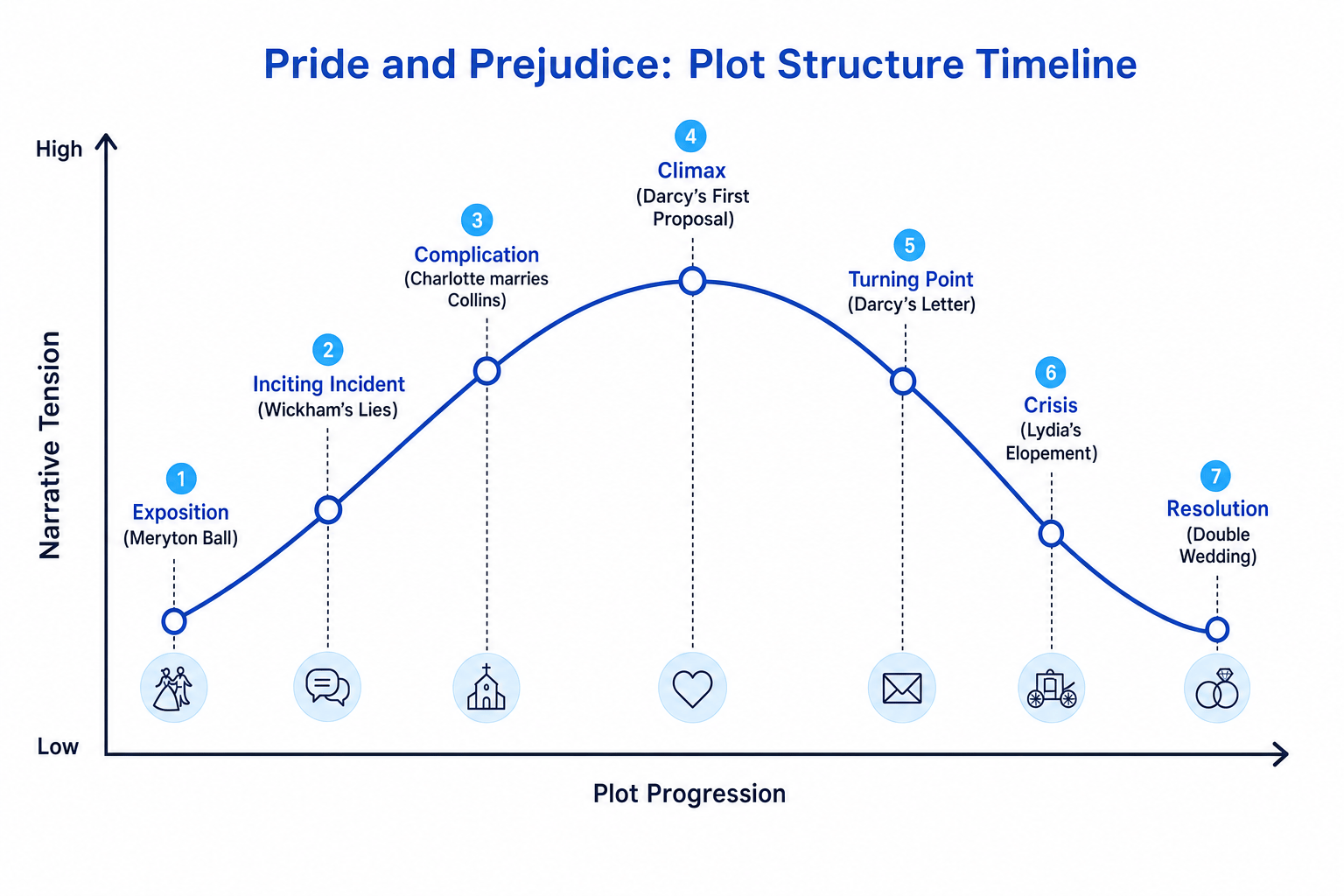
The Pivot Points: Why Darcy’s Letter Changes Everything
To score high marks for AO2 (Structure and Form), you should not simply list these plot points. You must analyse how they function. The most important structural device in the novel is Darcy’s Letter (Chapter 35).
Prior to this point, the story is dominated by Elizabeth's subjective, third-person limited perspective. We see Darcy through her prejudiced eyes. By introducing a physical letter, Austen temporarily shifts the form of the novel to an epistolary style.
Epistolary Element
A section of a novel written in the form of documents, such as letters or diary entries. Writers use this to allow characters to speak directly to the reader and other characters without the filter of a third-person narrator.
The letter acts as a structural mirror. It forces Elizabeth to re-read her own life and recognise her own errors:
"She grew absolutely ashamed of herself.—Of neither Darcy nor Wickham could she think, without feeling that she had been blind, partial, prejudiced, absurd." (Chapter 36)
The Letter as a Pivot
Darcy's letter is the narrative pivot of the novel. It splits the plot into two halves: the first half is characterized by misjudgement and rising conflict, while the second half details the slow, painful process of self-correction, humility, and reconciliation.
Worked Example: Analysing a Structural Turning Point
When writing about the plot in your exam, you must connect a specific narrative event to both its structural significance (AO2) and its social context (AO4).
Below is a step-by-step walkthrough of how to plan and construct an analytical paragraph on how Austen uses the Lydia-Wickham elopement to shift the plot and escalate the dramatic stakes.
Analysing the Lydia-Wickham Elopement
Prompt: Explain how Austen uses the plot development of Lydia’s elopement to alter the direction of the novel.
-
Identify the structural function of the event. Lydia’s elopement in Chapter 46 is not just a dramatic scandal; it is a structural "crisis" that threatens to permanently halt Elizabeth and Darcy's growing affection. By placing this crisis immediately after Elizabeth’s visit to Pemberley—where she begins to realise she loves Darcy—Austen creates a massive barrier to their union.
-
Integrate context (AO4) to explain the stakes. Explain why this event is so serious. In the Regency era, an unmarried daughter running off with a man threatened the social ruin of the entire family. The Bennet sisters would have been rendered socially untouchable, making marriages to respectable men like Darcy or Bingley impossible. This context turns a personal family crisis into a major plot obstacle.
-
Analyse the structural irony and resolution (AO2). Show how this crisis actually facilitates the resolution of the romance. Show that while the elopement seems to separate Elizabeth and Darcy forever, it actually provides the catalyst for Darcy to prove his love through action. By secretly tracking down Wickham, paying off his debts, and buying him a commission in the army to force the marriage, Darcy rescues the Bennet family from disgrace. This shifts Elizabeth’s gratitude into deep love, clearing the path to their eventual marriage.
The 'And Then' Trap
A common pitfall in IGCSE essays is writing a pure summary of the plot ("First Elizabeth meets Darcy, and then Wickham tells her a lie, and then Mr Collins proposes..."). This is known as "narrative retelling" and will limit you to lower mark bands. Instead, use structural verbs: "Austen complicates the plot...", "This scene mirrors...", "The arrival of Wickham acts as a catalyst...".
Pacing and Contrast
Notice how Austen paces her plot. The scenes in longbourn and Meryton are fast-paced, filled with dialogue, dances, and social visits. In contrast, the scenes at Hunsford and Pemberley are slower and more introspective, allowing Elizabeth the psychological space to reflect on her growth. Mentioning this contrast is an excellent way to address AO2!
In the exam
- Keep quotations brief: You don't need to quote entire paragraphs to prove a plot point. Use micro-quotations embedded directly into your structural analysis (e.g., when Charlotte Lucas marries Mr Collins for a "purely provider" match, quote her desire for "a comfortable home").
- Focus on structural intent: Whenever you mention a plot event, ask yourself: Why did Austen put this event here? What does it reveal about class (AO4) or character growth (AO1)?
- Contrast the subplots: Use the subplots (Jane and Bingley's passive romance, Charlotte and Collins's pragmatic marriage, Lydia and Wickham's reckless elopement) as structural foils to contrast and highlight Elizabeth and Darcy’s complex journey towards mutual respect.
Check yourself
- Why did Austen choose to put Darcy's first proposal and his subsequent letter at the exact physical midpoint of the original three-volume novel?
- How does the sudden news of Lydia's elopement disrupt the growing romantic resolution between Elizabeth and Darcy during her trip to Derbyshire?
- What structural role does Lady Catherine de Bourgh's confrontational visit to Longbourn in Chapter 56 play in bringing about the novel's final resolution?