What you'll learn
- How to turn a Pride and Prejudice question into a focused argument.
- How to build paragraphs that combine quotation, method and meaning.
- How to use Austen’s social context without “bolting it on”.
- How to shape a whole essay so it feels confident, purposeful and exam-ready.
What a model essay is
A model essay is not a script to memorise. It is a pattern you can learn from: how the answer stays focused, how quotations are embedded, and how Austen’s methods are analysed.
For Pride and Prejudice, you are writing for Edexcel International GCSE Component 2, Section B: Literary Heritage. This is open book, so you may use a clean copy of the novel. However, a strong answer still uses brief, precise quotations rather than copying long chunks from the text.
Assessment objective
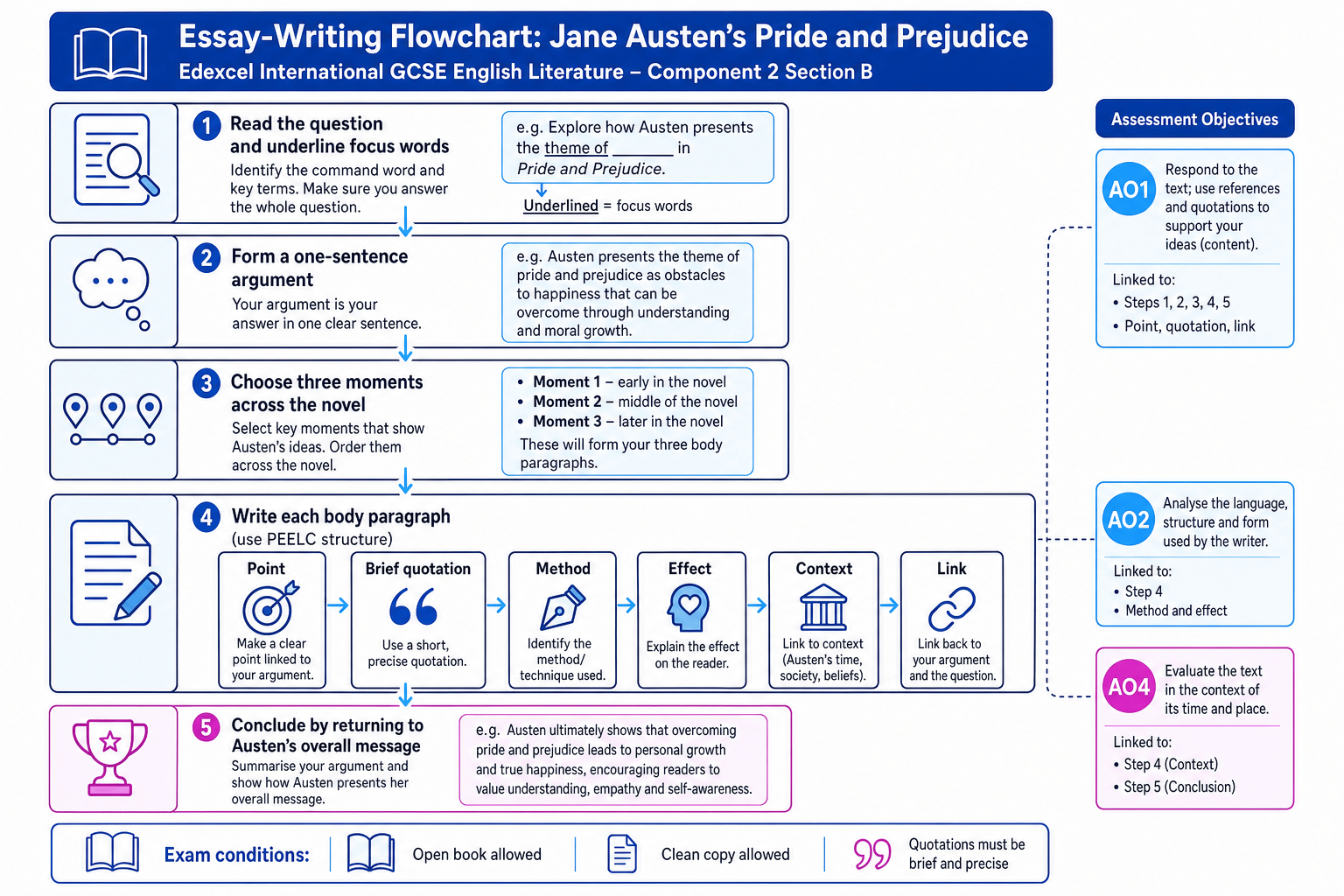
An assessment objective is a skill the examiner rewards. For Pride and Prejudice, you need to show close knowledge and a personal response through references to the novel, analyse Austen’s language, form and structure, and connect the text to its social and historical context.
The flowchart below shows the route from reading the question to writing a complete answer. Notice that the best essays are planned around an argument, not around everything you know about the novel.
Start with the question, not the topic
A common problem is writing a “character essay” or “theme essay” that could fit any question. In the exam, every paragraph must answer the exact wording.
If the question asks “Explore how Austen presents Elizabeth as a character who changes”, you should not simply retell Elizabeth’s story. You need to explain how Austen shapes the reader’s view of Elizabeth’s development.
Thesis
A thesis is your central argument: a one-sentence answer to the question that the whole essay proves.
A thesis should be debatable and specific. “Elizabeth changes in the novel” is true, but too simple. A better thesis would be:
Austen presents Elizabeth’s change as a movement from witty confidence to painful self-knowledge, suggesting that true judgement requires humility as well as intelligence.
That gives you something to prove across the essay.
Turning a question into an argument
Question: Explore how Austen presents pride in Pride and Prejudice.
-
Interpret the focus carefully: the question is not asking you to list proud characters, but to explain how Austen presents pride as a moral and social problem.
-
Choose a pattern across the novel: Darcy’s pride is obvious in Chapter 3 when he calls Elizabeth “tolerable; but not handsome enough to tempt me”, while Elizabeth’s pride is more hidden because it appears as confidence in her own judgement.
-
Add Austen’s method: Austen uses irony, dialogue and character development to show that pride can distort people’s understanding of themselves and others.
-
Shape the thesis: Austen presents pride as both socially damaging and personally blinding, but she also shows that self-awareness can correct it, especially through the moral growth of Elizabeth and Darcy.
Build paragraphs that prove your argument
A strong paragraph does more than include a quotation. It should move from a clear point to close analysis, then back to the question.
A useful structure is:
Point → Evidence → Method → Effect → Link
This is not a rigid formula, but it helps you remember the job of each sentence.
Close analysis
Close analysis means looking carefully at Austen’s choices — such as diction, irony, dialogue, narrative voice, structure or symbolism — and explaining how those choices shape the reader’s understanding.
Austen’s methods are often subtle. She writes a novel of manners, meaning a novel focused on social behaviour, class, courtship and conversation. She also uses irony, where the real meaning differs from the surface meaning, and free indirect discourse, where third-person narration slips into a character’s thoughts or attitudes.
Paragraph rule
Every analytical paragraph should make a claim about Austen’s meaning, support it with a short quotation, analyse a writer’s method, and link back to the question.
Building a paragraph on Darcy’s pride
-
Make the point specific: Darcy’s first appearance presents pride as socially rude and emotionally unattractive, not merely as personal confidence.
-
Select brief evidence: at the Meryton assembly in Chapter 3, Darcy dismisses Elizabeth as “tolerable; but not handsome enough to tempt me”.
-
Analyse the method: the dismissive adjective “tolerable” sounds cold and judgemental, while “tempt” suggests Darcy imagines himself as someone who must be persuaded downwards into ordinary society.
-
Explain the effect: the reader is encouraged to share Elizabeth’s dislike of Darcy at first, so Austen structurally makes us experience prejudice before later challenging it.
-
Link to the whole novel: this first impression matters because Austen later reveals that both Darcy’s pride and Elizabeth’s prejudice need correction.
A model paragraph might look like this:
Austen first presents Darcy’s pride as a form of social arrogance that wounds others. At the Meryton assembly in Chapter 3, he calls Elizabeth “tolerable; but not handsome enough to tempt me”. The dismissive adjective “tolerable” reduces Elizabeth to a harsh social judgement, while the verb “tempt” implies that Darcy sees dancing with her as beneath him. Austen’s dialogue makes Darcy appear cold and superior, so the reader understands why Elizabeth’s prejudice begins. However, because this is an early scene, Austen also uses structure to make the reader’s first impression incomplete, preparing us for Darcy’s later moral development.
Notice how the paragraph does not just say “Darcy is proud”. It analyses how Austen makes us think and feel that.
Use context as part of meaning
Context means the circumstances surrounding a text: the social values, laws, beliefs and expectations of the time in which it was written or set.
For Pride and Prejudice, context often includes marriage, inheritance, class, reputation and gender. The Bennet sisters’ future is insecure partly because Longbourn is entailed away from the female line. An entail was a legal arrangement controlling inheritance, often preventing women from inheriting property directly.
But context should never feel like a separate history paragraph. It should help you explain Austen’s choices.
Context dump
Avoid writing a general sentence such as “In Austen’s time women had to marry” and then moving on. Instead, connect the context to a specific moment, character or method in the novel.
Charlotte Lucas is a strong example. In Chapter 22, she tells Elizabeth, “I am not romantic, you know. I never was. I ask only a comfortable home.” Austen presents Charlotte’s choice to marry Mr Collins as emotionally unappealing, but socially understandable.
Making context analytical
-
Start with the textual moment: Charlotte’s phrase “comfortable home” reduces marriage to security rather than love.
-
Connect the context precisely: as an unmarried woman with limited financial independence, Charlotte has fewer choices than a modern reader might expect.
-
Analyse Austen’s presentation: Austen does not romanticise Charlotte’s decision, but she does make it rational within a society where women’s futures depend heavily on marriage.
-
Link to meaning: this allows Austen to criticise a social system that pressures women into practical marriages while still valuing Elizabeth’s refusal to marry without respect.
A compact model essay shape
Let’s use this question:
Explore how Austen presents Elizabeth as a character who learns about herself.
Model introduction
Austen presents Elizabeth Bennet as intelligent, lively and independent, but also as a character whose confidence can become prejudice. Through Elizabeth’s changing responses to Darcy and Wickham, Austen structures the novel as a journey towards self-knowledge. Elizabeth’s famous realisation, “Till this moment I never knew myself” in Chapter 36, becomes a turning point, showing that moral growth requires the courage to judge oneself as well as others.
Paragraph 1: Elizabeth’s early confidence
You could begin with Elizabeth’s wit. She says, “I dearly love a laugh” in Chapter 11, which shows her lively intelligence and independence from solemn social expectations. However, Austen also shows the danger of enjoying ridicule too much. In Chapter 5, Elizabeth admits, “I could easily forgive his pride, if he had not mortified mine.” The verb “mortified” reveals that her judgement of Darcy is partly personal. Austen therefore presents Elizabeth’s wit as attractive, but not always fair.
Paragraph 2: The turning point
The strongest paragraph would probably focus on Darcy’s letter and Elizabeth’s reaction. In Chapter 36, she cries, “How despicably have I acted!” and later concludes, “Till this moment I never knew myself.” The dramatic exclamation shows emotional shock, while the simple declarative sentence marks a moment of painful clarity. Structurally, this is the point where Elizabeth stops judging only Darcy and begins judging herself. Austen makes self-knowledge uncomfortable but necessary.
Paragraph 3: Elizabeth’s changed perception
Later, Pemberley helps Elizabeth reassess Darcy. Austen describes the estate as “neither formal, nor falsely adorned” in Chapter 43. This description works symbolically: the house’s natural elegance suggests a version of Darcy that Elizabeth has not yet understood. Austen uses setting to challenge Elizabeth’s earlier prejudice, showing that true judgement requires patience, evidence and humility.
Model conclusion
Overall, Austen presents Elizabeth’s self-knowledge as central to the novel’s moral design. Elizabeth does not lose her wit or independence; instead, she learns to balance them with humility. By allowing both Elizabeth and Darcy to change, Austen suggests that happy marriage depends not simply on attraction, but on honest self-examination and mutual respect.
What top-band writing sounds like
Top-band writing is clear, precise and analytical. It does not need to sound overly complicated.
Instead of:
This quote shows Elizabeth changes.
Write:
Austen’s declarative sentence “Till this moment I never knew myself” presents self-knowledge as sudden and painful, making Elizabeth’s change feel like a moral awakening rather than a simple change of opinion.
That sentence does three things: it names a method, explains the effect, and links to Austen’s larger idea.
Open-book advantage
Because you have a clean copy, use it to find exact short quotations and chapter moments. Do not waste time copying long passages: the examiner rewards selection and analysis, not length.
In the exam
-
Spend a few minutes turning the question into a thesis before you start writing.
-
Choose three moments from different parts of the novel so your essay shows a developed understanding of Austen’s structure.
-
In each paragraph, keep moving from quotation to method to meaning; do not let context or plot summary take over.
Check yourself
-
Can you write a one-sentence thesis for a question on Elizabeth, Darcy or marriage?
-
Can you analyse one short quotation by naming Austen’s method and explaining its effect?
-
Can you connect a contextual point, such as inheritance or class, to a specific moment in the novel?