Planning is the single most important step in writing a high-scoring essay for your Edexcel IGCSE English Literature exam. When sitting Component 2, Section B (Literary Heritage), you will be answering one essay question on Pride and Prejudice. Because this is an open-book exam, you have a clean copy of the novel with you. However, you only have about 45 minutes to write your response. Without a robust plan, it is incredibly easy to lose your way, retell the plot, or forget to balance your Assessment Objectives.
In this guide, you will learn how to build structurally sound, sophisticated essay plans that meet all of the examiner's requirements.
What you'll learn
- How to deconstruct an Edexcel IGCSE essay question to find its hidden prompts.
- The "Thesis-First" planning method that ensures a sustained, critical argument.
- How to seamlessly weave together Jane Austen's literary techniques (AO2) and Regency context (AO4).
- A step-by-step walkthrough of a real essay plan on a key theme.
Understanding the Edexcel Assessment Ingredients
To plan a brilliant essay, you first need to know what ingredients the examiner is grading. In Component 2, Section B, your marks are split equally across three assessment objectives:
- AO1: Close knowledge and understanding of the text, delivered in a critical style, using precise textual references (quotations) to support a personal response.
- AO2: Analysis of how the writer uses language, form, and structure to create meaning and effects.
- AO4: Exploration of the relationship between the text and its historical, social, and cultural context.
The Integration Principle
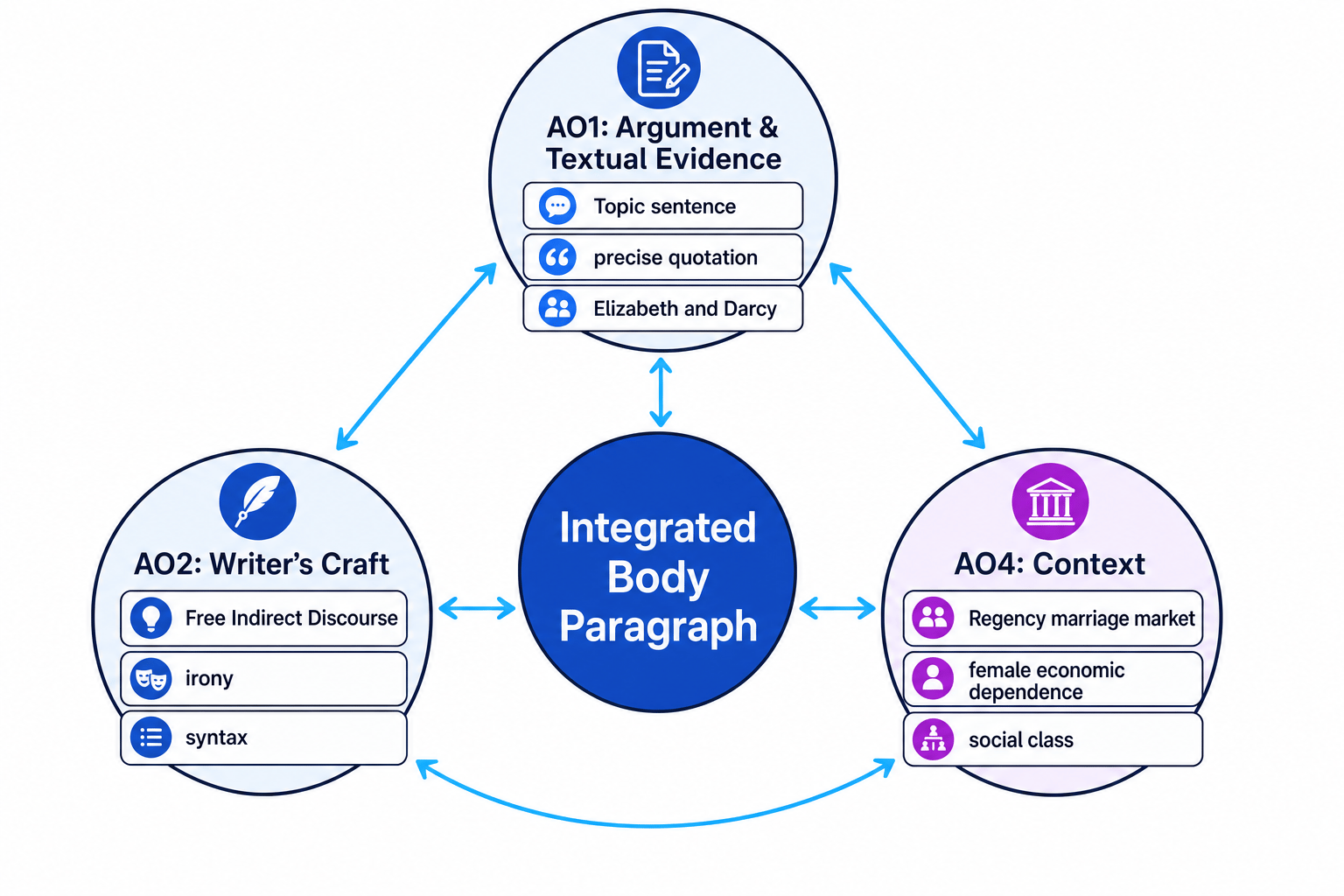
A Grade 9 essay does not treat AO1, AO2, and AO4 as separate checklist items. Instead, every single paragraph you write must blend these three elements together. If you write a paragraph purely about context, or purely analyzing a quote without explaining its thematic relevance, your mark will be capped.
To ensure your essay plans always hit this gold standard, let's define the key structural terms you should use during your planning stage.
Thesis Statement
A thesis statement is a one- or two-sentence summary of your central argument. It directly answers the prompt and outlines your line of inquiry. It is not a simple rewording of the question; it is an active, arguable statement of your interpretation.
Free Indirect Discourse
Austen's signature narrative technique is free indirect discourse (or free indirect style). This is a narrative method where a third-person limited narrative voice seamlessly adopts the internal vocabulary, thoughts, and emotional biases of a character (usually Elizabeth Bennet) without using explicit dialogue tags like "she thought."
When planning, you must deliberately choose quotes that allow you to analyze methods like free indirect discourse, irony, caricature, or structural juxtaposition (AO2), while linking them directly to Regency social codes (AO4).
How to Deconstruct the Prompt
Every Edexcel exam question contains two parts: the explicit prompt (the named character, relationship, or theme) and the implicit prompt (the underlying thematic debates, structural shifts, and social realities of Austen's world).
Before putting pen to paper, you must dissect the question using these three questions:
- What is the literal focus? (e.g., Darcy, marriage, pride, class).
- Where does this focus shift or develop? (Look for structural turning points, like Darcy's first proposal at Hunsford or his second at Longbourn).
- What is Austen's satirical or moral purpose? (How does this topic reflect her critique of her contemporary society?).
The 'Character Dump' Trap
Students often plan essays by writing down everything they know about a character in chronological order. This leads to a narrative retelling of the plot ("First, Elizabeth meets Wickham, then she believes him, then she finds out he's bad..."). Your plan must be organized around ideas, not chronological plot points.
Use the 'Even Though' Formula for Thesis Statements
To write a complex thesis, use an "Even though [opposing view], ultimately [your main argument]" structure. For example: "Even though Austen exposes the mercenary nature of marriage in the Regency era through characters like Charlotte Lucas, she ultimately argues that a true marriage must be built on mutual intellectual and moral respect."
Step-by-Step Worked Example: Planning a Grade 9 Essay
Let's walk through the exact intellectual process of building a high-scoring essay plan from scratch.
Planning a Class and Status Essay
Prompt: Explore the significance of social class and status in Pride and Prejudice.
Below is the step-by-step process to formulate a complete, highly integrated essay plan under exam conditions.
-
Deconstruct the prompt and draft a thesis statement: Identify the core conflict of the prompt. Class is not just background decoration; it dictates the characters' economic survival and forms the psychological barriers between them.
- Drafted Thesis: "Although Austen depicts a rigid Regency social hierarchy where class dictates power and marital prospects, she satirizes the moral arrogance of the aristocracy, ultimately arguing that nobility of character is far superior to nobility of birth."
-
Select three distinct, conceptually developmental main points: Divide your argument into a logical, three-stage journey. Do not just list characters; group them by how they represent different aspects of the class debate.
- Paragraph 1: The absurdity and moral bankruptcy of the highest class (Lady Catherine de Bourgh as a caricature of aristocratic pride).
- Paragraph 2: The anxious middle-class struggle for social mobility and respectability (The Bennet family's vulnerability due to the entail; Mrs. Bennet's frantic matchmaking; the snobbery of Caroline Bingley as a "new money" striver).
- Paragraph 3: The synthesis of class and character (Darcy and Elizabeth overcoming their class prejudices to find moral equality, symbolized by the landscape of Pemberley).
-
Map precise textual evidence (AO1) and literary techniques (AO2) to each point: For each paragraph, pick one or two highly productive quotes that contain rich language or structural devices.
- For Paragraph 1: Lady Catherine's dictatorial dialogue: "Are the shades of Pemberley to be thus polluted?" Analyze her interrogative syntax, the hyperbolic verb "polluted" (showing she views class mixing as a literal infection), and Austen's use of caricature.
- For Paragraph 2: Mrs. Bennet's complaints about the entail: "I cannot bear to hear that mentioned." Analyze the dramatic irony of her ignorance, and the structural foil of Mr. Collins’s groveling sycophancy toward Lady Catherine.
- For Paragraph 3: Description of Pemberley: "It was a large, handsome, stone building, standing well on rising ground... with less of splendour, and more real elegance." Analyze the architectural metaphor—Pemberley represents Darcy’s natural, unostentatious nobility, reflecting his moral character rather than just his bank account.
-
Integrate specific Regency context (AO4) to ground your textual analysis: Connect your literary analysis to the real social realities of late Georgian/Regency England.
- For Lady Catherine: Connect to the defensive posture of the landed gentry/aristocracy during the era of the French Revolution, where the upper class feared losing their traditional hegemony to the rising mercantile middle class.
- For Mrs. Bennet/Entail: Connect to the legal realities of primogeniture and the entail, which left women entirely dependent on marriage for economic survival, justifying Mrs. Bennet's frantic behavior despite her foolishness.
- For Pemberley: Connect to the contemporary debate between "artificial" estate landscaping (associated with pride and vanity) and the "picturesque" movement, which valued natural beauty and reflected moral authenticity.
Template for Your Exam Plans
When you enter the exam room and turn to your chosen Pride and Prejudice question, spend exactly 5 to 8 minutes drawing a rapid, streamlined version of this planning skeleton on your exam booklet.
THESIS STATEMENT:
[Even though..., ultimately...]

PARAGRAPH 1: [Thematic Point]
- Evidence (AO1): "..." / "..."
- Methods (AO2): [e.g., Satire, free indirect discourse, foils]
- Context (AO4): [e.g., Regency marriage market, gender inequality]

PARAGRAPH 2: [Thematic Point]
- Evidence (AO1): "..." / "..."
- Methods (AO2): [e.g., Epistolary form, dramatic irony, syntax]
- Context (AO4): [e.g., Class stratification, landed vs. trade wealth]

PARAGRAPH 3: [Thematic Point]
- Evidence (AO1): "..." / "..."
- Methods (AO2): [e.g., Metaphorical settings, character growth]
- Context (AO4): [e.g., Individualism vs. filial duty/reputation]

CONCLUSION IDEA:
[How does Austen's resolution reflect her ultimate moral lesson?]
Watch Out for the 'Context Dump'
Never start a paragraph with a historical fact (e.g., "In the Regency era, women had no rights..."). This is a literature exam, not a history exam. Always start your paragraph with an analytical point about Austen’s literary choices or thematic intent, and let the context flow naturally out of your quotation analysis.
The Trial Attorney
Think of yourself as a trial attorney. Your thesis is the verdict you want the jury (the examiner) to reach. Your topic sentences are the individual charges, your quotations are the physical evidence, and your analysis of literary devices (AO2) and social context (AO4) is the cross-examination that proves your evidence is genuine. A list of quotes without analysis is just a pile of evidence without an argument.
In the exam
- Don't skip the plan: It is tempting to start writing immediately to save time, but a student who spends 5 minutes planning and 40 minutes writing a structured essay will always outscore a student who writes a rambling, unplanned essay for 45 minutes.
- Anchor your plan with a clear thesis: Write your thesis statement out in full at the top of your planning sheet. Keep referring back to it during your writing to ensure your essay remains a sustained, coherent argument.
- Exploit the open-book format: Do not waste valuable planning time trying to recall long quotes from memory. Use your plan to note down the specific key terms or 2-3 word phrases you want to find, and then quickly use your clean copy of the novel to locate the exact page.
- Coordinate your AOs: As you plan each paragraph, do a quick visual check. Do you have at least one literary term (AO2) and one social context point (AO4) mapped next to your textual evidence (AO1)? If not, your paragraph is unbalanced.
Check yourself
- Can you write a thesis statement for an essay about the presentation of Mr. Darcy that uses the "Even though... ultimately..." formula?
- Which three characters would you select as evidence to plan an essay on the theme of "Reputation and Propriety"?
- How would you integrate the historical concept of the "entail" into a paragraph analyzing Mr. Collins’s proposal to Elizabeth?