Welcome to your study guide for Charles Dickens’s masterpiece, Great Expectations. First published between 1860 and 1861, this novel remains one of the most celebrated works of Victorian literature.
In your Edexcel IGCSE English Literature exam, Great Expectations is assessed in Component 2, Section B (Literary Heritage). This is an open-book exam, which means you will have a clean copy of the text with you. However, to score highly, you must know the novel's structure, themes, and language inside out so you can locate and analyze evidence quickly under timed conditions.
What you'll learn
- The three-stage structure of Pip’s psychological and social development.
- The literary and historical context of Victorian class systems and the penal system.
- How to balance close language analysis (AO2) with contextual awareness (AO4) in your essay responses.
The Genre: A Victorian Bildungsroman
To understand Great Expectations, we must first understand its form. Dickens did not write this book simply to tell an entertaining story; he wrote it to critique the very fabric of Victorian society.
Bildungsroman
A Bildungsroman (a German term meaning "education novel") is a literary genre that focuses on the psychological, moral, and social growth of the protagonist from youth to adulthood. Typically, the character undergoes a painful journey of self-discovery, moving from innocence and ignorance through a period of error to final maturity and self-awareness.
Pip's journey is the quintessential Bildungsroman. He begins as a vulnerable orphan in the cold, misty marshes of Kent, is elevated to the status of a "gentleman" in London due to a mysterious benefactor, and ultimately learns that true human value lies in loyalty and love rather than wealth and social status.
The Mirror of the Mind
Think of the novel as a mirror held up to Pip's conscience. When Pip is poor but honest, his surroundings are simple and wholesome (the forge). When he climbs the social ladder, his physical environment becomes dirty, crowded, and morally corrupting (London). The setting always mirrors his inner state.
The Three-Stage Structure
Dickens originally published Great Expectations in weekly installments in his literary magazine, All the Year Round. This method of publication is called serialisation.
Serialisation
Serialisation is the practice of publishing a novel in sequential parts or installments over a period of time, rather than releasing it as a single, complete book. This required Victorian writers to create regular cliffhangers to keep readers buying the next issue.
Because of serialisation, the novel is meticulously structured. Dickens divided the narrative neatly into three distinct parts, which he called "stages." These stages represent the critical turning points in Pip's expectations.
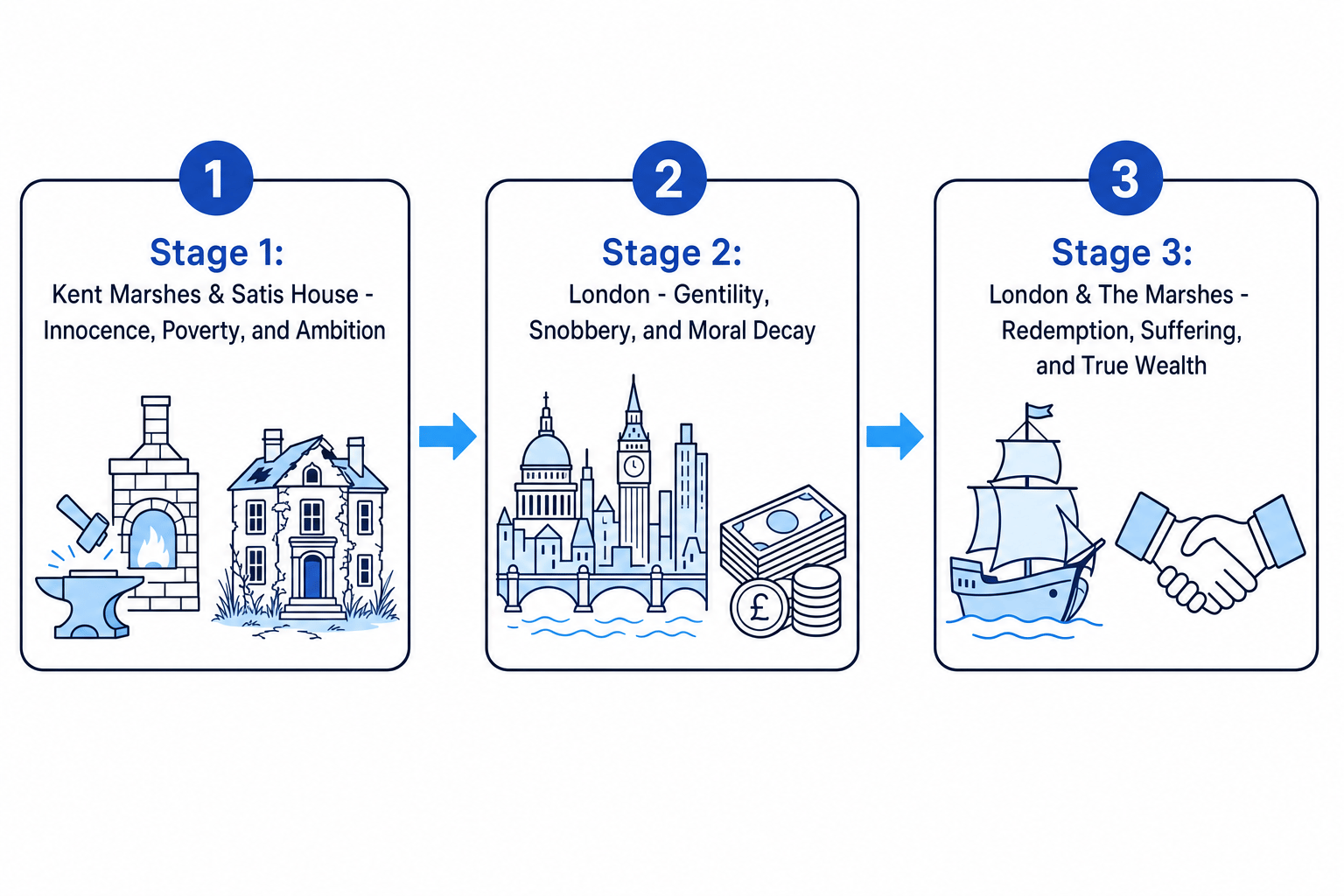
Stage 1 (Chapters 1–19): Childhood Innocence and Ambition
We meet Pip as an isolated, terrified orphan living with his abusive sister, Mrs. Joe, and her kind-hearted blacksmith husband, Joe Gargery. Pip’s life changes forever when he is summoned to Satis House to play with Estella, the adopted daughter of the bitter, jilted Miss Havisham.
Exposure to Satis House introduces Pip to class shame. He begins to view his simple life at the forge as "coarse and common," sparking his "great expectations" of becoming a wealthy gentleman to win Estella’s love.
Stage 2 (Chapters 20–39): London and Moral Decay
Upon learning that a secret benefactor has provided him with a massive fortune, Pip leaves the forge for London. Here, he is tutored by Matthew Pocket and managed by the cold, calculating lawyer, Jaggers.
As Pip adopts the superficial manners of a London gentleman, he becomes a snob. He actively rejects Joe, feeling ashamed of his adoptive father’s lack of education and rough manners. Pip’s moral degradation peaks in this stage as he falls into debt and idle vanity.
Stage 3 (Chapters 40–59): Redemption and Self-Knowledge
The climax of the novel arrives when Pip discovers his true benefactor is not the aristocratic Miss Havisham, but Magwitch—the terrifying convict he helped on the marshes in Chapter 1.
This revelation shatters Pip's illusions of superiority. By confronting his disgust and choosing to protect Magwitch, Pip experiences a moral awakening. He learns that true "gentility" is not a matter of birth or wealth, but of the heart.
True vs. False Gentility
The central moral lesson of the novel is that the Victorian class system conflates being a "gentleman" with wealth and social standing. Dickens argues instead that a true gentleman is defined by moral integrity, selflessness, and love—qualities embodied by the uneducated blacksmith, Joe, rather than the corrupt upper-class elite.
Key Contextual Foundations (AO4)
To secure the highest marks in your Edexcel exam, you must weave historical context into your analysis. Dickens was a passionate social reformer who used his writing to expose the injustices of the Victorian era.
Class and Social Mobility
Victorian society was highly stratified. The Industrial Revolution had created a new class of wealthy merchants and capitalists, yet the old aristocratic hierarchies remained. Social mobility—the ability to move up the social ladder—was fiercely desired but deeply fraught. Dickens critiques this obsession by showing how Pip's rise in social status corresponds directly with his fall in moral character.
The Victorian Penal System and Justice
In the 19th century, the British legal system was brutal and class-biased. Crimes against property were punished with extreme severity, including public execution or transportation to penal colonies in Australia (which is where Magwitch is sent).
Dickens uses the legal world of Jaggers and the criminal world of Magwitch to expose the hypocrisy of Victorian justice: the law protects the wealthy (like the abusive upper-class Compeyson) while relentlessly punishing the poor and desperate (like Magwitch).
Confusing Dickens's Voice with Pip's
Do not confuse the adult narrator (Pip) with Charles Dickens himself. While Dickens drew heavily on his own childhood experiences of poverty and debt, the novel is a fictionalized critique. Always refer to the author as "Dickens" and the storyteller as "Pip" or "the adult narrator."
Worked Example: Analyzing Pip's Transition of Perspective
When writing your exam essays, you must show how Dickens uses language (AO2) to reflect Pip's moral development, while linking this to Victorian social context (AO4). Let us look at how you can build an analytical paragraph focusing on Pip’s shift in perspective when he returns to the forge in Stage 3.
Analyzing Pip's moral development
Here is how you can build a high-level analytical response:
- Formulate a clear argumentative thesis (AO1): Start by directly answering how Pip's perspective changes, establishing a contrast between his past snobbishness and his current maturity.
- Drafting: In Stage 3 of the novel, Dickens uses Pip's changing attitude toward the forge to signal his moral redemption and his rejection of superficial Victorian class values.
- Select precise textual evidence and identify literary methods (AO2): Integrate a short quote that shows Pip’s sensory or emotional reaction, identifying key language techniques.
- Drafting: When Pip returns to the forge, he reflects on Joe’s simple workspace, noting that "the light of the fire" and the "old anvil" now seem to hold a "sacred" quality, a stark contrast to when he previously viewed them as "coarse and common." The use of the religious adjective "sacred" creates a semantic field of holiness and reverence.
- Analyze the deep structural and linguistic effects (AO2): Explain how this choice of words affects the reader and reveals the character’s psychological change.
- Drafting: By elevating the dusty, soot-stained forge to something "sacred," Dickens employs situational irony. Pip once associated the forge with dirt and social degradation; now, his moral awakening allows him to see it as a place of pure, uncorrupted goodness. The contrast with his earlier dismissive descriptor "coarse" highlights his transition from arrogant snobbery back to spiritual innocence.
- Anchor the analysis in Victorian context (AO4): Explain why Dickens structured the character's development this way, connecting it to wider 19th-century societal issues.
- Drafting: Through this transformation, Dickens directly challenges the Victorian middle-class assumption that manual labor is degrading. By sanctifying Joe's working-class labor, Dickens critiques a society that prioritizes the hollow, unproductive wealth of London over the genuine, loving productivity of the domestic hearth.
The Power of the Dual Narrator
Remember that Great Expectations is told in the first person by an older, wiser Pip looking back on his foolish youth. This "dual perspective" allows Dickens to create dramatic irony. Look out for moments where the mature narrator gently mocks or expresses deep regret for his younger self's snobbish actions.
In the exam
- Focus on the prompt: Your essay must directly address the specific question asked. Do not simply write a general summary of Pip's life; instead, tailor your overview knowledge of his three-stage journey to themes like guilt, ambition, or isolation.
- Utilize your open-book advantage: Because you have the text in front of you, you do not need to memorize massive blocks of text. Instead, memorize key chapter markers (e.g., Chapter 1 for the Marshes, Chapter 8 for Satis House, Chapter 39 for Magwitch's return) so you can find precise, short quotations quickly.
- Integrate context naturally: Never write a "standalone" paragraph about the Victorian era. Your AO4 points must be seamlessly woven into your language analysis. Use transition phrases like "This reflects the Victorian anxiety surrounding..." or "Dickens utilizes this character to protest the 19th-century penal system..."
Check yourself
- Why did Dickens split the novel into three distinct "stages of expectations," and what does Pip learn at the end of each stage?
- What is the difference between how the young Pip views Satis House and how the adult narrator reflects upon it?
- How does the character of Joe Gargery challenge the traditional Victorian definition of a "gentleman"?