Jane Austen’s Pride and Prejudice is a masterclass in literary craft. To secure top marks in your Edexcel IGCSE English Literature exam (specifically assessing AO2: analyse language, form, and structure), you must look beyond what happens to the characters and investigate how Austen tells their story.
This guide explores the architectural symmetry of Austen's plotting, her pioneering use of narrative perspective, and the sharp, ironic language that dissects the social hierarchies of Regency England.
What you'll learn:
- How to identify and analyse Free Indirect Discourse (FID) and its role in shaping reader empathy and irony.
- The elegant, mirror-like symmetrical structure of the novel, split by Darcy's pivotal letter.
- How to deconstruct Austen's use of irony, balanced syntax, and dialogue as tools for social satire.
1. The Form: The Novel of Manners and Epistolary Elements
To understand Pride and Prejudice, we must first define its literary form.
Novel of Manners
A novel of manners is a work of realist fiction that recreates a social world, detailing the customs, values, habits, and expectations of a specific class of people (in this case, the landed gentry of Regency England). The plot often hinges on courtship, marriage, and the financial anxieties of maintaining social status.
Austen does not write about wars, politics, or historical events, despite writing during the Napoleonic Wars. Instead, her focus is highly domestic, examining what she famously described as "three or four families in a country village."
The Epistolary Influence
Before it became the third-person novel we read today, Austen's early draft of the book (titled First Impressions) was written in an epistolary form.
Epistolary Novel
An epistolary novel is a novel written as a series of documents, usually letters written by one or more of the characters.
Although Austen eventually abandoned the purely epistolary format in favour of a third-person narrative, she retained letters as crucial structural devices. In a world where men and women could rarely speak in private without chaperones, letters are the only medium where characters can be completely honest, unmediated by social politeness.
The Power of Letters
Letters in Pride and Prejudice act as structural "truth bombs." Think of Mr. Collins’s pompous, self-important letters, Lydia’s chaotic, unpunctuated notes, or Darcy’s life-altering letter in Chapter 35. They allow Austen to shift the narrative voice and reveal a character's true psychological landscape without narrator intervention.
2. Narrative Perspective: Free Indirect Discourse
Austen’s most revolutionary contribution to the development of the English novel is her use of Free Indirect Discourse.
Free Indirect Discourse (FID)
Free Indirect Discourse is a narrative technique where a third-person omniscient narrator adopts the thoughts, feelings, and vocabulary of a specific character. It blends third-person narration ("she thought") with first-person consciousness ("how could I have been so blind?"), without using formal reporting verbs like "she realized that..." or "he thought that...".
How to Spot Free Indirect Discourse
If the narrator says: "Elizabeth felt that Darcy was extremely disagreeable," that is standard indirect speech. If the narrator says: "She stared at him. Was there ever a man so insufferable?" that is Free Indirect Discourse. The question "Was there ever a man so insufferable?" is Elizabeth's active, subjective thought, but it is delivered in the third person by the narrator.
By using FID, Austen achieves two things simultaneously:
- Intimacy: We see the world through Elizabeth's eyes, sharing her prejudices, her quick judgments, and her emotional vulnerability.
- Ironic Distance: Because the narrator is still technically separate, Austen can subtly invite the reader to laugh at Elizabeth's mistakes, prompting us to realize her blindness before she does.
Confusing the Narrator with Elizabeth
Students often write that the narrator "hates Darcy" in the first half of the book. Remember, the narrator is objective; it is Elizabeth's prejudiced perspective filtering through the narrator's voice via FID that makes Darcy seem so irredeemable. Always attribute these highly critical views of Darcy to Elizabeth’s subjective lens, not the narrator’s ultimate truth.
3. The Structural Symmetry of the Novel
The structure of Pride and Prejudice is beautifully architectural. The novel is built on a series of dualities, parallels, and mirror images that reflect the thematic journey from error to self-knowledge.
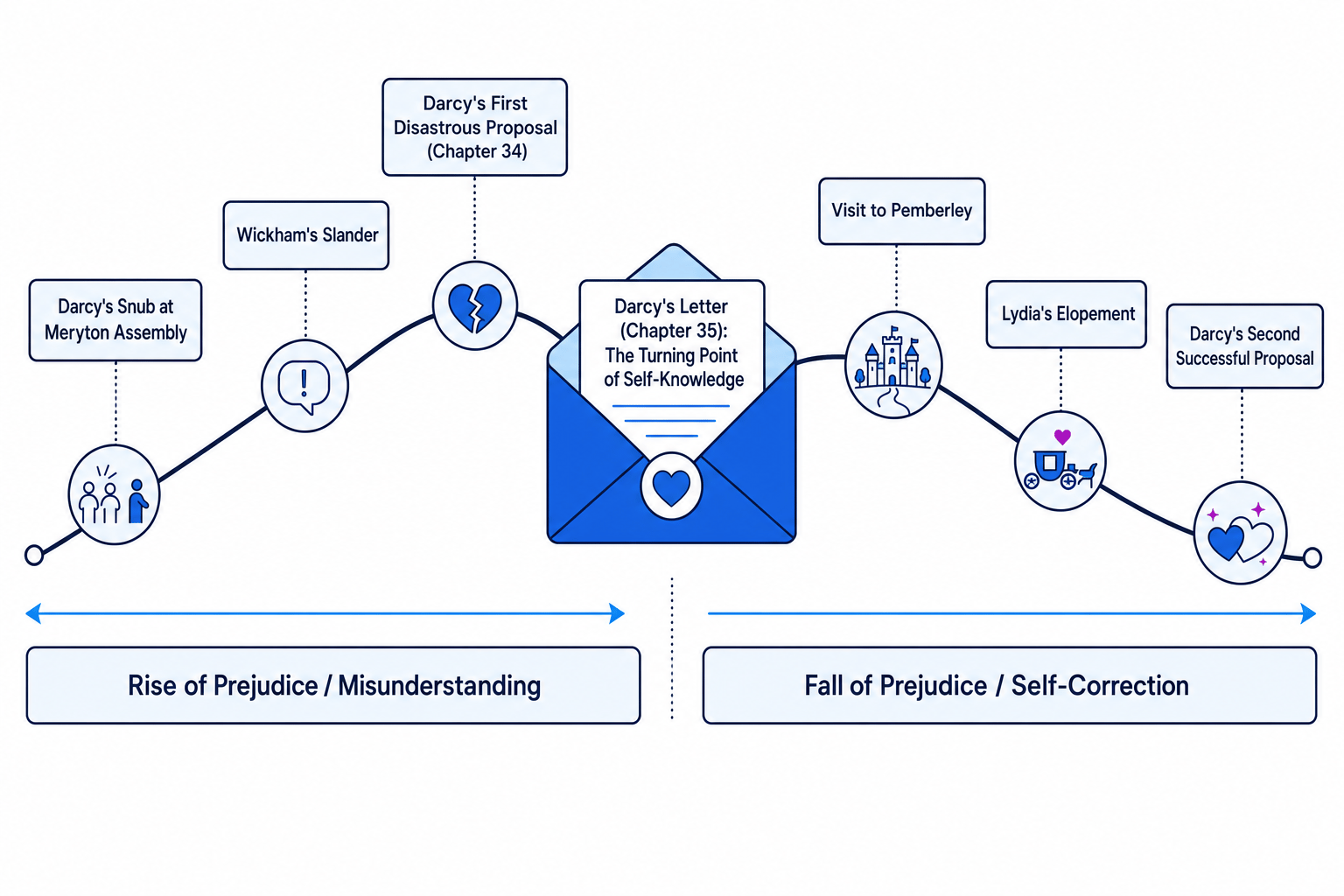
The Structural Fulcrum: Chapter 35 (Darcy's Letter)
The novel is divided neatly into two halves, with Darcy's letter in Chapter 35 serving as the axis or turning point.
- The First Half (Chapters 1–34): Characterized by the rise of prejudice and misunderstanding. Elizabeth misinterprets Darcy and Wickham; Darcy misinterprets Jane’s quietness. This half rises to a climax with Darcy's disastrous first proposal at Hunsford and Elizabeth's furious rejection.
- The Second Half (Chapters 36–61): Characterized by the fall of prejudice and self-correction. Elizabeth reads the letter, has her epiphany, and begins her journey towards self-knowledge. This half mirrors the first but resolves the conflicts, culminating in Darcy's second, successful proposal.
Mirror Scenes and Symmetrical Parallels
Austen structurally pairs events to highlight the moral growth of her characters:
| First Half (Error) | Second Half (Resolution) |
|---|---|
| Darcy's First Proposal (Ch. 34): Insulting, prideful, focused on social disparity. Occurs indoors in a tense, claustrophobic setting. | Darcy's Second Proposal (Ch. 58): Humble, respectful, focused entirely on affection. Occurs outdoors during an open, liberating walk. |
| Elizabeth's journey to Kent: Leads to isolation, confrontation with Lady Catherine, and Darcy's first proposal. | Elizabeth's journey to Derbyshire: Leads to Pemberley, a physical representation of Darcy's true, noble character, and reconciliation. |
| Wickham’s introduction: Elizabeth immediately believes Wickham’s polished lies over Darcy's cold truth. | Lydia's elopement with Wickham: The terrifying reality of Wickham’s lack of morals is exposed, forcing Darcy to rescue the Bennets. |
4. Austen's Language: Irony, Syntax, and Dialogue
Austen’s prose style is rooted in the 18th-century "Age of Reason." Her sentences are balanced, symmetrical, and deeply analytical.
Ironic Syntax and Antithesis
Austen frequently uses antithesis—the placing of opposing ideas in close proximity with parallel grammatical structures—to expose social hypocrisies.
Antithesis
Antithesis is a rhetorical device in which two opposite ideas are put together in a sentence to achieve a contrasting effect, often using parallel grammatical structures.
Consider the famous opening line of the novel:
"It is a truth universally acknowledged, that a single man in possession of a good fortune, must be in want of a wife."
- The Grammatical Balance: "truth universally acknowledged" (grand, objective) vs. "in want of a wife" (narrow, highly subjective social expectation of the mothers of Longbourn).
- The Irony: The "truth" is not universal at all. In reality, it is the mothers who are desperately "in want" of the wealthy single man for their daughters. This immediate mismatch between appearance and reality sets the tone for the entire novel.
How to Analyse Austen's Sentence Structure
Look for where Austen uses pairs of abstract nouns (e.g., pride and prejudice, sense and sensibility, civility and sincerity). Her characters must learn to balance these opposing forces. The symmetry of her sentences reflects the mental clarity and balance her characters must achieve to find happiness.
Dialogue as Characterisation
In Pride and Prejudice, how a character speaks is a direct reflection of their moral and intellectual worth. Austen utilizes dialogue to satirize the foolish and elevate the rational:
- Mr. Collins: Speaks in long, winding, repetitive sentences filled with empty, pompous vocabulary ("condescension," "bounty," "humble respect"). His syntax is rigid and rehearsed, reflecting his inability to feel genuine human emotion.
- Mrs. Bennet: Her speech is fragmented, exclamation-heavy, and dominated by hyperbole ("You take delight in vexing me. You have no compassion on my poor nerves!"). This syntactical chaos mirrors her intellectual vacuity and lack of self-control.
- Elizabeth and Darcy: When they spar, their dialogue is sharp, fast-paced, and intellectually matched. They use precise, analytical vocabulary, matching each other's syntactic patterns. This stylistic harmony foreshadows their ultimate marital compatibility.
5. Worked Example: Analysing Free Indirect Discourse
In your exam, you might be asked to analyse how Austen presents Elizabeth's changing feelings. Let’s look at how to construct a high-scoring AO2 analytical paragraph based on Chapter 36, immediately after Elizabeth reads Darcy’s letter.
Analysing Narrative Voice and Self-Knowledge
The Prompt: Analyse how Austen uses language to convey Elizabeth’s realization of her own errors in Chapter 36.
Our Chosen Quote:
"She grew absolutely ashamed of herself. Of neither Darcy nor Wickham could she think, without feeling that she had been blind, partial, prejudiced, absurd."
Analysis Steps:
- Identify the narrative method (AO2): Start by identifying that Austen is using Free Indirect Discourse here. Although it begins with "She grew...", the frantic listing of adjectives represents the raw, internal cadence of Elizabeth's self-reproach.
- Deconstruct the syntax and word choice: Focus on the specific vocabulary and structure. The list of four adjectives—"blind, partial, prejudiced, absurd"—is a devastating self-assessment.
- Blind: Metaphorical lack of perception.
- Partial: Lacking objectivity/fairness.
- Prejudiced: Directly linking her behavior to the novel's title.
- Absurd: The ultimate blow to her identity as a rational, clever observer.
- Analyse the emotional and structural effect: Explain how this linguistic breakdown mirrors her psychological shift. The sentence moves from a structured third-person opening to a rapid, desperate cascade of negative traits. This marks the death of her "first impression" of herself as an infallible judge of character, aligning structurally with the turning point of the entire novel.
Drafting the final analytical response:
Austen uses free indirect discourse to expose the painful collapse of Elizabeth’s self-delusion. After digesting Darcy’s letter, Elizabeth's thoughts are filtered through the narrator as she feels "absolutely ashamed of herself." The syntax of her realization is structured around a escalating syndetic list of self-reproaching adjectives: she has been "blind, partial, prejudiced, absurd." By grouping these terms, Austen highlights the sudden, shattering clarity of Elizabeth’s introspection. The adjective "blind" acts as a powerful metaphor for her previous lack of insight, while the explicit recognition of being "prejudiced" directly mirrors the novel's title, signalling to the reader that the structural climax of the novel has been reached. Her intellectual pride is thoroughly dismantled, as she admits her behavior was not merely mistaken, but "absurd."
In the exam
- Focus on Narrative Agency: Whenever you quote Elizabeth's thoughts, clarify how they are presented. Is she speaking aloud in dialogue, writing a letter, or is the narrator sliding into her mind using Free Indirect Discourse?
- Explore Symmetrical Contrast: If you are writing about a theme (like pride, marriage, or class), structure your essay to show how Austen contrasts two characters or two scenes (e.g., Charlotte Lucas's pragmatic view of marriage vs. Elizabeth’s romantic ideals). This shows the examiner you appreciate the structural design of the novel.
- Analyse Dialogue Dynamics: Do not just look at what characters say, but how they say it. Note if a character's speech is repetitive, hyperbolic, or highly balanced. Connect this directly to Austen's satirical purpose (AO4/AO2).
Check yourself
- Why does Austen retain letters in her novel if she moved away from the epistolary format? Give an example of a letter that alters the course of the plot.
- Find a quote from Mr. Collins. How does his syntax (sentence structure) reflect his sycophantic character?
- Explain how Chapter 35 (Darcy's letter) acts as a physical and emotional "pivot" for both Elizabeth and Darcy.