When preparing for your Pearson Edexcel International GCSE English Literature exam, memorising lists of random sentences from Pride and Prejudice is not enough. Under the high-pressure conditions of Component 2, Section B (which is an open-book exam, meaning you will have a clean copy of the text), knowing where key quotes are and how to dissect them rapidly is your secret weapon.
Rather than trying to remember hundreds of minor lines, your goal should be to master a small bank of highly versatile quotations. These are quotes that contain rich language and structure (AO2) and link directly to the central themes of class, gender, and social status (AO4).
What you'll learn
- How to select "utility" quotes that can be used across multiple essay prompts.
- Techniques for close-reading syntax, irony, and narrative voice in Jane Austen’s writing.
- How to seamlessly integrate quotation analysis with Regency-era context to secure top marks.
The Concept of the "Utility" Quote
A utility quote is a highly concentrated line of text that acts as a key to multiple doors. It is a quote that contains multiple layers of meaning, allowing you to use it whether you are writing an essay on a specific character, a central theme, or Austen’s stylistic techniques.
Utility Quotation
A utility quotation is a dense, high-yield passage of literature that can be adapted to answer several different exam prompts by shifting the focus of your analysis (e.g., from characterization to theme, or from literary method to historical context).
By mastering a few utility quotes, you save valuable planning time in the exam. Instead of flipping through your text to find obscure lines, you can confidently turn to a passage you have already deeply analyzed.
Selecting Your Utility Quotes
To determine whether a quotation is a "utility" quote, ask yourself three questions:
- Does it feature a distinct literary device (like dramatic irony, free indirect discourse, or parallel syntax)?
- Can it be linked to at least two different themes (e.g., marriage and social class)?
- Does it reflect the social pressures, gender constraints, or economic realities of the Regency era?
If the answer to all three is yes, you have found a goldmine.
Micro-Analysing Austen's Language (AO2)
Jane Austen’s style is famous for its subtlety. She rarely relies on dramatic metaphors or vivid imagery; instead, she uses irony, free indirect discourse, and meticulous sentence structure (syntax) to expose her characters' flaws.
The Power of Satire and Irony
Austen's main narrative tool is satire—using humor, irony, or exaggeration to expose and criticize people's stupidity or vices, particularly within the upper-middle-class gentry. When analysing quotes, look for where characters say one thing but the narrative voice implies another.
Let's break down how to analyze these elements step-by-step.
Step 1: Identify the Narrative Voice
Is the quote spoken by a character in dialogue, or is it delivered by the third-person narrator? If it is the narrator, is Austen using free indirect discourse?
Free Indirect Discourse
Free indirect discourse is a style of third-person narration that slips into a character's internal thoughts and feelings without using explicit tags like "she thought" or "he felt." This blurs the line between the objective narrator and the subjective character, often creating a highly ironic effect.
Step 2: Examine Sentence Structure (Syntax)
Look for balance and symmetry in Austen's sentences. She frequently uses antithesis (contrasting ideas placed side by side) and parallel clauses to highlight social hypocrisies.
The Essential Quote Bank
Let’s look at three essential utility quotes, breaking down their methods, thematic links, and context.
1. The Opening Gambit (Chapter 1)
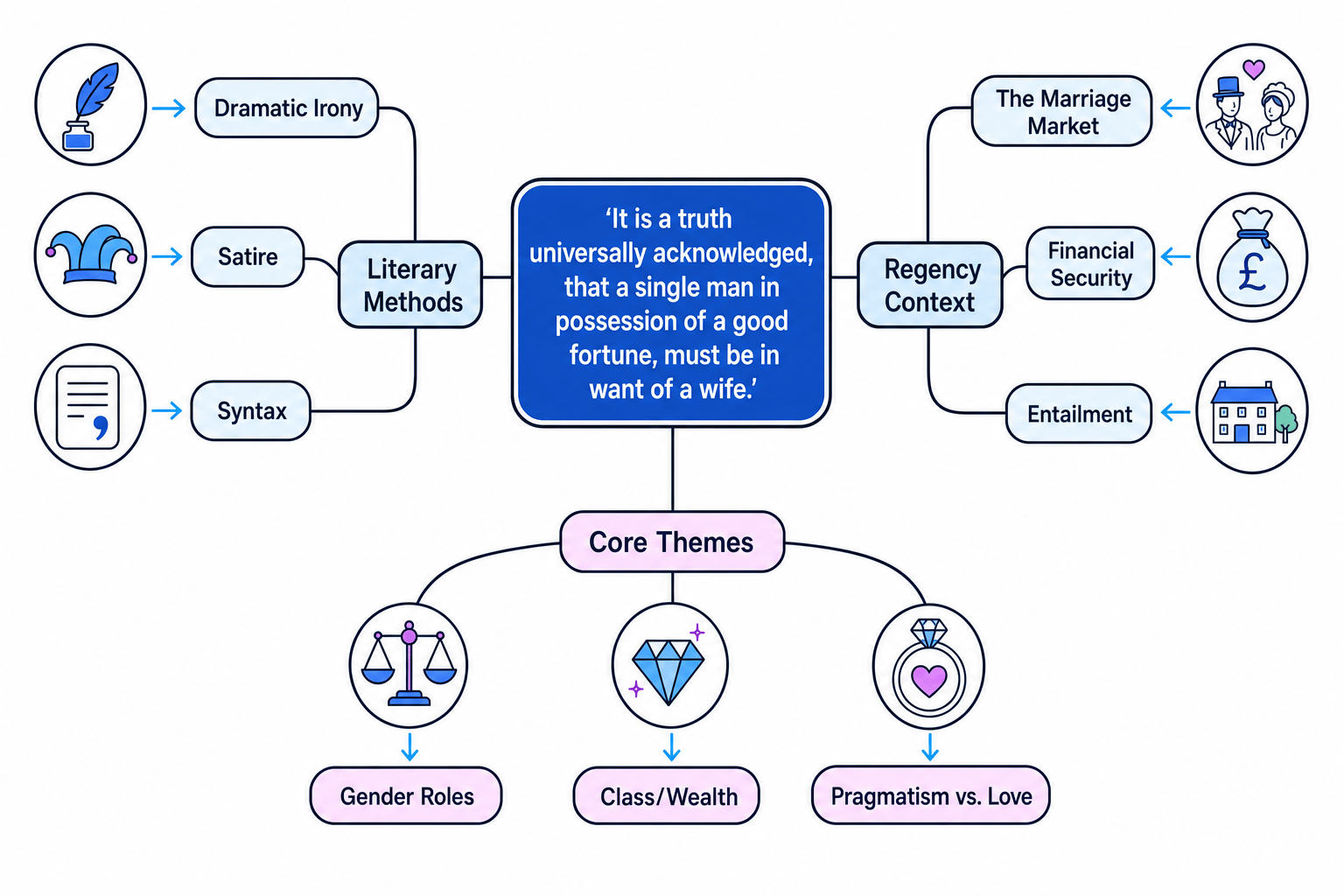
"It is a truth universally acknowledged, that a single man in possession of a good fortune, must be in want of a wife."
- Thematic Links: Marriage and Financial Security, Class and Status, Gender Roles.
- Literary Methods:
- Dramatic Irony: The sentence is framed as an absolute "truth," but the rest of the novel reveals that it is actually the single women (who have no independent wealth) who are desperately in want of a husband with a fortune.
- Passive Voice / Generalization: "Universally acknowledged" satirizes the narrow, inward-looking perspective of the provincial gentry (like Mrs. Bennet), who mistake their own desperate neighborhood gossip for a universal law of human nature.
- Regency Context (AO4): Under the laws of coverture and the system of entailment (which prevents female heirs from inheriting family estates), women had almost no financial independence. Marriage was not simply a romantic choice; it was an economic necessity for survival.
Avoid Literal Readings
Never read this opening line at face value! It is one of the most famous examples of irony in English literature. Show the examiner that you understand Austen is mocking the predatory nature of the Regency marriage market, not endorsing it.
2. Darcy's Initial Judgment (Chapter 3)
"She is tolerable; but not handsome enough to tempt me; and I am in no humour at present to give consequence to young ladies who are slighted by other men."
- Thematic Links: Pride, First Impressions, Class Snobbery.
- Literary Methods:
- Adjective Choice: The word "tolerable" acts as a cold, clinical evaluation, reducing Elizabeth to a product on a shelf.
- Social Verb: "Give consequence" highlights Darcy's acute awareness of his own superior social standing. In his eyes, attention from a man of his wealth elevates a woman's social status, and he refuses to bestow that gift easily.
- Regency Context (AO4): Darcy’s £10,000 a year puts him at the very top of the landed gentry. His initial refusal to dance with women outside his immediate social circle reflects the rigid class boundaries of the era, where dancing was a highly significant public endorsement of social equality.
3. Elizabeth’s Moment of Self-Realization (Chapter 36)
"How despicably have I acted!" she cried. — "I, who have prided myself on my discernment!... Till this moment, I never knew myself."
- Thematic Links: Prejudice, Self-Discovery, Blindness vs. Sight.
- Literary Methods:
- Exclamatory Syntax: The broken syntax, dashes, and exclamation marks contrast sharply with Elizabeth’s usual calm, articulate speech. This reflects her profound emotional shock and psychological crisis.
- Irony of "Discernment": Elizabeth has spent the entire novel laughing at the folly of others (such as her mother and Mr. Collins), only to realize that her own pride has made her completely blind to Darcy's true nature and Wickham’s villainy.
- Regency Context (AO4): In the 18th and early 19th centuries, self-knowledge was considered a vital moral virtue. Elizabeth’s realization is her transition from a flawed observer to a mature, morally responsible adult capable of a companionate marriage.
Working Through an Analytical Paragraph
Let’s look at how to build an analytical paragraph using a key utility quote to answer an exam question.
Analysing the Theme of Class and Marriage
Question: Explore how Jane Austen presents the relationship between class and marriage in Pride and Prejudice.
-
Step 1: Write a focused topic sentence (AO1/AO4). Start by stating your main argument clearly, linking the theme of class to the economic realities of the Regency era.
Draft: Austen presents marriage not as a romantic fantasy, but as a calculated transaction driven by the rigid class structures and economic insecurities of Regency England.
-
Step 2: Introduce and embed your key utility quote (AO1). Introduce your quotation naturally into the flow of your sentence, ensuring you attribute it correctly.
Draft: This is established in the novel's famous opening sentence, where the narrator ironizes the social expectations of the gentry: "It is a truth universally acknowledged, that a single man in possession of a good fortune, must be in want of a wife."
-
Step 3: Analyze the literary methods and word choices (AO2). Deconstruct the specific words and structural techniques used in the quotation, explaining their deeper effects.
Draft: The genius of this line lies in its use of dramatic irony. By stating this "truth" as an absolute, "universal" law, Austen satirizes the narrow-mindedness of families like the Bennets. The passive phrasing hides the real actors in this scenario: it is not the wealthy "single man" who is actively searching for a wife, but rather the desperate families of portionless daughters who are hunting for his "good fortune."
-
Step 4: Connect your analysis back to Regency context (AO4). Explain why this social dynamic existed by referencing the historical context of the period.
Draft: This financial desperation was a direct result of Regency legal structures like entailment and primogeniture, which left women entirely dependent on marriage for economic survival. Through this satiric opening, Austen exposes how the high-society focus on class and wealth turns human relationships into cold business transactions.
Quotation Dumping
A common mistake is "quotation dumping"—dropping a long quote into your essay and moving on without dissecting its language. Your quote should never sit in a sentence by itself. Always wrap your own analytical words around it, and aim to analyze specific words (like "universally" or "tolerable") rather than the whole sentence at once.
In the exam
- Leverage the Open-Book Format: Because you have the text with you, don't waste time memorising long paragraphs. Instead, memorize the exact chapter or key scenes of your 10-15 "utility" quotes so you can find them in seconds.
- Weave Context In naturally: Do not write a separate paragraph of history facts. Always tie your context (AO4) directly to the specific words in your quote (AO2). For example, link the word "fortune" directly to the laws of entailment.
- Analyze the Unsaid: Look out for Austen's use of irony. If a character says something self-righteous, explain the contrast between what they think they are saying and what Austen wants the reader to understand.
Check yourself
- Can you list three distinct themes that can be analyzed using the opening quote: "It is a truth universally acknowledged..."?
- What literary device is Austen using when she allows us to see into Elizabeth's thoughts without using "she thought"?
- How does Darcy's use of the word "tolerable" in Chapter 3 reveal his initial class prejudice?