To master Jane Austen's Pride and Prejudice for your Edexcel IGCSE English Literature exam, you must look beyond character and theme to understand how Austen structures her novel.
By analyzing key chapters, you will see how she meticulously builds tension, engineers dramatic shifts, and reflects the rigid social realities of Regency England.
What You'll Learn
- How to identify and analyze the critical structural turning points of the novel.
- How Austen uses literary techniques like free indirect discourse and the epistolary form to shape reader response.
- How to link specific key scenes to the context of Regency marriage, wealth, and class (AO4).
- How to write high-scoring, structurally aware essays for Component 2, Section B.
The Narrative Architecture of Pride and Prejudice
Before diving into individual chapters, we must understand how Austen constructs her plot. Pride and Prejudice is not just a linear romance; it is a carefully balanced symmetrical drama.
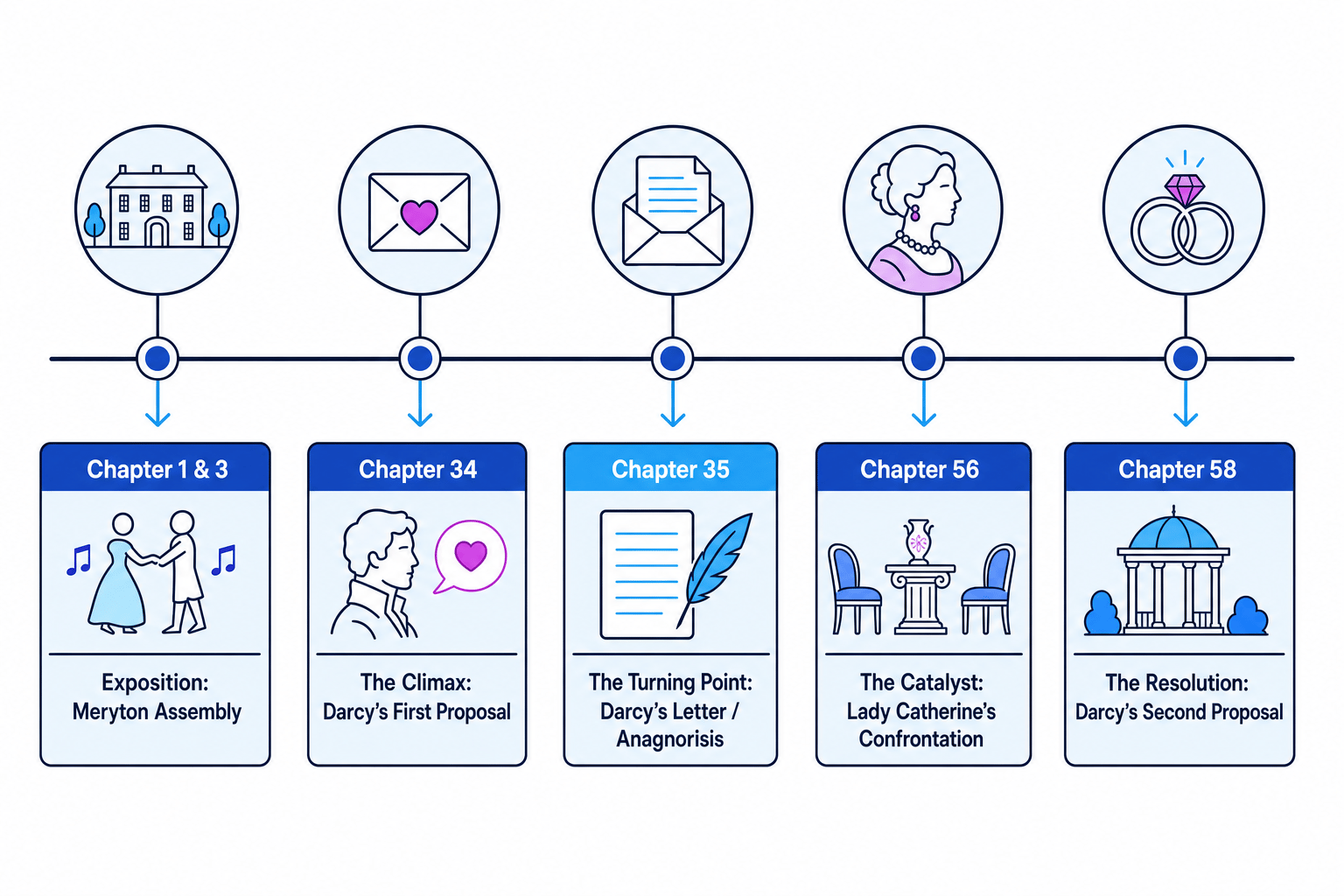
Austen employs a three-volume structure (reflecting its original 1813 publication format), which pivots around a central crisis: Darcy's first proposal in Chapter 34.
Free Indirect Discourse
Free indirect discourse is a narrative technique where a third-person omniscient narrator adopts the thoughts, feelings, and vocabulary of a specific character (usually Elizabeth Bennet), blurring the line between the narrator's voice and the character's internal monologue.
Anagnorisis
Anagnorisis is the moment in a play or novel when a character makes a critical discovery or experiences a sudden realization of their true situation or character flaw.
Chapter 1 & Chapter 3: Exposition and the Social Rules
Chapter 1: Setting the Satirical Tone
The novel opens with one of the most famous declarations in English literature:
"It is a truth universally acknowledged, that a single man in possession of a good fortune, must be in want of a wife."
This opening sentence establishes Austen's use of irony. While it claims to state a truth about men, it actually reveals the desperate perspective of families with unmarried daughters.
Through the snappy, contrasting dialogue between the cynical Mr. Bennet and the hysterical Mrs. Bennet, Austen introduces the driving force of the plot: the entailment of the Longbourn estate. Because women could not inherit property under Regency law, marriage was not simply a romantic choice but a financial necessity for survival.
The Theme of Marriage vs. Survival
Chapter 1 establishes that marriage is the primary transaction of this society. Mrs. Bennet's frantic desire to marry off her daughters is presented comically, but it is rooted in the harsh historical reality of female economic dependence.
Chapter 3: The Meryton Assembly
The ball at Meryton acts as the catalyst for the entire narrative. Here, we see the first clash of the two protagonists.
- The Inciting Incident: Mr. Darcy refuses to dance with Elizabeth, declaring her:
"tolerable; but not handsome enough to tempt me."
- The Consequences: Darcy's statement exposes his social pride, which immediately triggers Elizabeth’s prejudice. Her wounded pride leads her to adopt a highly critical view of him, blinding her to his actual character for the first half of the novel.
Chapter 34 & Chapter 35: The Pivot of the Novel
These two chapters, occurring at the end of Volume Two, form the structural core of the novel. Everything before builds up to Darcy's proposal; everything after is a consequence of Elizabeth’s rejection.
Chapter 34: Darcy's First Proposal
This scene is a masterpiece of dramatic irony and tension. Darcy's proposal is incredibly insulting because he focuses more on Elizabeth’s lower social status and her embarrassing family than on his affection for her:
"In vain have I struggled. It will not do. My feelings will not be repressed. You must allow me to tell you how ardently I admire and love you."
While the opening of his speech sounds romantic, he quickly spends more time dwelling on her "inferiority" and the "obstacle" her family presents to his social standing.
Elizabeth’s rejection is sharp and absolute, citing his behavior toward Jane and Bingley, and his alleged ruin of George Wickham:
"I had not known you a month before I felt that you were the last man in the world whom I could ever be prevailed on to marry."
Missing the Balance of Faults
Do not write that Darcy is solely at fault in this chapter. While his proposal is tactless and arrogant, Elizabeth's rejection is fueled by misinformation from Wickham. Both characters are acting out of their respective flaws: Darcy's active Pride and Elizabeth's active Prejudice.
Chapter 35: The Letter
In this chapter, Darcy hands Elizabeth a letter explaining his actions regarding Wickham and Bingley. This introduces the epistolary form (storytelling through letters) to the novel.
The letter acts as a structural device to force Elizabeth—and the reader—into a state of anagnorisis. Read through Elizabeth's eyes, the letter dismantles her prejudice step by step:
- Wickham’s True Nature: Darcy reveals that Wickham is a profligate gambler who tried to elope with Darcy’s 15-year-old sister, Georgiana, for her money.
- The Bingley-Jane Separation: Darcy admits he separated them because he believed Jane was indifferent to Bingley, a belief reinforced by Mrs. Bennet’s vulgar boasting.
By using the letter, Austen allows Elizabeth to reread Darcy’s words in private, away from the heat of verbal conflict. This forces her to admit: "I have courted prepossession and ignorance, and driven reason away... Till this moment, I never knew myself."
Chapter 56: The Confrontation at Longbourn
Chapter 56 acts as the dramatic catalyst that seals the resolution of the novel. Lady Catherine de Bourgh, Darcy’s arrogant, aristocratic aunt, arrives unexpectedly at Longbourn.
The Clash of Social Classes
Lady Catherine represents the old, rigid feudal aristocracy. She demands that Elizabeth promise never to enter into an engagement with Darcy, describing such a union as a "disgrace" to his noble family.
Elizabeth’s response is a powerful declaration of individual autonomy and female empowerment:
"He is a gentleman; I am a gentleman's daughter; so far we are equal."
Through this dialogue, Austen challenges the rigid class distinctions of the Regency era. Elizabeth does not back down to aristocratic bullying. Ironically, Lady Catherine's attempt to prevent the marriage has the opposite effect: she reports Elizabeth's defiance to Darcy, which gives him the hope he needs to propose a second time.
Structure is the Key to Lady Catherine's Role
Always mention the irony of Lady Catherine's visit. She tries to build a barrier between Elizabeth and Darcy, but structurally, she acts as the bridge that brings them back together.
Analysing Austen's Structure and Language
When analyzing key chapters in the exam, you must show the examiner how Austen uses language to reflect character development and social commentary.
Let's look at how to construct an analytical paragraph step-by-step.
Analysing the Structural Significance of Darcy's Letter in Chapter 35
Analyze how Austen uses the epistolary form in Chapter 35 to develop the character of Elizabeth.
- Point (AO1): Introduce the argument. State that the epistolary form in Chapter 35 acts as a vital structural catalyst for Elizabeth’s psychological shift, moving her from blind prejudice to self-awareness.
- Evidence (AO1): Use precise textual references. Show how Elizabeth is forced to read Darcy's defense in solitude, which leads to her painful realization: "She grew absolutely ashamed of herself. Of neither Darcy nor Wickham could she think, without feeling that she had been blind, partial, prejudiced, absurd."
- Method (AO2): Analyze Austen's linguistic and structural techniques. Highlight the cumulative effect of the emotive list of adjectives ("blind, partial, prejudiced, absurd"), which emphasizes her overwhelming sense of shame. Point out how the epistolary form acts as a mirror, removing Darcy's physical presence so Elizabeth can evaluate his words objectively without her wounded pride interfering.
- Context (AO4): Link the analysis to Regency social expectations. Explain that in Austen's era, women's lives were restricted to the private domestic sphere. Reading and writing letters was one of the few areas where women could exercise intellectual autonomy and deep personal reflection.
- Effect (AO2/AO1): Conclude by explaining the impact on the reader. The reader shares Elizabeth's shock because Austen has kept us aligned with Elizabeth's perspective up to this point. We experience the humbling of our own prejudice alongside the heroine.
In the exam
- Never treat a chapter in isolation: Always explain how a key scene relates to what came before and what follows (e.g., "Chapter 35 is the direct psychological consequence of the explosive confrontation in Chapter 34...").
- Integrate context seamlessly (AO4): Do not write a separate paragraph of history facts. Instead, weave context into your analysis. For example, explain Mrs. Bennet's hysteria in Chapter 1 through the lens of Regency property laws and the entailment of Longbourn.
- Focus on narrative voice (AO2): Look out for free indirect discourse. When analyzing Elizabeth's thoughts in Chapter 35, show how Austen blends the narrator's objective voice with Elizabeth’s subjective panic.
Check yourself
- Why is Darcy's first proposal in Chapter 34 considered the structural pivot (or turning point) of the entire novel?
- How does Lady Catherine’s intervention in Chapter 56 backfire, and what is the structural irony of this scene?
- What are the two secrets Darcy reveals in his letter in Chapter 35, and how do they dismantle Elizabeth's prejudice?