Louis MacNeice’s "Prayer Before Birth" is one of the most powerful and haunting poems in your Edexcel Anthology. Written in 1944 during the dark depths of the Second World War, it acts as a passionate, desperate plea from an unborn child who is terrified of the world they are about to enter.
For your Edexcel International GCSE English Literature exam (Component 1, Section B), you need to show a deep understanding of how MacNeice uses language, form, and structure to convey his warnings about human cruelty, loss of individuality, and the horrors of war.
What you'll learn
By the end of these study notes, you will:
- Understand the historical and personal context behind MacNeice’s wartime poem.
- Analyse how the poem's unique form and structure build dramatic tension.
- Deconstruct key imagery, metaphors, and phonetic techniques (like plosives and sibilance).
- Know how to formulate a high-level analytical paragraph matching the Edexcel assessment objectives (AO2 and AO3).
1. Context: A World on the Brink of Destruction
To truly appreciate the desperation in "Prayer Before Birth," we must first look at when and why it was written.
Context (AO4)
Context refers to the historical, social, and literary circumstances surrounding the writing of a text. While your Anthology Poetry essay (Component 1, Section B) focuses primarily on AO2 (analysing language, form, and structure) and AO3 (comparing poems), understanding the context is vital for unlocking the deeper meanings behind a writer's choices.
MacNeice wrote this poem in 1944. At this point, the world had been at war for five brutal years. The scale of devastation was unprecedented:
- The Blitz had destroyed British cities.
- Industrialised warfare meant that humans were using advanced technology (bombers, tanks, machine guns) to murder each other on a massive, mechanical scale.
- Totalitarian regimes (such as Nazi Germany and Stalinist Russia) had shown how easily individuals could be brainwashed, coerced, and stripped of their moral conscience by the state.
MacNeice, an Irish poet living in England, was deeply disillusioned by how modern society could corrupt a perfectly innocent baby. He feared that any child born into this era would inevitably be forced to become either a victim of violence or, worse, a perpetrator of it.
2. Form and Structure: The Echoing Ritual
The way a poem looks and sounds is just as important as the words it uses. MacNeice makes several striking structural choices that mimic the psychological state of panic and prayer.
The Litany and Incantation
Litany & Incantation
A litany is a repetitive prayer consisting of a series of petitions or invocations. An incantation is a chant or formulaic use of words designed to produce a magical or hypnotic effect.
Each of the eight stanzas (except the very last line) begins with the same haunting, anaphoric refrain: "I am not yet born..."
This repetition creates a rhythmic chant, suggesting that the unborn child is performing a desperate protective ritual to keep the evils of the world at bay. The constant return to this line acts as a reminder of the child's vulnerability and absolute purity before birth.
Free Verse and Enjambment
The poem is written in free verse (it has no regular meter or rhyme scheme). Instead, it relies on incredibly long, cascading sentences that spill across lines using enjambment (where a sentence runs over from one poetic line to the next without terminal punctuation).
This creates a sense of overwhelming, breathless panic. The fears are piling up so quickly that the speaker cannot catch their breath.
The Dramatic Progression
Structurally, the poem is not static. It moves systematically through different tiers of human and environmental corruption.
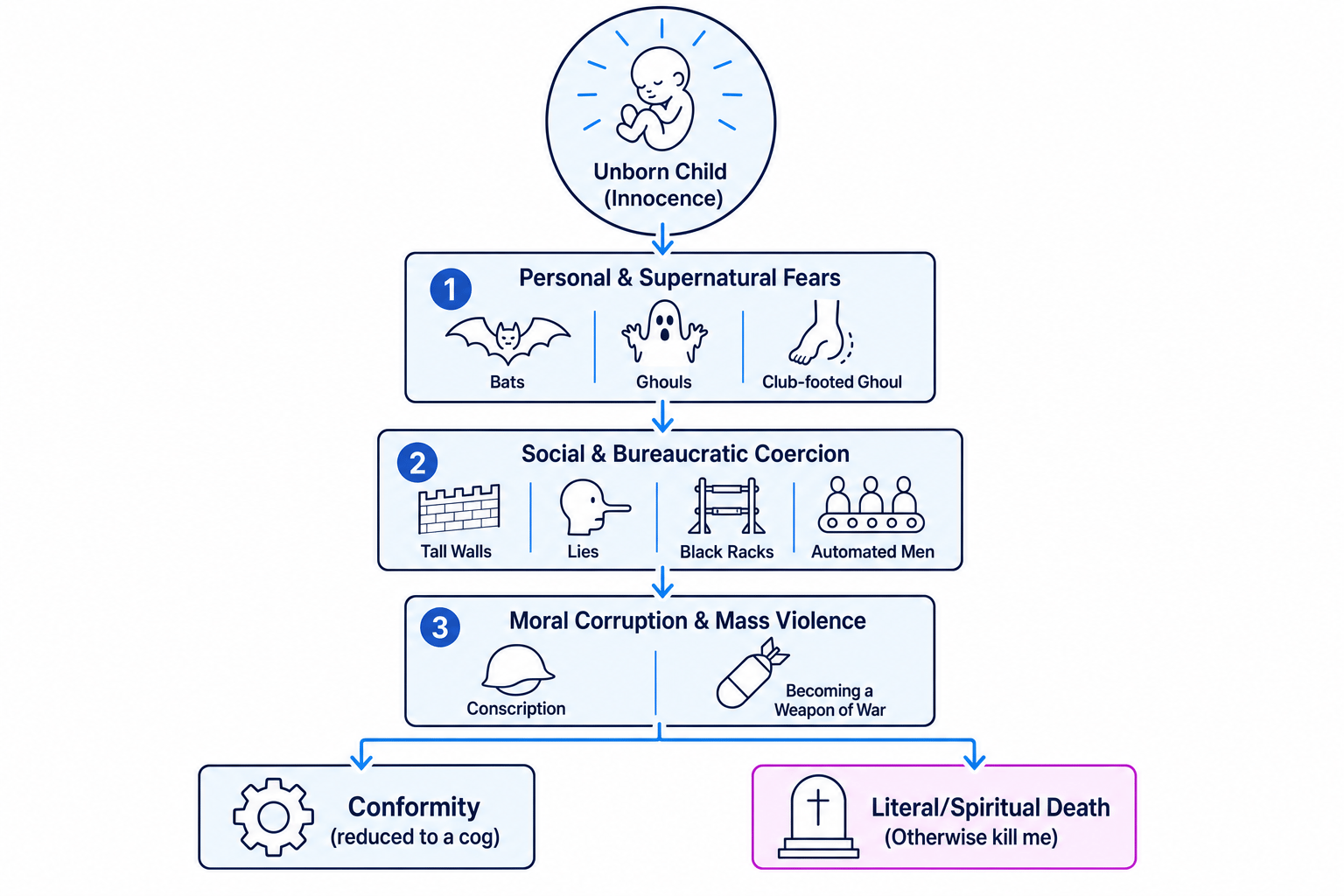
As shown in the diagram, the poem begins with simple, child-like fears of fairy-tale creatures and quickly escalates into terrifying, adult realities of war, bureaucracy, and moral death.
The Escalating Threat
Notice how the poem moves from external physical threats (bats, ghouls) in Stanza 1, to societal threats (lies, mental conditioning) in Stanzas 2–4, to moral threats (conscription, committing war crimes) in Stanzas 5–7. The ultimate horror is not being killed, but losing one's humanity and becoming a mindless cog in a destructive state machine.
3. Language and Imagery: The Weaponisation of Words
MacNeice uses raw, visceral language to juxtapose the absolute innocence of the foetus with the grotesque, mechanised world of adulthood.
Sibilance, Plosives, and Cacophony
The poem is highly sensory, full of harsh sounds designed to make the reader feel physically uncomfortable.
- Sibilance (the repetition of 's' sounds): In Stanza 1, the child begs: "let not the bloat-fly nor the lying poison wyrm / nor the chipped-faced goblin beside my crib / near me." The slithering 's' sounds evoke a sinister, snake-like presence, mimicking the deceptive nature of evil.
- Plosives (the repetition of harsh consonant sounds like 'b', 'p', 'd', 't'): In Stanza 2, the child fears "tall walls wall me, with strong drugs dope me, with wise lies lure me." The punching, rhythmic plosives sound like a physical assault, reflecting how the state aggressively forces compliance onto the individual.
Cacophony
Cacophony is a mixture of harsh, discordant, and unmelodious sounds in poetry, used to convey chaos, violence, or distress.
Metaphor and Objectification
In the later stanzas, the imagery becomes increasingly mechanical. The child begs not to be turned into a "cog" or a "machine."
In Stanza 7, the child pleads:
"Let them not make me a stone and let them not spill me. / Otherwise kill me."
- "A stone" represents total emotional numbness. The child fears that society will harden their heart until they can no longer feel empathy.
- "Spill me" is a highly unusual passive verb. Liquids are spilled, not people. By choosing this verb, MacNeice suggests that war treats human life as cheap, disposable, and easily wasted—like water or blood poured onto the ground.
4. Worked Example: Analysing a Complex Metaphor
Let's look at how you can transform these linguistic observations into a top-grade analytical response.
Suppose you are answering an exam question on how MacNeice presents the threat of societal influence and conformity.
Analysing the 'black racks' metaphor
Walk through this three-step analysis of the quotation: "In the parts I must play on the sheets of the course / halter-looms and black racks, racks of racked-up hours" (Stanza 4).
- Contextualise the quote and identify its structural device: First, locate where this quote sits. It occurs in the middle of the poem (Stanza 4), where the focus shifts firmly onto societal structures. The child uses the metaphor of a theatrical play ("parts I must play") and a pre-written script ("sheets of the course") to establish that society robs the individual of free will before they are even born.
- Deconstruct the language techniques: Focus on the specific nouns and wordplay. MacNeice uses the term "halter-looms"—a "halter" is a rope used to hang people or lead beasts of burden, while a "loom" is a machine used to weave fabric. This compound noun suggests that human life is mechanically woven into a pre-determined pattern of execution or slavery. He follows this with a pun on the word "racks" ("racks of racked-up hours"). "Racks" refers both to the medieval torture device and to a physical shelving system.
- Explain the structural and thematic effect on the reader: Connect this back to the poet's message. By blending the imagery of torture with the monotonous routine of industrial work ("racked-up hours"), MacNeice illustrates how modern life is a form of slow, psychological torment. The repetition of the hard 'k' sound in "racks," "black," and "racked-up" creates a harsh, mechanical cacophony that aurally mimics the grinding gears of a factory. This forces the reader to feel the oppressive, claustrophobic weight of a life stripped of spontaneous joy and personal autonomy.
5. Key Themes: What to Compare
In Component 1, Section B, you must compare two poems from the Anthology. To do this successfully, you need to know the core themes of "Prayer Before Birth" so you can link them to other poems in the collection (such as War Photographer or Half-Caste).
| Theme | How it is shown in "Prayer Before Birth" | Potential Comparison Poems |
|---|---|---|
| Innocence vs. Experience | The unborn child represents pure, uncorrupted potential, which is threatened by the dirty, violent realities of the adult world. | Hide and Seek (the loss of childhood innocence) |
| The Horrors of War | War is shown as an inevitable, dehumanising machine that forces innocent individuals to commit acts of violence ("my lethal weapon"). | War Photographer (the psychological trauma and human cost of global conflict) |
| Loss of Identity & Autonomy | The fear of being brainwashed, forced into a mold, and turned into a mindless, automated worker ("a cog in a machine"). | Half-Caste (resisting societal boxes and categorisation) |
Literal vs. Figurative Speaker
Do not write that the speaker is literally a "talking baby." This is a sophisticated dramatic monologue. The unborn child is a symbolic device used by MacNeice. The "child" is a blank canvas representing humanity's lost potential. When you write your essay, refer to the "unborn speaker" or "the voice of the child," and always focus on what MacNeice is trying to communicate through this construct.
The Power of the Final Line
Always comment on the final, devastating line of the poem: "Otherwise kill me." It stands completely alone as a two-word stanza (the shortest in the poem). Structurally, its abruptness represents a sudden, shocking halt. Thematically, it delivers the ultimate paradox: the child would literally rather die than live a life without a soul. It leaves the reader with a stark, uncompromising warning.
In the exam
If you choose to write on "Prayer Before Birth" in your anthology comparison question, keep these strategy tips in mind:
- Form is your friend: Do not just write about the metaphors. Mention the free verse, the rolling enjambment, and the rhythmic litany. High-scoring Edexcel students must address structure alongside language (AO2).
- Integrate short, precise quotes: Instead of quoting three long lines, embed tiny fragments of language into your analytical sentences (e.g., MacNeice fears the child will be turned into a "cog", a "stone", or treated like water to "spill").
- Drive the comparison through themes: Start your paragraphs with a conceptual point that applies to both poems (e.g., “Both MacNeice in ‘Prayer Before Birth’ and Duffy in ‘War Photographer’ explore how exposure to human cruelty destroys the speaker's peace of mind.”), then move into the detailed analysis of each poem's specific methods.
Check yourself
Before closing these notes, make sure you can answer these questions confidently:
- Why does MacNeice choose an unborn child as his speaker, and how does this create pathos?
- What is the effect of the repetitive structure ("I am not yet born...") at the start of each stanza?
- How does the poet use mechanical imagery to convey the loss of human individuality?
