Welcome to your comprehensive study guide for Rudyard Kipling’s famous poem, "If—". This guide is designed to help you achieve the highest marks in your Pearson Edexcel International GCSE English Literature exam (Specification 4ET1, Section B: Anthology Poetry, Part 3).
By studying this poem, you will learn to look beyond its popular "inspirational" surface and analyze its tight structural mechanics, historical context, and masterful use of language.
What you'll learn
- Contextual foundations: The late-Victorian ideals of the "stiff upper lip" and the historical event that inspired the poem.
- Structural mechanics: How Kipling uses syntactic suspension, iambic pentameter, and rigid stanzas to mirror the self-control he preaches.
- Poetic devices: Analyzing antithesis, personification, and imperatives to explain how Kipling crafts his advice.
- Exam skills: How to construct a high-level analytical response that meets the Assessment Objectives (AO2 analysis and AO3/AO4 context).
1. Historical and Social Context (AO4)
To understand "If—", we must step back into the late Victorian era. Written around 1895 and published in 1910 in his collection Rewards and Fairies, the poem reflects the cultural values of the British Empire at its peak.
Stoicism
Stoicism is an ancient Greek philosophy that teaches the development of self-control and fortitude as a means of overcoming destructive emotions. In Victorian Britain, this was popularized as the "stiff upper lip"—the ideal of remaining calm, silent, and resilient in the face of adversity, pain, or disaster.
Kipling’s direct inspiration for the poem was Leander Starr Jameson, a British military officer who led the "Jameson Raid" (1895) against the South African Republic. Although the raid was a disastrous failure and led to Jameson's imprisonment, he was celebrated in Britain as a hero who took responsibility and bore his defeat without complaint.
The Imperial Ideal
While the poem is written as a father's advice to his son (traditionally thought to be Kipling’s son, John), it acts as a blueprint for the ideal British imperial citizen: selfless, emotionally controlled, resilient, and humble.
2. Structural Mechanics and Form (AO2)
One of Kipling’s greatest achievements in "If—" is the way the form of the poem mirrors its meaning. The poem advocates for perfect self-discipline, and its structure is likewise incredibly disciplined.
The Single-Sentence Journey: Syntactic Suspension
The most striking structural feature of "If—" is that it consists of one long, continuous conditional sentence.
Across 32 lines, Kipling heaps conditional clause upon conditional clause ("If you can..."). The main clause—the consequence of all these conditions—is delayed until the very last two lines:
"Yours is the Earth and everything that’s in it, / And—which is more—you’ll be a Man, my son!"
This technique is called syntactic suspension. It forces you to read the poem with a sense of growing anticipation. It also means that the reward of "manhood" or "self-mastery" is not easily won; it is only achieved after surviving a long, grueling list of trials.
Meter and Rhythm: Iambic Pentameter
The poem is written predominantly in iambic pentameter (five beats of unstressed-stressed syllables per line: da-DUM da-DUM da-DUM da-DUM da-DUM\text{da-DUM da-DUM da-DUM da-DUM da-DUM}da-DUM da-DUM da-DUM da-DUM da-DUM).
This heartbeat-like rhythm creates a sense of steady, marching progress. It suggests control, order, and stability—the exact qualities Kipling is encouraging in his reader.
Feminine Endings
Be careful! Not every line has exactly ten syllables. Kipling frequently uses feminine endings (an extra, unstressed 11th syllable at the end of a line), such as in:
"If you can keep your head when all about you" This slight disruption prevents the rhythm from becoming too robotic, mirroring the idea that life will throw unexpected, unbalanced moments at you.
Rhyme Scheme Variations
The poem is structured into four stanzas of eight lines (octaves).
- Stanza 1 uses an AAAA BCBC rhyme scheme (you/too/you/too followed by waiting/lies/waiting/wise). This tight, repetitive initial rhyme establishes an immediate sense of authority and consistency.
- Stanzas 2 and 3 shift to a rigid AABBCCDD scheme. This rhyming couplet structure creates pairs of balanced opposites, reinforcing the theme of weighing two sides of life.
- Stanza 4 shifts to ABAB CDCD, building a sweeping, lyrical momentum that carries us to the poem's triumphant conclusion.
3. Language, Themes, and Imagery (AO2)
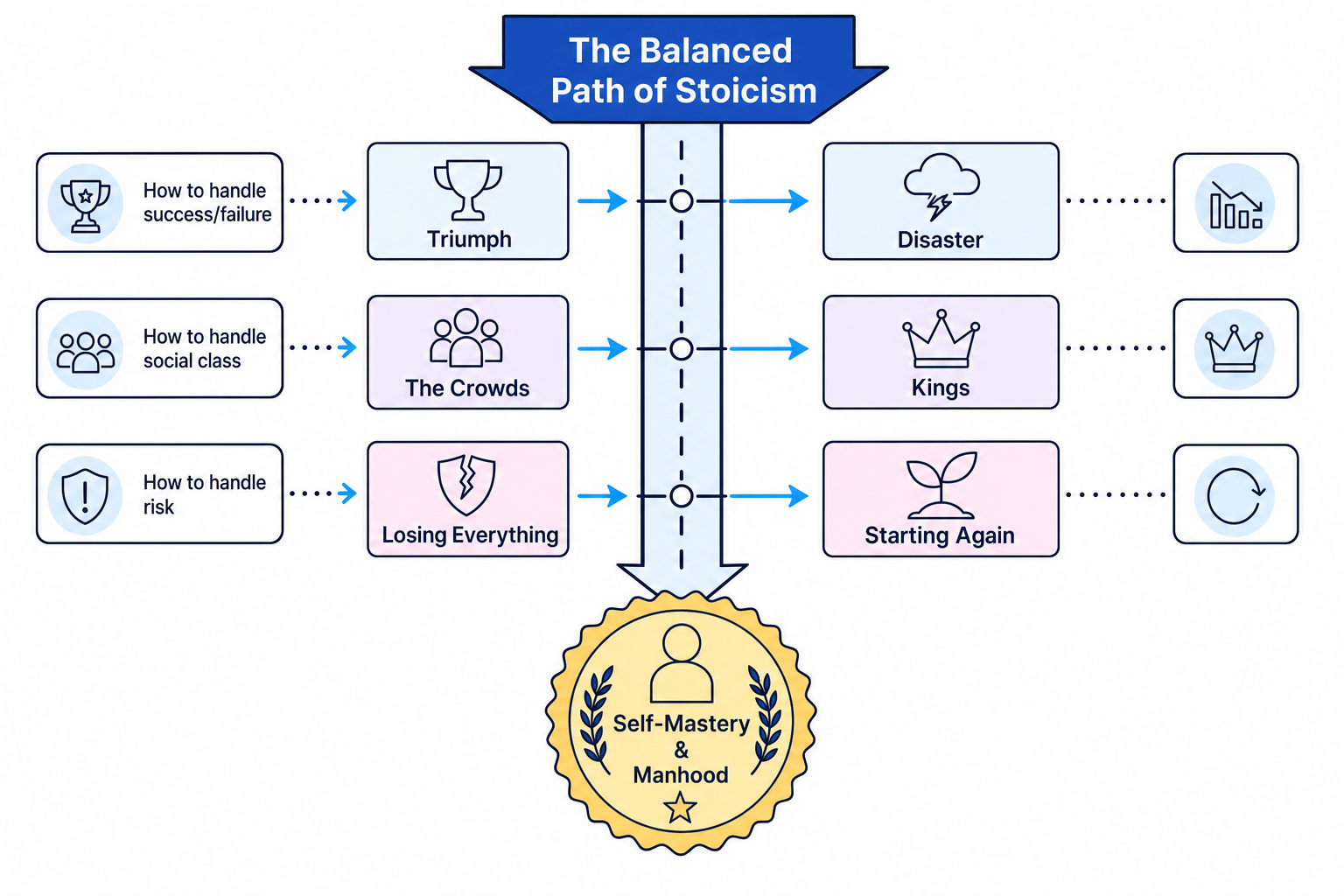
The core theme of "If—" is balance. Kipling presents a series of extreme, opposing forces and explains that a "Man" must navigate the middle path between them.
Antithesis (Opposites)
Kipling uses antithesis—the juxtaposition of contrasting ideas in balanced phrases—to show the dualities of life. You must learn to navigate both sides of these pairings without being swayed by either:
- Trust vs. Doubt: "trust yourself when all men doubt you, / But make allowance for their doubting too"
- Triumph vs. Disaster: "meet with Triumph and Disaster"
- Kings vs. Crowds: "walk with Kings—nor lose the common touch"
Personification of Abstract Concepts
In Stanza 2, Kipling famously personifies the concepts of success and failure:
"If you can meet with Triumph and Disaster And treat those two impostors just the same"
By calling Triumph and Disaster "impostors", Kipling argues that neither state is permanent or truly reflective of a person's worth. High praise and deep failure are both illusions; the stoic individual must remain indifferent to both.
The Language of Endurance
In Stanza 3, Kipling shifts his focus to physical and mental grit. He uses bodily imagery to describe the effort required to rebuild your life after a total loss:
"And force your heart and nerve and sinew To serve your turn long after they are gone"
The words "heart", "nerve", and "sinew" represent the physical and emotional components of human strength. The verb "force" highlights that self-discipline is not natural or easy—it requires an act of supreme, painful willpower.
4. Worked Example: Analyzing Kipling's Methods
In your Edexcel exam, you must write analytical paragraphs that link the writer's methods (language, form, structure) directly to their effects on the reader.
Analyzing the 'Two Impostors' Metaphor
Evaluate how Kipling uses language and personification to convey his message about resilience in Stanza 2.
- State your analytical point clearly: Kipling uses personification to warn the reader against being overly influenced by life’s highs and lows, suggesting that true character is defined by emotional stability.
- Introduce and embed your evidence: This is demonstrated when he advises the reader to "meet with Triumph and Disaster / And treat those two impostors just the same."
- Identify the specific literary methods: The capitalisation of "Triumph" and "Disaster" personifies these abstract concepts, transforming them into characters, while the noun "impostors" serves as a metaphor.
- Analyse the effect and meaning: By labeling both success ("Triumph") and failure ("Disaster") as "impostors," Kipling implies that both states are deceptive and temporary. They tempt individuals into either excessive pride or unwarranted despair. The verb "treat" suggests that the reader must actively choose how to respond to these forces, maintaining an objective, calm detachment.
- Link back to the theme / context: This directly reinforces the Victorian ideal of stoicism. By maintaining an equal distance from both victory and defeat, the individual remains master of their own mind, which Kipling presents as a prerequisite for true maturity.
5. Summary of Key Quotations
| Quotation | Method | Key Theme | Why it matters |
|---|---|---|---|
"keep your head when all about you / Are losing theirs" | Metaphor / Idiom | Self-Control | Imagery of "keeping your head" suggests maintaining rationality when surrounded by panic. |
"Triumph and Disaster / ... those two impostors" | Personification / Metaphor | Emotional Balance | Shows that both good and bad luck are fleeting illusions that should not disrupt your inner peace. |
"watch the things you gave your life to, broken, / And stoop and build ’em up with worn-out tools" | Visual Imagery / Verb Choice | Resilience / Grit | The verb "stoop" shows humility, while "worn-out tools" symbolises exhausting, continuous effort. |
"fill the unforgiving minute / With sixty seconds’ worth of distance run" | Personification / Quantitative Imagery | Time / Productivity | "Unforgiving" implies time waits for no one. A successful person must extract value from every single second. |
In the exam
- Compare Wisely (AO3): "If—" is often compared to other poems about identity, parenting, or struggle (such as Do not go gentle into that good night or Mother in a Refugee Camp). Focus your comparison on how different writers use form to present authority or advice.
- Do Not Just List Devices: Do not simply write, "Kipling uses iambic pentameter." Instead, write: "Kipling uses the steady, controlled pulse of iambic pentameter to aurally reinforce the absolute self-control he demands from his son."
- Integrate Context Seamlessly: Do not drop in isolated history paragraphs. Weave context into your analysis. For example, explain how the physical grit in Stanza 3 reflects the Victorian "stiff upper lip" expectation during imperial hardships.
Check yourself
- Why does Kipling structure the entire poem as one single sentence, and how does this affect the reader's experience?
- Explain the significance of referring to Triumph and Disaster as "impostors".
- How does the rhyme scheme change between the first stanza and the subsequent stanzas, and what is the thematic effect of this change?
