What you'll learn
- What AO2 means in Edexcel IGCSE unseen poetry.
- How to name poetic methods accurately without “feature spotting”.
- How to analyse imagery, language choice, tone, mood, form and structure.
- How to build a strong method → effect → meaning chain in your writing.
Why AO2 matters in unseen poetry
In Component 1, Section A: Unseen Poetry, you are given a poem you have not studied before. Component 1 is closed book, but the unseen poem itself is printed in the exam, so you can quote from it.
This section focuses on AO2: analysing the writer’s language, form and structure and their effects, using relevant terminology.
AO2
AO2 means explaining how a poet creates meaning. You look at the poet’s methods — such as word choice, imagery, sound, form and structure — and explain their effects on the reader.
A strong AO2 answer does not just say, “The poet uses a metaphor.” It explains what the metaphor suggests, how it shapes the reader’s response, and why it matters to the poem’s overall meaning.
Terminology is not the analysis
A literary term is useful only when it helps you explain meaning. Naming a method is the starting point, not the finish line.
The diagram below shows the basic AO2 thinking chain you should aim to follow.
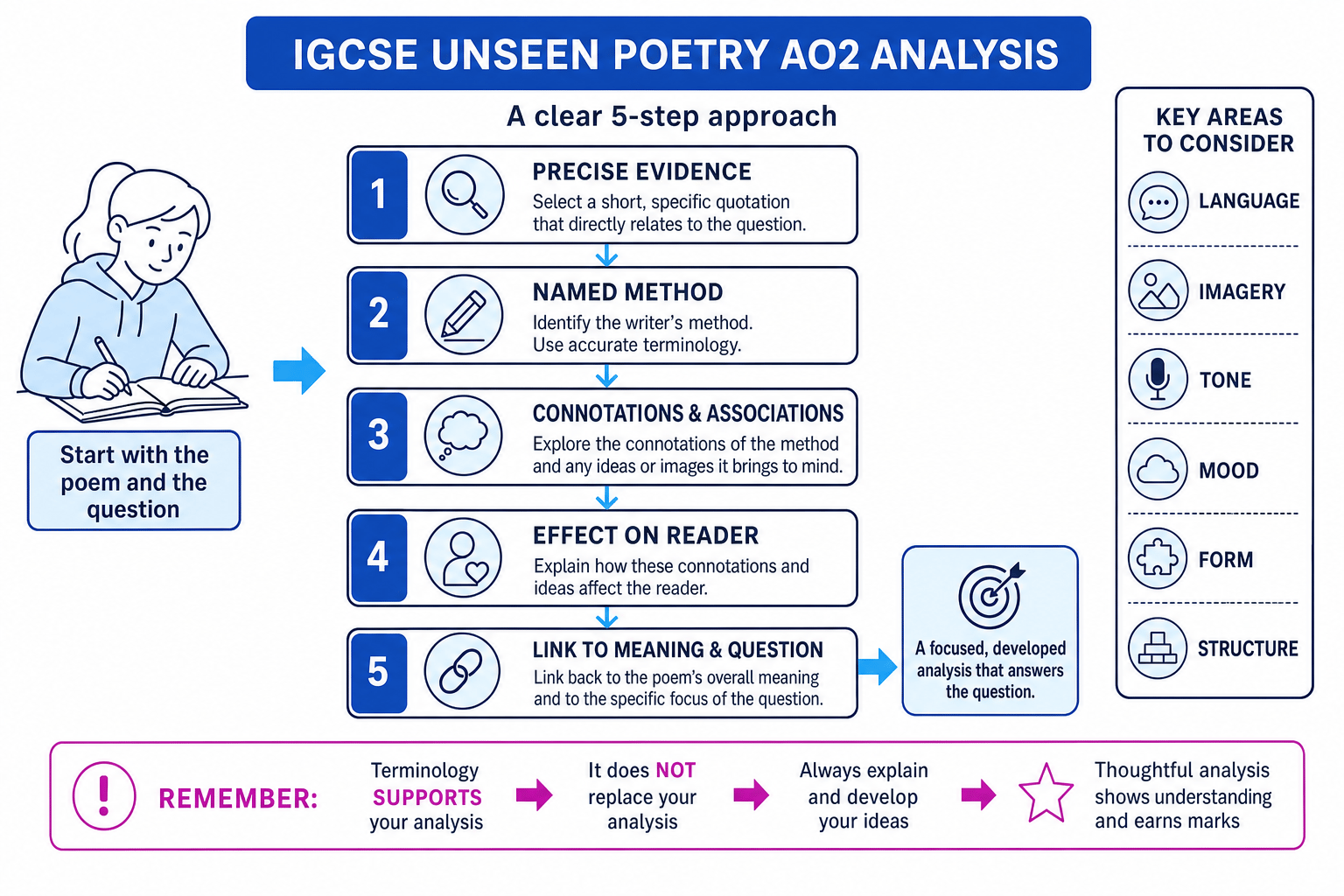
The AO2 chain: method, evidence, effect, meaning
Before learning lots of terminology, you need the basic pattern.
Evidence
Evidence means a short, precise quotation from the poem. In unseen poetry, choose small pieces of language rather than copying out whole lines.
Method
A method is a deliberate choice made by the poet. This could be a metaphor, a repeated phrase, a short stanza, a shift in tone, a rhyme pattern, or a sound effect.
Effect
The effect is what the method makes the reader think, feel or notice. Strong effects are specific: “creates a sense of panic” is better than “makes it interesting”.
Meaning
Meaning is the bigger idea in the poem: for example, grief, memory, conflict, loneliness, hope, nature, identity or time.
Building an AO2 chain
Imagine a practice line, written just for these notes: “The city swallowed the sun.”
- The noun “city” and verb “swallowed” suggest an urban place that behaves like a living creature.
- The method is personification, because the city is given a human or animal action.
- The verb “swallowed” has violent connotations: it suggests darkness, power and loss of control.
- This could make the reader feel that the city is threatening or overwhelming.
- Linked to meaning, the line might present urban life as something that consumes natural beauty or hope.
Imagery: turning pictures into meaning
Imagery
Imagery is descriptive language that creates a picture, feeling or sensory impression in the reader’s mind.
Imagery often works through comparison. In poetry, the most common comparison methods are simile, metaphor and personification.
Simile
A simile compares one thing to another using “like” or “as”. For example, “the moon was like a coin” would compare the moon’s shape or brightness to money.
Metaphor
A metaphor says one thing is another thing. It is usually more direct than a simile. For example, “the moon was a coin” might suggest value, coldness, distance or artificial brightness.
Personification
Personification gives human qualities or actions to something non-human, such as an object, animal, place or idea.
Symbolism
Symbolism is when an object, place, colour or action represents a larger idea. A door might symbolise opportunity, a cage might symbolise restriction, and light might symbolise hope or truth.
Analysing imagery
Practice line: “Hope flickered like a candle in the storm.”
- The line compares “hope” to “a candle”, so the method is a simile.
- A candle is small, fragile and easily extinguished, so the comparison suggests hope is vulnerable.
- The “storm” creates a threatening setting, implying emotional pressure or danger.
- The verb “flickered” suggests hope has not disappeared completely, but it is unstable.
- Overall, the imagery presents hope as delicate yet still alive, which may make the reader feel anxious but not entirely despairing.
Spotting the image but missing the idea
Do not stop at “this creates an image in the reader’s mind”. Always ask: what kind of image, with what associations, and why does it matter?
Language choice: zooming into individual words
Diction
Diction means the poet’s choice of words.
In unseen poetry, strong analysis often comes from zooming into one or two words. You can analyse:
- verbs — action words, such as “crawl”, “shatter”, “whisper”
- adjectives — describing words, such as “bitter”, “golden”, “empty”
- nouns — naming words, such as “child”, “machine”, “grave”
- adverbs — words that describe actions, such as “slowly”, “silently”, “wildly”
Connotation
A connotation is an associated meaning or feeling a word suggests, beyond its basic dictionary meaning.
For example, “home” and “house” may refer to a place where someone lives, but “home” often has warmer connotations of belonging and comfort.
Semantic fields
Semantic field
A semantic field is a group of words connected by meaning, such as words linked to violence, nature, religion, childhood or illness.
If a poem uses several words like “wound”, “scar”, “blood” and “knife”, you could say it uses a semantic field of violence or injury. Then you must explain the effect: perhaps the speaker presents love, memory or conflict as painful.
Analysing word choice
Practice phrase: “the brittle morning”
- The adjective “brittle” literally suggests something hard but easy to break.
- Applied to “morning”, it creates an unusual image because a time of day cannot physically snap.
- The connotations of “brittle” suggest fragility, coldness and tension.
- This may make the reader sense that the day begins in an emotionally delicate or uncomfortable way.
- If the poem is about grief or anxiety, the phrase could show that even ordinary life feels unstable.
The zoom-in test
If you choose one word, ask: Why this word and not a simpler alternative? For example, why “staggered” instead of “walked”? Why “glared” instead of “looked”?
Sound: hearing the poem as well as reading it
Poetry is not only visual. Poets use sound to shape pace, mood and emphasis.
Alliteration
Alliteration is the repetition of consonant sounds near each other, usually at the beginnings of words. For example, “cold, cruel clouds” repeats the hard “c” sound.
Sibilance
Sibilance is the repetition of soft “s”, “sh” or sometimes “z” sounds. It can sound soothing, secretive, sinister or whisper-like, depending on context.
Plosives
Plosives are hard consonant sounds such as “b”, “p”, “t”, “d”, “k” and “g”. They can create a harsh, explosive or abrupt effect.
Onomatopoeia
Onomatopoeia is when a word imitates a sound, such as “buzz”, “crash”, “hiss” or “clang”.
Analysing sound effects
Practice phrase: “stones cracked and clattered down”
- The repeated hard “c” sounds in “cracked” and “clattered” create alliteration.
- These sounds are also harsh and abrupt, so they imitate the noise of falling stones.
- The verbs suggest sudden movement and damage, creating a sense of danger.
- The reader may hear the violence of the moment, making the scene feel more immediate.
- This could support a wider meaning about collapse, conflict or loss of control.
Sound depends on context
Do not say “sibilance always creates a sinister effect” or “plosives always show anger”. The effect depends on the words, the situation and the poem’s mood.
Tone and mood: attitude and atmosphere
Tone
Tone is the speaker’s attitude towards the subject, another person, or themselves.
Tone might be bitter, nostalgic, admiring, sarcastic, fearful, regretful, playful, angry or resigned.
Mood
Mood is the atmosphere or feeling created for the reader.
Mood might be tense, calm, gloomy, hopeful, eerie, peaceful or unsettling.
Tone and mood are connected, but they are not identical. A speaker may have a calm tone while the mood feels threatening, or a cheerful tone may create an uneasy mood if the subject is disturbing.
Distinguishing tone and mood
Practice sentence: “Of course, the door was locked again.”
- The phrase “Of course” may suggest a sarcastic or weary tone, as if the speaker expected disappointment.
- The locked “door” could create a mood of restriction, frustration or entrapment.
- The adverb “again” implies repetition, making the situation feel ongoing rather than accidental.
- The reader may sense that the speaker is trapped in a pattern.
- This could link to a poem about powerlessness, routine or emotional confinement.
Form: the type and overall shape of the poem
Form
Form means the overall type or design of a poem, including its shape, stanza pattern, rhyme scheme and sometimes traditional category.
Common forms you might notice include:
- free verse — poetry without a regular rhyme scheme or metre
- sonnet — a fourteen-line poem, often associated with love, conflict or argument
- monologue — a poem spoken by one voice
- narrative poem — a poem that tells a story
- lyric poem — a poem focused on personal emotion or reflection
You do not need to force a form label if the poem does not clearly fit one. It is often better to say something precise about what you can see: “The poem is written in irregular stanzas” or “The lack of rhyme makes the speaker’s thoughts feel uncontrolled.”
Forcing a form label
Do not call every fourteen-line poem a sonnet unless the poem’s structure supports that idea. If you are unsure, describe the visible features instead.
Structure: how the poem develops
Structure
Structure means the order, arrangement and development of ideas across a poem.
You can analyse structure by asking:
- Where does the poem begin and end?
- Does the speaker’s mood change?
- Is there a turning point?
- Are lines or ideas repeated?
- Are stanzas regular or irregular?
- Does the pace speed up or slow down?
Key structure terms
Stanza: a group of lines in a poem, like a paragraph in prose.
Enjambment: when a sentence or phrase runs over from one line to the next without a strong pause.
Caesura: a pause in the middle of a line, often created by punctuation.
Volta: a turning point or shift in thought, argument, tone or mood.
Repetition: when a word, phrase, sound or structure is used more than once.
Refrain: a repeated line or phrase, often returning at intervals.
Analysing structural change
Practice mini-poem:
I waited by the window.
The street was still.
Then sirens split the dark.
- The opening two lines are quiet and still, creating a slow pace and a tense pause.
- The word “Then” marks a structural shift, as the calm scene suddenly changes.
- The verb “split” suggests violence and interruption, making the sirens feel forceful.
- The movement from stillness to noise creates shock for the reader.
- Structurally, the poem could be moving from expectation into crisis.
Rhythm, rhyme and metre
Rhythm
Rhythm is the pattern of beats or stresses in a line of poetry.
Rhyme
Rhyme is the repetition of similar sounds, usually at the ends of lines.
Metre
Metre is a regular pattern of stressed and unstressed syllables in poetry.
You do not need to scan every line perfectly for IGCSE unseen poetry. Instead, focus on the effect. A regular rhythm might suggest control, calm, routine or inevitability. An irregular rhythm might suggest confusion, emotional disturbance or freedom.
Iambic pentameter is a line of ten syllables arranged in five pairs, usually with an unstressed syllable followed by a stressed syllable. It is common in traditional English poetry and drama, but you should only mention it if you can connect it to meaning.
Useful phrasing for rhythm
Try: “The regular rhythm creates a sense of…” or “The broken rhythm mirrors…” Then link it to the speaker’s feelings or the poem’s subject.
Turning terminology into a paragraph
A strong unseen paragraph usually follows this movement:
Point → evidence → method → effect → link to the question
You can vary the order, but you need all the thinking. The best paragraphs often analyse more than one method briefly, but they stay focused on one main idea.
Developing an AO2 paragraph
Question focus: How does the poet present fear?
Practice line: “Fear crouched in the corner, breathing with me.”
- Start with a clear point: the poet presents fear as a constant physical presence rather than just an emotion.
- Use precise evidence: “Fear crouched” and “breathing with me”.
- Name the methods: personification makes fear seem alive, while the verb “crouched” suggests something hidden, tense and ready to move.
- Analyse effect: the reader may feel that fear is intimate and inescapable because it shares the speaker’s space and even their breathing.
- Link to meaning: this presents fear as controlling the speaker from within their ordinary surroundings.
A developed paragraph could read:
The poet presents fear as a constant physical presence rather than a passing emotion. The personification in “Fear crouched” makes fear seem alive, while the verb “crouched” suggests something hidden, tense and possibly predatory. The phrase “breathing with me” makes the fear feel intimate and inescapable, as though it shares the speaker’s body and space. This creates a claustrophobic effect for the reader and suggests that fear has become part of the speaker’s everyday existence.
The most useful AO2 question to ask
When you notice a method, ask:
“What does this choice make the reader understand, feel or question?”
That one question stops you from feature spotting. It pushes you from naming a technique into explaining its effect.
Writing vague effects
Avoid phrases like “it makes the reader want to read on”, “it creates an image”, or “it has a big effect”. Replace them with a specific feeling or idea: tension, sympathy, unease, admiration, uncertainty, isolation, urgency.
In the exam
- Read the poem twice: first for overall meaning, then for methods such as imagery, tone, structure and word choice.
- Choose short quotations that let you zoom in on individual words or phrases.
- Name terminology only when it helps your analysis; do not list devices without explaining effects.
- Track any change across the poem, especially shifts in tone, mood, pace or perspective.
- Keep linking back to the question so every paragraph proves a clear idea.
Check yourself
- Can you explain the difference between tone and mood?
- When you identify a metaphor, can you explain its connotations and effect?
- Can you write one sentence that links a structural choice to the poem’s meaning?
