What you'll learn
- How to work out a poem’s meaning and tone when you have never seen it before.
- How to track form and structure without panicking about technical labels.
- How to choose short, precise quotations and turn them into focused AO2 analysis.
- How to avoid the common traps of paraphrasing, feature-spotting and guessing context.
What the unseen poetry task is asking you to do
In Edexcel IGCSE English Literature Component 1, Section A gives you a poem you have not studied before. Component 1 is closed book, but the unseen poem itself is printed in the paper, so your job is not memory: it is close reading.
Unseen poem
An unseen poem is a poem you meet for the first time in the exam. You are assessed on how well you analyse the writer’s choices in the poem itself, especially language, form and structure.
AO2
AO2 means analysing how a writer uses language — individual words and images, form — the type or overall shape of the poem, and structure — the order and arrangement of ideas, to create meanings and effects.
A strong unseen response does not try to “solve” the poem perfectly. It builds a convincing interpretation from details in the text.
This five-stage process gives you a calm route from first reading to written analysis.
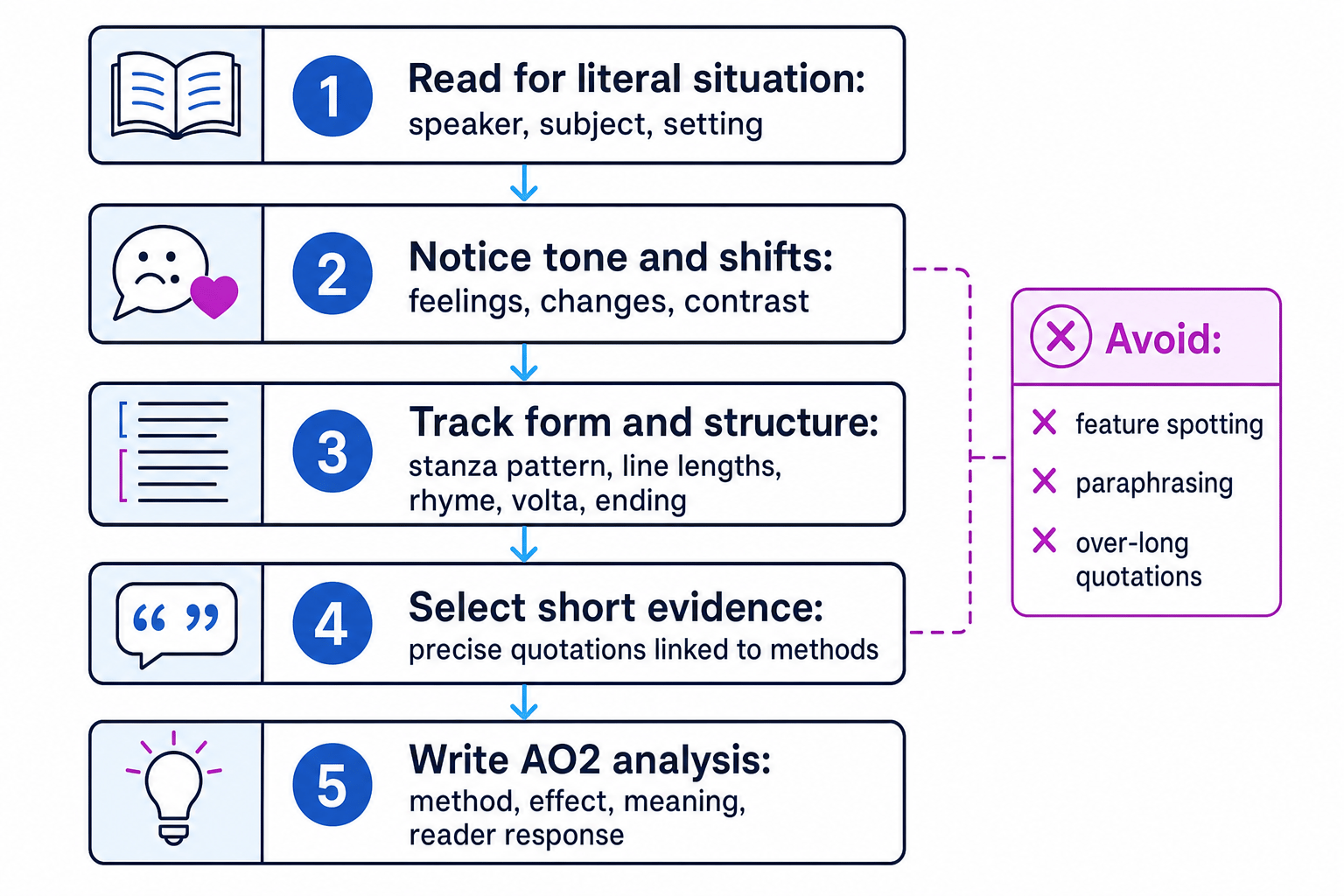
The big principle
Start with what is happening, then move to how the writer makes it feel that way. Meaning first; methods second.
1. First reading: work out the literal situation
Before analysing techniques, make sure you understand the basic situation.
The speaker is the voice speaking in the poem. The speaker is not automatically the poet. The addressee is the person, group or thing being spoken to, if there is one.
Ask yourself:
- Who seems to be speaking?
- What are they describing, remembering or reacting to?
- Where might the poem be set?
- Is anything changing from the beginning to the end?
Finding the literal situation
Imagine these sample lines:
“By the locked gate I count the trains
that leave without my name.”
- The phrase “locked gate” suggests the speaker is physically or emotionally shut out. A gate usually allows movement, but here it blocks it.
- The speaker “count[s] the trains”, which implies repeated watching rather than one brief moment. This suggests waiting, longing or being stuck.
- The phrase “without my name” makes the exclusion personal. The trains do not simply leave; they leave without recognising or including the speaker.
- A sensible interpretation is that the speaker feels left behind, separated from movement, opportunity or escape.
Confusing poet and speaker
Do not write “the poet feels…” unless the poem clearly presents itself as autobiographical. Safer phrasing is: “the speaker seems…” or “the voice of the poem suggests…”
2. Tone: identify the poem’s emotional attitude
Tone means the emotional attitude or mood of the voice. A poem might sound bitter, nostalgic, playful, fearful, calm, angry, regretful or uncertain.
Tone is usually created by:
- word choices
- punctuation
- sentence length
- contrasts
- shifts between stanzas or lines
A shift is a change in mood, idea or direction. A volta is a significant turning point in a poem, especially when the poem’s argument or feeling changes.
Tracking a change in tone
Imagine these sample lines:
“I laughed at first,
until the house answered back
with nothing.”
- The phrase “laughed at first” initially suggests lightness or confidence, but “at first” hints that this feeling will not last.
- The word “until” marks a turning point. It tells us the mood is about to change.
- The phrase “answered back / with nothing” creates a disturbing contradiction: an answer should contain sound, but this answer is silence.
- The tone shifts from casual or amused to lonely and unsettling, suggesting the speaker’s confidence has been replaced by isolation.
Useful tone sentence starters
Try: “The tone initially seems…”, “However, this changes when…”, or “By the end, the tone becomes…”
3. Language methods: name them only when they help
A method is a choice made by the writer. In unseen poetry, useful language methods often include:
- imagery: language that creates a mental picture or sensory impression
- metaphor: describing one thing as if it is another
- simile: comparing using “like” or “as”
- personification: giving human qualities to something non-human
- symbolism: using an object, place or image to represent a bigger idea
- semantic field: a group of words connected by meaning, such as words of violence, nature, religion or illness
Do not list devices for the sake of it. The examiner wants to see how the method shapes meaning.
Analysing a metaphor and semantic field
Imagine these sample lines:
“The city was a jaw of glass,
chewing the morning crowd.”
- “The city was a jaw” is a metaphor because the city is described directly as part of a mouth, not compared with “like” or “as”.
- The words “jaw” and “chewing” form a semantic field of eating, which makes the city seem aggressive and predatory.
- The “morning crowd” sounds ordinary and vulnerable beside this violent image, as if people are being consumed by daily urban life.
- The method therefore presents the city as threatening rather than exciting, encouraging the reader to see it as a force that crushes individuality.
Feature spotting
Avoid sentences like: “The writer uses a metaphor, a simile and personification.” Always add what the method suggests and why it matters.
4. Form and structure: follow the poem’s movement
Form is the poem’s overall type or shape. For example, a poem might be a sonnet, a dramatic monologue or free verse. Free verse means poetry without a regular rhyme scheme or metre.
Structure is how the poem is organised: where it begins, where it ends, how ideas develop, and where changes happen.
Useful structural features include:
- stanza: a group of lines in a poem
- line break: where one line ends and the next begins
- enjambment: when a sentence runs on over a line break without a full stop
- caesura: a pause within a line, often created by punctuation
- rhyme scheme: the pattern of rhyming sounds at the ends of lines
- rhythm: the pattern of beats or stresses in the lines
Connecting line breaks to meaning
Imagine these sample lines:
“I held the word
under my tongue
until it dissolved.”
- The line break after “word” briefly isolates it, making the reader focus on something unsaid.
- The enjambment across the first two lines makes the sentence continue, which mirrors the speaker’s ongoing effort to hold back speech.
- The final phrase “until it dissolved” suggests the word disappears before it can be spoken, creating a sense of silence, regret or self-control.
- The structure therefore reinforces the meaning: the poem does not just say the speaker is withholding speech; its line breaks make the reader experience that delay.
Do not force a named form
If you are unsure whether a poem is a sonnet, ballad or another set form, do not guess. You can still analyse what you can see: stanza lengths, repetition, rhyme, line breaks, contrasts and the ending.
5. Selecting evidence: choose small, powerful quotations
Evidence means the words from the poem that support your interpretation. In poetry, the best evidence is often short. A micro-quotation is a very brief quotation, sometimes just one or two words, embedded into your sentence.
Strong evidence usually does at least one of these things:
- reveals tone
- contains an important image
- shows a structural shift
- links to the question’s focus
- appears at a key point, such as the opening or ending
Choosing the strongest evidence
Imagine these sample lines:
“In the room, the clock bit through the dark.
I waited, waited, for the key
that never turned.”
- “In the room” gives setting, but it is quite general. Unless the question focuses on confinement or place, it is probably not the strongest quotation.
- “The clock bit” is stronger because it uses personification and violent imagery, making time seem painful or hostile.
- “Waited, waited” is also useful because the repetition stretches the moment and suggests frustration or desperation.
- “Never turned” is a powerful ending because it confirms disappointment. It could help you analyse how the poem moves from waiting to hopelessness.
Quote less, analyse more
A short quotation like “clock bit” gives you more to analyse than a whole copied line. Zoom in on individual words.
6. Writing a focused AO2 paragraph
A clear analytical paragraph usually follows this pattern:
point → evidence → method → effect → link
Your point is your interpretation. Your evidence proves it. Your method names the writer’s choice. Your effect explains how meaning is created. Your link connects back to the question or the poem’s overall idea.
Building an AO2 paragraph
Using the sample lines about the clock and the key:
- Choose a focused point: the speaker’s waiting feels painful and increasingly hopeless.
- Select precise evidence: “the clock bit”, “waited, waited” and “never turned”.
- Identify methods that genuinely matter: personification in “clock bit”, repetition in “waited, waited”, and the finality of “never”.
- Connect each method to meaning: time seems violent, the waiting feels prolonged, and the ending removes hope.
A possible paragraph:
The poet presents waiting as painful and oppressive. The personification of the clock as something that “bit” makes time seem physically violent, as if every passing moment injures the speaker. This sense of suffering is extended through the repetition of “waited, waited”, which slows the pace and makes the reader feel the length of the delay. By ending the sentence with the key that “never turned”, the poem moves from expectation to disappointment, suggesting that the speaker’s hope has been permanently shut out.
What makes analysis strong
Strong AO2 writing explains the connection between method and meaning. Do not stop at naming the technique.
7. Planning your whole response
A good unseen answer normally covers the whole poem, not just the first few lines. You do not need to analyse every image. Instead, choose a route through the poem.
One simple structure is:
- Opening: what situation, voice or central feeling is introduced?
- Middle: how does the tone, imagery or idea develop?
- Ending: what changes, intensifies or remains unresolved?
This helps you write about structure naturally because you are following the poem’s movement.
Paraphrasing the poem
Paraphrasing means retelling what the poem says in your own words. Some explanation is useful, but most of your marks come from analysing how the writer creates effects.
In the exam
- Read the poem twice: first for the basic situation, then for tone, shifts, language and structure.
- Plan 3–4 analytical points that move through the poem from beginning to end.
- Use short quotations, name methods accurately, and always explain their effect on meaning and the reader.
Check yourself
- Can you explain the difference between the poet and the speaker?
- Can you identify a shift in tone and link it to a specific word, line break or stanza?
- Can you turn a short quotation into a full AO2 point about method and effect?
