In your Pearson Edexcel International GCSE English Literature exam, you will be expected to write analytically about the poems in Section B of the Anthology. D. H. Lawrence’s "Piano" is a highly evocative lyric poem that explores the overwhelming power of memory and the painful transition from childhood innocence to adult reality.
What you'll learn
By the end of these study notes, you will be able to:
- Explain how Lawrence uses sensory language and structural shifts to depict the pull of memory.
- Analyse the core tension between adult masculinity and childhood vulnerability (AO2).
- Structure high-scoring, comparative exam responses linking "Piano" to other anthology poems on memory and childhood (AO3).
Understanding the Poem's Context and Narrative
Before looking at the language, we must understand the core narrative and emotional journey of the speaker. "Piano" is a retrospective narrative—a poem looking back at past events from a point in the present.
Retrospective Narrative
A retrospective narrative is a literary technique where the speaker or narrator looks back on past events, often reflecting on how those experiences shaped their current identity or emotional state.
In "Piano", a mature male speaker is listening to a woman singing in the present day. Her song acts as an involuntary trigger, transporting him back to his childhood. He remembers sitting under a piano while his mother played and sang. Though he tries to resist this wave of nostalgia, the memory is too powerful. By the end of the poem, his adult composure completely breaks down, and he weeps for his lost childhood.
The Power of Nostalgia
Memory in "Piano" is not a gentle comfort; it is a violent, invasive force. Lawrence presents nostalgia as something that actively overpowers the speaker’s adult identity and "manhood".
Structure and Temporal Shifts
"Piano" is structured in three stanzas, each containing four lines (quatrains). The rhyme scheme is exceptionally regular: AABB CCDD EEFF (rhyming couplets). This highly structured, lyrical pattern mirrors the rhythmic, predictable ticking of a clock or the steady playing of a piano scale.
However, beneath this orderly surface, Lawrence uses enjambment (where a sentence runs over from one line or stanza to the next without pause) to show how his emotions are spilling over and breaking through his self-control.
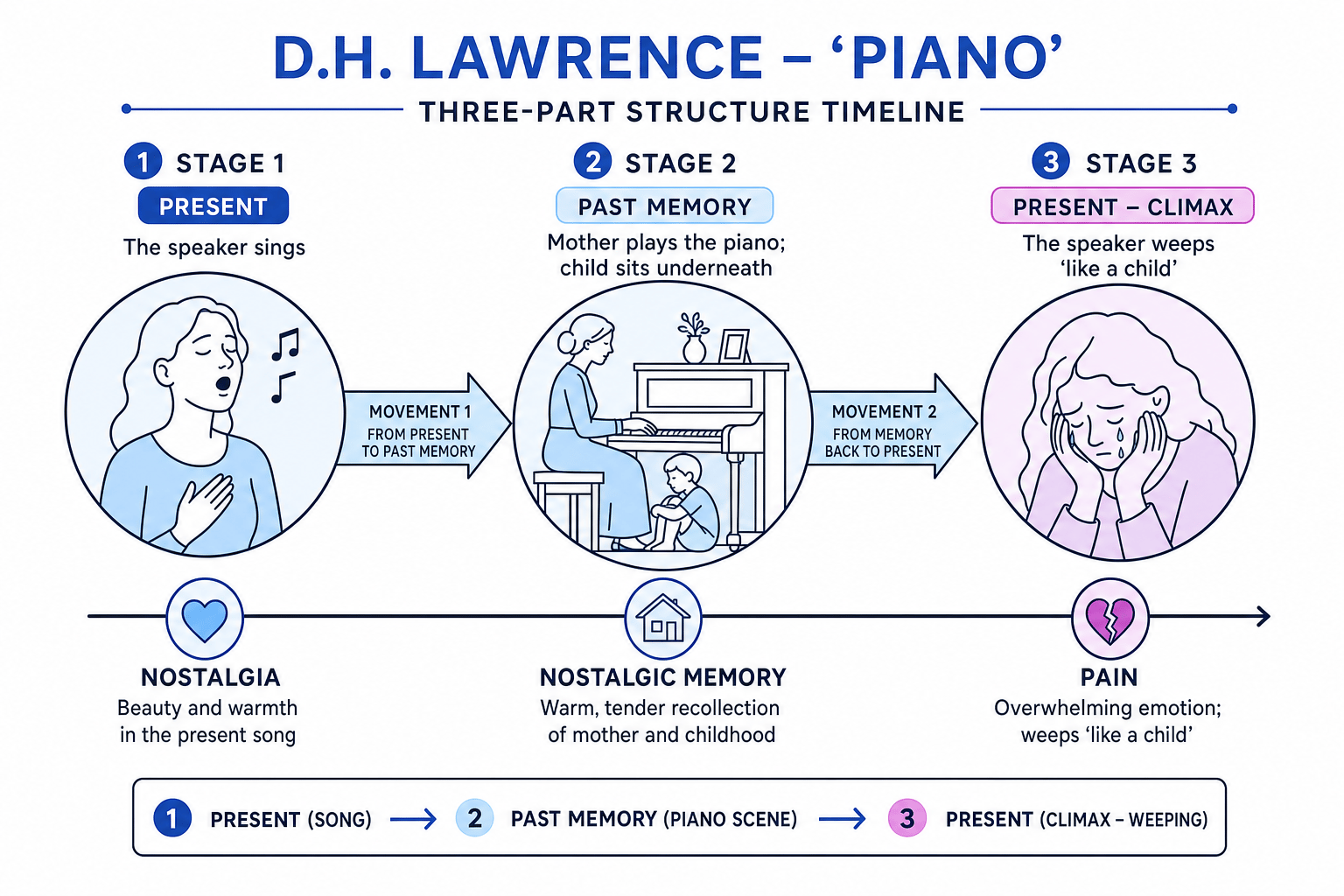
Let's break down the poem's structural timeline as shown in the diagram above:
Stanza 1: The Present Triggers the Past
The poem opens in the present tense: "Softly, in the dusk, a woman is singing to me". The atmospheric setting of "dusk" suggests a half-light, a liminal space where the boundary between the present and the past is easily blurred. By line 3, we have slipped into the past: "till I see / A child sitting under the piano". Notice how Lawrence refers to himself in the third person here as "a child", distancing his adult self from the memory.
Stanza 2: The Battle Between Resistance and Nostalgia
The speaker actively tries to fight the memory. He describes the music as having an "insidious mastery" that "betrays" him. The word choice here is fascinating: memory is framed as a hostile force or an enemy agent. Despite his resistance, he is drawn into the warmth of the memory: a cozy family scene of "Sunday evenings at home" with "winter outside" and "hymns in the cosy parlour".
Stanza 3: The Climax and Emotional Collapse
The final stanza returns to the present, but the speaker has been utterly changed by the memory. The woman's present singing is now dismissed as "vain" (useless). Her playing has grown loud and dramatic—"piano appassionato"—but it cannot compete with the "glamour" of his childhood. The poem ends with a complete emotional collapse as the speaker’s "manhood is cast / Down" and he weeps "like a child".
Language and Imagery: Sound and Contrast
Lawrence masterfully uses contrasting soundscapes to chart the speaker's psychological journey.
Auditory Imagery and Onomatopoeia
To evoke the childhood memory, Lawrence uses light, musical, and tactile words:
- "Tingling strings": Implies a light, vibrating physical sensation. The child is close to the music, physically feeling its resonance.
- "Tinkling piano": A gentle, domestic sound that evokes safety and innocence.
In sharp contrast, the present-day music is described with terms that suggest aggressive, overwhelming force:
- "Clamour": A harsh, loud, and chaotic noise.
- "Appassionato": A musical term meaning "with passion," which here feels too intense and performative for the speaker.
Confusing the Two Pianos
Do not confuse the two pianos in the poem. The "tinkling" piano belongs to the cozy, nostalgic past of his mother. The "great black piano" played "appassionato" belongs to the present-day woman. Lawrence contrasts these to show that the simple, domestic music of his childhood holds far more emotional power than the dramatic art of the present.
The Imagery of Ruin and Submission
As the poem progresses, the verbs become more destructive:
- "Insidious mastery": "Insidious" suggests something that creeps up on you slowly and harmfully.
- "Betrays me back": The speaker feels his adult defences are being breached.
- "Cast down" and "flood of remembrance": These water metaphors suggest drowning or being swept away by a tidal wave of emotion, emphasizing that the speaker is completely powerless to stop his tears.
Worked Example: Analyzing Language and Structure
Analyzing Lawrence's use of sensory language
Read the following prompt: How does D. H. Lawrence use sensory language in "Piano" to convey the speaker’s changing emotional state?
Here is a step-by-step walkthrough of how to write a high-scoring analytical paragraph (AO2).
-
Formulate a precise thesis point. Start with a clear analytical claim that addresses both the method (sensory language) and the emotional shift.
Example: "Lawrence utilizes contrasting auditory and tactile imagery to transition the speaker from a state of reluctant nostalgia to one of complete emotional submission."
-
Integrate precise textual evidence. Select a quote that shows this sensory shift. Do not just drop the quote in; weave it naturally into your sentence.
Example: This transition is evident when the speaker recalls sitting underneath the piano, feeling the "boom of the tingling strings" while pressing his mother's "small, poised feet."
-
Analyse the specific literary devices and word choices. Identify the exact techniques (like onomatopoeia or plosive sounds) and explain their immediate effects.
Example: The onomatopoeia in "boom" creates a deep, resonant sound that contrasts sharply with the delicate, high-pitched associations of the adjective "tingling." This tactile and auditory pairing physically places the young child inside the music, emphasizing how deeply comforting and physically enveloping his childhood environment was.
-
Link the analysis back to the overall theme and the effect on the reader. Explain why the writer made these choices and how they relate to the speaker's emotional state.
Example: By emphasizing the physical, sensory reality of this memory, Lawrence helps the reader understand why the speaker cannot resist its pull. The sheer sensory warmth of the past makes the present world feel cold and empty, explaining why his adult "manhood" ultimately collapses into tears by the poem's end.
Key Quotations to Memorize
To succeed in your closed-book exam (Component 1, Section B), you must memorize several key lines from "Piano".
| Quotation | Key Literary Devices | Thematic Meaning / Effect |
|---|---|---|
| "Softly, in the dusk, a woman is singing to me" | Sibilance, Liminal setting | Establishes a quiet, hypnotic atmosphere that allows the speaker to slip easily into memory. |
| "In spite of myself, the insidious mastery of song / Betrays me back" | Personification, Dark diction | Presents memory as a hostile, deceptive force that overpowers the speaker’s conscious will. |
| "The cosy parlour, the tinkling piano our guide" | Cozy domestic semantic field, Diminutive language | Creates an image of absolute childhood safety and spiritual guidance within the family home. |
| "My manhood is cast / Down in the flood of remembrance" | Water metaphor, Enjambment | Illustrates the destructive power of nostalgia; the speaker's adult stoicism is completely drowned by his emotions. |
| "I weep like a child for the past." | Simile, Short sentence ending | Represents the ultimate defeat of the speaker's adult masculinity, reverting back to the vulnerability of childhood. |
Sibilance and Quietness
Notice the heavy use of the "s" sound (sibilance) in the first stanza: "Softly... dusk... singing... see... sitting... strings... smiles... sings". This creates a whispering, quiet effect that mimics the hushed environment of twilight, lulling the reader into the same hypnotic state as the speaker.
Comparative Connections (AO3)
In Component 1, Section B of your Edexcel exam, you will have to compare "Piano" with another poem from the Anthology. When planning your comparative essay, focus on shared themes such as childhood, the passage of time, loss, and memory.
The Mirror of Memory
Think of memory in these anthology poems as a mirror. In "Piano", the mirror is cracked by the pain of adulthood, showing a perfect past that can never be reached again. In other poems, memory acts as a shield or a prison.
Potential Poem Pairings:
- "Half-past Two" (U. A. Fanthorpe): Both poems deal with childhood perceptions of time and safety. However, while "Piano" looks back with intense pain and longing, "Half-past Two" uses a gentler, slightly more comic tone to explore a child's escape from the adult constraints of time.
- "Remember" (Christina Rossetti): Both poems deal with the agonizing grip of memory and the pain of looking back. However, while Rossetti’s speaker begs to be remembered but eventually chooses to let go to spare her lover pain, Lawrence’s speaker has no choice—he is utterly victimized and mastered by his memories.
- "Hide and Seek" (Vernon Scannell): Both poems explore the loss of childhood innocence and the cold reality of the adult world. In "Hide and Seek", the transition is represented by a literal game turning cold and lonely; in "Piano", it is triggered by a musical performance.
In the exam
- Analyse Form and Structure (AO2): Do not just write about the story of the poem. Make sure you comment on how the regular AABB rhyme scheme represents the controlled rhythm of the piano, and how enjambment represents the breaking of that control.
- Embed Short Quotations: Avoid long, block quotes. Instead, integrate single words or short phrases (like "insidious mastery" or "tinkling piano") directly into your analytical sentences.
- Address the Transition (AO2): Make sure your essay traces the change in the speaker's emotional state. He starts in calm observation, moves to struggle, and ends in weeping. Your analysis must follow this trajectory.
- Compare systematically (AO3): If pairing "Piano" with another poem, use comparative transitional phrases such as "Similarly, Lawrence uses..." or "In contrast to Fanthorpe's gentle depiction of childhood, Lawrence presents..." to ensure you are meeting the AO3 criteria throughout your essay.
Check yourself
- Why does Lawrence describe the memory of his mother's piano as "tinkling" but the present-day piano as a "great black piano appassionato"?
- What is the significance of the verb "betrays" in the second stanza? Who or what is doing the betraying?
- How does the physical structure of the poem (the rhyme scheme and stanzas) contrast with the emotional state of the speaker in the final lines?
