What you'll learn
- How to turn a broad theme into a precise argument about Steinbeck’s message.
- The key themes in Of Mice and Men: dreams, loneliness, prejudice, friendship, violence and fate.
- How to connect short quotations to context for Edexcel IGCSE.
- How to avoid vague “theme spotting” and write analytically in a closed-book exam.
What is a theme?
A theme is a big idea that runs through a text. It is not just a topic like “dreams” or “loneliness”; it is what the writer seems to be saying about that topic.
For Of Mice and Men, try to phrase themes as arguments:
- Not just dreams, but dreams give people hope, yet the harsh social world makes them almost impossible.
- Not just loneliness, but loneliness damages people because society leaves the vulnerable without protection or belonging.
Theme
A theme is a central idea explored across a text, usually developed through characters, settings, symbols, repeated images and structural patterns.
Because Of Mice and Men is assessed as modern prose in Component 1, you should focus especially on AO1 — close knowledge and a personal, critical response — and AO4 — the relationship between the novella and its context. The exam is closed book, so learn a small bank of accurate, flexible quotations.
Theme vs topic
A topic is one word; a theme is a meaningful claim. In essays, write “Steinbeck presents loneliness as destructive” rather than “There is a theme of loneliness.”
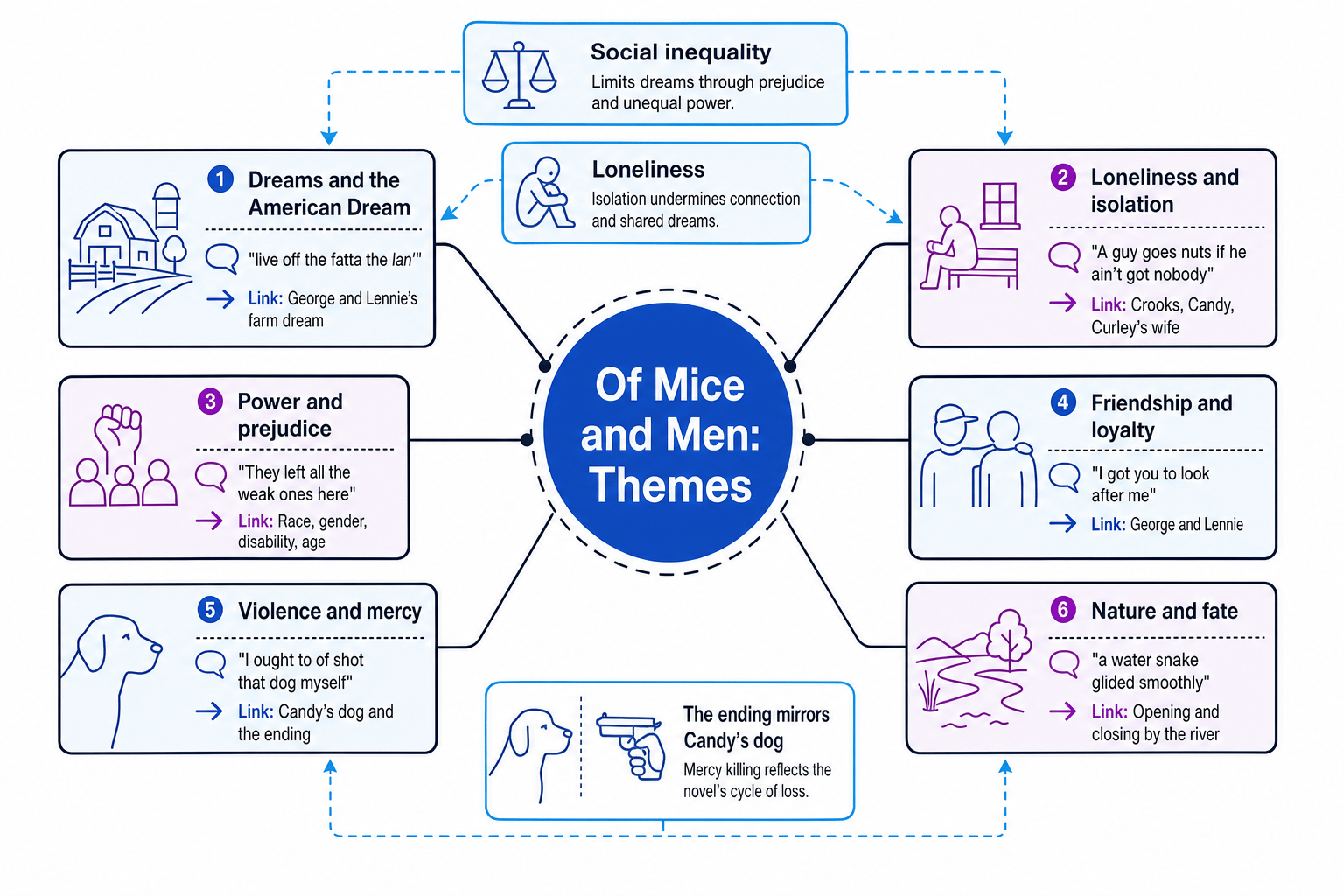
Turning a topic into a theme argument
- Start with the topic dreams and make it more precise: Steinbeck shows that dreams are emotionally necessary for migrant workers.
- Connect that idea to evidence: George and Lennie repeat the fantasy that they will “live off the fatta the lan’”, suggesting the dream is almost like a comforting ritual.
- Add context: during the Great Depression, many itinerant workers had little security, so owning land would represent freedom and dignity.
- Link to the whole novella: because the dream collapses, Steinbeck questions whether the American Dream is achievable for poor, vulnerable people.
Dreams and the American Dream
The American Dream is the belief that anyone can achieve success, independence and prosperity through hard work. In the novella, Steinbeck tests this belief by placing it in the world of poor ranch workers during the Great Depression, the severe economic crisis of the 1930s.
George and Lennie’s dream is simple: “a little house and a couple of acres” where they can “live off the fatta the lan’”. The repeated phrase sounds childish and musical, especially when Lennie joins in. This makes the dream feel warm, familiar and protective.
But Steinbeck also makes the dream fragile. It depends on money, safety and self-control — all things George and Lennie do not fully have. When Candy offers his savings, the dream suddenly feels possible. Even Crooks, who first mocks it, briefly asks to join: “If you… guys would want a hand to work for nothing — just his keep, why I’d come.” This shows how powerful the dream is: even a lonely, excluded man is drawn towards the hope of belonging.
Motif
A motif is a repeated detail, image, phrase or situation that helps develop a theme. The farm dream is a motif because it returns throughout the novella and gathers meaning each time.
Steinbeck’s message is not that dreaming is foolish. Instead, he shows that dreams are vital because they give people dignity — but the social and economic world of the ranch crushes them.
Loneliness and the need for companionship
Loneliness is one of the novella’s most painful themes. George says that ranch workers are “the loneliest guys in the world” because “they don’t belong no place”. The informal dialect makes the statement sound ordinary, as if isolation is simply a normal part of working life.
George and Lennie are unusual because they travel together. Lennie explains their bond in simple language: “I got you to look after me, and you got me to look after you.” Their friendship gives them an identity beyond being disposable workers.
Crooks expresses the theme most directly: “A guy goes nuts if he ain’t got nobody.” His room is separate from the bunkhouse because he is Black, and he says, “I can’t play because I’m black.” Steinbeck connects loneliness to racial segregation, showing that isolation is not just personal — it is created by prejudice.
Curley’s wife is also lonely. She asks, “Think I don’t like to talk to somebody ever’ once in a while?” Although she often appears flirtatious or threatening, Steinbeck gradually reveals that she is trapped in a loveless marriage and denied a real name of her own.
Only calling Curley’s wife a villain
Curley’s wife can be cruel, especially towards Crooks, but Steinbeck also presents her as isolated and powerless. A strong answer keeps both ideas in tension.
Power, prejudice and inequality
Steinbeck presents the ranch as a hierarchy. A hierarchy is a system where some people have more power or status than others. Curley has power because he is the boss’s son. Slim has moral authority because he is respected. Crooks, Candy, Lennie and Curley’s wife are vulnerable in different ways.
In Chapter 4, Curley’s wife says, “They left all the weak ones here.” The sentence is cruel, but it is also revealing. The people left behind — Crooks, Candy, Lennie and Curley’s wife herself — are all excluded from the main group. Steinbeck shows how people who are oppressed may still try to gain power over others.
Crooks is the clearest example of racial prejudice. Curley’s wife threatens him: “I could get you strung up on a tree so easy it ain’t even funny.” This refers to the racist violence and lynching that Black Americans faced, especially in the segregated America of the early twentieth century. Steinbeck does not present prejudice as background detail; he shows it as a force that controls where Crooks can sleep, who he can speak to and how safe he is.
Candy’s age also makes him insecure. He fears being dismissed when he is no longer useful: “They’ll can me purty soon.” Through Candy, Steinbeck criticises a world that values people only for their labour.
Analysing power in Chapter 4
- Choose the moment where the “weak ones” are left behind: Crooks, Candy, Lennie and Curley’s wife are outside the main social group.
- Compare their forms of powerlessness: Crooks faces racism, Candy is old and disabled, Lennie has a learning disability, and Curley’s wife is restricted by gender.
- Notice the shift in power: Curley’s wife is isolated, but she can still threaten Crooks because racism gives her power over him.
- Link to context: Steinbeck exposes how 1930s American society divides vulnerable people instead of allowing them to unite.
Friendship, loyalty and responsibility
George and Lennie’s friendship is the emotional centre of the novella. Their relationship is not perfect: George often speaks harshly to Lennie and feels burdened by him. However, he also protects him, repeats the dream for him and plans escape routes when trouble comes.
The phrase “Because I got you to look after me, and you got me to look after you” is important because it expresses mutual care. In a world where most workers are isolated, George and Lennie’s friendship is almost radical.
Yet Steinbeck makes responsibility complicated. George’s final decision to shoot Lennie can be read as an act of mercy because it saves Lennie from Curley’s violent revenge. But it is also devastating because George destroys the friend who gave his life meaning.
Write about complexity
The best essays avoid simple labels like “George is good” or “George is bad”. Instead, argue that Steinbeck presents George’s final act as morally painful: loving, protective and tragic all at once.
Violence, mercy and foreshadowing
Violence builds throughout the novella. Lennie accidentally kills a mouse, then his puppy, then Curley’s wife. This pattern prepares the reader for the ending.
Foreshadowing
Foreshadowing is when a writer plants hints about events that will happen later, creating tension or inevitability.
Candy’s dog is the most important piece of foreshadowing. Carlson shoots the old dog because it is no longer useful. Later, Candy says, “I ought to of shot that dog myself.” This prepares us for George’s decision at the end: he chooses to kill Lennie himself rather than let Curley or the others do it brutally.
The ending is full of emotional conflict. Slim understands George and says, “You hadda, George. I swear you hadda.” Carlson, however, cannot understand the grief: “Now what the hell ya suppose is eatin’ them two guys?” Steinbeck contrasts sensitivity with emotional ignorance.
Nature, fate and structure
The novella begins and ends by the Salinas River. This is an example of cyclical structure, where a text finishes in a place or situation that echoes the beginning.
Cyclical structure
Cyclical structure is when the ending mirrors the beginning, making events feel circular, trapped or inevitable.
At the start, the natural world seems peaceful: “rabbits sat as quietly as little gray, sculptured stones.” The setting feels almost like a paradise outside society. But by the final chapter, nature appears more violent: a heron catches and eats a water snake. This shift suggests that danger has always existed beneath the surface.
The title also matters. It alludes to Robert Burns’s poem “To a Mouse”, especially the idea that “the best laid schemes o’ mice an’ men” often go wrong. Steinbeck uses this allusion to suggest that human plans are easily destroyed by forces beyond individual control: poverty, prejudice, fear and accident.
The big thematic picture
Steinbeck’s themes overlap. Dreams fail because of loneliness, poverty and prejudice; friendship matters because the world is violent; the ending feels tragic because love cannot defeat the social forces around it.
Quick quotation bank for themes
| Theme | Useful quotation | How to use it |
|---|---|---|
| Dreams | “live off the fatta the lan’” | Hope, independence, American Dream |
| Loneliness | “A guy goes nuts if he ain’t got nobody” | Crooks, isolation, mental suffering |
| Friendship | “I got you to look after me” | Mutual care, unusual companionship |
| Prejudice | “I can’t play because I’m black” | Racism and exclusion |
| Age / usefulness | “They’ll can me purty soon” | Fear of being discarded |
| Mercy | “I ought to of shot that dog myself” | Foreshadowing George’s final act |
| Misunderstanding | “what the hell ya suppose is eatin’ them two guys?” | Carlson’s emotional ignorance |
In the exam
- Begin each paragraph with a thematic argument, not just a character summary: “Steinbeck presents dreams as necessary but fragile…”
- Use short, accurate quotations from memory and attach them to context: Great Depression poverty, migrant labour, racism, gender inequality or disability.
- Keep linking themes together. For example, Curley’s wife belongs in essays on loneliness, power, dreams and violence — not just “women”.
Check yourself
- Can you explain how Candy’s dog foreshadows the ending without simply retelling the plot?
- Which characters are lonely, and how is each one isolated in a different way?
- How does Steinbeck make the farm dream both hopeful and unrealistic?
