What you'll learn
- What context means for Of Mice and Men in Edexcel IGCSE Literature.
- How 1930s America shapes Steinbeck’s presentation of dreams, loneliness and power.
- How to connect context to short, accurate quotations in a closed-book essay.
- How to avoid the common mistake of writing history instead of literary analysis.
What “context” means
Context
Context means the circumstances surrounding a text: the historical period, society, culture, writer’s life, literary influences and beliefs that help us understand why the text is written in a particular way.
For Of Mice and Men, the most useful context is 1930s America: the Great Depression, migrant ranch work, racism, sexism, poverty and the powerful dream of owning land.
In Edexcel IGCSE English Literature, Of Mice and Men is in Component 1, Section C: Modern Prose, which is closed book. This section assesses mainly AO1 — your close knowledge and personal response — and AO4 — the relationship between the text and its context.
Context is a lens, not a replacement
Context should help you explain Steinbeck’s choices. Do not bolt on a history paragraph. Link the context to a specific character, moment, quotation or pattern in the novella.
Turning a context fact into analysis
- Start with the text: George says, “Guys like us, that work on ranches, are the loneliest guys in the world.”
- Connect the context: in the 1930s, many ranch workers were itinerant, meaning they moved from place to place for temporary work.
- Explain Steinbeck’s meaning: George’s loneliness is not just personal sadness; it reflects a whole economic system where workers have “no fambly” and “don’t belong no place.”
- Link to the theme: this makes George and Lennie’s friendship seem unusual and precious because it challenges the isolation expected of men in their position.
A quick context timeline
Use this timeline as a mental map. You do not need to memorise every historical detail, but you should know which contexts connect to which characters and themes.
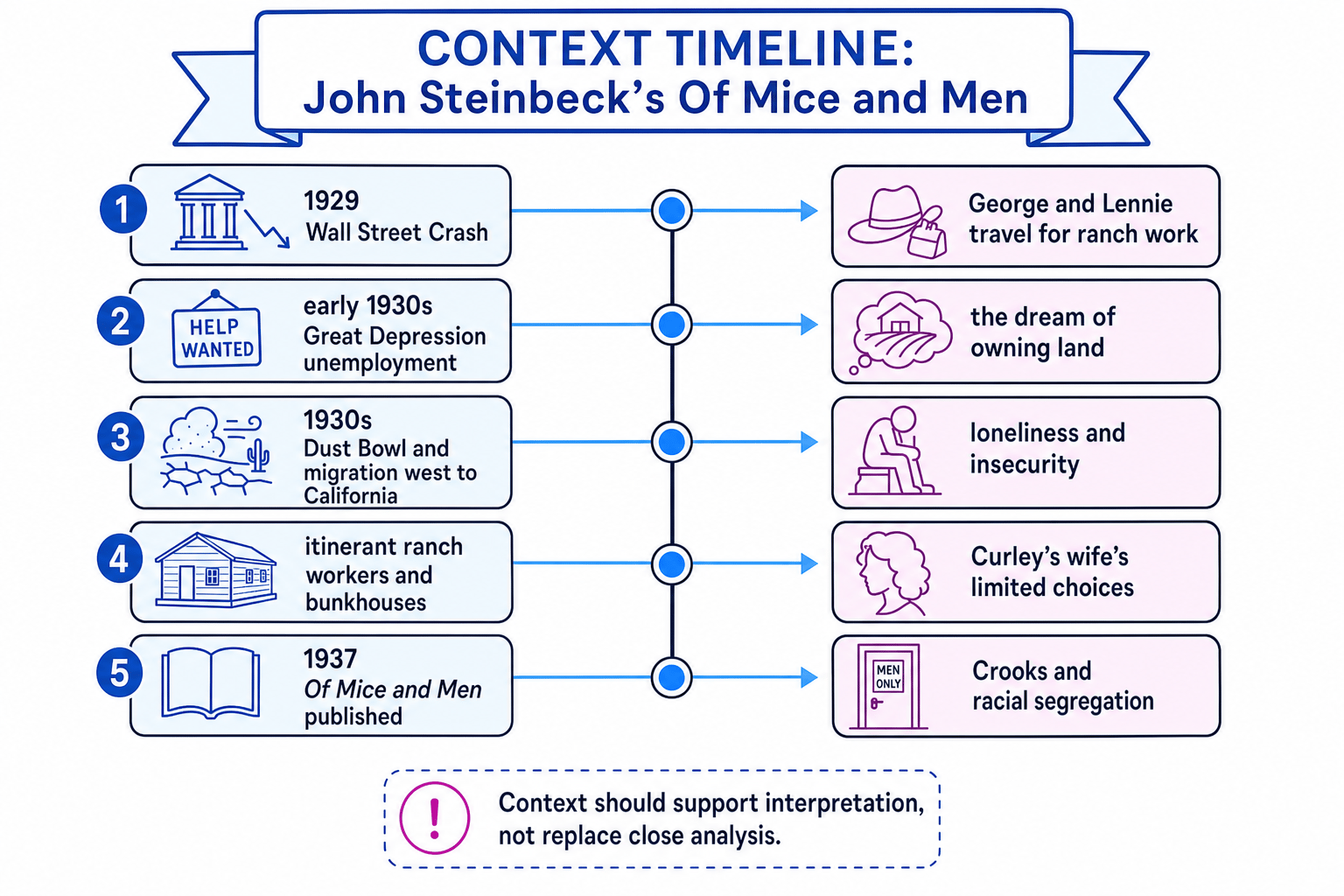
1930s America: poverty and insecure work
Of Mice and Men was published in 1937, during the Great Depression: a severe economic crisis that followed the 1929 Wall Street Crash. Millions of Americans lost work, savings and security.
George and Lennie are migrant ranch workers. They travel to wherever there is labour, carrying their possessions in bindles. This explains why the bunkhouse feels temporary rather than homely. The men are paid for physical labour and can be replaced easily.
George describes ordinary ranch workers as men who “ain’t got nothing to look ahead to.” Steinbeck shows a world where poverty damages hope. The workers’ lives are repetitive: work, spend wages, move on.
The Dust Bowl overreach
Do not write that George and Lennie are definitely Dust Bowl refugees. Steinbeck does not say this. Safer: the Dust Bowl intensified migration and job scarcity in 1930s America, creating the wider world of insecurity that the novella explores.
The American Dream and the dream farm
The American Dream
The American Dream is the belief that anyone can achieve independence, success and security through hard work. In the novella, this becomes the dream of owning land.
George and Lennie’s dream is simple but powerful: they want to “live off the fatta the lan’.” Land means more than money. It means independence, food, safety, friendship and control over their own lives.
This dream matters because the men are currently powerless. They work for other people. They live in shared spaces. They can be dismissed. So when George says, “We got a future,” Steinbeck makes the dream emotionally meaningful.
However, the context also makes the dream fragile. Crooks has seen many men with “that same damn thing in their heads,” and he bitterly says, “Nobody never gets to heaven, and nobody gets no land.” His words suggest that the American Dream may be more fantasy than reality for poor workers.
Reading the dream as historical pressure
- Choose a precise quotation: Lennie repeats, “An’ live off the fatta the lan’.”
- Notice the method: the repeated phrase becomes a motif, which means a recurring idea or image in a text.
- Connect to context: in a society of insecure wage labour, owning land would mean freedom from bosses and temporary ranch work.
- Explain the effect: the reader understands why the dream comforts George and Lennie, but also why its failure feels like a criticism of the society around them.
Race and segregation: Crooks
Segregation means the enforced separation of people by race. In 1930s America, racism shaped housing, work, law and everyday social life. California was not the Deep South, but racial discrimination was still deeply present.
Crooks is isolated because he is Black. He is made to live separately in the harness room, and he tells Lennie, “S’pose you couldn’t go into the bunk house and play rummy ’cause you was black.” This is not just personal exclusion; it reflects a racist social structure.
Steinbeck also shows how quickly Crooks can be threatened. Curley’s wife says she could get him “strung up on a tree,” which evokes the terror of racist violence and lynching. The moment reveals that Crooks’ intelligence and dignity cannot protect him from a society built on racial power.
Gender and Curley’s wife
The novella is set in a patriarchal society: a society where men hold most social, economic and legal power. Curley’s wife is never given a personal name, which shows how she is defined through her husband.
Her limited choices help explain her loneliness. She says, “I don’t like Curley. He ain’t a nice fella,” and later admits, “I coulda made somethin’ of myself.” Her dream of films and attention reflects the attraction of Hollywood culture, but also the lack of realistic routes to independence for many women.
At the same time, Steinbeck does not present her simply as innocent. Her racist threat to Crooks is cruel and dangerous. A strong answer can hold both ideas together: she is oppressed by gender, but she can still use racial power against Crooks.
Making Curley’s wife only a victim
It is too simple to say Curley’s wife is just a victim. Steinbeck presents her loneliness sympathetically, but he also shows that she can be threatening and prejudiced.
Age, disability and usefulness
The ranch values people mainly for physical labour. This context helps us understand Candy and Lennie.
Candy is old and disabled after losing his hand. He fears being discarded when he is no longer useful: “When they can me here I wisht somebody’d shoot me.” His dog is shot because it is considered old and useless, which foreshadows Candy’s own fear of being treated the same way.
Lennie is also vulnerable. He is “strong as a bull,” but his learning difficulties mean he cannot navigate the harsh adult world safely. Steinbeck exposes a society with little protection for people who do not fit its standards of independence and usefulness.
Literary context: title, place and realism
An allusion is a reference to another text. Steinbeck’s title alludes to Robert Burns’ poem “To a Mouse”: “The best laid schemes o’ mice an’ men / Gang aft agley,” meaning that even careful plans often go wrong.
This helps frame the whole novella. George and Lennie’s “scheme” is loving and detailed, but the title hints from the start that it may fail.
The setting also matters. The opening places the story “a few miles south of Soledad.” Soledad means solitude or loneliness in Spanish, so the place-name supports one of the novella’s central concerns.
Steinbeck writes in a style close to social realism, meaning fiction that represents ordinary working people and real social conditions. His use of ranch dialect, bunkhouse routines and economic detail makes the world feel grounded and believable.
Judging dialect
Do not say the characters’ dialect proves they are unintelligent. Steinbeck uses dialect to represent region, class and speech patterns, not to mock the workers.
How to use context in paragraphs
A useful context sentence usually answers: What does this detail reveal about the world Steinbeck is criticising or exploring?
| Context area | Textual anchor | Useful link |
|---|---|---|
| Great Depression and migrant labour | “Guys like us... are the loneliest guys in the world” | Loneliness is produced by insecure work and rootlessness. |
| American Dream | “live off the fatta the lan’” | The dream of land offers independence from poverty and employers. |
| Racism | “’cause you was black” | Crooks’ isolation reflects wider racial segregation. |
| Gender | “I coulda made somethin’ of myself” | Curley’s wife’s frustration reflects limited female opportunities. |
| Age and usefulness | “When they can me here...” | Candy fears being discarded in a world that values productivity. |
Building an AO4 paragraph
- Make a point about Steinbeck’s idea: Steinbeck presents the dream farm as a response to economic insecurity.
- Embed evidence: George and Lennie imagine they will “live off the fatta the lan’.”
- Analyse the method: the repeated dream becomes a comforting motif, almost like a ritual between them.
- Add context precisely: for migrant ranch workers in the Great Depression, land ownership would mean stability, food and independence.
- Link back to meaning: this makes the dream emotionally powerful, but its collapse suggests Steinbeck’s criticism of a society where poor workers are rarely allowed lasting security.
In the exam
- Use short, accurate quotations from memory, then attach context directly to the wording.
- Avoid separate history paragraphs; make every contextual point explain Steinbeck’s characters, themes or methods.
- Balance your interpretations: show how context creates sympathy, but do not ignore moments of cruelty, prejudice or violence.
Check yourself
- How does migrant ranch work help explain George and Lennie’s loneliness?
- Why is Crooks’ isolation more than just personal loneliness?
- How can you write about Curley’s wife’s limited choices without ignoring her racist threat to Crooks?
