Welcome to your study guide on the characters of John Steinbeck’s Of Mice and Men. In your Pearson Edexcel International GCSE English Literature exam (Component 1, Section C), you will be assessed on your ability to show a deep understanding of these characters (AO1) and link them directly to their historical and social contexts (AO4).
Because Section C is a closed-book exam, you need to know these characters intimately, understand what they represent, and have a strong bank of short, versatile quotations ready to use.
What you'll learn
- How Steinbeck uses the dynamic between George and Lennie to explore companionship and dependency.
- How the ranch operates as a microcosm of Great Depression-era America.
- How to analyze characters as literary constructs designed to convey themes of isolation, power, and prejudice.
- How to write high-scoring exam responses linking character analysis to 1930s context.
The Central Partnership: George and Lennie
At the heart of the novella is the relationship between George Milton and Lennie Small. They are introduced in stark contrast to one another, a classic literary pairing of opposites.
Microcosm
A microcosm is a miniature representation of something much larger, such as a community, place, or situation. In this novella, Tyler Ranch acts as a microcosm of 1930s American society, where the social hierarchies and prejudices of the wider world are played out in a small space.
Contrast and Companionship
From the very first page, Steinbeck establishes their physical differences to reflect their inner dynamics:
- George is described as "small and quick, dark of face, with restless eyes and sharp, strong features." His physical sharpness mirrors his mental alertness and defensive, protective nature.
- Lennie is "a huge man, shapeless of face, with large, pale eyes, and wide, sloping shoulders." He is physically imposing but mentally simple, walking "heavily, dragging his feet a little, the way a bear drags his paws."
The Symbiotic Bond
In a world dominated by lonely, itinerant (migrant) ranch workers who "ain't got nothing to look ahead to," George and Lennie stand out. Their relationship is symbiotic—meaning they both depend on each other, albeit in different ways.
The Power of 'We'
While George provides the intellect, direction, and protection, Lennie provides George with a sense of purpose and a shield against the soul-crushing isolation of the migrant worker lifestyle. Their shared refrain, "We got a future. We got somebody to talk to that gives a damn about us," is their protective shield against the harsh world.
The Ranch Hierarchy: Character Relationships
To understand the other characters, you must understand how they relate to George and Lennie, and where they sit in the rigid social pyramid of the ranch.
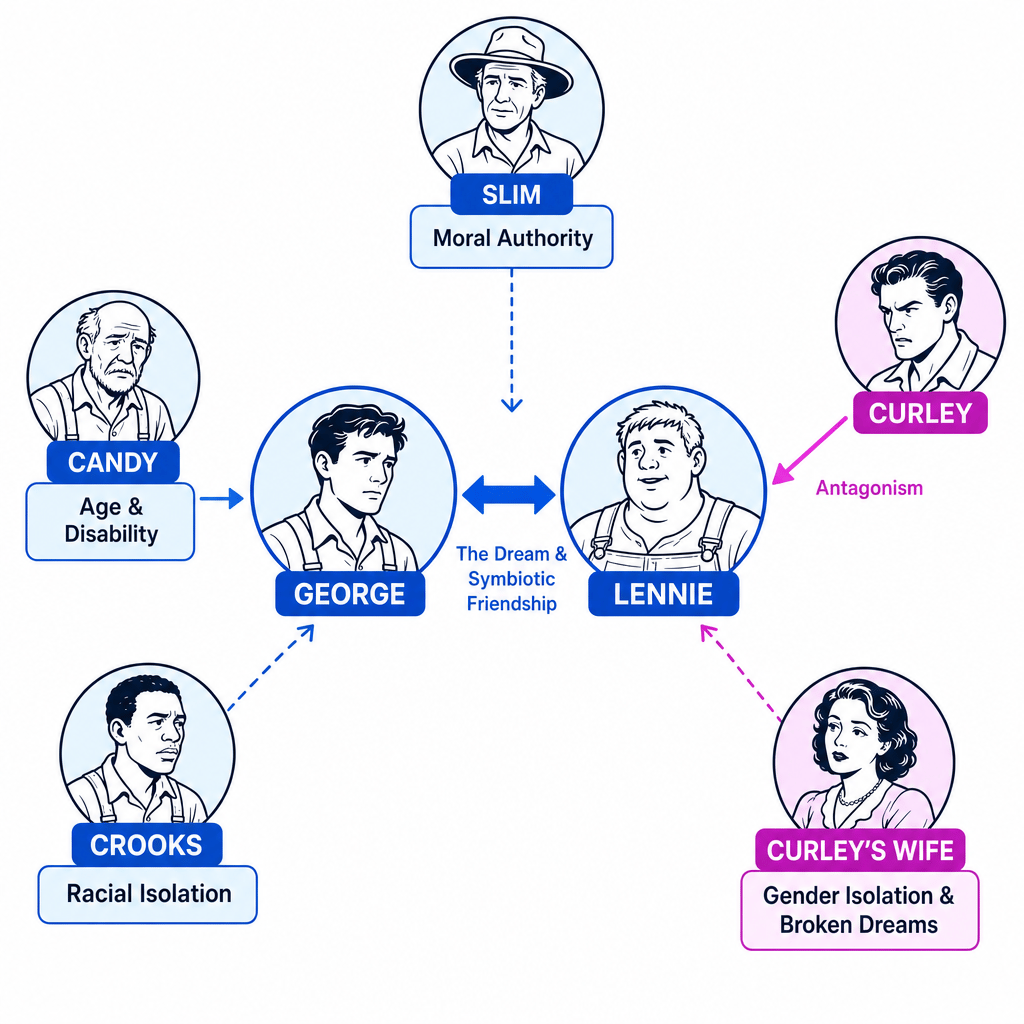
The Marginalized Characters
Steinbeck uses the characters on the ranch to expose the systemic cruelties of 1930s America. Those who cannot work or do not fit the white, male, able-bodied ideal are systematically pushed to the margins.
- Candy: The old swamper (cleaner) who has lost his right hand. He represents the fear of aging and uselessness in a capitalist society that discards human beings once their labor power is spent. His physical vulnerability is mirrored by his old dog, who is shot by Carlson because he is "no good to himself" anymore—a brutal piece of foreshadowing for Candy’s own eventual fate.
- Crooks: The black stable buck, physically disabled by a crooked spine and socially segregated due to the Jim Crow-era racism of America. He is forced to sleep in the harness room, separate from the bunkhouse. He is deeply bitter, defensive, and articulate, serving as the voice of harsh reality when he tells Lennie that "nobody never gets to heaven, and nobody gets no land."
- Curley's Wife: The only female on the ranch, she is never given a name. This anonymity highlights her status as Curley’s possession. Desperate for attention and lonely, she is viewed by the men as a "tramp," "looloo," or "jail bait." Her bright red shoes and heavily made-up appearance are desperate attempts to assert her identity and femininity in an aggressive, masculine environment.
The Figures of Power and Authority
- Slim: The "jerkline skinner" and the moral compass of the ranch. Steinbeck describes him in almost mythical terms: "his authority was so great that his word was taken on any subject." Slim represents natural authority and dignity, standing in contrast to Curley’s artificial authority.
- Curley: The boss's son. He is aggressive, deeply insecure about his height, and constantly seeks to assert his dominance. He wears "high-heeled boots" to distinguish himself from the working men and a glove full of vaseline on his left hand. He targets Lennie because he hates big men—an insecurity that ultimately leads to his hand being crushed.
- Carlson: A thick-bodied, pragmatic, and unfeeling ranch hand. He represents the survival-of-the-fittest mentality of the Great Depression. He cannot comprehend why Slim and George are upset at the end of the novel, asking, "Now what the hell ya suppose is eatin' them two guys?"
Reducing characters to flat symbols
Do not treat these characters purely as historical facts. While Crooks represents racism and Candy represents ageism, Steinbeck writes them as complex human beings. Show the examiner that you see their inner conflicts. For example, Crooks is lonely and desperate for company, yet he cruelly tortures Lennie by suggesting George might not return. Even Curley’s Wife, who can be cruel and vindictive, is shown to have lost her girlhood dreams of being a movie star.
Characterization and Context (AO4)
When analyzing characters for your Edexcel exam, you must always anchor your literary analysis to the social, historical, and economic context of the 1930s.
| Character | Literary Method / Key Detail | Cultural & Historical Context (AO4) |
|---|---|---|
| Lennie | Animal imagery ("snorting into the water like a horse") | Lack of understanding and care for mental disabilities in the 1930s; asylum conditions were horrific. |
| Candy | The shooting of his dog | The lack of a social safety net or pension schemes during the Great Depression. |
| Crooks | "a tattered dictionary and a dirty copy of the California civil code" | Segregation, racial prejudice, and the systemic denial of civil rights to Black Americans. |
| Curley's Wife | "They left all the weak ones here," she notes bitterly. | The domestic isolation of women and the hollow promises of Hollywood as an escape from rural poverty. |
Writing an Analytical Paragraph
Let's look at how to construct a high-scoring paragraph analyzing character and context. In the exam, you should use the PEEL structure:
- Point: Answer the question directly.
- Evidence: Integrate a short, precise quotation.
- Explanation / Method: Analyze the writer’s language, structure, and techniques.
- Link: Connect your point back to the essay question and the wider historical context.
Analyzing Candy's vulnerability
Let's construct an analytical response to the question: How does Steinbeck present Candy as a vulnerable figure on the ranch?
- Formulate a clear point that identifies how Candy is presented:
Steinbeck presents Candy as a vulnerable figure whose physical disability and age leave him entirely dependent on the whims of a ruthless capitalist system. - Select and integrate a precise quotation to support this point:
When describing his future on the ranch, Candy tells George, "Just as soon as I can't swamp out no bunkhouses they'll put me on the county." - Analyze the specific words and literary techniques used by the author:
The colloquial verb "swamp out" highlights the low-status, menial nature of the work Candy is reduced to. By using the passive phrasing "put me on the county," Steinbeck strips Candy of his agency, illustrating how he is treated as an object to be relocated or discarded rather than an employee with dignity. The term "on the county" refers to the basic, dehumanizing public relief system of the era. - Link the analysis back to the 1930s context (AO4) to show deep understanding:
This reflects the grim reality of 1930s America prior to the introduction of comprehensive social security, where elderly or disabled workers had no safety net and faced immediate destitution once their physical capacity to work was exhausted. Through Candy’s despair, Steinbeck exposes the cruel survival-of-the-fittest ethos of the Great Depression.
In the exam
To achieve the highest marks in Component 1, Section C:
- Focus on the prompt: Ensure your opening sentence directly addresses the specific character or relationship named in the question.
- Weave context into your analysis: Do not dump historical facts in isolated paragraphs. Instead, integrate them seamlessly as the reason why a character behaves or is treated a certain way.
- Use precise terminology: When talking about characters, refer to them as literary constructs used by Steinbeck to deliver his social critique.
- Select high-impact, short quotes: Memorize brief phrases (such as "tart," "bindle stiffs," "stable buck," "god-like") rather than long sentences, so you can easily weave them into your own prose.
Check yourself
- Why does Steinbeck never give Curley's Wife a proper first name, and how does this affect our perception of her?
- In what ways does the execution of Candy's old dog act as a structural parallel (foreshadowing) for Lennie's death?
- How does the character of Slim challenge the social Darwinism (survival of the fittest) that dominates the ranch?
