What you'll learn
- The key events of each chapter in Of Mice and Men.
- How Steinbeck shapes the plot from hope to disaster.
- Why the ending is prepared carefully, not just “sudden”.
- How to use plot knowledge in an Edexcel IGCSE closed-book answer.
Before the plot: what is a good summary?
Of Mice and Men is a novella: a short prose fiction text, longer than a short story but usually shorter and more tightly focused than a novel. Steinbeck keeps the plot simple, but every event matters.
A good plot summary does not mention every detail. It selects the events that change the direction of the story.
Plot and summary
Plot is the ordered chain of events a writer chooses to present. A summary is a brief version of that chain, focusing on the most important causes, turning points and consequences.
For Of Mice and Men, the plot is driven by one central pressure: George and Lennie’s dream of owning land seems briefly possible, then becomes impossible.
Use cause and consequence
When revising plot, think in “because” and “therefore” sentences: because Lennie has caused trouble in Weed, George tells him to hide by the river; therefore the final chapter can return to that same place.
The overall shape of the novella
Structure means the way a text is organised: where it begins, how events are ordered, and where it ends. Steinbeck’s structure is especially tight because the novella begins and ends in the same setting: the clearing by the Salinas River.
This is a cyclical structure, meaning the ending returns to the place, image or situation of the beginning. However, the characters are not unchanged. By the end, George and Lennie’s shared dream has collapsed.
The timeline below shows the six-chapter movement from hope to disaster, including the return to the Chapter 1 setting.
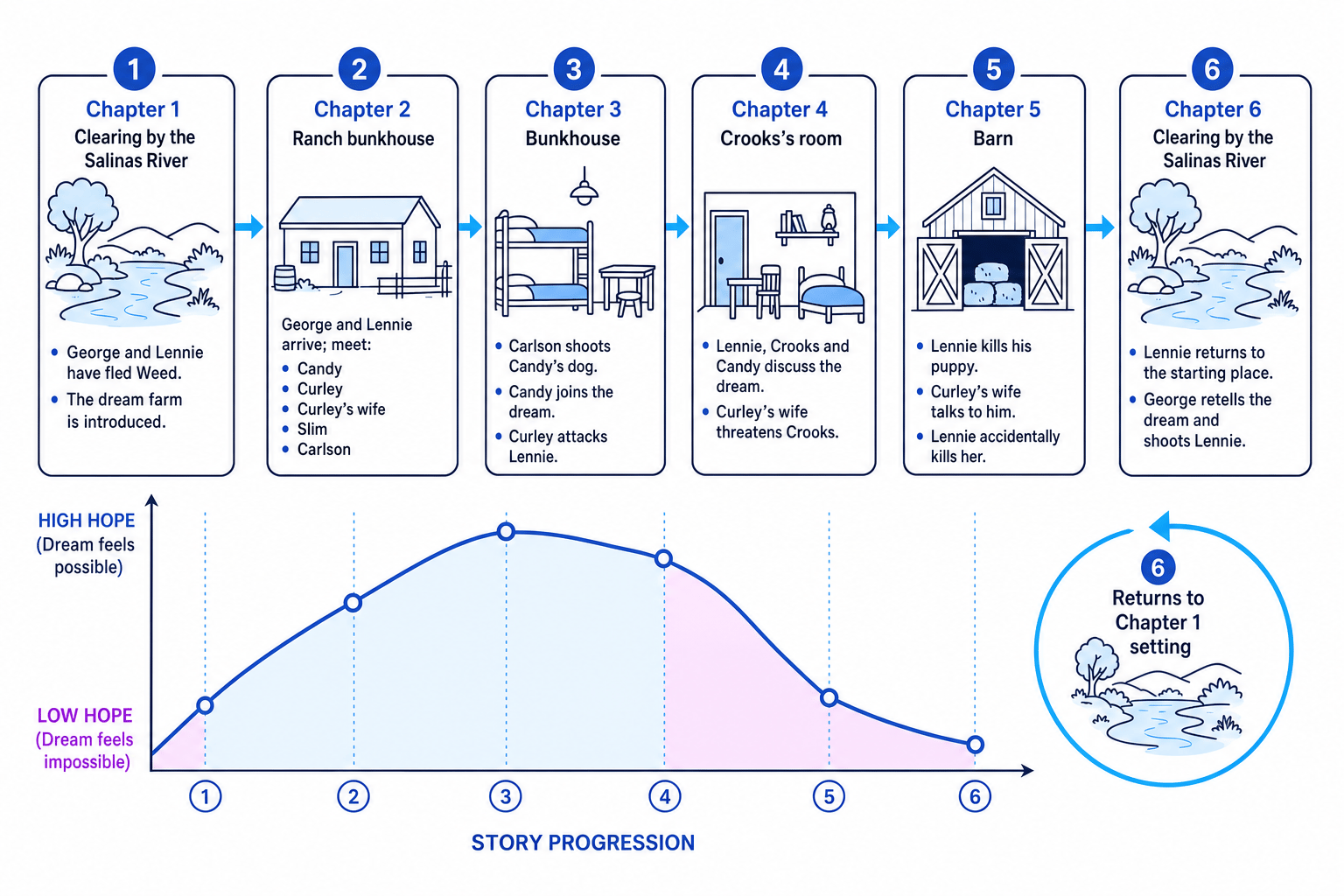
The plot moves in a circle, but the dream does not
Steinbeck returns to the river clearing to show a cruel contrast: the natural setting looks calm again, but George’s relationship with Lennie and the dream of “the fatta the lan’” have been destroyed.
Chapter 1 — The river clearing: friendship and danger
The novella opens near Soledad, beside the Salinas River. George Milton and Lennie Small are travelling to a ranch for work after leaving Weed, where Lennie frightened a woman by touching her dress.
This chapter is the exposition, which means the opening part of a story where the writer introduces the setting, main characters and early conflicts. A conflict is a struggle or tension that drives the plot forward.
We learn that George is quick-thinking and frustrated, while Lennie is physically strong but childlike and dependent. George complains that life would be easier alone, but their bond is also clear when he explains that most ranch workers are lonely: “Guys like us, that work on ranches, are the loneliest guys in the world.” Lennie answers with the comforting idea that they are different because they have each other.
George also tells Lennie what to do if he gets into trouble: return to the brush by the river and hide. This instruction seems practical at first, but it becomes crucial later.
The dream is introduced here too. Lennie loves hearing George describe how they will “live off the fatta the lan’”, especially the rabbits he hopes to tend. At this point, the dream is more like a story they tell to survive loneliness.
Chapter 2 — The bunkhouse: arrival at the ranch
George and Lennie arrive at the ranch and enter the bunkhouse. Steinbeck introduces the social world of the ranch: the Boss, Candy, Curley, Curley’s wife, Slim and Carlson.
Curley is immediately aggressive, especially towards Lennie, because Lennie’s size threatens him. Curley’s wife also appears, described with “full, rouged lips” and red fingernails. The men treat her as dangerous, and George warns Lennie to stay away from both Curley and his wife.
This chapter builds tension because the ranch is not a safe community. It is a place of suspicion, hierarchy and masculine pride. Lennie and George have arrived looking for work, but the reader can already see possible sources of trouble.
Forgetting Chapter 2’s purpose
Do not summarise Chapter 2 as “they meet people” and stop there. Its real purpose is to set up the dangers that will later trap Lennie: Curley’s aggression, Curley’s wife’s isolation, and the ranch’s harsh attitudes.
Chapter 3 — The bunkhouse: the dream seems possible
Chapter 3 is one of the most important turning points. Slim, who is respected by the other men, understands that Lennie “ain’t a bit mean”. George confesses that Lennie got into trouble in Weed because he “jus’ wanted to feel that girl’s dress”. This helps the reader see a pattern: Lennie does harmful things without intending harm.
Carlson pressures Candy into allowing his old dog to be shot. The dog is no longer useful, and the ranch men treat this as enough reason to kill it. Candy later says, “I ought to of shot that dog myself,” showing regret that he allowed a stranger to do it.
Then the dream suddenly becomes more realistic. Candy offers his savings, and for the first time George calculates that the farm might actually be bought. The dream shifts from fantasy to possible plan.
The chapter ends with violence: Curley attacks Lennie, and Lennie crushes Curley’s hand when George tells him to fight back. This shows Lennie’s dangerous strength and prepares us for later disaster.
Foreshadowing
Foreshadowing is a structural method where a writer plants hints early in the text about events that will happen later.
Linking Candy’s dog to Lennie’s ending
-
Candy’s dog is killed because the ranch world values usefulness and strength. The old dog is seen as weak, inconvenient and no longer worth keeping alive.
-
Candy’s regret — “I ought to of shot that dog myself” — creates a structural link with George’s later decision. George learns that if someone he loves must die, it is better that the death comes from him than from a cruel stranger.
-
This foreshadows the ending because George shoots Lennie before Curley can. The effect is tragic: the final act feels shocking, but also grimly prepared by the earlier plot.
Chapter 4 — Crooks’s room: loneliness and broken hope
Chapter 4 takes place in Crooks’s room while most of the men are away. Crooks is the Black stable buck, segregated from the bunkhouse because of racism. He tells Lennie, “A guy needs somebody—to be near him,” which shows how deeply isolation affects him.
For a short time, Crooks is drawn into the dream. When Candy arrives and talks about the farm, Crooks begins to imagine joining them. This matters because the dream briefly seems to include the excluded men: Lennie, Candy and Crooks.
However, Curley’s wife enters and destroys that fragile hope. When Crooks challenges her, she threatens him: “I could get you strung up on a tree so easy it ain’t even funny.” The plot shows how quickly power works on the ranch. Crooks withdraws his interest in the dream, and the moment of hope closes.
Chapter 5 — The barn: the point of highest tension
Chapter 5 is the climax of the novella: the moment of greatest tension where the main conflict reaches a decisive crisis.
Lennie is alone in the barn with the puppy Slim gave him, but he has accidentally killed it by handling it too roughly. Curley’s wife enters and speaks to him. She reveals her own disappointed dream, saying she “Coulda been in the movies”.
Lennie tells her he likes soft things. She lets him touch her hair, but when he holds on too tightly, she panics. Lennie becomes frightened, tries to silence her, and accidentally breaks her neck.
This is the event that makes the dream impossible. Candy finds the body and still asks George whether they can get the farm, but George admits, “I think I knowed we’d never do her.” Curley then leads the men in a hunt for Lennie, wanting revenge.
Calling the death ‘random’
Lennie killing Curley’s wife is accidental, but it is not random. Steinbeck has prepared it through repeated incidents involving touch, panic and strength: the mouse, the dress in Weed, Curley’s hand, and the puppy.
Chapter 6 — Return to the river: the ending
The final chapter returns to the Salinas River clearing. This is the resolution, meaning the part of a plot where the consequences of the climax are completed.
Lennie remembers George’s instruction and hides by the river. He imagines Aunt Clara and a giant rabbit accusing him, showing his fear that he has ruined everything.
George arrives before the other men. Instead of scolding Lennie, he retells the dream one last time. He tells Lennie to look across the river “like you can almost see the place”. As Lennie imagines the farm, George shoots him.
The ending is devastating because George’s act is both violent and protective. Slim understands this, saying, “You hadda, George. I swear you hadda.” Carlson, however, cannot understand their grief: “Now what the hell ya suppose is eatin’ them two guys?” This final line reinforces the loneliness of the ranch world.
How to use plot summary in an essay
For Edexcel IGCSE, Of Mice and Men is studied as modern prose in Component 1 Section C. This is closed book, meaning you will not have a copy of the text in the exam. Strong answers use plot knowledge for AO1: clear understanding, relevant references and a personal response. They also connect events to AO4: context, meaning the social and historical conditions around the text, such as 1930s America, migrant labour and inequality.
You should not simply retell the story. Instead, choose the plot moment that best proves your point.
Selecting plot evidence for the dream
-
If the focus is the fragility of dreams, Chapter 3 is powerful because Candy’s money makes the farm seem achievable for the first time. The dream briefly becomes practical, not just comforting talk.
-
Chapter 5 then reverses that hope. After Curley’s wife dies, George says, “I think I knowed we’d never do her,” which shows that the dream’s collapse confirms a fear he already had.
-
Linking these moments lets you argue that Steinbeck gives the reader hope in order to make the ending more painful and to expose how hard it is for vulnerable people to escape their circumstances.
In the exam
-
Memorise the six-chapter sequence and a few short, accurate quotations, especially “live off the fatta the lan’”, “I ought to of shot that dog myself,” and “You hadda, George.”
-
Use plot moments as evidence, but always explain their significance: what changes, what is revealed, and how the event affects the reader’s understanding.
-
Link events to context where relevant, especially the insecurity of migrant workers, loneliness, racism, sexism and the harsh treatment of people seen as weak.
Check yourself
- Why does Steinbeck begin and end the novella in the same river clearing?
- Which Chapter 3 event most clearly foreshadows George’s final decision?
- How does Candy’s involvement change the dream from fantasy to possibility?
