What you'll learn
- How to turn an Of Mice and Men question into a clear argument.
- How to plan paragraphs that include evidence, methods, effects and context.
- How to use short, accurate quotations in a closed-book exam.
- How to adapt flexible plans for common themes and characters.
Why essay plans matter
For Edexcel IGCSE English Literature, Of Mice and Men is studied as modern prose in Component 1, which is closed book. That means you will not have a copy of the novella in the exam, so your plan needs to help you use the quotations and references you have memorised.
Your essay is mainly assessed for AO1 and AO4: you need a clear, personal response supported by textual references, and you need to connect Steinbeck’s ideas to relevant context, such as the Great Depression, migrant labour, racism, sexism and economic insecurity.
Essay plan
An essay plan is a brief map of your answer before you write it. It should show your main argument, the order of your paragraphs, the evidence you will use, and how context helps explain Steinbeck’s message.
Planning is not plot summary
A strong plan does not simply retell what happens. It chooses moments from across the novella to prove an argument about how and why Steinbeck presents a character, theme or relationship.
Step 1: Decode the question
Before you plan paragraphs, you need to understand exactly what the question is asking.
The focus is the main topic of the question, such as dreams, loneliness, Curley’s wife, violence, or George and Lennie’s relationship. The command is what you are being asked to do, often “Explore” or “How does Steinbeck present…?” The scope is how much of the novella you need to use — usually the whole text, not just one scene.
Thesis
A thesis is your central answer to the question: the main idea your whole essay will prove.
Planning from a question
Question: Explore the significance of dreams in Of Mice and Men.
-
Identify the focus: the question is not asking for every detail about George and Lennie. It is asking about dreams and why they matter in the novella.
-
Decide what “significance” means: dreams are important because they give characters hope, reveal their loneliness, and expose how harsh 1930s America is for poor and vulnerable people.
-
Choose moments from across the structure: George and Lennie’s dream in Chapter 1, Candy joining the dream in Chapter 3, Crooks briefly believing in the dream in Chapter 4, and the dream being retold before Lennie’s death in Chapter 6.
-
Turn this into a thesis: Steinbeck presents dreams as emotionally necessary but socially fragile, showing that poor migrant workers need hope even when the world makes fulfilment almost impossible.
Step 2: Build a line of argument
A line of argument is the thread that connects all your paragraphs. Each paragraph should develop your thesis, not start a completely separate mini-essay.
For Of Mice and Men, a useful line of argument often shows development: how Steinbeck introduces an idea, complicates it, then resolves or destroys it by the ending.
Creating a thesis on loneliness
Question: How does Steinbeck present loneliness in Of Mice and Men?
-
Begin with the central pattern: George says “guys like us, that work on ranches, are the loneliest guys in the world,” so loneliness is presented as normal for migrant workers.
-
Add development: Steinbeck then shows different forms of loneliness through Crooks, who says “I ain’t wanted in the bunk house,” Curley’s wife, who says “I get awful lonely,” and Candy, who fears becoming useless like his dog.
-
Connect context: in the Great Depression, poverty, racism, sexism and lack of security make isolation worse.
-
Shape the thesis: Steinbeck presents loneliness as both an emotional pain and a social condition, suggesting that the ranch world divides people who desperately need companionship.
Step 3: Choose a paragraph route
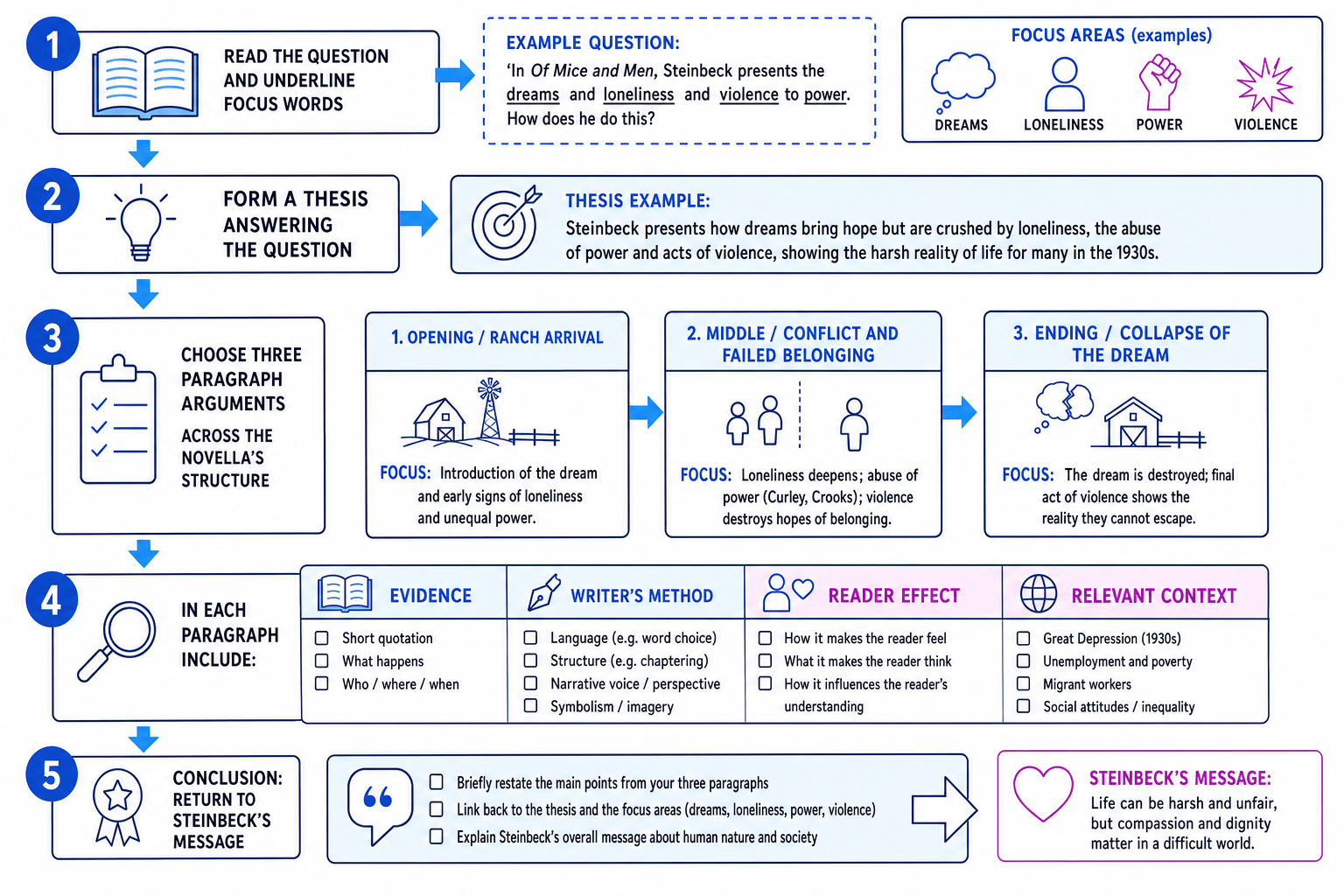
A strong plan usually has three main analytical paragraphs. You do not have to write about events in chronological order, but for Of Mice and Men it often works well because Steinbeck’s structure is so controlled.
Structure
Structure means the way a text is organised: the order of events, contrasts, repeated patterns, openings, endings and turning points.
A useful route is: beginning → middle → ending. This helps you show how Steinbeck develops an idea across the novella rather than treating one scene in isolation.
The three-paragraph test
Before writing, check that each paragraph has a different job. If all three paragraphs make the same point, your essay will feel repetitive even if your quotations are good.
Step 4: Make each paragraph analytical
Each planned paragraph should include more than a quotation. You need to know what the quotation proves.
Evidence means a short quotation or precise reference to the text. A writer’s method is a deliberate choice Steinbeck makes, such as symbolism, foreshadowing, dialogue, contrast, cyclical structure or animal imagery. Effect means what the method makes the reader think, feel or understand.
A good paragraph plan can follow this pattern:
- Point — your answer to the question.
- Evidence — a short quotation or reference.
- Method — how Steinbeck presents the idea.
- Effect — what this suggests to the reader.
- Context — why the idea matters in the world of the novella.
- Link — return directly to the question.
Building a paragraph plan on Candy’s dog
-
Choose the point: Candy’s dog shows how the ranch values usefulness over loyalty, which prepares the reader for Lennie’s death.
-
Select evidence: Carlson says the dog “ain’t no good to you,” and Candy later says, “I ought to of shot that dog myself.”
-
Identify method: the dog is used as foreshadowing, because its shooting anticipates George shooting Lennie, and as symbolism, because it represents the vulnerability of the old and weak.
-
Explain effect and context: the episode makes the reader see the ranch as a harsh economic world where those who cannot work are treated as burdens. This reflects the insecurity of Depression-era labour, especially for elderly or disabled workers.
-
Link to the question: if the essay is about violence, this paragraph shows violence being presented as practical and socially accepted, not only as personal cruelty.
Listing methods without meaning
Do not write, “Steinbeck uses foreshadowing and symbolism,” and then stop. Always explain what the method reveals about the character, theme or society.
Step 5: Weave in context
Context
Context means the historical, social and cultural circumstances connected to a text. For Of Mice and Men, important context includes the Great Depression, migrant ranch work, the American Dream, racism, sexism, disability and insecure employment.
Context should not feel like a random history paragraph. It should explain Steinbeck’s choices and deepen your argument.
Turning context into analysis
-
Start with a weak version: “This links to the Great Depression.” This is too vague because it does not explain the text.
-
Choose precise context: many migrant workers moved from ranch to ranch for temporary jobs, with little security or community.
-
Attach it to evidence: George’s comment that ranch workers are “the loneliest guys in the world” shows that loneliness is not just personal sadness; it is built into this way of life.
-
Improve the sentence: Steinbeck connects George’s loneliness to the instability of migrant labour in the Great Depression, suggesting that economic hardship damages relationships as well as finances.
Do not overclaim context
Context should support your reading, not replace it. Avoid sweeping claims like “all women had no rights” or “all workers were hopeless.” Be precise: Curley’s wife is limited by patriarchal attitudes, and Crooks is isolated by racist segregation and prejudice.
Flexible essay plan bank
Use these as starting points. In the exam, adapt them to the exact wording of the question.
Plan A: Dreams and the American Dream
Possible thesis: Steinbeck presents dreams as a necessary source of hope, but also as painfully fragile in a society shaped by poverty and inequality.
-
Opening dream: George tells Lennie that “with us it ain’t like that” and imagines living “off the fatta the lan’.” The repeated dream gives the men comfort and makes their friendship seem unusual among lonely ranch workers.
-
Dream becomes almost possible: Candy offers his savings after his dog is shot. This makes the dream feel practical, but it also shows how desperate vulnerable workers are for safety.
-
Dream collapses: Crooks says, “Nobody never gets to heaven, and nobody gets no land,” exposing the dream as a fantasy for many poor men. By the ending, George retells the dream before killing Lennie, making it an act of mercy rather than a real future.
Plan B: Loneliness and isolation
Possible thesis: Steinbeck presents loneliness as a shared condition on the ranch, but prejudice and fear prevent characters from forming lasting connections.
-
Migrant loneliness: George says ranch workers are “the loneliest guys in the world.” Their travelling lifestyle creates rootlessness and emotional isolation.
-
Excluded characters: Crooks says, “I ain’t wanted in the bunk house,” while Curley’s wife admits, “I get awful lonely.” Steinbeck shows that racism and sexism create different but connected forms of isolation.
-
Final loneliness: After Lennie’s death, George loses the companionship that made him different. Carlson’s question, “Now what the hell ya suppose is eatin’ them two guys?” shows that he cannot understand George and Slim’s grief.
Plan C: Power, prejudice and cruelty
Possible thesis: Steinbeck presents power as unstable and often cruel, especially when characters use social status, race, gender or physical strength to dominate others.
-
Curley’s aggression: Curley is described as “pugnacious,” and his hostility towards Lennie reveals insecurity behind his authority as the boss’s son.
-
Crooks and Curley’s wife: Crooks is isolated by racism, but Curley’s wife can still threaten him with being “strung up on a tree.” Steinbeck shows a hierarchy where even lonely characters may use power against someone more vulnerable.
-
Violence as control: Candy’s dog is shot because it is no longer useful, and George kills Lennie to prevent worse violence. The ranch world solves problems brutally.
Plan D: George and Lennie’s relationship
Possible thesis: Steinbeck presents George and Lennie’s friendship as rare, protective and deeply moving, but ultimately unable to survive the brutal conditions around them.
-
Rare companionship: George says, “I got you to look after me, and you got me to look after you.” Their bond contrasts with the loneliness of other ranch workers.
-
Care and responsibility: George can be frustrated with Lennie, but he also protects him from danger and keeps their dream alive. This makes their relationship both loving and unequal.
-
Tragic ending: Slim tells George, “You hadda, George,” recognising the mercy behind George’s action. The ending forces the reader to see love and violence painfully combined.
Plan E: Curley’s wife
Possible thesis: Steinbeck first presents Curley’s wife through the suspicious eyes of the men, but later reveals her loneliness, frustrated ambition and lack of power.
-
First impressions: She is associated with “rouged lips” and “red mules,” and the men call her dangerous. This shows how quickly she is judged on the male-dominated ranch.
-
Loneliness and dreams: She tells Lennie, “I never get to talk to nobody” and says, “I coulda made somethin’ of myself.” Steinbeck reveals the person behind the label “Curley’s wife.”
-
After death: The narrator says “the ache for attention” is gone from her face. This creates pathos and suggests that the ranch only sees her humanity when it is too late.
Planning your conclusion
Your conclusion should not introduce a new quotation or a completely new idea. It should return to your thesis and state what Steinbeck finally suggests.
For example, an essay on dreams might conclude that Steinbeck does not mock the dream. Instead, he shows why the dream matters so much to lonely, poor workers — and why its destruction is so tragic.
In the exam
-
Spend about five minutes planning: write a thesis, three paragraph points, and one or two quotations for each.
-
Use short, accurate quotations. If you cannot remember a quotation exactly, use a precise reference instead of inventing one.
-
Link context to the argument: explain how Depression-era poverty, migrant labour, racism or sexism shapes Steinbeck’s presentation.
-
Keep returning to the exact question wording, especially in the first and last sentence of each paragraph.
-
End with Steinbeck’s overall message, not just what happens in the plot.
Check yourself
-
Can you write a one-sentence thesis for a question on dreams, loneliness, or Curley’s wife?
-
Does each planned paragraph include evidence, method, effect and relevant context?
-
Are your quotations short, accurate and useful enough to memorise for a closed-book exam?
