To score top marks in your Pearson Edexcel International GCSE English Literature exam, you must show a deep understanding of how John Steinbeck constructs Of Mice and Men. This goes far beyond simply naming literary techniques. You need to understand how Steinbeck uses the form of a play-novelette, a circular structure, and stark, naturalistic language to convey his central themes: the fragility of the American Dream, the brutality of the Great Depression, and the inevitability of human loneliness.
What you'll learn
- How Steinbeck’s unique "play-novelette" form shapes the pace and presentation of the narrative.
- How the circular structure of the novella mirrors the inescapable cycle of poverty for 1930s migrant workers.
- How to analyse Steinbeck's naturalistic language, animal imagery, and localized vernacular to unlock deeper thematic meaning.
1. Form: The "Play-Novelette"
Before looking at individual words, we must look at the overall shape of the text. Of Mice and Men is written in a very specific literary form.
Play-Novelette
A play-novelette is a short novel (novella) written with the structure, pacing, and descriptive style of a theatre production, allowing it to be easily adapted for the stage with minimal changes.
Steinbeck designed this book to be both read as a novel and performed as a play. This hybrid form impacts how you experience the story in several ways:
- Scenic division: The book is divided into six chapters. Each chapter functions as a self-contained "scene" set in a single location:
- Chapter 1: The clearing by the Salinas River (Evening)
- Chapter 2: The bunkhouse (Late morning)
- Chapter 3: The bunkhouse (Night)
- Chapter 4: Crooks’s room in the harness room (Night)
- Chapter 5: The barn (Sunday afternoon)
- Chapter 6: The clearing by the Salinas River (Late afternoon)
- Stage-direction descriptions: The beginning of each chapter starts with a detailed, static sensory description of the setting, which establishes the mood and lighting before characters enter. Once the characters arrive, the text relies heavily on realistic, uninterrupted dialogue and physical actions, much like a script.
- Lack of an omniscient narrator's commentary: Unlike many authors, Steinbeck rarely enters his characters' minds to explain their thoughts. Instead, we must deduce what they are feeling through their dialogue, facial expressions, and physical gestures.
Form mimics constraint
The theatrical form keeps the action claustrophobic. By trapping characters within tight, distinct physical spaces (the bunkhouse, Crooks's room, the barn), Steinbeck reinforces the wider thematic sense of entrapment and isolation experienced by marginalized people during the Great Depression.
2. Structure: The Circular Trap
The overarching structure of Of Mice and Men is cyclical and symmetric. The novel begins and ends in the exact same location: the beautiful, green clearing by the Salinas River.
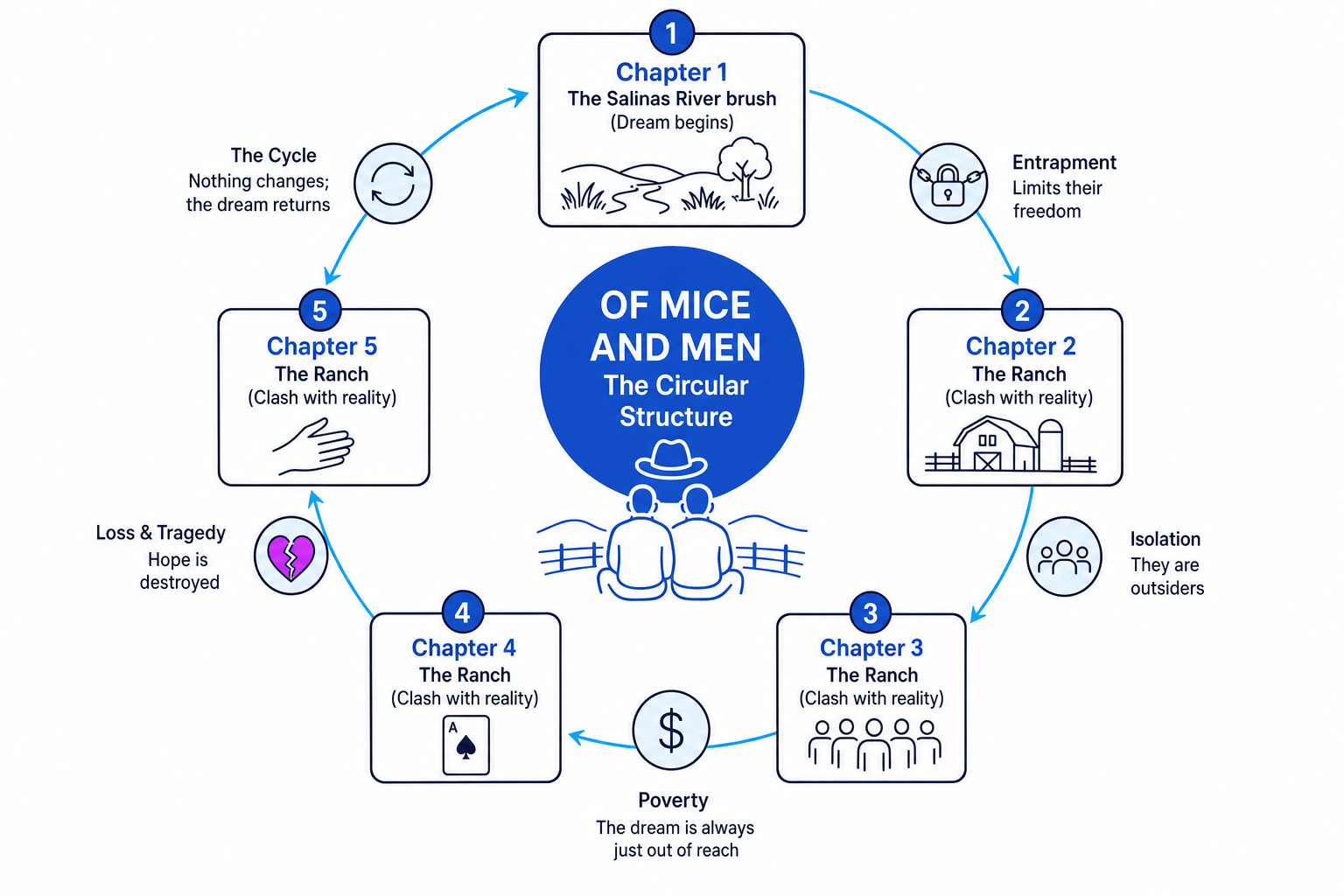
This circular design is not just a neat narrative trick; it is a profound structural comment on the lives of 1930s migrant workers. George and Lennie end up exactly where they started, unable to break out of their socio-economic bracket. Their dream of owning a piece of land is proven to be a fantasy, and they are forced back into the dirt.
Foreshadowing as a Structural Device
Steinbeck uses structural parallels and foreshadowing to make the tragic climax feel inevitable. Events in the early chapters mirror and predict events in the later chapters:
- The fate of the mice and soft things: In Chapter 1, Lennie accidentally kills a mouse. In Chapter 5, he kills a puppy. These events build up in scale and structural weight, directly foreshadowing the accidental killing of Curley's wife in the barn.
- The killing of Candy's dog: In Chapter 3, Carlson shoots Candy’s old, blind dog in the back of the head to spare it from suffering. This mirrors Chapter 6, where George is forced to shoot Lennie in the back of the head with Carlson's Luger pistol to spare him from a brutal lynching by Curley's mob.
Ignoring the parallel
Many students treat the death of Candy's dog and the death of Lennie as completely separate incidents. In your essay, you must link them structurally. Steinbeck deliberately uses the dog's death to establish the moral logic of the ranch: those who are no longer useful or cannot look after themselves are discarded.
3. Language: Realism, Motif, and Style
Steinbeck's prose style in Of Mice and Men is deeply rooted in Naturalism (a literary movement that suggests family background, social conditions, and environment shape human character and fate).
The Vernacular (Dialect)
The characters do not speak in polished, poetic sentences. Steinbeck uses phonetic spelling, slang, and grammatically incorrect phrasing to capture the authentic vernacular of 1930s itinerant workers.
- Examples: "We got a future. We got somebody to talk to that gives a damn about us." / "An' live off the fatta the lan'."
- Effect: This gritty realism immediately grounds the characters in their social class. It demonstrates their lack of formal education and their rough lifestyle, highlighting how ill-equipped they are to navigate the complex social systems that oppress them.
Animal Imagery
Lennie is consistently described using animalistic language. This is a deliberate linguistic motif that highlights his physical power and his lack of intellectual capacity.
- Examples: He walks "heavily, dragging his feet a little, the way a bear drags his paws"; he drinks from the pool "snorting into the water like a horse"; and when threatened, he is described as crouching like a "terrier."
- Effect: This imagery dehumanizes Lennie, preparing the reader for his tragic fate. Just like Candy's dog, Lennie is viewed by the ranch world not as a complex human being, but as an animal that has become too dangerous to keep alive.
Light and Dark (Chiaroscuro)
Steinbeck uses the transition between light and shadow to signal shifting power dynamics and impending tragedy.
- Example: When Curley's wife first appears in the doorway of the bunkhouse in Chapter 2, "the rectangle of sunshine in the doorway was cut off."
- Effect: The physical blocking of the light immediately establishes her character as a symbol of danger and darkness for George and Lennie's dream. It is a visual, atmospheric warning of the doom she will inadvertently bring.
Analysing structural parallels and foreshadowing
To understand how to write a high-scoring analytical paragraph, let's look at how to unpack the structural parallel between the killing of Candy’s dog in Chapter 3 and Lennie’s death in Chapter 6.
- Identify the structural link: State clearly how the two events mirror one another. Steinbeck constructs the shooting of Candy's dog to act as a direct dramatic blueprint for Lennie's mercy killing.
- Select precise textual evidence: Look at the specific details surrounding both deaths. When Carlson kills the dog, Candy laments: "I ought to of shot that dog myself, George. I shouldn't ought to of let no stranger shoot my dog." In Chapter 6, George remembers this lesson, choosing to shoot Lennie himself rather than letting the hostile Curley do it.
- Analyse the linguistic techniques: Focus on the recurring motif of the gun (Carlson’s Luger). The Luger is the specific weapon used in both instances. It is a cold, mechanical tool of destruction that represents the unfeeling, clinical nature of the ranch society.
- Link to the wider thematic and historical context: Connect this structural echo to the harsh social conditions of the Great Depression. In the 1930s, there was no social safety net for those who were vulnerable, disabled, or elderly. Through this tragic parallel, Steinbeck structurally proves that in a capitalist, survival-of-the-fittest world, both the helpless dog and the vulnerable man share the same inevitable fate.
Look closely at the descriptions of nature
Don't skip the quiet, descriptive paragraphs at the start of Chapters 1 and 6. Notice how the water snake is introduced in both. In Chapter 1, the snake slips smoothly through the pool while the world is peaceful. In Chapter 6, a water snake is suddenly swallowed whole by a heron. Nature has become hostile, signaling that the safe haven has been breached and tragedy is imminent.
In the exam
- Never write a "shopping list" of devices: Do not just point out similes, metaphors, or foreshadowing and move on. Always explain how the technique develops Steinbeck's characterization or themes.
- Integrate short, precise quotes: Instead of copying out long sentences, weave short words and phrases directly into your analytical sentences (e.g., Steinbeck's description of Lennie "snorting" like a "horse" immediately associates his physical nature with brute, animal force...).
- Structure your response around the text's development: To write a sophisticated essay, track how Steinbeck builds tension chronologically across the six "scenes," showing how his linguistic and structural choices guide the reader toward the inevitable tragic climax.
Check yourself
- Why did Steinbeck choose to structure the novel so that it begins and ends in the exact same location? What does this tell us about the lives of migrant workers?
- How does the description of the light changing in the barn in Chapter 5 reflect the shifting mood of the scene?
- Can you find three distinct animal comparisons used for Lennie, and explain what each reveals about his character?
